Torbjorn Aune Clinical Research Coordinator II, CCRC Durham, 27705, United States [email protected] · (919) 555-1444
11 September 2026
Dr. Adaeze Okonkwo Research Operations Carolina Cancer Trials Network Chapel Hill, United States
Application for Clinical Research Coordinator II, Carolina Cancer Trials Network
Dear Dr. Okonkwo,
I am applying for the Clinical Research Coordinator II post with the Carolina Cancer Trials Network. I hold the ACRP CCRC credential and have spent six years across oncology and neurology, phases I through III, currently running seven to nine concurrent protocols for four principal investigators, two of them investigator-initiated.
Two numbers describe most of what I do. I met or exceeded enrollment target on 11 of 14 completed studies, and when a phase III stalled at 4 participants against a target of 18, I rebuilt the prescreening pathway with the clinic schedulers and we finished at 18 of 18 in seven months. On the data side I closed 312 monitor queries last year at a median of 3 days against a site standard of 10, and the binders and delegation logs I keep for nine concurrent studies have been through two sponsor audits and one FDA inspection with no Form FDA 483 observations at the site.
I noticed the network is opening two phase I slots next year and that your sites run on OnCore, which is what I use now. Phase I is the work I want to move further into, and I have supported a dose escalation with a two-visit consent process. I would also be glad to keep doing inspection preparation, which I seem to end up owning wherever I go.
I can start on four weeks of notice and I am happy to travel between sites. Thank you for reading this.
Sincerely, Torbjorn Aune, CCRC
Summary
A clinical research coordinator cover letter names the phases and therapeutic areas you have run, how many concurrent protocols you carry, what your enrollment looked like against target, and what happened the last time a monitor or an inspector sat down with your binders. This guide gives you a full adaptable letter and the openings that get a good file read.
Clinical Research Coordinator cover letter examples by experience level
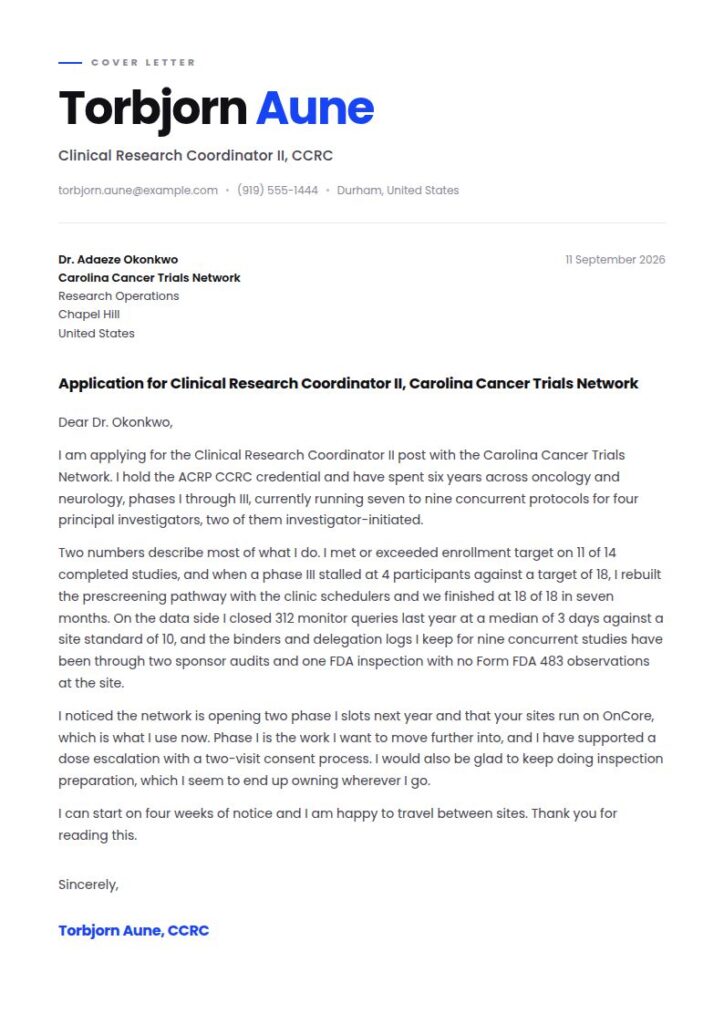
A clinical research coordinator cover letter is a one-page letter saying what you have run: which phases, which areas, how many protocols at once, and what your enrollment and regulatory record looked like when someone checked.
Research managers read these against a site behind on enrollment, short a coordinator, or preparing for a monitoring visit. A letter answering one of those in its first paragraph is a different document from one opening on a fascination with science.
Guide to a clinical research coordinator cover letter
This guide and the CRC cover letter example below will cover:
- How to structure the letter, paragraph by paragraph
- Why the phase and therapeutic area belong in the first sentence
- The three numbers a research manager reads first
- How to write about regulatory work without saying "maintained compliance"
How to write a clinical research coordinator cover letter
| Paragraph | Its job | Length |
|---|---|---|
| Opening | The post, certification, phases and areas, concurrent protocols | 2 to 3 sentences |
| Evidence | One enrollment number, one data or regulatory number | 4 to 5 sentences |
| Fit | Something specific about their program, and what you would take on | 3 to 4 sentences |
| Close | Availability and a thank you | 2 sentences |
Phase and therapeutic area go in the first sentence
"Clinical research coordinator with six years of experience" tells a manager nothing usable. Phase and area tell them everything.
A phase I unit hires for consent complexity, sampling windows and dose escalation meetings. A phase III oncology program hires for enrollment volume and long-term follow-up. An academic site running investigator-initiated studies hires for someone who can build a regulatory binder without a sponsor's help. Three different jobs.
So open with specifics: "six years across oncology and neurology, phases I through III, running seven to nine concurrent protocols for industry sponsors and two investigator-initiated studies." The reader now knows whether to keep going, which is what a first sentence is for.
A clinical research coordinator cover letter example you can adapt
Dear Dr. Okonkwo,
I am applying for the Clinical Research Coordinator II post with the Carolina Cancer Trials Network. I hold the ACRP CCRC credential and have spent six years across oncology and neurology, phases I through III, currently running seven to nine concurrent protocols for four principal investigators, two of them investigator-initiated.
Two numbers describe most of what I do. I met or exceeded enrollment target on 11 of 14 completed studies, and when a phase III stalled at 4 participants against a target of 18, I rebuilt the prescreening pathway with the clinic schedulers and we finished at 18 of 18 in seven months. On the data side I closed 312 monitor queries last year at a median of 3 days against a site standard of 10, and the binders and delegation logs I keep for nine concurrent studies have been through two sponsor audits and one FDA inspection with no Form FDA 483 observations at the site.
I noticed the network is opening two phase I slots next year and that your sites run on OnCore, which is what I use now. Phase I is the work I want to move further into, and I have supported a dose escalation with a two-visit consent process. I would also be glad to keep doing inspection preparation, which I seem to end up owning wherever I go.
I can start on four weeks of notice and I am happy to travel between sites. Thank you for reading this.
Sincerely, Torbjorn Aune, CCRC
Openings that work
| Instead of | Use |
|---|---|
| I am passionate about advancing medical research | I hold the ACRP CCRC and run seven to nine concurrent protocols, phases I to III, in oncology and neurology |
| I am detail-oriented and highly organized | I closed 312 monitor queries last year at a median of 3 days |
The three numbers a research manager reads first
| Number | What it looks like in a sentence |
|---|---|
| Enrollment against target | Met or exceeded target on 11 of 14 completed studies; took a stalled phase III from 4 of 18 to 18 of 18 in seven months |
| Query volume and speed | Closed 312 monitor queries last year at a median of 3 days against a site standard of 10 |
Enrollment is first because enrollment failure costs a site its next study. If you have never rescued a stalled protocol, use the fraction you have and say how you protected it: prescreening pathway, referral relationships, or a recruitment plan you wrote.
Writing the regulatory paragraph without saying "compliance"
"Maintained compliance with all applicable regulations" is the sentence every coordinator writes and no manager reads. Name the instrument instead.
Before an investigator takes part, the sponsor obtains a signed investigator statement on Form FDA-1572, in which the investigator commits to conduct the study in accordance with the current protocol, to personally conduct or supervise it, and to ensure staff are informed about their obligations, and which requires a list of subinvestigators and affirmation that an IRB will be responsible for initial and continuing review (21 CFR 312.53). If you are on a delegation log, say for how many investigators and protocols. That sentence says more about your seniority than any adjective.
The same goes for electronic records. Closed systems must use secure, computer-generated, time-stamped audit trails to independently record the date and time of operator entries and actions that create, modify or delete electronic records (21 CFR 11.10(e)). Very few applicants can say they have been through a Part 11 system review.
Name the good clinical practice revision you were trained on, too. The current revision of ICH E6 is E6(R3), finalized in September 2025 (US Food and Drug Administration, E6(R3) guidance).
Give phases and therapeutic areas in the first sentence. Say how many concurrent protocols you carry. Give enrollment as a fraction of target. Name your EDC and CTMS, because sites hire on those. Cite the actual regulation. Name one real thing about their program from their own pages.
Do not write "maintained compliance with all applicable regulations". Do not claim zero protocol deviations. Do not name a participant, a diagnosis or anything identifying. Do not claim an organization's inspection outcome when you mean your site. Do not name a sponsor's compound if your site agreement does not allow it; give the phase and indication.
No BLS profile for the title, and what that means
The Bureau of Labor Statistics publishes no Occupational Outlook Handbook profile for clinical research coordinators, so there is no official median wage or projection for the job title, and any single figure quoted for it should be treated carefully. The published occupations around it are the useful frame. Medical scientists had 181,000 jobs in 2025, 13 percent projected growth through 2035 and a May 2025 median of $103,410, but entry typically requires a doctoral or professional degree. Medical and health services managers had 640,400 jobs in 2025, 24 percent projected growth, about 62,300 openings a year and a May 2025 median of $123,860, with bachelor's degree entry (BLS Occupational Outlook Handbook, 2025 to 2035 projections and May 2025 wages).
Since the title has no official definition, your letter supplies one. Portfolio size, phases, staff supervised and inspection record tell a manager which version of the job you have been doing.
Length, format and sending it
One page, four paragraphs, 250 to 400 words. PDF unless the portal asks otherwise, named for yourself and the post: torbjorn-aune-crc-cover-letter.pdf.
Address a person. Principal investigators and research managers are named on program pages, publications and trial registry entries, so a generic salutation has no excuse here.
Keep every figure identical to your resume; a research manager is exactly the reader who cross-checks. Our clinical research coordinator resume example uses the same numbers as the letter above.
Key takeaways
- Put phases and therapeutic areas in the first sentence.
- Say how many protocols you run at once, and for how many investigators.
- Give enrollment as a fraction of target, and a rescue if you have one.
- Give query volume with a median resolution time.
- Cite the regulation rather than writing "compliance".
Write your clinical research coordinator cover letter in 10 minutes with our AI cover letter builder.
Clinical research coordinator cover letter questions, answered
How long should a CRC cover letter be?
One page, four paragraphs, 250 to 400 words. The portfolio detail belongs on the resume; the letter picks two or three numbers from it and says why they matter here.
What should the first sentence say?
Your certification if you hold one, the phases and therapeutic areas you have run, and how many concurrent protocols you carry. A phase I unit, a phase III oncology program and an academic investigator-initiated site hire for different skills, and that sentence says which one you are.
Should I mention certification if I am not certified yet?
Yes, as accrued hours and a date. The ACRP CCRC requires 3,000 hours of verifiable paid work experience in human subject research, with a possible waiver of 1,500 hours for holders of an active ACRP certification or graduates of an approved clinical research education program (ACRP, checked September 2026). "3,100 verifiable hours accrued, examination scheduled for March 2027" is concrete and dates your plan.
How do I write about an FDA inspection without overclaiming?
Attribute it to your site and state the outcome plainly. "The binders I keep for nine concurrent studies went through one FDA inspection with no Form FDA 483 observations at the site" is accurate and checkable. Claiming an organization-wide outcome you were one part of unravels in an interview.
What do I write with no coordinator experience yet?
Write what you have done that is the same work under another title: chart prescreening, consent observation, specimen handling, data entry and query response, IRB submissions, or regulatory filing as a research assistant. Then your good clinical practice and human subjects training with dates, and the systems you have used. Sites hire on EDC and CTMS familiarity more than applicants expect.