MS2, Doctor of Medicine Expected May 2027 Ravindra Kulkarni B.S.
Student Research Assistant, Chronic Kidney Disease Registry
[email protected] | (205) 555-1384 | Birmingham, United States
Profile
Second-year medical student at Red Mountain University School of Medicine, Doctor of Medicine expected May 2027, applying for a summer research studentship in nephrology. Completed the pre-clerkship curriculum with distinction in the renal and cardiovascular modules and holds current CITI Program human subjects research certification. Works two clinics a month at a student-run free clinic as an intake and vitals volunteer, and tutors first-year students in physiology in a weekly group of eight.
Work Experience
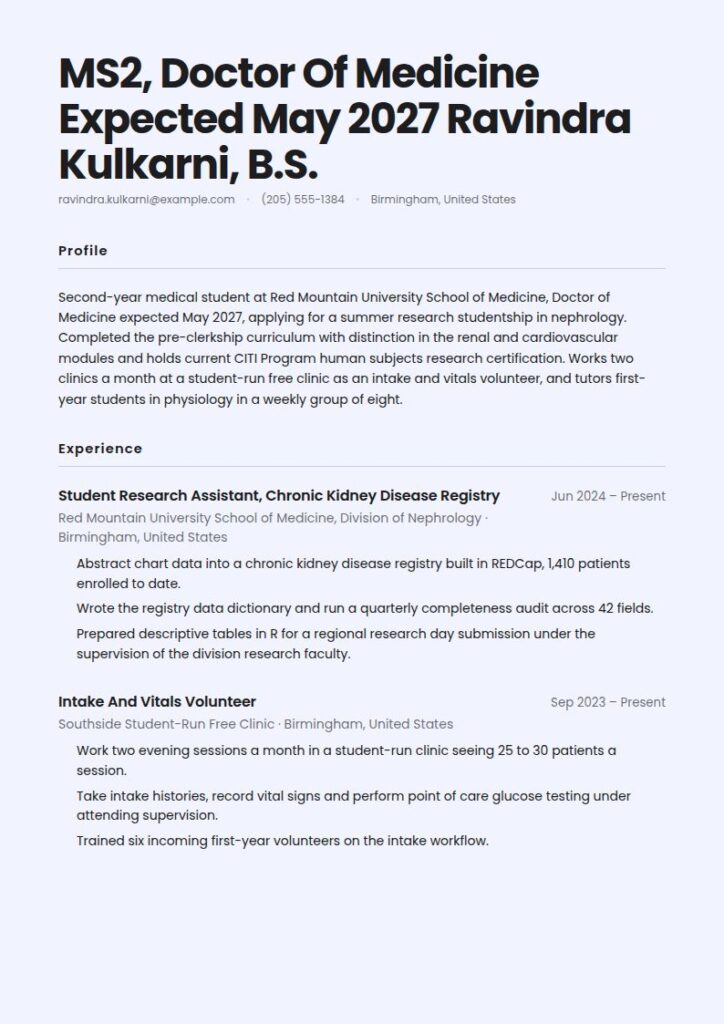
06/2024 - Present, Student Research Assistant, Chronic Kidney Disease Registry, Red Mountain University School of Medicine, Division of Nephrology, Birmingham, United States
- Abstract chart data into a chronic kidney disease registry built in REDCap, 1,410 patients enrolled to date.
- Wrote the registry data dictionary and run a quarterly completeness audit across 42 fields.
- Prepared descriptive tables in R for a regional research day submission under the supervision of the division research faculty.
09/2023 - Present, Intake and Vitals Volunteer, Southside Student-Run Free Clinic, Birmingham, United States
- Work two evening sessions a month in a student-run clinic seeing 25 to 30 patients a session.
- Take intake histories, record vital signs and perform point of care glucose testing under attending supervision.
- Trained six incoming first-year volunteers on the intake workflow.
05/2022 - 06/2023, Medical Scribe, Emergency Department, Cahaba Emergency Physicians, Birmingham, United States
- Documented 12 to 18 emergency department encounters a shift in Epic for two attending physicians.
- Worked roughly 24 hours a week alongside full-time undergraduate study.
Education
08/2023 - Present, Doctor of Medicine, Medicine, Red Mountain University School of Medicine, Birmingham, United States
Pre-clerkship curriculum complete, with distinction in the renal and cardiovascular modules. Nephrology interest group secretary.
08/2019 - 05/2023, Bachelor of Science, Biochemistry, Auburn University, Auburn, United States
Minor in Spanish.
Skills
History taking and physical examination, 60
Retrospective chart review, 75
REDCap registry build and maintenance, 75
Descriptive statistics in R, 60
Epic documentation, 80
PubMed and Ovid literature searching, 70
Peer teaching in physiology, 70
Languages
English, native
Marathi, native
Spanish, intermediate
Certificates
05/2024, Biomedical Research Investigators and Key Personnel, CITI Program
Human subjects research training required for registry access.
08/2023, Basic Life Support Provider, American Heart Association
Summary
A medical student resume is a one to two page document showing where you sit in the four-year calendar, what you have completed and what you are applying for now. This guide gives you three adaptable versions for pre-clerkship, clerkship and fourth-year applicants, the resume and CV split that decides which document you send, and current Bureau of Labor Statistics data.
Medical Student resume examples by experience level
In short, a medical student resume is a one to two page document showing a reader where you sit in the four-year calendar, what you have finished, and what you are applying for now.
That last part is why medical students carry two documents rather than one. For example, a one-page resume goes to a summer research post, a scribe or teaching job, a scholarship committee or a student clinic leadership application. A full curriculum vitae goes to residency programs: a record rather than a pitch, with no page limit, organized by category instead of by argument. However, sending the second when the first was asked for is the most common error on a medical student's page, and the reverse costs more.
Resume guide for a medical student resume
This guide and the corresponding medical student resume example will cover:
- How to write a medical student resume at each stage of the four-year calendar
- When a one-page resume is right and when the reader wants the full CV
- Three adaptable summaries: pre-clerkship, clerkship, and fourth-year applicant
- How to write research output with an honest authorship position
- What Bureau of Labor Statistics data shows about the destination occupation
How to write a medical student resume
Six blocks: contact header, summary, education with your expected degree date, clinical experience, research and scholarship, then teaching, service and leadership together. One page until you apply into residency, when the document changes shape.
In practice, the order follows how the reader sorts. For instance, a principal investigator hiring a summer student reads for method. An elective coordinator reads for stage, because stage governs what you are permitted to do. A residency program reads for a specialty-shaped record against a calendar it knows by heart.
| Section | What it is answering | Where it goes |
|---|---|---|
| Stage in the program | Which year are they in, and what are they eligible to do? | Header line, then the education block |
| Education | Which school, and what is the expected degree date? | Directly under the summary |
| Clinical experience | What have they done with patients, and under whose supervision? | Reverse chronological |
| Research and scholarship | What did they contribute, and where did it land? | Its own block, with authorship position |
| Teaching, service and leadership | What do they take on when nobody assigns it? | One block, not three |
Put your stage and your expected degree date in the header
Every reader of a medical student's page is trying to work out one thing before anything else: what year are you in. It governs which electives you may take, whether you can be paid for a summer post, what a letter writer can honestly say about you, and which application cycle you belong to.
Write it as a line under your name: "MS3, Doctor of Medicine expected May 2027." Two facts, eight words, and the reader stops guessing.
Be consistent everywhere. A file that says "third-year medical student" in the header, "MS2" in a bullet and gives no graduation date makes a coordinator open your transcript to find something you could have told them.
Run the finished file through the ATS resume checker before you send it. Hospital and university systems parse student applications into a structured record, and a two-column academic template is what breaks that parse.
Choosing the best resume format for a medical student resume
Reverse chronological, single column, one page, for anything that is not a residency application. Also keep plain headings, no photograph, no shaded sidebar.
However, two decisions cause most of the trouble. The first is length, because a one-page resume is a selection, and selecting is the work. If you have four research projects and the post is a wet-lab studentship, the two bench projects go first and the quality improvement project gets a line. The second is grouping: a student's experience is not a clean job history, so group by kind and keep each group in reverse chronological order inside itself.
Therefore, keep one master document holding everything in full detail, and cut each application down from it. That master file is also what becomes your CV.
Include your contact information
| ✅ Right | ❌ Wrong |
|---|---|
| Ravindra Kulkarni | Ravindra Kulkarni |
| MS3, Doctor of Medicine expected May 2027 | Aspiring physician, passionate about patient care |
| Red Mountain University School of Medicine, Birmingham, AL | Medical student |
| (205) 555-1384, [email protected] | (205) 555-1384, [email protected] |
Also, use your school email or a plain personal address, and include your school's city and state. Geography matters more in residency selection than students expect, and regional ties are read off the header long before anyone opens a personal statement.
Make use of a summary
Three or four lines: stage and expected degree date, what you have completed, one concrete piece of evidence, and what you are applying for.
Second-year medical student at Red Mountain University School of Medicine, Doctor of Medicine expected May 2027, applying for a summer research studentship in nephrology. Completed the pre-clerkship curriculum with distinction in the renal and cardiovascular modules and holds current CITI Program human subjects research certification. Works two clinics a month at a student-run free clinic as an intake and vitals volunteer, and tutors first-year students in physiology in a weekly group of eight.
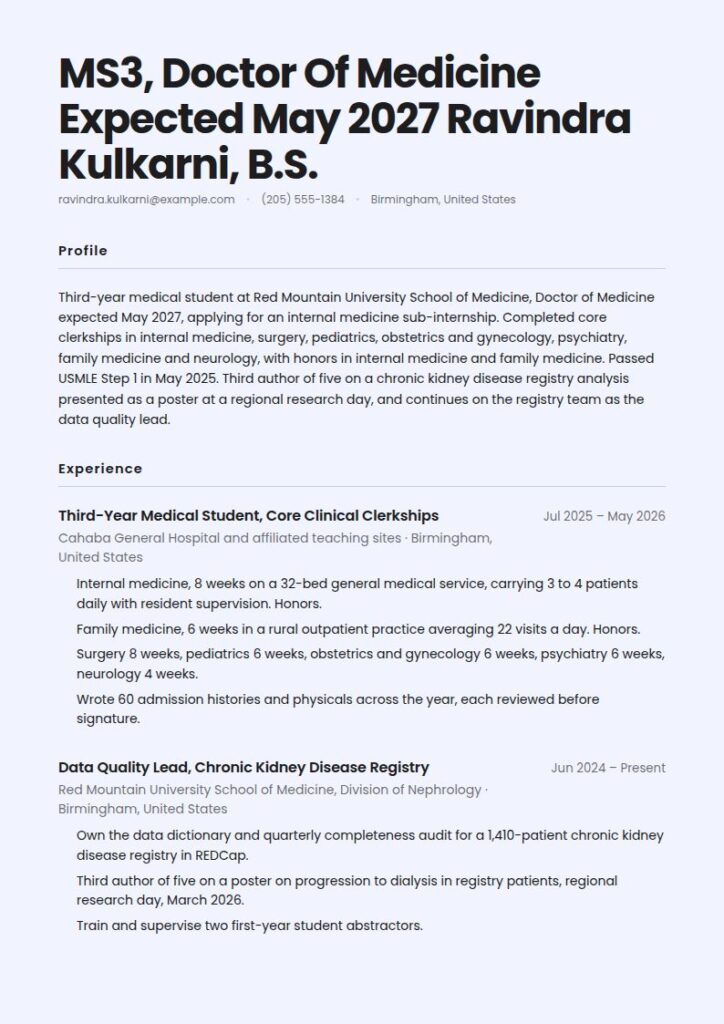
Third-year medical student at Red Mountain University School of Medicine, Doctor of Medicine expected May 2027, applying for an internal medicine sub-internship. Completed core clerkships in internal medicine, surgery, pediatrics, obstetrics and gynecology, psychiatry, family medicine and neurology, with honors in internal medicine and family medicine. Passed USMLE Step 1 in May 2025. Third author of five on a chronic kidney disease registry analysis presented as a poster at a regional research day, and continues on the registry team as the data quality lead.
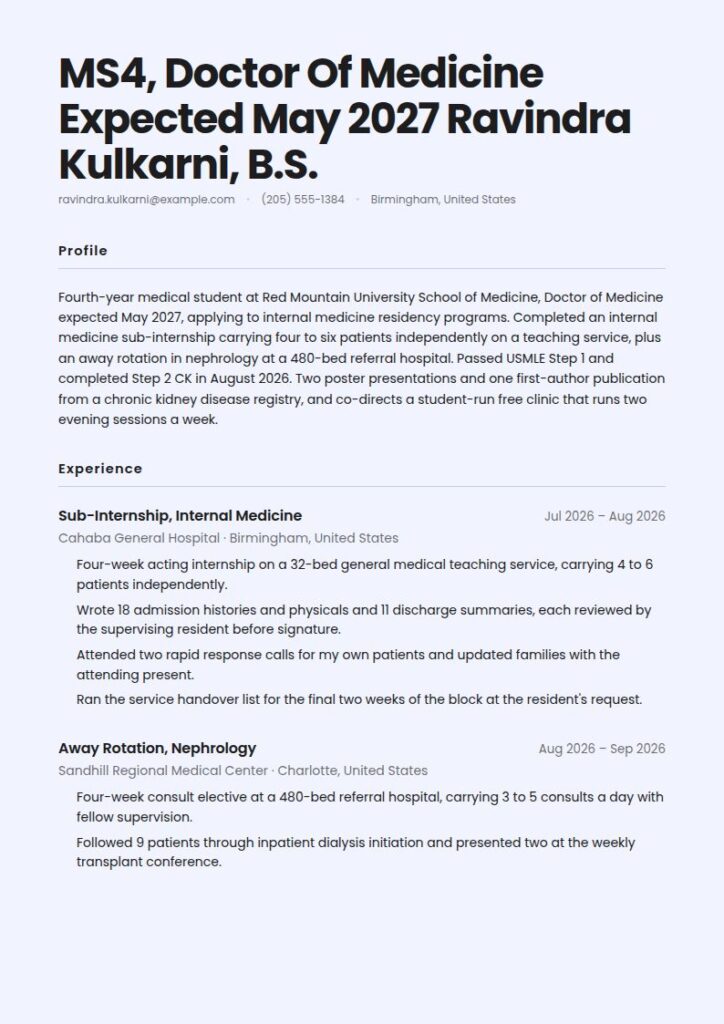
Fourth-year medical student at Red Mountain University School of Medicine, Doctor of Medicine expected May 2027, applying to internal medicine residency programs. Completed an internal medicine sub-internship carrying four to six patients independently on a teaching service, plus an away rotation in nephrology at a 480-bed referral hospital. Passed USMLE Step 1 and completed Step 2 CK in August 2026. Two poster presentations and one first-author publication from a chronic kidney disease registry, and co-directs a student-run free clinic that runs two evening sessions a week.
Right vs wrong: the same medical student summary, twice
| ✅ Right | ❌ Wrong |
|---|---|
| Third-year medical student, Doctor of Medicine expected May 2027, applying for an internal medicine sub-internship. | Hard-working medical student seeking opportunities to grow as a clinician. |
| Core clerkships complete, with honors in internal medicine and family medicine. Passed USMLE Step 1 in May 2025. | Strong clinical skills and a passion for delivering compassionate care. |
| Third author of five on a chronic kidney disease registry analysis presented at a regional research day. | Involved in research projects and presentations throughout medical school. |
The left column, for example, tells a program director what year you are in, what you have cleared, and what you contributed, in the order they ask it. In contrast, the right column could be written by anyone in your class, which is exactly the problem.
Outline your clinical and research experience
Site, role, department, dates, then two to four bullets. Similarly, clinical entries lead with the setting and what you were responsible for at your level of training. Research entries lead with the question and the method, then your contribution.
| Instead of | Use |
|---|---|
| Participated in internal medicine clerkship | Eight-week internal medicine clerkship on a 32-bed general medical service, carrying three to four patients daily with resident supervision |
| Assisted with research in a laboratory | Built and maintained a 1,410-patient chronic kidney disease registry, writing the data dictionary and running quarterly completeness audits |
| Presented research at a conference | Third author of five, poster, regional research day, March 2026, on progression to dialysis in registry patients |
| Volunteered at a free clinic | Intake and vitals volunteer, then evening co-director, at a student-run free clinic seeing 25 to 30 patients a session |
| Tutored students | Peer tutor in physiology, weekly group of eight first-year students, across two academic years |
| Shadowed physicians | 40 hours of longitudinal preceptorship in an outpatient nephrology clinic, attending two half-days a month |
Note what the right column does with numbers. A student cannot claim an outcome, because a student is not the person responsible for it. Instead, what a student can claim is scope and volume: how many patients, how many sessions, how many records, how long. That is honest, checkable, and more persuasive than a claim of impact nobody would believe from a trainee.
Sub-Internship, Internal Medicine, Cahaba General Hospital, Birmingham, AL, July 2026 to August 2026
Four-week acting internship on a 32-bed general medical teaching service. Carried four to six patients independently, wrote daily progress notes and admission histories, presented on rounds, and took first call for my patients during the day.
Wrote 18 admission histories and physicals and 11 discharge summaries, each reviewed by the supervising resident before signature.
Followed two patients through a transfer to the intensive care unit, attending both rapid response calls and updating the family with the attending present.
Ran the service handover list for the last two weeks of the block at the resident's request.
Write the resume against the Match calendar
In fact, everything on a medical student's page is read against a calendar, and that calendar is the same for everyone in the class. Your reader knows exactly what you should have finished by now, so any gap is visible without being mentioned.
The four years, and what each puts on the page. The first two are pre-clerkship: basic science, early clinical skills, and the commitments you actually choose. Almost everything distinctive on a fourth-year page started here, which is why a first-year should not wait to build one. The third year is core clerkships, which convert into named rotations with lengths and grades. The fourth is sub-internships, away rotations, electives and the application itself.
Step 1 stopped being a number. The United States Medical Licensing Examination moved Step 1 score reporting to pass or fail only for examinations taken on or after 26 January 2022 (USMLE, usmle.org). Write it the way it is reported: "USMLE Step 1: Pass, May 2025." Do not invent a percentile for it and do not leave it off, because a missing Step 1 line reads as a failed attempt whether or not that is true. Step 2 CK is still reported numerically, so if you have taken it, say when, and give the score if you are choosing to report it.
Clerkships and sub-internships on the page
Clerkships are the spine of the third-year page. List each core rotation with its length, its site and its grade in your school's own words, because grading language varies and a program reads it against your school's key. If your school uses honors, high pass and pass, use those words rather than a letter grade nobody issued you.
Sub-internships and away rotations are the fourth year's evidence. A sub-internship is the closest thing to the job you are applying for, so write it as a job: the service, the bed count, how many patients you carried, and what you were trusted to do without a second signature. An away rotation says a program has already watched you work, so name the site and the service.
The MSPE and your letters are not on the resume, but the resume shapes them. Your Medical Student Performance Evaluation and your letters arrive through the application service rather than your CV. What the CV does is remind a letter writer of everything they did not personally see. Send it with every letter request.
The Match, research output and the split
Then the Match itself. Applications reach residency programs through the Electronic Residency Application Service, and positions are filled through the National Resident Matching Program. In the 2026 Main Residency Match, announced on 20 March 2026, 44,344 training positions were offered against 53,373 registered applicants, and 38,354 applicants matched to a post-graduate year-1 position (National Resident Matching Program, 2026 Main Residency Match).
Research goes on the page as output, with the authorship stated. Split it into publications, then abstracts and posters, then presentations, and state your position plainly: "third author of five" rather than "contributed to". Programs verify publications, and an inflated position found during an interview is a much larger problem than a modest one listed honestly.
Finally, the split. For a research post, a campus job, a scholarship or a leadership application, send one page selected for that reader. For residency, send the full CV: every rotation, presentation, teaching role and service commitment, by category with dates. Never send the master file to somebody who asked for a resume.
Build a snapshot of your key skills
Ten to fourteen entries in three groups: clinical, research and data, then systems and languages. Keep out anything you would not want examined in an interview.
Clinical: history taking and physical examination, oral case presentation, admission history and physical documentation, discharge summaries, venipuncture and peripheral intravenous access, arterial blood gas sampling, basic point of care ultrasound familiarity, sterile technique and gowning
Research and data: clinical registry design and maintenance, REDCap, retrospective chart review, descriptive statistics in R, survival analysis under supervision, manuscript preparation, poster design, CITI Program human subjects research training
Systems and languages: Epic, PubMed and Ovid literature searching, reference management in Zotero, English native, Marathi native, Spanish conversational
List your education, examinations and certifications
Medical school first with the expected degree date, then your undergraduate degree, then examinations, then certifications. After all, a student's education block carries more weight than a working professional's, so it belongs near the top of the page.
Doctor of Medicine, Red Mountain University School of Medicine, Birmingham, AL, expected May 2027. Core clerkships completed May 2026: internal medicine (honors), family medicine (honors), pediatrics, surgery, obstetrics and gynecology, psychiatry, neurology.
Bachelor of Science, Biochemistry, Auburn University, Auburn, AL, 2023
USMLE Step 1: Pass, May 2025. USMLE Step 2 CK: completed August 2026.
Certifications: Basic Life Support Provider, American Heart Association, current. CITI Program, Biomedical Research Investigators and Key Personnel, completed 2024.
Choose the right layout and design
Finally, keep a single column, 11 or 12 point, plain headings, no photograph, no color blocks, name and page number in the footer of a multi-page CV. Academic templates with a shaded left rail look considered, but they parse badly.
State your stage and expected degree date in the header. Group experience by kind and keep each group in reverse chronological order. Write clerkships with length, site and the grade in your school's own words. Give your authorship position in every research entry. Write scope and volume rather than outcomes, because scope is what a trainee can honestly claim. Keep one master file and cut each application down from it.
Do not send a full CV where a one-page resume was requested, or the reverse. Do not omit the Step 1 line; a missing line reads worse than a pass. Do not describe a research contribution without saying where you sat in the author list. Do not list a manuscript as published before it is accepted; use the status the journal has actually given it. Do not name or describe an identifiable patient, however anonymous you believe the detail to be.
Medical student job market and outlook
There is no Bureau of Labor Statistics Occupational Outlook Handbook profile for medical students, because a medical student is a stage rather than an occupation. The honest reference point is the destination, physicians and surgeons, and that is the profile used throughout this page.
| Measure | Value |
|---|---|
| Physician and surgeon jobs, 2025 | 862,800 |
| Projected change, 2025-35 | 4 percent, about as fast as the average for all occupations |
| Projected annual openings | About 22,100 |
| Typical entry-level education | Doctoral or professional degree |
| Training after the degree | 3 to 9 years of internship and residency, depending on specialty |
| Subspecialty fellowship | A further 1 to 3 years |
| Median annual wage, May 2025 | $275,930 |
Source: U.S. Bureau of Labor Statistics, Occupational Outlook Handbook, physicians and surgeons, May 2025 wages with 2025 to 2035 projections.
Read the training line carefully. In short, the degree is the halfway mark: a student choosing between specialties is choosing between three more years and nine more, and the record you build in your third year is what opens or closes that choice.
What the 2026 Match actually looked like
In the 2026 Main Residency Match, announced on 20 March 2026, 44,344 training positions were offered and 53,373 applicants registered. Of those, 38,354 matched to a post-graduate year-1 position, and 93.5 percent of the offered positions, 41,482, were filled. United States MD seniors achieved a post-graduate year-1 match rate of 93.5 percent, and United States DO seniors reached their highest post-graduate year-1 match rate on record at 93.2 percent (National Resident Matching Program, 2026 Main Residency Match).
Two things follow from those numbers. The gap between registered applicants and offered positions is real, so the application list matters and the record you bring to it matters more. And the match rate for seniors of United States medical schools is high, which means the question your page is usually answering is not whether you will match at all, but whether you will match into the specialty and the kind of program you want.
That is the argument for building the page from the first year. The distinctive entries on a strong fourth-year CV, the longitudinal clinic, the registry, the teaching role, all started early and ran long.
What salary you can expect
Meanwhile, the median annual wage for physicians and surgeons was $275,930 as of May 2025 (BLS Occupational Outlook Handbook, May 2025). That is the destination figure, not a figure for a student or a resident, and the distance between the two is measured in the 3 to 9 years of residency the same Handbook describes.
Indeed, the spread by specialty is wide and the Handbook publishes it. Emergency medicine physicians had a median annual wage of $335,550, psychiatrists $281,870 and pediatricians $210,040, all as of May 2025 (BLS Occupational Outlook Handbook, May 2025). Those gaps are durable, and they interact with training length in ways worth weighing before your third year rather than during your fourth.
Even so, what your resume controls now is narrower and more useful. It decides whether you get the summer research post that becomes a poster, the teaching role that becomes a letter, the sub-internship that becomes an interview. Each of these, then, sits upstream of the specialty the wage table is describing.
Key takeaways for a medical student resume
- Put your stage and expected degree date in the header and keep them consistent everywhere.
- First, group experience by kind, clinical, research, teaching and service, and keep each group in date order.
- Then write clerkships with length, site and the grade in your school's own words.
- Finally, state your authorship position in every research entry, exactly as it stands.
- Claim scope and volume rather than outcomes; that is what a trainee can honestly own.
- Report Step 1 as a pass, because it has been pass or fail since 26 January 2022.
- Keep one master file, send one page to everyone except residency programs, and send the full CV to them.
Build your medical student resume in 15 minutes with our AI resume builder.
Related medical resume examples
- Doctor resume
- Physician resume
- Physician assistant resume
- Medical scribe resume
- Clinical research coordinator resume
- Nursing student resume
- Epidemiologist resume
- Medical assistant resume
- EMT resume
- Pharmacist resume
- Healthcare resume
- Medical resume
Pair it with a matching medical student cover letter.
Medical student resume questions, answered
How long should a medical student resume be?
One page for anything that is not a residency application: research posts, campus jobs, scholarships, leadership applications. For residency you send a full curriculum vitae instead, organized by category with no page limit, because it is a record rather than a selection. Keep both from one master file so the facts never disagree.
What goes on a medical student resume in the first year?
Your school, your expected degree date, your undergraduate degree and anything you are actually doing: the student clinic shift, the tutoring group, the interest group role, the laboratory you have joined, the research training you have completed. A first-year page is short and that is expected. What matters is starting the commitments that will read as long by your fourth year.
Should I list my USMLE scores?
List Step 1 as a pass, because score reporting moved to pass or fail only for examinations taken on or after 26 January 2022 (USMLE). Step 2 CK is reported numerically, so give the date you took it and the score if you are choosing to report it. Leaving the examination lines off entirely is worse than reporting a modest result, because a reader fills the gap with the least flattering explanation available.
How do I write research when I was not the first author?
State your position exactly: "third author of five" or "second author of four". Then say what you did in one clause, the data dictionary, the chart abstraction, the analysis, the figures. Programs check publications, and an honest middle authorship with a clear contribution reads far better than a vague claim that collapses under one interview question.
What is the difference between a resume and a CV for a medical student?
A resume is one page, selected for one reader, and it argues. A CV lists everything in categories with dates, and it records. You need both, fed from the same master file, which is why keeping that file current every term is the highest-value habit on this page.