Devika Zaveri MD
Resident Physician, Internal Medicine
[email protected] | (614) 555-0703 | Columbus, United States
Profile
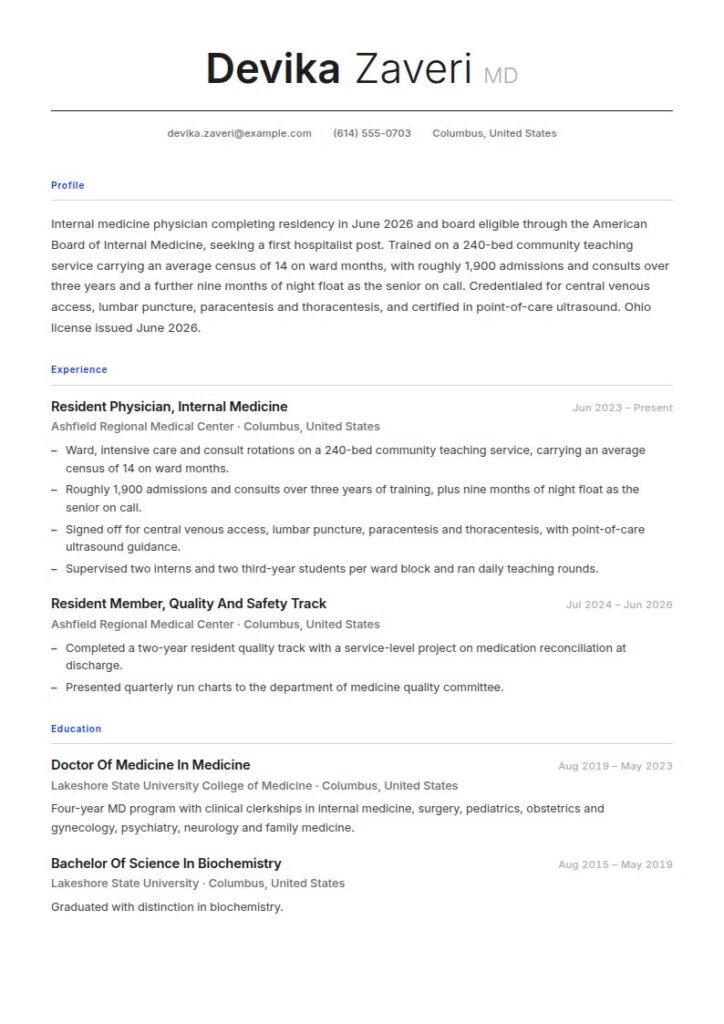
Internal medicine physician completing residency in June 2026 and board eligible through the American Board of Internal Medicine, seeking a first hospitalist post. Trained on a 240-bed community teaching service carrying an average census of 14 on ward months, with roughly 1,900 admissions and consults over three years and a further nine months of night float as the senior on call. Credentialed for central venous access, lumbar puncture, paracentesis and thoracentesis, and certified in point-of-care ultrasound. Ohio license issued June 2026.
Work Experience
06/2023 - Present, Resident Physician, Internal Medicine, Ashfield Regional Medical Center, Columbus, United States
- Ward, intensive care and consult rotations on a 240-bed community teaching service, carrying an average census of 14 on ward months.
- Roughly 1,900 admissions and consults over three years of training, plus nine months of night float as the senior on call.
- Signed off for central venous access, lumbar puncture, paracentesis and thoracentesis, with point-of-care ultrasound guidance.
- Supervised two interns and two third-year students per ward block and ran daily teaching rounds.
07/2024 - 06/2026, Resident Member, Quality and Safety Track, Ashfield Regional Medical Center, Columbus, United States
- Completed a two-year resident quality track with a service-level project on medication reconciliation at discharge.
- Presented quarterly run charts to the department of medicine quality committee.
Education
08/2019 - 05/2023, Doctor of Medicine, Medicine, Lakeshore State University College of Medicine, Columbus, United States
Four-year MD program with clinical clerkships in internal medicine, surgery, pediatrics, obstetrics and gynecology, psychiatry, neurology and family medicine.
08/2015 - 05/2019, Bachelor of Science, Biochemistry, Lakeshore State University, Columbus, United States
Graduated with distinction in biochemistry.
Skills
Inpatient internal medicine, 80
Central venous access, 75
Lumbar puncture, 75
Paracentesis and thoracentesis, 75
Point-of-care ultrasound, 70
Code team participation, 75
Medication reconciliation, 80
Epic inpatient workflows, 85
Clinical documentation integrity, 70
Quality improvement run charts, 70
Languages
English, native
Gujarati, native
Spanish, intermediate
Certificates
06/2026, Medical License, State of Ohio, State Medical Board of Ohio, OH-35-088142
Active. Issued on completion of residency.
06/2026, Internal Medicine, board eligible, American Board of Internal Medicine
Board eligible; certifying examination scheduled for August 2026.
04/2025, Advanced Cardiovascular Life Support and Basic Life Support, American Heart Association
Current through 2027.
Summary
A doctor resume is a one to two page document naming your training, your board certification, the states you are licensed in, the setting you practice in and the volume it runs at. This guide gives you three adaptable versions, the rule that keeps patient detail off the page entirely, and current Bureau of Labor Statistics pay and outlook for physicians and surgeons.
Doctor resume examples by experience level
In short, a doctor resume is a one to two page document that names your training, your board certification, the states you hold a license in, the setting you practice in, and the volume that setting runs at.
It is not a curriculum vitae. A CV is an open-ended record that grows for a whole career, and academic medicine still runs on it. By contrast, a resume is a closed argument for one job, and it is what a hospitalist group, a health system recruiter, a medical affairs team, a payer or a locums agency will ask for. However, most physicians own the first document and have never written the second.
Before anything else, one rule that applies to every line of this page.
No patient belongs on your resume, ever
Not a name, not initials, not an age, not a diagnosis, not a case, not an outcome, not a photograph, not a circumstance specific enough to identify someone. Not a de-identified case either, because a reader cannot verify that it is, and because the interesting cases are exactly the ones that are identifiable.
Describe your clinical work by type, volume, setting, procedure and process instead: "an average daily census of 17 on a 310-bed community hospital," not a story about a person.
This is a HIPAA problem before it is a taste problem, and it is the fastest way for a physician application to be remembered for the wrong reason. Recruiters and credentialing staff notice it immediately. It is also the most common defect in physician resumes written by physicians, because case detail is how doctors have described their work since their first year of training.
Resume guide for a doctor resume
To help, this guide and the corresponding doctor resume example will cover:
- First, how to write a doctor resume, section by section
- What to cut when you convert a CV into two pages, and what must survive
- Then three adaptable summaries: new attending, practicing physician and medical director
- Also, how to describe volume, procedures and privileges without describing a patient
- Finally, what the physician job market looks like and what you can expect to earn
This page is deliberately generic. If you practice in a named specialty, write it into every section below; the structure does not change, but the numbers, the procedure list and the board do.
How to write a doctor resume
Overall, it takes seven blocks: contact header, summary, licensure and certification, clinical experience, procedures and privileges, education and training, and skills. One page if you finished training in the last two years, two pages after that. Not three.
Licensure comes above experience because it is a gate rather than an achievement. A credentialing office reads for eligibility first: license, board status, DEA registration, and whether you can be credentialed where the job is.
| Block | The question it answers | Where it goes |
|---|---|---|
| Licensure and board status | Can this physician be credentialed here, and how soon? | Directly under the summary |
| Clinical experience | What setting, what volume, what scope? | Reverse chronological, each role with a number |
| Procedures and privileges | What can be granted without a proctoring period? | Its own short block |
| Education and training | Medical school, residency, fellowship, in that order | One compact block, no coursework |
Run the finished file through the ATS resume checker before you send it. Health system applicant systems parse a resume into a structured record before a human opens it, and a CV pasted into that field parses badly.
Choosing the best resume format for a doctor resume
Reverse chronological, always. After all, medicine is a field where the timeline is the credential: dates of training, dates of licensure, dates of board certification, dates in each role. A functional format hides exactly what a credentialing committee has to reconstruct anyway, and an unexplained gap looks worse when the format seems designed to hide it.
If you have a gap, date it plainly and label it in one neutral line: research, parental leave, a move between states while a license was pending. In practice, a dated gap is routine; an undated one is a phone call you will have to take.
Include your contact information
| ✅ Right | ❌ Wrong |
|---|---|
| Devika Zaveri, MD | Dr. Devika Zaveri |
| Internal Medicine Hospitalist, ABIM certified 2019 | Experienced physician and compassionate caregiver |
| Ohio license #OH-35-088142, active; IMLC Letter of Qualification held | Licensed physician |
| (614) 555-0703, [email protected], Columbus, OH | (614) 555-0703, [email protected] |
Also, put the license state and number on the page. Credentialing verifies it whatever you write; even so, the file that lets them start in ten seconds moves ahead of the file that does not. If you hold licenses in more than one state, list them all; if you hold an Interstate Medical Licensure Compact Letter of Qualification, say so, because it shortens the timeline to a start date in any of the 44 member states and 2 US territories in the compact (Interstate Medical Licensure Compact Commission, page updated 6 August 2026).
Make use of a summary
First, write four lines: specialty and board status, years in practice, the setting and its volume, and one thing you built or ran.
Internal medicine physician completing residency in June 2026 and board eligible through the American Board of Internal Medicine, seeking a first hospitalist post. Trained on a 240-bed community teaching service carrying an average census of 14 on ward months, with roughly 1,900 admissions and consults over three years and a further nine months of night float as the senior on call. Credentialed for central venous access, lumbar puncture, paracentesis and thoracentesis, and certified in point-of-care ultrasound. Ohio license issued June 2026.
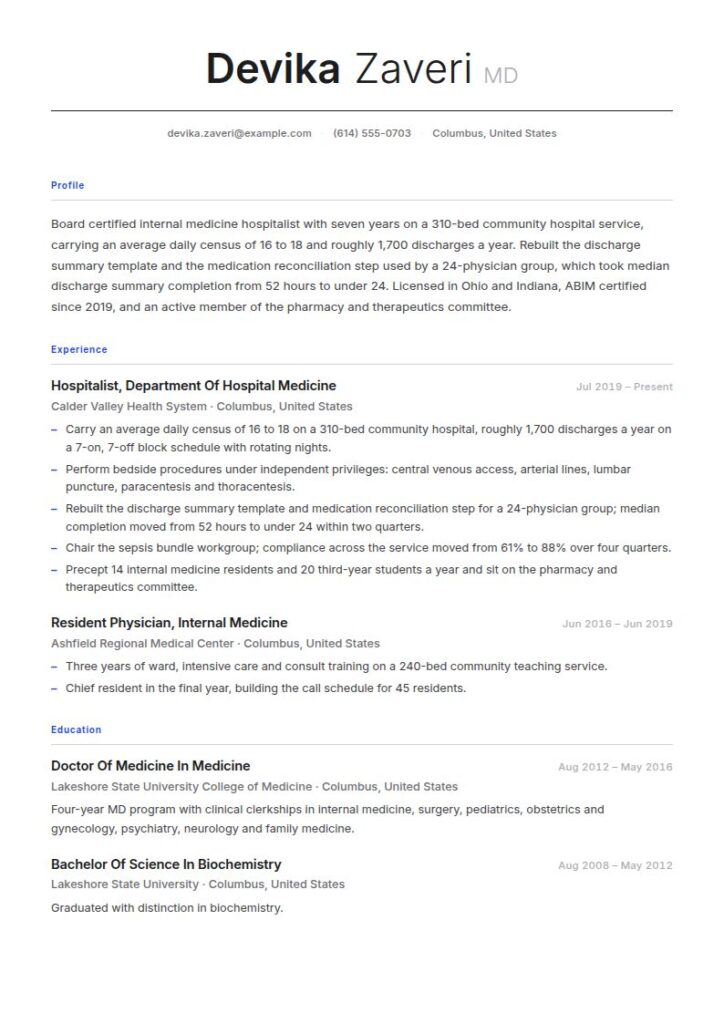
Board certified internal medicine hospitalist with seven years on a 310-bed community hospital service, carrying an average daily census of 16 to 18 and roughly 1,700 discharges a year. Rebuilt the discharge summary template and the medication reconciliation step used by a 24-physician group, which took median discharge summary completion from 52 hours to under 24. Licensed in Ohio and Indiana, ABIM certified since 2019, and an active member of the pharmacy and therapeutics committee.
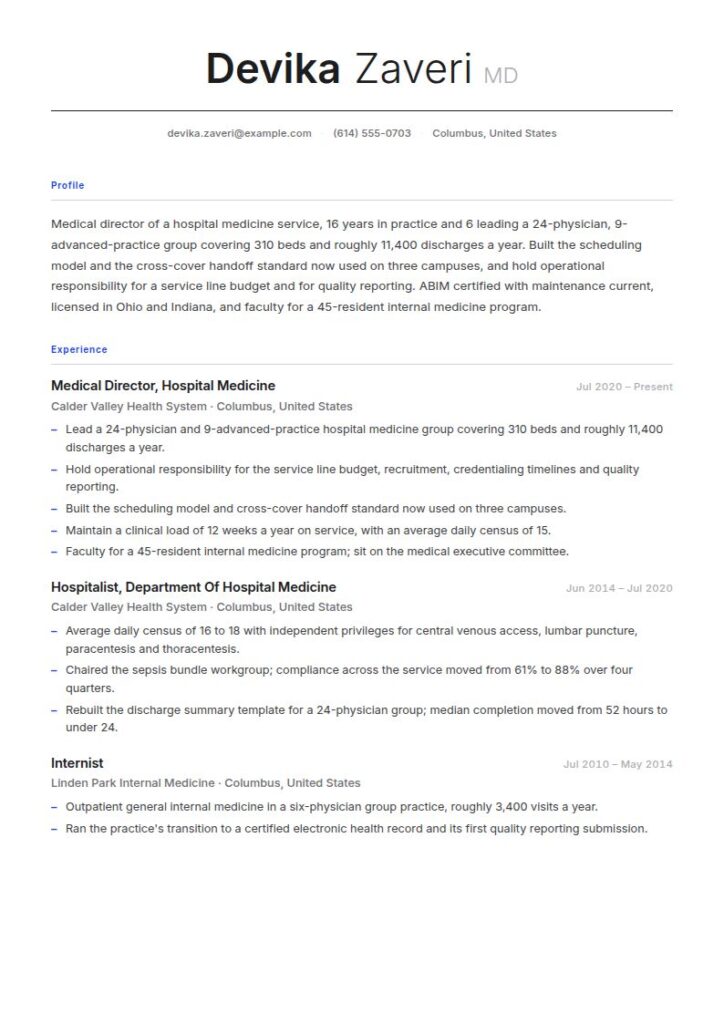
Medical director of a hospital medicine service, 16 years in practice and 6 leading a 24-physician, 9-advanced-practice group covering 310 beds and roughly 11,400 discharges a year. Built the scheduling model and the cross-cover handoff standard now used on three campuses, and hold operational responsibility for a service line budget and for quality reporting. ABIM certified with maintenance current, licensed in Ohio and Indiana, and faculty for a 45-resident internal medicine program.
Right vs wrong: the same doctor summary, twice
| ✅ Right | ❌ Wrong |
|---|---|
| Board certified internal medicine hospitalist, seven years on a 310-bed community service. | Compassionate physician dedicated to excellence in patient care. |
| Average daily census of 16 to 18, roughly 1,700 discharges a year. | Extensive experience managing complex and challenging cases. |
| Took median discharge summary completion from 52 hours to under 24 across a 24-physician group. | Recognized by colleagues for clinical judgment and bedside manner. |
For example, the right column can be credentialed, scheduled and budgeted for. Meanwhile, the left column is a sentence that appears in almost every physician file a recruiter opens, and in none of the ones that get called.
Outline your clinical experience
Employer, city, service line, dates, then three to five bullets. In other words, every bullet carries a number, and none of them carries a patient.
| Instead of | Use |
|---|---|
| Managed a complex panel of inpatients | Carried an average daily census of 16 to 18 on a 310-bed community hospital service |
| Performed a range of bedside procedures | Performed roughly 90 central venous catheter placements and 60 paracenteses a year under independent privileges |
| Improved quality outcomes on the unit | Led the sepsis bundle workgroup; bundle compliance across the service moved from 61% to 88% over four quarters |
| Supervised residents and students | Precepted 14 internal medicine residents and 20 third-year students a year as ward attending |
| Handled a challenging case involving a rare diagnosis | Delete this line and replace it with a volume, a rate or a process you changed |
That last row is the whole rule. If a bullet only makes sense as a story about one person, it cannot go on a resume. Convert it into what you do repeatedly, how often, and what changed as a result.
Hospitalist, Department of Hospital Medicine, Calder Valley Health System, Columbus, OH, July 2019 to Present
Carry an average daily census of 16 to 18 on a 310-bed community hospital, roughly 1,700 discharges a year across a 7-on, 7-off block schedule with rotating night coverage.
Perform bedside procedures under independent privileges: central venous access, arterial lines, lumbar puncture, paracentesis and thoracentesis, with point-of-care ultrasound guidance.
Rebuilt the discharge summary template and the medication reconciliation step for a 24-physician group; median completion moved from 52 hours to under 24 within two quarters.
Chair the sepsis bundle workgroup; compliance across the service moved from 61% to 88% over four quarters.
Precept 14 internal medicine residents and 20 third-year medical students a year and sit on the pharmacy and therapeutics committee.
Turn your academic CV into a two page doctor resume
In practice, most physicians start from an eleven-page CV and try to shorten it. That produces a bad resume, because the two documents answer different questions. That is because the CV asks what you have done, while the resume asks what you can be hired to do next. Start from the job instead, and pull forward only what that job has to know.
| CV section | What happens to it on a resume |
|---|---|
| Full publication list | One line: the count, the field, and your highest-impact role. Keep the full list as a separate page if the post is academic |
| Every poster and abstract | Cut, unless the post is research or medical affairs, and then keep three |
| Grand rounds and invited talks | One line naming the count and the audience, or cut |
| Committee memberships | Keep the two or three that show operational responsibility; cut the rest |
| Medical school honors and clerkship grades | Cut after your first attending job |
| Licensure, DEA, board status | Keep, and move it up |
| Procedures and privileges | Keep and expand; a CV usually buries this and a resume needs it |
| Teaching | One line with a number of learners, not a list of lecture titles |
| Professional society memberships | Two at most, and only the ones a reader would recognize |
| Personal details, photograph, date of birth | Cut. These belong on a European CV, not a US resume |
Three conversions from CV to doctor resume
Three conversions decide whether the result reads as a resume or as a truncated CV.
Turn positions into scope. A CV line reads "Hospitalist, 2019 to present." A resume line reads "Hospitalist on a 310-bed community service, average daily census 16 to 18, roughly 1,700 discharges a year."
Turn training into eligibility. A reader in a non-academic setting does not need your rotation schedule. They need the specialty, the board, the certification date, and whether maintenance is current.
Turn output into operations. Papers, talks and committees matter on a resume in proportion to what they let you run. "First author on 6 peer-reviewed papers in hospital medicine quality" is one line and it is enough.
Keep the CV. You will still need it
Do not overwrite the CV when you build the resume. Keep both files and update them together, because they get asked for by different people.
The CV is what an academic search committee, a medical staff office, a fellowship program and a licensing board will want. The resume is what a health system recruiter, a locums agency, an industry medical affairs team, a payer, a start-up and almost every non-clinical employer will want.
Physicians applying outside the match usually need the resume first and the CV within a week, and the two must agree on every date.
Build a snapshot of your key skills
For skills, list ten to fourteen entries in four groups. Also, keep them concrete enough to be verified.
Clinical: Inpatient internal medicine, Perioperative medical consultation, Anticoagulation management, Point-of-care ultrasound, Code team leadership
Procedures: Central venous access, Arterial line placement, Lumbar puncture, Paracentesis, Thoracentesis
Systems and quality: Sepsis bundle compliance, Length of stay and readmission review, Medication reconciliation redesign, Root cause analysis, Pharmacy and therapeutics committee
Records and documentation: Epic and Cerner inpatient workflows, Clinical documentation integrity, ICD-10-CM and CPT coding accuracy, Utilization review criteria
Instead, leave out the qualities every physician claims. After all, clinical judgment, empathy and communication are not skills a resume can evidence; they are what interviews and references are for.
List your education, training and board certification
Order it the way a credentialing office reads it: license, board status, training, degree, then certifications that expire.
Licensure: Ohio #OH-35-088142, active through 2028. Indiana #IN-01-44907, active through 2027. Interstate Medical Licensure Compact Letter of Qualification held. DEA registration active.
Board certification: American Board of Internal Medicine, Internal Medicine, certified 2019, maintenance of certification current.
Residency: Internal Medicine, Ashfield Regional Medical Center, Columbus, OH, 2016 to 2019. Chief resident 2018 to 2019.
Doctor of Medicine, Lakeshore State University College of Medicine, Columbus, OH, 2012 to 2016.
Certifications: Advanced Cardiovascular Life Support and Basic Life Support, American Heart Association, current through 2027.
Similarly, board status has three honest answers and you write whichever is true: certified with maintenance current, board eligible with the date you sit, or lapsed with the date you regain it. For context, as of 30 June 2025 there were 1,025,104 physicians holding an active certification from one of the 24 ABMS Member Boards, which certify in 38 specialty and 89 subspecialty areas (American Board of Medical Specialties, Board Certification Report 2024-2025, published 12 December 2025). As a result, it is common enough that its absence gets noticed.
Choose the right layout and design
For layout, use a single column, 11 or 12 point, clear headings, no photograph, no headshot, no colored sidebar. Health system portals parse before a person reads, and two-column templates are where that parsing fails.
Lead with license state, number and status. Give the board, the certification year and whether maintenance is current. State the setting and its volume in numbers. List procedures you hold independent privileges for. Date any gap and label it in one neutral line. Keep a matching CV updated alongside.
Do not put a patient, a case, a diagnosis, an outcome or an identifying circumstance anywhere on the page, de-identified or not. Do not send an eleven-page CV to a job that asked for a resume. Do not list clerkship grades or medical school honors once you are an attending. Do not include a photograph, a date of birth or a marital status. Do not claim a procedure you have not been privileged for.
Doctor job market and outlook
A large, steadily growing occupation in which the hiring constraint is credentialing time rather than demand.
| Measure | Value |
|---|---|
| Physician and surgeon jobs, 2025 | 862,800 |
| Projected change, 2025-35 | 4% (as fast as average), +31,300 |
| Projected annual openings | ~22,100 |
| Typical entry-level education | Doctoral or professional degree |
| On-the-job training | Internship or residency |
| Median annual wage, May 2025 | $275,930 |
Source: U.S. Above all, see the Bureau of Labor Statistics, Occupational Outlook Handbook, Physicians and Surgeons, 2025-35 projections and May 2025 wage data, published 27 August 2026.
The Handbook publishes employment for this occupation by specialty rather than by industry, so there is no share-of-employment table for physicians of the kind it prints for most occupations. Instead, the specialty distribution is the useful equivalent:
| Specialty | Jobs, 2025 | Median annual wage, May 2025 |
|---|---|---|
| Physicians, all other | 367,400 | $265,930 |
| Family medicine physicians | 114,300 | $244,180 |
| General internal medicine physicians | 73,100 | $256,560 |
| Pediatricians, general | 42,200 | $210,040 |
| Anesthesiologists | 41,500 | $391,490 |
| Emergency medicine physicians | 34,900 | $335,550 |
| Psychiatrists | 30,000 | $281,870 |
| Radiologists | 28,700 | $420,860 |
Source: U.S. Similarly, see the Bureau of Labor Statistics, Occupational Outlook Handbook, May 2025 wage data and 2025 employment.
More licensed physicians than physician jobs, and that is the point
The Federation of State Medical Boards counted 1,082,187 licensed physicians in the United States in its 2024 census, a 27 percent increase since 2010, with US medical graduates making up 77 percent of the workforce and international medical graduates 23 percent (FSMB, released 15 August 2025 in the Journal of Medical Regulation).
The Bureau of Labor Statistics counts 862,800 physician and surgeon jobs in 2025 (BLS Occupational Outlook Handbook, published 27 August 2026). The gap is not unemployment. It is physicians holding licenses in more than one state, physicians in administrative, research, industry and public health roles that are counted under other occupations, and physicians who have retired from clinical work but kept a license.
For your resume that gap is the market. A lot of physician hiring now happens outside a clinical staff posting, and those employers ask for a resume rather than a CV. Through 31 July 2026 the Interstate Medical Licensure Compact had issued 227,966 licenses to 65,558 physician members (Interstate Medical Licensure Compact Commission, page updated 6 August 2026), which is a measure of how many physicians now need to be credentialed in more than one place at once.
What salary you can expect as a doctor
Overall, the median annual wage for physicians and surgeons was $275,930 as of May 2025, or $132.66 an hour. The lowest 10 percent earned less than $76,560 and the highest 10 percent more than $488,320 (BLS Occupational Outlook Handbook, May 2025 wage data, published 27 August 2026).
That spread is mostly specialty, and specialty is set long before the resume. However, pediatric surgeons had a median of $559,030, cardiologists $496,010 and radiologists $420,860, against $244,180 for family medicine physicians and $210,040 for general pediatricians (BLS, May 2025).
What a resume can move is narrower: the number of states you can be credentialed in quickly, the procedures you can be privileged for without a proctoring period, whether you can take a service line or medical director role rather than a clinical-only one, and whether your coding accuracy is good enough to name. Those decide start date, call burden, stipends and administrative time, and each is a line you either wrote or did not.
Key takeaways for a doctor resume
- Above all, never put a patient, a case, a diagnosis or an identifying circumstance on the page.
- Lead with license state, number and status, then board certification with its date.
- Instead, describe clinical work as setting, volume, procedure and process, with a number in every bullet.
- In addition, give procedures you hold independent privileges for their own block.
- Then convert a CV by pulling forward eligibility and scope, and cutting everything the next job cannot use.
- Finally, keep the CV updated in parallel; the two documents get asked for by different people.
- One page in your first two years, two pages after that, single column and parseable.
Build your doctor resume in 15 minutes with our AI resume builder.
Related medical resume examples
- Physician resume
- Physician assistant resume
- Medical student resume
- Nurse practitioner resume
- Nurse resume
- Dentist resume
- Optometrist resume
- Pharmacist resume
- Psychologist resume
- Veterinarian resume
- Epidemiologist resume
- Healthcare resume
Pair it with a matching doctor cover letter.
Doctor resume questions, answered
How long should a doctor resume be?
One page if you finished training within the last two years, two pages after that. The length limit is what forces the useful edit: if a line does not help this employer decide whether to credential and schedule you, it belongs on the CV instead.
Should I send a CV or a resume?
Send what was asked for. Academic posts, medical staff offices, fellowships and licensing boards want the CV. Health system recruiters, locums agencies, industry medical affairs teams, payers and non-clinical employers want the resume. When the posting is ambiguous, send the two-page resume and offer the CV in the same sentence.
Can I describe a case if I remove the identifying details?
No. Leave cases off entirely. A reader cannot verify that a case has been de-identified, the cases worth writing about are usually the ones that could still be recognized, and clinical narrative on a resume tells a hiring manager something about how you handle records. Write the volume, the procedure, the rate or the process you changed instead.
What do I put on a doctor resume before my first attending job?
Residency written as a job: the institution, the service, the bed count, the census you carried, the total admissions or consults, the procedures you were signed off for, and any quality or committee work with a number attached. Then license status with its issue date, board eligibility with the date you sit, and life support certifications. A new attending who can state a census, a procedure list and a license date is easy to plan around.
How do I show results without naming a patient or a case?
Use whatever your service actually measures: census, discharges, procedure volume, length of stay, readmission rate, bundle compliance, documentation turnaround, clinic throughput, learners precepted, or a protocol you wrote and how it changed a rate. Give the before, the after and the period. That is evidence, and none of it describes a person.
Do I list every state license?
Yes, with the number and the status, plus any Interstate Medical Licensure Compact Letter of Qualification. The compact covers 44 member states and 2 US territories (Interstate Medical Licensure Compact Commission, page updated 6 August 2026), and starting sooner in more places is a real advantage worth two lines.