Ingrid Halvorsen DVM
Veterinary Student, Clinical Year Rotations
[email protected] | (406) 555-1120 | Missoula, United States
Profile
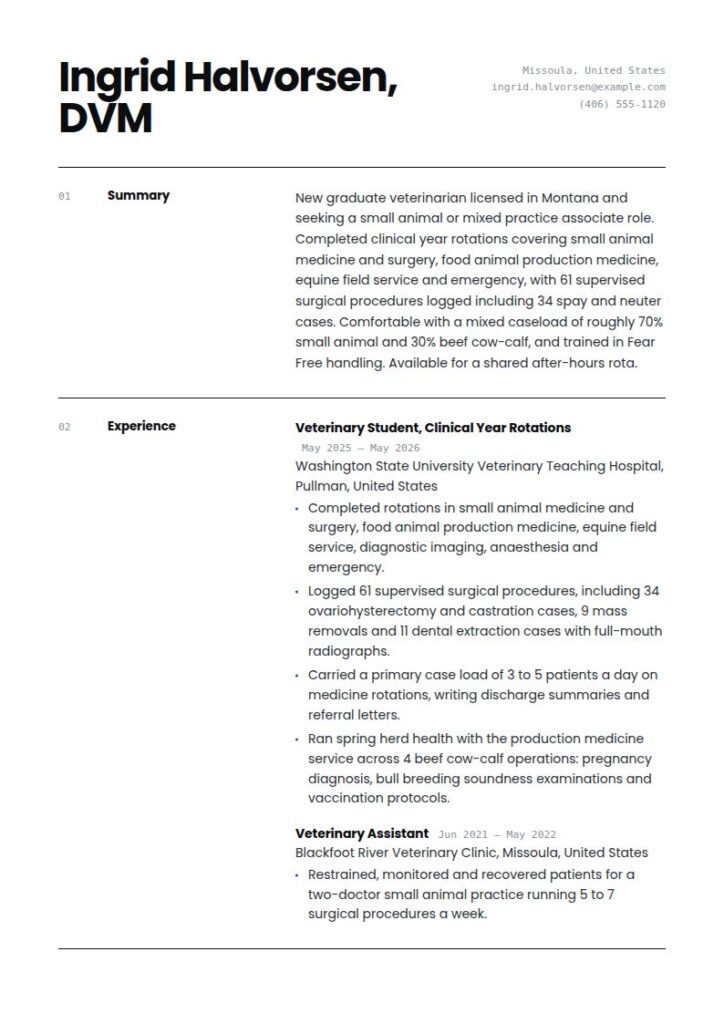
New graduate veterinarian licensed in Montana and seeking a small animal or mixed practice associate role. Completed clinical year rotations covering small animal medicine and surgery, food animal production medicine, equine field service and emergency, with 61 supervised surgical procedures logged including 34 spay and neuter cases. Comfortable with a mixed caseload of roughly 70% small animal and 30% beef cow-calf, and trained in Fear Free handling. Available for a shared after-hours rota.
Work Experience
05/2025 - 05/2026, Veterinary Student, Clinical Year Rotations, Washington State University Veterinary Teaching Hospital, Pullman, United States
- Completed rotations in small animal medicine and surgery, food animal production medicine, equine field service, diagnostic imaging, anaesthesia and emergency.
- Logged 61 supervised surgical procedures, including 34 ovariohysterectomy and castration cases, 9 mass removals and 11 dental extraction cases with full-mouth radiographs.
- Carried a primary case load of 3 to 5 patients a day on medicine rotations, writing discharge summaries and referral letters.
- Ran spring herd health with the production medicine service across 4 beef cow-calf operations: pregnancy diagnosis, bull breeding soundness examinations and vaccination protocols.
06/2021 - 05/2022, Veterinary Assistant, Blackfoot River Veterinary Clinic, Missoula, United States
- Restrained, monitored and recovered patients for a two-doctor small animal practice running 5 to 7 surgical procedures a week.
- Ran in-house haematology and chemistry, prepared cytology slides and maintained the controlled substance log.
Education
08/2022 - 05/2026, Doctor of Veterinary Medicine, Veterinary Medicine, Washington State University College of Veterinary Medicine, Pullman, United States
AVMA Council on Education accredited program. NAVLE passed 2026. Clinical year rotations in small animal medicine and surgery, food animal production medicine, equine field service, diagnostic imaging and emergency.
08/2018 - 05/2022, Bachelor of Science, Animal Science, Montana State University, Bozeman, United States
Minor in chemistry. Undergraduate research assistant in a beef cattle reproduction laboratory for three semesters.
Skills
Ovariohysterectomy and castration, 70
Dental extraction and full-mouth radiographs, 60
Anaesthetic protocol design and monitoring, 70
Digital radiography and positioning, 75
In-house haematology, chemistry and cytology, 80
Beef cow-calf herd health, 65
Fear Free handling, 80
Cornerstone practice management, 70
Languages
English, native
Norwegian, intermediate
Spanish, beginner
Certificates
07/2026, Montana Veterinary License, Montana Board of Veterinary Medicine, MT-VM-8417
Active. NAVLE passed 2026, administered by the International Council for Veterinary Assessment.
07/2026, DEA Registration, Practitioner, U.S. Drug Enforcement Administration
Current, Montana. Registered at the practice location.
09/2025, Fear Free Certified Professional, Level 1, Fear Free
Summary
A veterinarian resume is a one to two page document naming your state license, your DEA registration, your species mix and the practice type you are trained to carry. This guide gives you three adaptable versions, the species and caseload block most applicants leave out, the credential facts that a practice verifies before it calls you, and current Bureau of Labor Statistics pay and outlook for the occupation.
Veterinarian resume examples by experience level
A veterinarian resume is a one to two page document that names your state license, the species you treat, and the kind of practice you are trained to carry, before it says anything about how much you love animals.
In fact, species mix is the part almost every applicant leaves implicit, and it is the part that decides the shortlist. "Veterinarian" is not one labor market. For example, a small animal general practitioner, an equine ambulatory clinician, a dairy production veterinarian, a shelter medicine director and an overnight emergency clinician hold the same degree and the same kind of license and share almost nothing else about their working week. The person reading your file is trying to work out in about ten seconds whether you can take their caseload on a Tuesday.
Resume guide for a veterinarian resume
To help, this guide and the corresponding veterinarian resume example will cover:
- How to write a veterinarian resume, section by section
- Why species mix and practice type belong above your experience
- Three adaptable summaries: new graduate, practicing associate and medical director
- What the NAVLE, state licensure, DEA registration and board certification are worth on the page
- What the job market looks like and what you can expect to earn
How to write a veterinarian resume
Overall, it takes seven blocks: contact header, summary, licensure and registrations, species and practice profile, clinical experience, education, and skills. As for length, use one page as a new graduate, two once you have a surgical log and a leadership line worth reading.
The order matters. Licensure comes before experience because it is a gate rather than an achievement, and the species block comes before experience because it tells the reader how to interpret everything underneath it.
| Section | What it is answering | Where it goes |
|---|---|---|
| License and registrations | Can this person legally practice here, and can they prescribe? | Directly under the summary |
| Species and practice profile | Can they take my caseload, and what fraction of it? | Its own block, above experience |
| Clinical experience | What have they actually done with their hands, and how often? | Reverse chronological, with volumes |
| Education | Is the degree from an AVMA COE accredited college? | With the college and the graduation year |
Your DEA registration is tied to a place, not just to you
The DEA's Diversion Control Division states that "a separate registration is required for each principal place of business or professional practice at one general physical location where controlled substances are manufactured, distributed, imported, exported, or dispensed," and that a practitioner maintaining offices in more than one state must obtain a separate DEA registration in each state (DEA Diversion Control Division registration guidance, accessed September 2026).
That matters more to veterinarians than to most prescribers, because relief work, ambulatory food animal rounds and multi-site corporate groups all cross locations routinely.
Put the fact on the page as a fact: "DEA registration current, Montana." If you hold registrations in two states, say both. A practice that needs a relief veterinarian who can already prescribe in their building next week reads that line and stops looking.
Run the finished file through the ATS resume checker before you send it. Corporate veterinary groups and university systems parse applications into a database before a human opens one.
Choosing the best resume format for a veterinarian resume
Reverse chronological. In practice, use one page through your first associate role, two once you have a surgical caseload, a species shift, a residency or a medical director line.
By contrast, functional and skills-first formats fail badly here. That is because a veterinary employer reads the timeline for continuity and for volume: which practice, which species, how many years, how many surgeries, how much emergency. As a result, a format that hides the sequence reads as a sequence with something in it.
Include your contact information
| ✅ Right | ❌ Wrong |
|---|---|
| Ingrid Halvorsen, DVM | Ingrid Halvorsen |
| Small Animal and Mixed Practice Veterinarian | Animal lover and dedicated veterinary professional |
| Montana Veterinary License #MT-VM-8417, DEA registration current | Licensed veterinarian |
| (406) 555-1120, [email protected], Missoula, MT | (406) 555-1120, [email protected] |
First, put the license number on the page. Whoever handles credentialing will verify it anyway, and the file that lets them do it in ten seconds moves through faster than the one that does not. Then add the post-nominal DVM or VMD after your name; it is the fastest signal in the document.
Make use of a summary
In the summary, write four lines: your credential and license state, your species mix, your caseload with a number, and one procedure or program you own.
New graduate veterinarian licensed in Montana and seeking a small animal or mixed practice associate role. Completed clinical year rotations covering small animal medicine and surgery, food animal production medicine, equine field service and emergency, with 61 supervised surgical procedures logged including 34 spay and neuter cases. Comfortable with a mixed caseload of roughly 70% small animal and 30% beef cow-calf, and trained in Fear Free handling. Available for a shared after-hours rota.
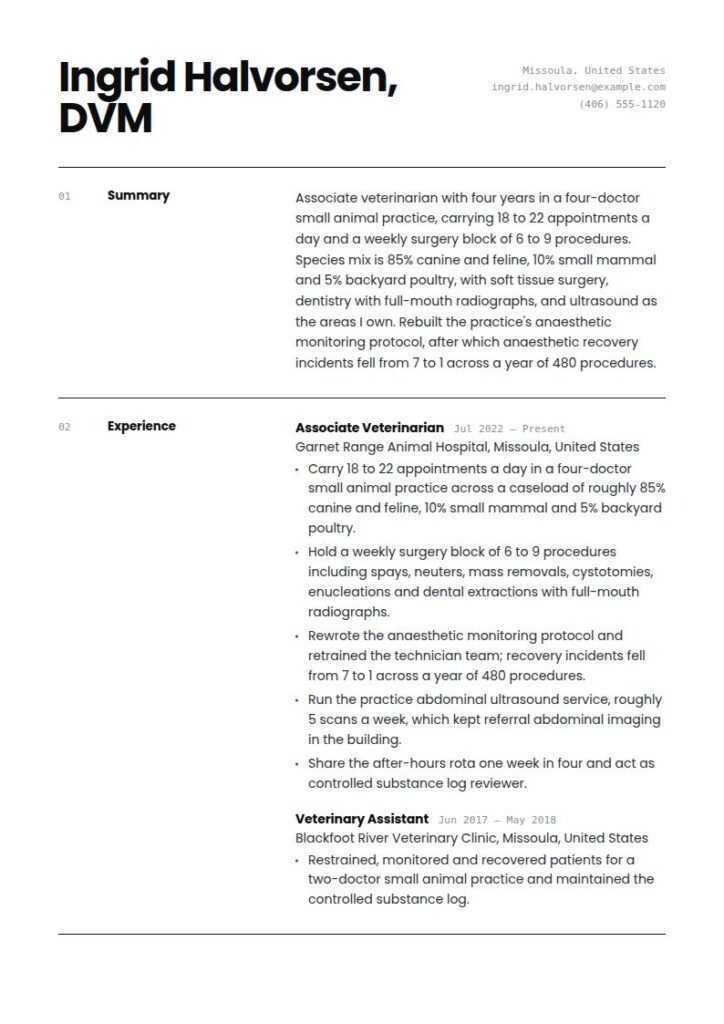
Associate veterinarian with four years in a four-doctor small animal practice, carrying 18 to 22 appointments a day and a weekly surgery block of 6 to 9 procedures. Species mix is 85% canine and feline, 10% small mammal and 5% backyard poultry, with soft tissue surgery, dentistry with full-mouth radiographs, and ultrasound as the areas I own. Rebuilt the practice's anaesthetic monitoring protocol, after which anaesthetic recovery incidents fell from 7 to 1 across a year of 480 procedures.
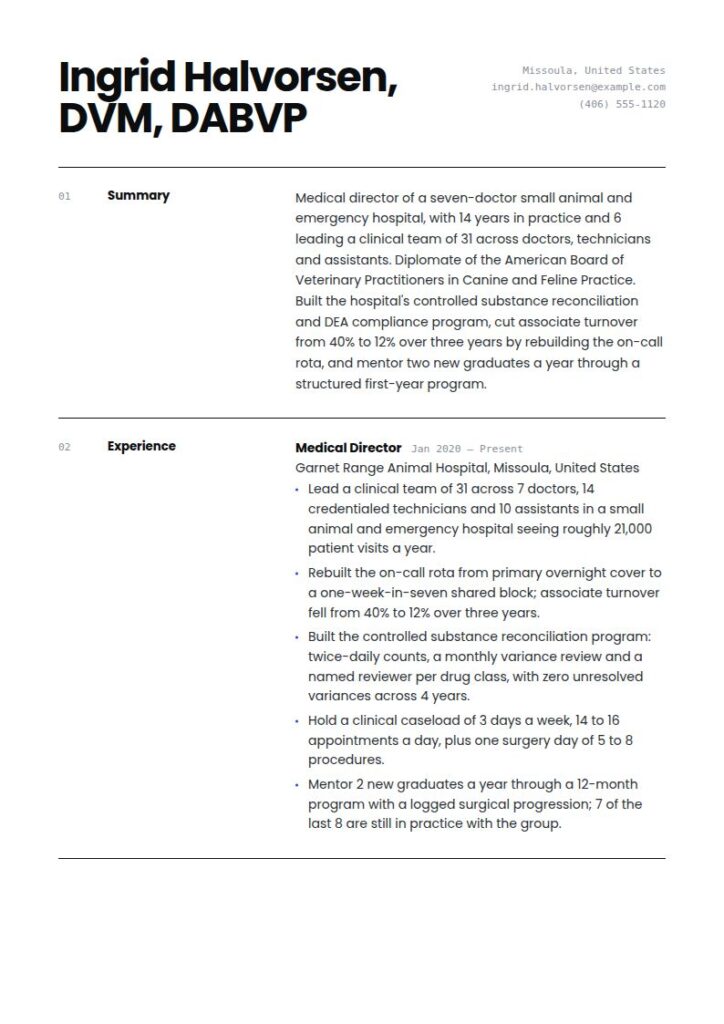
Medical director of a seven-doctor small animal and emergency hospital, with 14 years in practice and 6 leading a clinical team of 31 across doctors, technicians and assistants. Diplomate of the American Board of Veterinary Practitioners in Canine and Feline Practice. Built the hospital's controlled substance reconciliation and DEA compliance program, cut associate turnover from 40% to 12% over three years by rebuilding the on-call rota, and mentor two new graduates a year through a structured first-year program.
Right vs wrong: the same veterinarian summary, twice
| ✅ Right | ❌ Wrong |
|---|---|
| Associate veterinarian with four years in a four-doctor small animal practice. | Compassionate veterinarian with a lifelong love of animals. |
| Species mix 85% canine and feline, 10% small mammal, 5% backyard poultry. | Experienced treating a wide variety of species. |
| Weekly surgery block of 6 to 9 procedures; anaesthetic recovery incidents fell from 7 to 1 across 480 procedures. | Skilled in surgery and committed to the highest standard of care. |
For example, the right column can be scheduled into a rota and a surgery board. However, the left column cannot, and a practice owner reading thirty files between appointments is scheduling.
Outline your clinical experience
Then list practice name, city, practice type, doctor count and dates. Then three to five bullets, each naming a species group or a procedure class and carrying a volume.
Above all, volume is the currency of this document. "Performed surgery" tells a reader nothing. "Six to nine soft tissue and dental procedures a week" tells them whether you can hold a surgery day on your own.
| Instead of | Use |
|---|---|
| Provided medical care to a variety of animals | Carried 18 to 22 appointments a day across a caseload of 85% canine and feline, 10% small mammal, 5% backyard poultry |
| Performed surgeries | Ran a weekly surgery block of 6 to 9 procedures: spays, neuters, mass removals, cystotomies and dental extractions with full-mouth radiographs |
| Experienced with emergency cases | Covered a shared after-hours rota, roughly 9 emergency presentations per on-call night, with stabilisation and transfer to a 24-hour facility |
| Worked with farm animals | Ran spring herd health for 14 beef cow-calf operations: pregnancy diagnosis on about 2,100 head a season, bull breeding soundness examinations and vaccination protocols |
| Improved clinic protocols | Rewrote the anaesthetic monitoring protocol; recovery incidents fell from 7 to 1 across a year of 480 procedures |
Associate Veterinarian, Garnet Range Animal Hospital, Missoula, MT, four-doctor small animal practice, July 2022 to Present
Carry 18 to 22 appointments a day across a caseload of roughly 85% canine and feline, 10% small mammal and 5% backyard poultry.
Hold a weekly surgery block of 6 to 9 procedures including spays, neuters, mass removals, cystotomies, enucleations and dental extractions with full-mouth radiographs.
Rewrote the practice anaesthetic monitoring protocol and retrained the technician team; recovery incidents fell from 7 to 1 across a year of 480 procedures.
Share the after-hours rota one week in four and act as controlled substance log reviewer for the practice.
Declare your species mix and practice type
This is the block almost nobody writes, and it is the one that decides whether the rest of the resume is even relevant to the reader.
The AVMA's own employment statistics divide practicing veterinarians by the animals they see rather than by job title, using the categories companion animal, mixed animal, equine, food animal and laboratory animal; it counted an estimated 133,475 United States veterinarians as of 31 December 2025 (American Veterinary Medical Association, U.S. veterinarian numbers, data as of 31 December 2025). In other words, those categories are close to separate professions. They differ in case load, in on-call shape, in the physical demands of the work, in the drugs on the truck and in who signs the check.
Write three lines, not one:
Current species mix: 85% canine and feline, 10% small mammal and backyard poultry, 5% equine on referral
Practice types worked: small animal general practice (4 doctors), mixed animal practice (2 doctors, 60% small animal and 40% beef cow-calf), shared after-hours emergency rota
Trained and willing to take on: food animal herd health, exotic companion mammal medicine, shelter high-volume spay and neuter
Not currently offering: equine ambulatory, production dairy, laboratory animal medicine
Finally, the fourth line is the one that earns trust. Saying plainly what you do not do stops a practice from interviewing you for the half of the job you cannot cover, and it reads as someone who has been in the room rather than someone selling.
Practice type and doctor count
Practice type carries a second set of facts the reader needs. Say how many doctors are in the building, because a solo practice and a seven-doctor hospital demand different judgement; say whether the practice is general, referral, emergency, shelter, mobile or production; say what the on-call shape was, because "one week in four with transfer to a 24-hour facility" and "primary overnight emergency" are entirely different lives. Say whether the site is AAHA accredited if it is, since the practice reading your file may be too.
Veterinarian credentials with named authorities
Three credential facts belong alongside the species block, and each has a named authority behind it.
The NAVLE. The North American Veterinary Licensing Examination is administered by the International Council for Veterinary Assessment, which has run it since 2000 and describes it as "a requirement for licensure to practice veterinary medicine in all licensing jurisdictions in the United States and Canada." It is 360 clinically relevant multiple-choice questions, delivered in three annual testing windows (ICVA, accessed September 2026). Give the year you passed it.
AVMA Council on Education accreditation. The COE is the accrediting body for veterinary colleges and holds recognition from the US Department of Education. Its official list carries 32 accredited colleges in the United States and 48 worldwide (AVMA Council on Education accredited veterinary colleges list, 2026). If you trained outside North America, this is the first thing a credentialing office looks for, so name the accreditation route you took.
Board certification. The American Board of Veterinary Specialties recognizes 22 veterinary specialty organizations covering 48 distinct AVMA-recognized specialties, held by more than 16,500 diplomates (AVMA, veterinary specialties, accessed September 2026). If you are a diplomate, put the college and the specialty in your header line, not in a certifications list at the bottom. If you are in a residency or have completed a rotating internship, say which college the residency is under and the expected examination year.
Build a snapshot of your key skills
For skills, list twelve to sixteen entries in four groups: surgery, medicine and diagnostics, practice systems, and the client and team side.
Surgery: Ovariohysterectomy and castration, Mass removal and biopsy, Cystotomy, Enucleation, Dental extraction with full-mouth radiographs, Laceration and wound management
Medicine and diagnostics: Abdominal and thoracic ultrasound, Digital radiography and positioning, In-house haematology and chemistry, Cytology, Anaesthetic protocol design and monitoring, Pain management and multimodal analgesia
Production and field: Beef cow-calf herd health, Pregnancy diagnosis by palpation and ultrasound, Bull breeding soundness examination, Vaccination and parasite program design
Practice systems: ezyVet and Cornerstone practice management, Controlled substance logging and reconciliation, Inventory and drug ordering, Fear Free handling, Client communication and estimate conversations
Name the practice management software. After all, it is one of the few things a practice manager can screen on, and switching systems costs a new associate two weeks of speed.
List your education, license and certifications
License first with its number and state, then DEA registration, then the DVM with its college, then certifications.
Montana Veterinary License #MT-VM-8417, active. NAVLE passed 2022.
DEA registration current, Montana. Controlled substance log reviewer for a four-doctor practice.
Doctor of Veterinary Medicine, Washington State University College of Veterinary Medicine, Pullman, WA, 2022. Clinical year rotations in small animal medicine and surgery, food animal production medicine, equine field service, diagnostic imaging and emergency.
Bachelor of Science, Animal Science, Montana State University, Bozeman, MT, 2018.
Certifications: Fear Free Certified Professional, Level 3 (2024). AVMA Council on Education accredited degree. Veterinary ultrasound short course, abdominal, 2023.
In addition, a new graduate should add a surgical log summary here: the number of supervised procedures by type. It is the only quantitative evidence you have before your first job, and it is stronger evidence than a grade point average.
Choose the right layout and design
For layout, use a single column, 11 or 12 point, clear headings, no photograph and no animal clip art. Two pages maximum. Send a PDF unless the portal says otherwise, named for yourself and the post.
Put the license number, the state and the DEA status in the first block. Give your species mix as percentages. Name the practice type, the doctor count and the on-call shape for every role. Put a volume on every clinical bullet: appointments a day, surgeries a week, head per season. Name the practice management software you know. Say plainly which species you are not offering.
Do not write "all species" or "a wide variety of animals" when the specific mix is what gets you shortlisted. Do not open with why you wanted to be a veterinarian since childhood. Do not describe an identifiable client or a named owner's pet; describe the case and the procedure. Do not list a lapsed license or an inactive DEA registration without saying so. Do not use a two-column template for a corporate group's applicant system.
Veterinarian job market and outlook
A small occupation growing much faster than average, with a modest absolute number of openings each year, which makes species mix and location the two things that move your odds.
| Measure | Value |
|---|---|
| Veterinarian jobs, 2025 | 91,100 |
| Projected change, 2025-35 | 9% (much faster than average) |
| Projected annual openings | About 3,100 |
| Typical entry-level education | Doctoral or professional degree |
| Median annual wage, May 2025 | $130,100 |
Source: U.S. Bureau of Labor Statistics, Occupational Outlook Handbook, 2025 to 2035 projections and May 2025 wage data.
Growth is fast, but the absolute number of openings is small
The Occupational Outlook Handbook puts veterinarian employment at 91,100 in 2025 and projects 9 percent growth through 2035, much faster than the average for all occupations, but only about 3,100 openings a year on average over the decade (BLS Occupational Outlook Handbook, 2025 to 2035 projections).
A fast-growing occupation with only 3,100 annual openings is one where an individual practice may go a year without hiring, and where the practices that are hiring are usually hiring for a specific gap: a surgery day, a dairy contract, an overnight block.
The practical consequence for your resume is that generic breadth is worth less than a precise match. The file that says "85% canine and feline, weekly surgery block of 6 to 9, shares the after-hours rota one week in four" is answering an advertisement that was written about exactly that gap.
For reference, here is where the jobs sit, and what each setting pays:
| Setting | Median annual wage (May 2025) |
|---|---|
| Social advocacy organizations | $131,760 |
| Veterinary services | $129,990 |
| Educational services; state, local, and private | $121,890 |
| Government, excluding state and local education and hospitals | $115,210 |
Source: U.S. Bureau of Labor Statistics, Occupational Outlook Handbook, May 2025 wage data.
What salary you can expect as a veterinarian
On pay, the median annual wage for veterinarians was $130,100 as of May 2025, or $62.55 an hour. The lowest 10 percent earned less than $73,920 and the highest 10 percent more than $215,700 (BLS Occupational Outlook Handbook, May 2025 wage data).
Even so, that spread of roughly $142,000 between the tenth and ninetieth percentile is the widest thing about this occupation, and very little of it is explained by the industry table above, where the four largest settings sit within about $17,000 of each other. Instead, the spread is explained by production model, by ownership, by specialty and by hours.
As a result, three things on a resume move the number. Board certification is the largest: the ABVS recognizes 48 distinct specialties and fewer than 17,000 diplomates hold them nationally, which is a genuinely scarce credential. Similarly, production capacity is the second: a documented surgery volume and a documented appointment volume are what production-based pay is calculated against, and a candidate who can show them negotiates from evidence. The third is scope you can bill for in house: ultrasound, advanced dentistry, orthopaedics, endoscopy and behavior consultations each keep revenue in the building rather than sending it to a referral center, and each is worth naming as a line.
Key takeaways for a veterinarian resume
- First, lead with the license, its state and its number, and say the DEA registration is current.
- Also, give your species mix as percentages, in its own block, above your experience.
- Name the practice type, the doctor count and the on-call shape for every role.
- Put a volume on every clinical bullet: appointments a day, surgeries a week, head per season.
- Say what you do not do; it builds more trust than claiming everything.
- Also, put board certification or residency status in the header, not at the bottom.
- Finally, as a new graduate, summarize your surgical log; it is the only hard evidence you have.
Build your veterinarian resume in 15 minutes with our AI resume builder.
Related medical resume examples
- Vet tech resume
- Veterinary assistant resume
- Doctor resume
- Physician resume
- Physician assistant resume
- Nurse resume
- Pharmacist resume
- Lab technician resume
- Medical assistant resume
- Sonographer resume
- Clinical research coordinator resume
- Medical office manager resume
Pair it with a matching veterinarian cover letter.
Veterinarian resume questions, answered
How long should a veterinarian resume be?
One page as a new graduate, two once you have a surgical caseload, a species shift, a residency or a medical director line. Two pages is normal and expected mid-career, because the species block, the procedure list and the licensure block all take real space. Three pages is a curriculum vitae, which is the right document for an academic or research post and the wrong one for a practice.
Should I list my species mix as percentages?
Yes. Percentages are the clearest way to say what you actually do all day, and they let a reader decide in seconds whether you fit. "Mixed practice" covers everything from 90% small animal with a few horses to a genuine even split, and the reader cannot tell which you mean. Give the current mix, the practice types you have worked, what you would take on, and what you are not offering.
What do I put on a veterinarian resume with no experience?
Your clinical year rotations, written as jobs: the service, the institution, the dates and what you did. Then a surgical log summary with procedure counts by type, your NAVLE year, your license, and any preceptorship or relief shifts. Add the species mix you are seeking and the on-call you are willing to take. A new graduate who states a mix and offers a shared rota is an easier hire than one who says they are open to anything.
Does board certification belong on a veterinarian resume?
Yes, in the header line beside your name. The American Board of Veterinary Specialties recognizes 22 specialty organizations covering 48 distinct specialties, held by more than 16,500 diplomates nationally (AVMA, accessed September 2026), so it is a genuinely separating credential. If you are mid-residency, say the college, the program and the expected examination year rather than leaving it off.
How do I show results when I cannot cite patient outcomes?
Use the numbers a practice already tracks and that no individual animal or client appears in: appointments a day, surgeries a week, anaesthetic recovery incidents over a stated number of procedures, dental radiograph compliance, average client transaction, referral rate before and after you brought a service in house, inventory shrinkage on controlled drugs, or new graduate retention if you mentor. Give the before, the after and the period.
What is the difference between a resume and a CV for a veterinarian?
A resume is one or two pages aimed at a practice and organized around caseload. A veterinary CV is unbounded and organized around scholarship: publications, presentations, grants, teaching and committee service. Academic posts, residencies and government research positions usually ask for the CV; clinical practice almost always wants the resume.