Registered Veterinary Technician Lidia Pandolfi RVT
Registered Veterinary Technician
[email protected] | (515) 555-1498 | Des Moines, United States
Profile
Registered Veterinary Technician credentialed in Iowa, #IA-RVT-7412, after graduating an AVMA-CVTEA accredited program and passing the VTNE in 2025. First year in a 4 doctor small animal general practice at roughly 55 appointments a day, monitoring 8 to 12 anesthetic cases a week and running dental prophylaxis and full mouth radiographs. Place peripheral IV catheters, run in-house hematology and chemistry, and log controlled drugs on every shift. Fear Free certified.
Work Experience
08/2025 - Present, Registered Veterinary Technician, Raccoon Bend Animal Hospital, Des Moines, United States
- Monitor 8 to 12 anesthetic cases a week, ASA classes I to II, in a 4 doctor small animal general practice running roughly 55 appointments a day.
- Run 4 to 6 dental prophylaxis procedures a week with full mouth radiographs and charting under the attending veterinarian.
- Place peripheral IV catheters, draw samples and run in-house hematology, chemistry and urinalysis.
- Log and reconcile controlled drugs on every shift alongside the practice manager.
08/2024 - 05/2025, Veterinary Technician Student, clinical rotations, Des Moines Area Community College, Veterinary Technology Program, Des Moines, United States
- Completed the accredited program's clinical requirements across small animal, equine and laboratory animal placements.
- Logged 61 monitored anesthetic cases, 38 radiographic studies and 94 venipunctures with competency sign-off.
Education
08/2023 - 05/2025, Associate of Applied Science, Veterinary Technology, Des Moines Area Community College, Des Moines, United States
AVMA-CVTEA accredited program. VTNE passed June 2025.
Skills
Anesthetic monitoring, ASA I to II, 70
Dental prophylaxis and radiography, 75
Peripheral IV catheter placement, 75
In-house hematology and chemistry, 75
Digital radiography positioning, 70
Controlled drug logging, 70
Low stress handling, 80
Languages
English, native
Italian, intermediate
Certificates
07/2025, Registered Veterinary Technician, Iowa Board of Veterinary Medicine, IA-RVT-7412
Current through December 2027. VTNE passed June 2025 through the AVMA-CVTEA accredited program pathway.
09/2025, Fear Free Certified Professional, Fear Free
Summary
A vet tech resume is a one page document naming the credential your state issues, the national exam behind it and the procedures you have actually performed. This guide gives you three adaptable versions, the procedure log most applicants leave out, how the state titles differ, the specialty route through the recognized academies, and current Bureau of Labor Statistics pay and outlook for the occupation.
Vet Tech resume examples by experience level
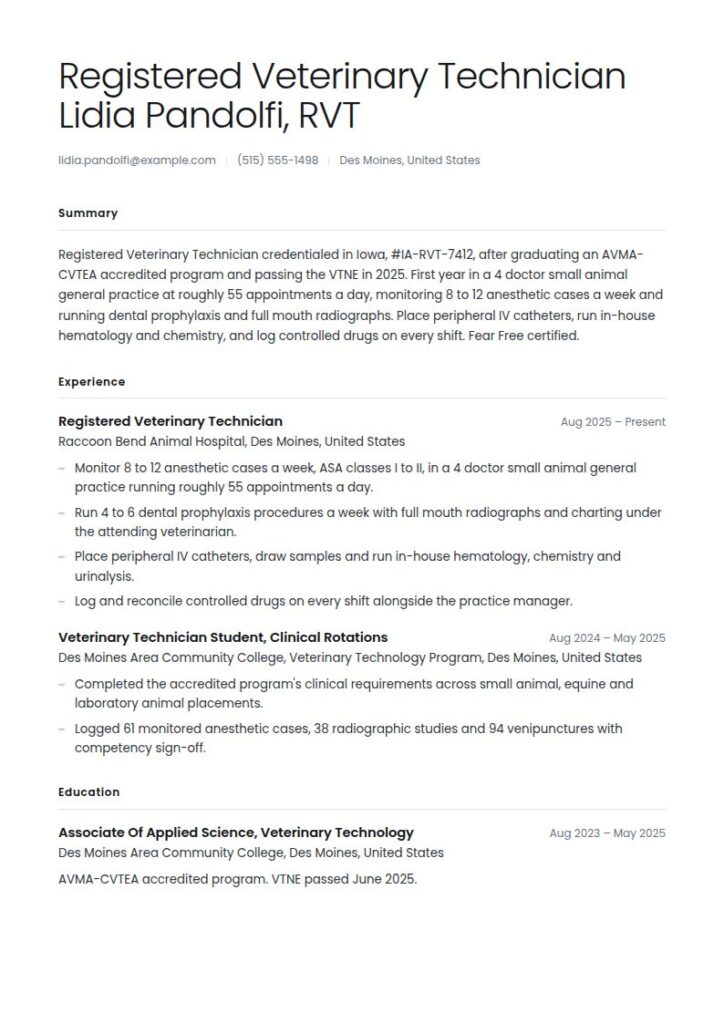
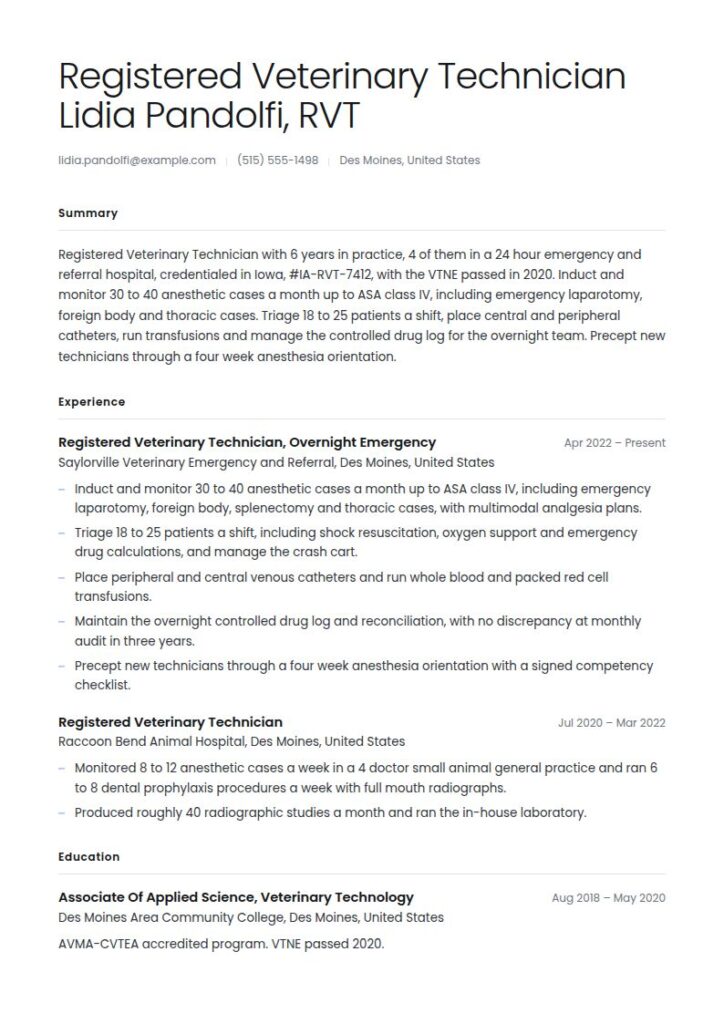
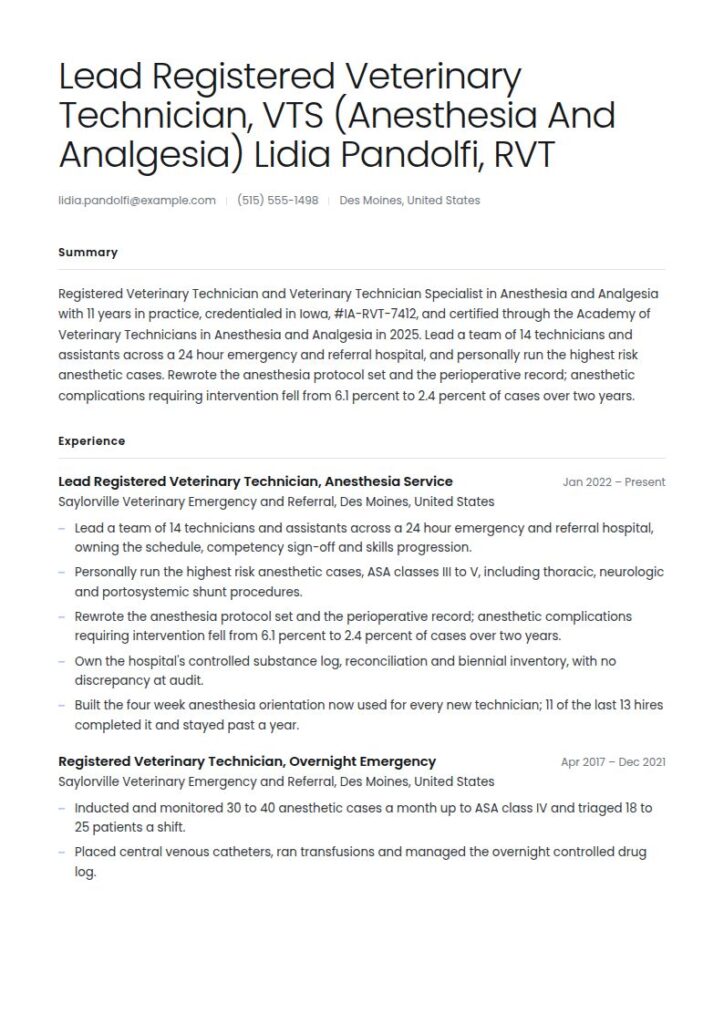
A vet tech resume is a one page document naming the credential your state issues, the national examination behind it, and a log of the procedures you have actually performed.
In fact, in most practices a credentialed technician and an uncredentialed assistant stand next to each other doing overlapping work, and a resume that says "provided patient care and assisted the veterinarian" describes both of them. Yours has to make the difference legible in ten seconds, and the way to do that is a credential line and a set of numbers.
Resume guide for a vet tech resume
Specifically, this guide and the corresponding vet tech resume example will cover:
- How to write a vet tech resume, section by section
- The credential line: RVT, LVT and CVT, and the exam behind all three
- Three adaptable summaries: newly credentialed, emergency technician and lead
- The procedure log that separates you from an assistant
- What the job market looks like and what you can expect to earn
How to write a vet tech resume
Overall, it takes five blocks: contact header with your credential initials, summary, credential and exam, experience with procedure volume, and the procedure log. In general, use one page for nearly everyone, and two only with a specialty credential and a management line.
The credential goes near the top because it is a legal gate in most states, and because it is the one thing on the page an uncredentialed applicant cannot write.
| Section | What it is answering | Where it goes |
|---|---|---|
| Credential | Is this person credentialed in my state, and current? | Header, with initials, state and number |
| National exam | Did they pass the VTNE, and by which pathway? | Credential block, with the year |
| Procedure volume | Can they induct, monitor and run a dental without me watching? | Every employer line, with counts |
Lead with the credential initials, then the volume
Your credential initials are the searched string and the fastest signal on the page. Put them next to your name: "Lidia Pandolfi, RVT" or "LVT" or "CVT", whichever your state issues.
Then write the state and number underneath, with the expiry. A practice manager verifies the registration with the state board, and the file that lets them do it in one search moves ahead of the file that does not.
Then attach volume in the first employer line: inductions a month, monitored cases, dental prophylaxis, radiographic studies, catheter placements, triage cases a shift. Volume is what distinguishes six months of technician work from six years of it, and almost nobody writes it down.
Run the finished file through the ATS resume checker first. Corporate practice groups and university hospitals parse applications into a structured record before anyone reads them.
Choosing the best resume format for a vet tech resume
Reverse chronological, one page. Practice, city, practice type, doctor count, caseload, dates, then three to five bullets that each carry a number.
A functional or skills-only format is a mistake here, because the reader is working out what you have done unsupervised and how recently. After all, a block of skill words with no employer attached reads as a list of things you have watched.
Include your contact information
| ✅ Right | ❌ Wrong |
|---|---|
| Lidia Pandolfi, RVT | Lidia Pandolfi |
| Registered Veterinary Technician, Iowa #IA-RVT-7412, current through 2027 | Certified vet tech |
| VTNE passed 2018. Emergency and anesthesia focus | Animal lover with hands-on experience |
| (515) 555-1498, [email protected], Des Moines, IA | (515) 555-1498, [email protected] |
In practice, the initials matter because titles differ by state and a reader elsewhere may not recognize yours. "Registered Veterinary Technician (RVT), Iowa" removes the ambiguity in five words.
Make use of a summary
In short, use four lines: credential and state, years and practice type, the procedure volume you carry, and one thing you own beyond your own cases.
Registered Veterinary Technician credentialed in Iowa, #IA-RVT-7412, after graduating an AVMA-CVTEA accredited program and passing the VTNE in 2025. First year in a 4 doctor small animal general practice at roughly 55 appointments a day, monitoring 8 to 12 anesthetic cases a week and running dental prophylaxis and full mouth radiographs. Place peripheral IV catheters, run in-house hematology and chemistry, and log controlled drugs on every shift. Fear Free certified.
Registered Veterinary Technician with 6 years in practice, 4 of them in a 24 hour emergency and referral hospital, credentialed in Iowa, #IA-RVT-7412, with the VTNE passed in 2020. Induct and monitor 30 to 40 anesthetic cases a month up to ASA class IV, including emergency laparotomy, foreign body and thoracic cases. Triage 18 to 25 patients a shift, place central and peripheral catheters, run transfusions and manage the controlled drug log for the overnight team. Precept new technicians through a four week anesthesia orientation.
Registered Veterinary Technician and Veterinary Technician Specialist in Anesthesia and Analgesia with 11 years in practice, credentialed in Iowa, #IA-RVT-7412, and certified through the Academy of Veterinary Technicians in Anesthesia and Analgesia in 2025. Lead a team of 14 technicians and assistants across a 24 hour emergency and referral hospital, and personally run the highest risk anesthetic cases. Rewrote the anesthesia protocol set and the perioperative record; anesthetic complications requiring intervention fell from 6.1 percent to 2.4 percent of cases over two years.
Right vs wrong: the same vet tech summary, twice
| ✅ Right | ❌ Wrong |
|---|---|
| Registered Veterinary Technician, Iowa #IA-RVT-7412, VTNE passed 2020. | Experienced vet tech with a passion for animals. |
| Induct and monitor 30 to 40 anesthetic cases a month up to ASA class IV. | Assisted veterinarians with surgical procedures and anesthesia. |
| Triage 18 to 25 patients a shift and manage the overnight controlled drug log. | Provided compassionate care in a fast-paced clinical environment. |
For example, the right column names a credential, a volume and a responsibility. The left column, however, could have been written by anyone who has worked in a practice, credentialed or not, which is exactly the problem.
Outline your clinical experience
Then list practice, city, practice type, doctor count, caseload, dates. Then bullets, each with a number attached.
| Instead of | Use |
|---|---|
| Assisted with surgeries and anesthesia | Induct and monitor 30 to 40 anesthetic cases a month up to ASA class IV, including thoracic and emergency laparotomy |
| Performed dental cleanings | Run 6 to 8 dental prophylaxis procedures a week with full mouth radiographs and charting, under the attending veterinarian |
| Took radiographs | Produce roughly 45 radiographic studies a month, including positioning for thorax, abdomen, orthopedic and dental series |
| Handled controlled substances | Maintain the overnight controlled drug log and reconciliation, with no discrepancy at monthly audit in three years |
Registered Veterinary Technician, Saylorville Veterinary Emergency and Referral, Des Moines, IA, 24 hour emergency and referral hospital, 9 doctors, overnight shift, April 2022 to Present
Induct and monitor 30 to 40 anesthetic cases a month up to ASA class IV, including emergency laparotomy, foreign body, splenectomy and thoracic cases, with multimodal analgesia plans.
Triage 18 to 25 patients a shift, including shock resuscitation, oxygen support and management of the crash cart and emergency drug calculations.
Maintain the overnight controlled drug log and reconciliation, with no discrepancy at monthly audit in three years.
Precept new technicians through a four week anesthesia orientation with a signed competency checklist.
Your vet tech credential, the VTNE behind it, and the procedure log that proves your hands
In fact, this is the block that separates a credentialed technician's resume from an assistant's. Specifically, it has three parts: the title your state issues, the examination behind it, and the log.
Start with the title, because it changes at the state line. RVT, LVT and CVT are three names for the same credentialed role, and which you hold depends on the issuing state rather than on your training. Iowa issues the title "registered veterinary technician" and requires the board-approved state examination, with a certificate of registration that "expires on December 31 of the third year of the triennium" and at least "30 hours of continuing education within the last three calendar years" (Iowa Administrative Code chapter 811-8, effective 1 July 2024). Write the title in full with its initials, the issuing state, the number and the renewal date.
The VTNE behind every vet tech credential
Then the VTNE, which is national and is not a BLS creation. The Veterinary Technician National Examination is administered by the American Association of Veterinary State Boards, and most states and provinces require a passing score before a technician can be credentialed. There are three eligibility routes: graduation from an AVMA-CVTEA or CVMA accredited program, an on-the-job training pathway in jurisdictions that allow one, and an alternate pathway that "includes non-AVMA-CVTEA accredited graduates" and varies by jurisdiction. The AAVSB is direct about the consequence: "Taking the VTNE through the OJT or Alternate Pathways may limit where you can practice" (AAVSB, VTNE eligibility pathway guidance, checked September 2026). So write the year you passed, and if you came through the accredited program route, say the program was AVMA-CVTEA accredited, because that is the route with no geographic limits attached.
Name the supervision relationship once, then move on. Your tasks are delegated: Iowa's rules describe a registered technician performing delegated tasks "under the indicated level of supervision if the supervising veterinarian has delegated the task" (Iowa Administrative Code chapter 811-8). One sentence saying which procedures you perform under direct supervision and which under indirect is enough; it shows you know where the line is without turning the resume into a statute.
If you are heading for a specialty, name the academy. The specialty route runs through academies recognized by the National Association of Veterinary Technicians in America, which lists 16: 11 with full recognition, covering emergency and critical care, dentistry, internal medicine, anesthesia and analgesia, zoological medicine, clinical practice, clinical pathology, nutrition, surgery, behavior and equine nursing, plus 5 provisionally recognized, in laboratory animal medicine, ophthalmology, dermatology, diagnostic imaging and physical rehabilitation (NAVTA, list of approved academies, checked September 2026). If you hold a Veterinary Technician Specialist credential, write the academy and the year. If you are working toward one, say which academy and where you are in the case log, because that reads as a multi-year investment rather than a hire.
The vet tech procedure log
Now the log, which is the part almost nobody writes. A procedure log turns "experienced technician" into something a reader can price. Give counts with a period of time attached, and cover six areas.
Anesthesia is the most valuable: inductions and monitored cases a month, the ASA physical status classes you have taken, the case types, and whether you build the analgesia plan or follow one. Then dentistry: prophylaxis procedures a week, full mouth radiographs, charting, extractions assisted. Similarly, imaging: studies a month and the views you position independently. Vascular access: peripheral and central catheters, transfusions, pumps. In addition, laboratory: the in-house analyzers you run, by name. And emergency volume: triage cases a shift, resuscitation, and whether you run the crash cart.
Controlled drugs deserve their own line. Federal rules require that "every inventory and other record required to be kept under this part must be kept by the registrant and be available for inspection and copying by authorized employees of the Administration, for at least 2 years", with Schedule I and II records kept separately (21 CFR 1304.04, eCFR current as of 14 September 2026). A technician who has owned that log and can say there was no discrepancy at audit is offering a practice something it worries about, in ten words.
Anesthesia: 30 to 40 monitored cases a month, ASA classes I to IV. Induction, intubation, multimodal analgesia plans, mechanical ventilation, blood pressure and capnography monitoring, recovery. Emergency laparotomy, foreign body, splenectomy, thoracic and orthopedic cases.
Dentistry: 6 to 8 prophylaxis procedures a week with full mouth radiographs and charting; assist extractions and regional blocks.
Imaging: roughly 45 radiographic studies a month. Independent positioning for thorax, abdomen, orthopedic and dental series. Assist abdominal ultrasound.
Vascular access and fluids: peripheral and central venous catheters, whole blood and packed red cell transfusions, syringe and infusion pumps, nasogastric and feeding tube care.
Laboratory: in-house hematology, chemistry, blood gas, coagulation and urinalysis; blood smear and cytology preparation.
Emergency: triage 18 to 25 patients a shift, shock resuscitation, oxygen support, crash cart management and emergency drug calculations.
Controlled substances: own the overnight log and reconciliation, no discrepancy at monthly audit in three years.
Species: canine, feline and small exotic mammals; equine handling during the program.
Build a snapshot of your key skills
Then list twelve to sixteen entries in four groups: named equipment and procedures, not adjectives.
Anesthesia and analgesia: Induction and intubation, Multimodal analgesia planning, Capnography and blood pressure monitoring, Mechanical ventilation, Locoregional block assistance, Recovery and extubation
Emergency and critical care: Triage, Shock resuscitation, Oxygen therapy, Transfusion medicine, Central venous access, Crash cart management
Diagnostics and dentistry: Digital radiography positioning, Dental radiography and charting, In-house hematology and chemistry, Blood gas and coagulation, Cytology and blood smear preparation
Operations and handling: Controlled drug logging and reconciliation, Instrument packing and autoclave logs, Low stress handling, Client education and discharge instructions
List your education and certifications
Credential first with its state and number, then the VTNE year, then the accredited program, then everything else.
Registered Veterinary Technician, Iowa Board of Veterinary Medicine, #IA-RVT-7412, current through December 2027. VTNE passed 2020. Continuing education current: 34 hours in the last three calendar years.
Veterinary Technician Specialist, Anesthesia and Analgesia, Academy of Veterinary Technicians in Anesthesia and Analgesia, 2025.
Associate of Applied Science, Veterinary Technology, Des Moines Area Community College, Des Moines, IA, 2020. AVMA-CVTEA accredited program.
Additional: Fear Free Certified Professional, 2023. Canine and feline CPR, RECOVER initiative guidelines training, 2024.
Choose the right layout and design
Finally, keep a single column, plain type at 11 or 12 point, clear headings, no photograph, no rating bars, no paw print graphics. After all, practice groups parse these into a structured record before a human opens them, and a five star rating beside "anesthesia" reads badly to a manager who has done the job.
Put your credential initials next to your name and the state and number underneath. Say the year you passed the VTNE and whether your program was AVMA-CVTEA accredited. Give the procedure log with counts and a period of time. Name the ASA classes you have monitored. Say who owned the controlled drug log. Name the in-house analyzers and the practice software. Name the academy if you hold or are pursuing a specialty.
Do not write "animal lover" anywhere. Do not describe yourself as an assistant if you are credentialed, or as a technician if you are not; the titles are legally distinct in most states. Do not claim a procedure your state requires a veterinarian to perform. Do not name a client or an individual animal. Do not let the resume imply you diagnose or prescribe. Do not pad to two pages without a specialty credential.
Vet tech job market and outlook
Indeed, this is one of the faster growing occupations here, with almost all employment in private practice.
| Measure | Value |
|---|---|
| Veterinary technologist and technician jobs, 2025 | 131,400 |
| Projected change, 2025-35 | 9 percent, much faster than average, +12,300 |
| Projected annual openings | About 13,400 |
| Typical entry-level education | Associate's degree for technicians, bachelor's for technologists |
| Median annual wage, May 2025 | $47,380, or $22.78 an hour |
Source: U.S. Bureau of Labor Statistics, Occupational Outlook Handbook, veterinary technologists and technicians, May 2025 wages and 2025-35 projections, published 27 August 2026.
Where the jobs sit:
| Setting | Share of employment | Median annual wage (May 2025) |
|---|---|---|
| Veterinary services | 89 percent | $47,170 |
| Educational services, state, local and private | 4 percent | $52,200 |
| Social advocacy organizations | 1 percent | $45,970 |
| Other personal services | 1 percent | $44,730 |
Source: U.S. Bureau of Labor Statistics, Occupational Outlook Handbook, May 2025.
Nearly half of technicians say the credential is invisible at work
In NAVTA's 2024 demographic survey, 83 percent of responding technicians held a credential, but 48 percent reported that they perceive little distinction between credentialed technicians and uncredentialed support staff, and only 36 percent felt their training was fully used. Average reported gross income was $53,759, or $32.89 an hour (NAVTA, 2024 Demographic Survey, published 3 April 2025).
That is a hiring problem and a resume problem at once. If nearly half of credentialed technicians feel the credential does not visibly change their work, a resume written in general terms will be read as interchangeable with an assistant's.
The fix is mechanical rather than rhetorical: credential initials in the header, the state and number underneath, the VTNE year in the credential block, and a procedure log with counts in place of a skills paragraph. Those four moves make a claim an uncredentialed applicant cannot make, which is the whole point of holding the credential.
What salary you can expect as a vet tech
Meanwhile, the median annual wage for veterinary technologists and technicians was $47,380, or $22.78 an hour, as of May 2025, with the lowest 10 percent below $35,710 and the highest 10 percent above $63,180 (BLS Occupational Outlook Handbook, May 2025).
Setting matters less here than in most health occupations, because 89 percent of the jobs sit in veterinary services at a median of $47,170. The exception, however, is education: 4 percent of the occupation works in educational services at a median of $52,200, roughly 11 percent above private practice (BLS, May 2025). University teaching hospitals and accredited technician programs are worth looking at for that reason alone.
Even so, within private practice, three things move an individual offer. Emergency and overnight work, because those shifts carry differentials and are the hardest to staff. The anesthesia and critical care skill set, because a technician who can induct, monitor and recover an ASA class IV patient without supervision changes what a surgeon can schedule. And a specialty credential, because a Veterinary Technician Specialist from one of the recognized academies is a small population and priced accordingly.
The ladder from here is lead technician, then technician or hospital manager, the specialty route through an academy, or teaching in an accredited program. All are awarded against documentation, so keeping the procedure log current is worth doing in the years you are not applying for anything.
Key takeaways for a vet tech resume
- Put your credential initials next to your name and the state and number underneath.
- Write the title in full, since RVT, LVT and CVT differ only by the issuing state.
- Give the VTNE year and say if your program was AVMA-CVTEA accredited.
- First, replace the skills paragraph with a procedure log carrying counts and time periods.
- Also name the ASA physical status classes you have monitored, not just "anesthesia".
- Say who owned the controlled drug log and whether audits were clean.
- Name the academy if you hold or are working toward a specialty credential.
Build your vet tech resume in 15 minutes with our AI resume builder.
Related medical resume examples
- Veterinarian resume
- Veterinary assistant resume
- Surgical tech resume
- Lab technician resume
- Lab assistant resume
- Phlebotomist resume
- Sonographer resume
- Respiratory therapist resume
- Medical technologist resume
- Pharmacy technician resume
- Medical assistant resume
- EMT resume
Pair it with a matching vet tech cover letter.
Vet tech resume questions, answered
How long should a vet tech resume be?
One page for nearly everyone. Two only with a specialty credential and a management or teaching line to go with it. Depth belongs in the procedure log, where a reader can price it, not in a second page of duties.
What is the difference between RVT, LVT and CVT?
They are different state titles for the same credentialed role: registered, licensed and certified veterinary technician. Which one you hold depends on the state that issued it. Write the full title, the initials, the issuing state and the number, because a reader in another state may not recognize your three letters.
Who administers the VTNE, and does the pathway matter?
The Veterinary Technician National Examination is administered by the American Association of Veterinary State Boards, and most states and provinces require a passing score to be credentialed. The pathway does matter: there is a route for graduates of AVMA-CVTEA or CVMA accredited programs, an on-the-job training route in jurisdictions that allow it, and an alternate pathway, and the AAVSB warns that "taking the VTNE through the OJT or Alternate Pathways may limit where you can practice" (AAVSB, checked September 2026).
Is a veterinary technician specialty worth putting on a resume?
Yes, with the academy named and the year. NAVTA recognizes 16 specialty academies, 11 fully and 5 provisionally, covering areas from emergency and critical care to anesthesia, dentistry, behavior and physical rehabilitation (NAVTA, list of approved academies, checked September 2026). It is a small population, and it is the clearest way to be read as a specialist rather than as general staff.
What do I put on a vet tech resume with no paid experience?
Your accredited program's clinical requirements, written as a job: the teaching hospital or practice, the weeks, the species, and the procedures you performed with counts, meaning inductions monitored, dentals, radiographic studies and catheters placed. Then the credential with its state and number, the VTNE year, and certificates such as Fear Free or CPR training. A new technician with a real procedure log reads as someone who can be scheduled.