Diagnostic Medical Sonographer Renata Duarte RDMS
Sonography Student, Clinical Placement
[email protected] | (813) 555-1162 | Tampa, United States
Profile
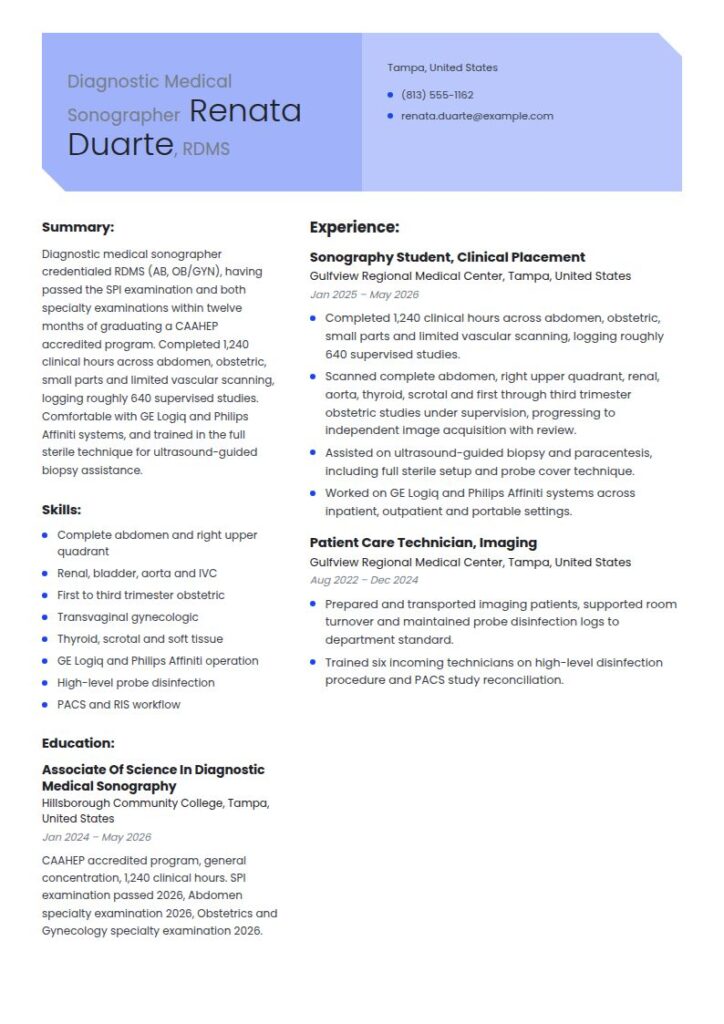
Diagnostic medical sonographer credentialed RDMS (AB, OB/GYN), having passed the SPI examination and both specialty examinations within twelve months of graduating a CAAHEP accredited program. Completed 1,240 clinical hours across abdomen, obstetric, small parts and limited vascular scanning, logging roughly 640 supervised studies. Comfortable with GE Logiq and Philips Affiniti systems, and trained in the full sterile technique for ultrasound-guided biopsy assistance.
Work Experience
01/2025 - 05/2026, Sonography Student, Clinical Placement, Gulfview Regional Medical Center, Tampa, United States
- Completed 1,240 clinical hours across abdomen, obstetric, small parts and limited vascular scanning, logging roughly 640 supervised studies.
- Scanned complete abdomen, right upper quadrant, renal, aorta, thyroid, scrotal and first through third trimester obstetric studies under supervision, progressing to independent image acquisition with review.
- Assisted on ultrasound-guided biopsy and paracentesis, including full sterile setup and probe cover technique.
- Worked on GE Logiq and Philips Affiniti systems across inpatient, outpatient and portable settings.
08/2022 - 12/2024, Patient Care Technician, Imaging, Gulfview Regional Medical Center, Tampa, United States
- Prepared and transported imaging patients, supported room turnover and maintained probe disinfection logs to department standard.
- Trained six incoming technicians on high-level disinfection procedure and PACS study reconciliation.
Education
01/2024 - 05/2026, Associate of Science, Diagnostic Medical Sonography, Hillsborough Community College, Tampa, United States
CAAHEP accredited program, general concentration, 1,240 clinical hours. SPI examination passed 2026, Abdomen specialty examination 2026, Obstetrics and Gynecology specialty examination 2026.
Skills
Complete abdomen and right upper quadrant, 80
Renal, bladder, aorta and IVC, 75
First to third trimester obstetric, 75
Transvaginal gynecologic, 70
Thyroid, scrotal and soft tissue, 75
GE Logiq and Philips Affiniti operation, 80
High-level probe disinfection, 90
PACS and RIS workflow, 75
Languages
English, native
Portuguese, native
Spanish, intermediate
Certificates
06/2026, RDMS, Registered Diagnostic Medical Sonographer, American Registry for Diagnostic Medical Sonography, D-2201947
Specialty examinations: Abdomen (AB) and Obstetrics and Gynecology (OB/GYN). SPI examination passed 2026. Annual renewal current.
02/2026, Basic Life Support Provider, American Heart Association
Summary
A sonographer resume is a one to two page document naming your registry credentials with their specialty examinations attached, the exam types you scan unassisted, and your daily study volume. This guide gives you three adaptable versions, the credential block most applicants write too vaguely, where program accreditation and state licensure actually matter, and current Bureau of Labor Statistics pay and outlook for the occupation.
Sonographer resume examples by experience level
In short, a sonographer resume is a one to two page document that names your registry credentials with their specialty examinations attached, the exam types you scan unassisted, and how many studies a day you complete.
However, that first item is more specific than most applicants write it. After all, "ARDMS registered" is not a credential. It is a registry. Instead, the credential is RDMS with a named specialty examination behind it, and the difference matters because a lead sonographer building next week's schedule is not assigning people, they are assigning lists: an abdomen list, an OB list, a vascular list, an echo room. In short, the examinations you have passed decide which list you can be put on, and nothing else on your resume changes that.
Resume guide for a sonographer resume
Overall, this guide and the corresponding sonographer resume example will cover:
- How to write a sonographer resume, section by section
- Which credentials open which exam lists, and how to write them
- Three adaptable summaries: new registrant, staff sonographer and lead
- Where program accreditation and state licensure actually matter
- What the job market looks like and what you can expect to earn
How to write a sonographer resume
First, use six blocks: contact header, summary, credentials, clinical experience, exam types and equipment, and education. One page for your first three years, two once you carry more than one registry credential or lead a section.
Credentials sit directly under the summary because they are the scheduling constraint. A manager reading your file is checking a list of exam types against a list of credentials, and everything else waits until that check clears.
| Block | The question it answers | Where it goes |
|---|---|---|
| Registry credentials | Which exam lists can this person be scheduled on? | Directly under the summary, with each specialty exam named |
| Exam types scanned | What do they scan unassisted, and how many a day? | Its own block, by modality |
| Equipment | Will they need training on our systems? | One line, by manufacturer |
| Clinical experience | What volume and setting did they carry? | Reverse chronological, with studies per day |
Write the specialty examination, not just the registry
Every registry credential in sonography is built from two examinations, and the resume that names only one of them has told the reader half the story.
ARDMS states that "to earn an RDMS, RDCS, RVT or RMSKS credential, you must pass the SPI examination and a corresponding specialty examination within five years, regardless of sequence" (ARDMS). The SPI, or Sonography Principles and Instrumentation examination, "assesses the knowledge, skills and abilities in the areas of clinical safety, physical principles, pulsed echo instrumentation, and quality assurance" (ARDMS). It is the physics half, and it is shared across credentials.
The specialty half is the one that decides your list. So write "RDMS (AB, OB/GYN), RVT", not "ARDMS certified". The first version tells a manager you can be scheduled on abdomen, obstetric and vascular work tomorrow. The second tells them to open a verification portal and find out.
Run the finished file through the ATS resume checker before you submit. After all, hospital systems parse these into a structured record before a person reads them, and credential strings are exactly the kind of text that a two-column layout mangles.
Choosing the best resume format for a sonographer resume
Reverse chronological, single column. Generally, one page for your first three years, two once you hold multiple registry credentials, cover call, or run quality assurance for a section.
However, a functional format fits poorly because currency matters here. Credentials carry renewal cycles and exam types go stale when you have not scanned them for two years, so a reader needs to see when you last worked in each modality. Consequently, a timeline that hides that invites the least generous reading.
Include your contact information
| ✅ Right | ❌ Wrong |
|---|---|
| Renata Duarte, RDMS, RVT | Renata Duarte |
| Diagnostic Medical Sonographer, Abdomen and Vascular | Dedicated imaging professional with a passion for patient care |
| RDMS (AB, OB/GYN), RVT. ARDMS #D-2201947, renewal current. | ARDMS certified, registered sonographer |
| (813) 555-1162, [email protected], Tampa, FL | (813) 555-1162, [email protected] |
Therefore, put the credential string and the registry number in the header. ARDMS runs public verification, and a manager who can confirm your credentials in a minute will call you before the applicant who made them go looking.
Make use of a summary
Specifically, write four lines: credentials with specialty examinations, years and setting, daily volume, and the exam types you cover that most applicants do not.
Diagnostic medical sonographer credentialed RDMS (AB, OB/GYN), having passed the SPI examination and both specialty examinations within twelve months of graduating a CAAHEP accredited program. Completed 1,240 clinical hours across abdomen, obstetric, small parts and limited vascular scanning, logging roughly 640 supervised studies. Comfortable with GE Logiq and Philips Affiniti systems, and trained in the full sterile technique for ultrasound-guided biopsy assistance.
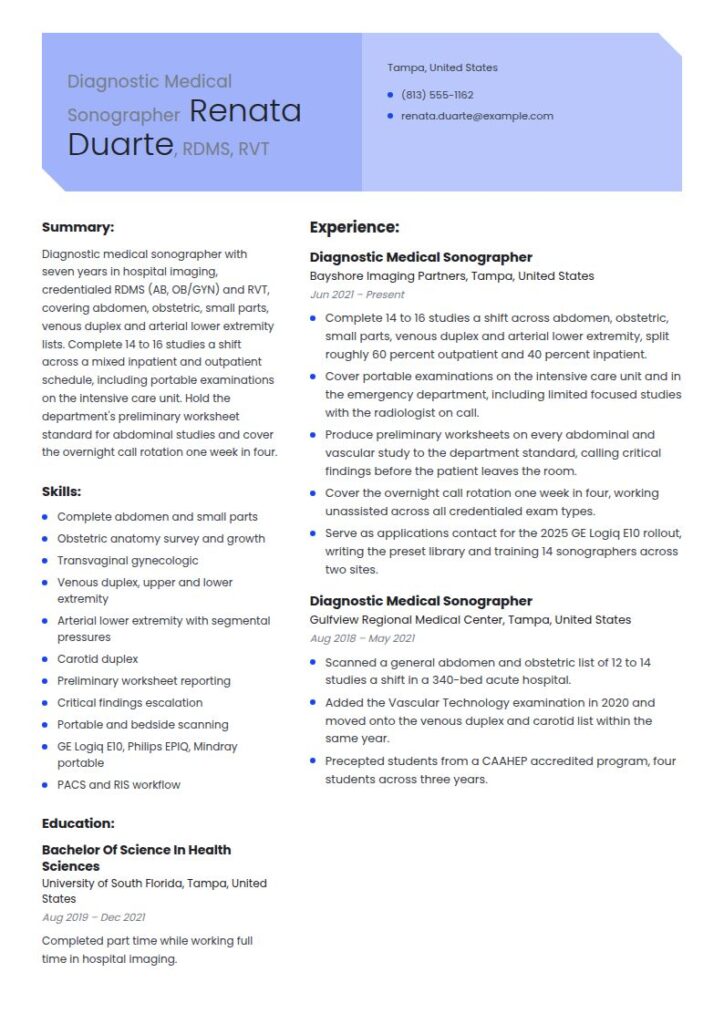
Diagnostic medical sonographer with seven years in hospital imaging, credentialed RDMS (AB, OB/GYN) and RVT, covering abdomen, obstetric, small parts, venous duplex and arterial lower extremity lists. Complete 14 to 16 studies a shift across a mixed inpatient and outpatient schedule, including portable examinations on the intensive care unit. Hold the department's preliminary worksheet standard for abdominal studies and cover the overnight call rotation one week in four.
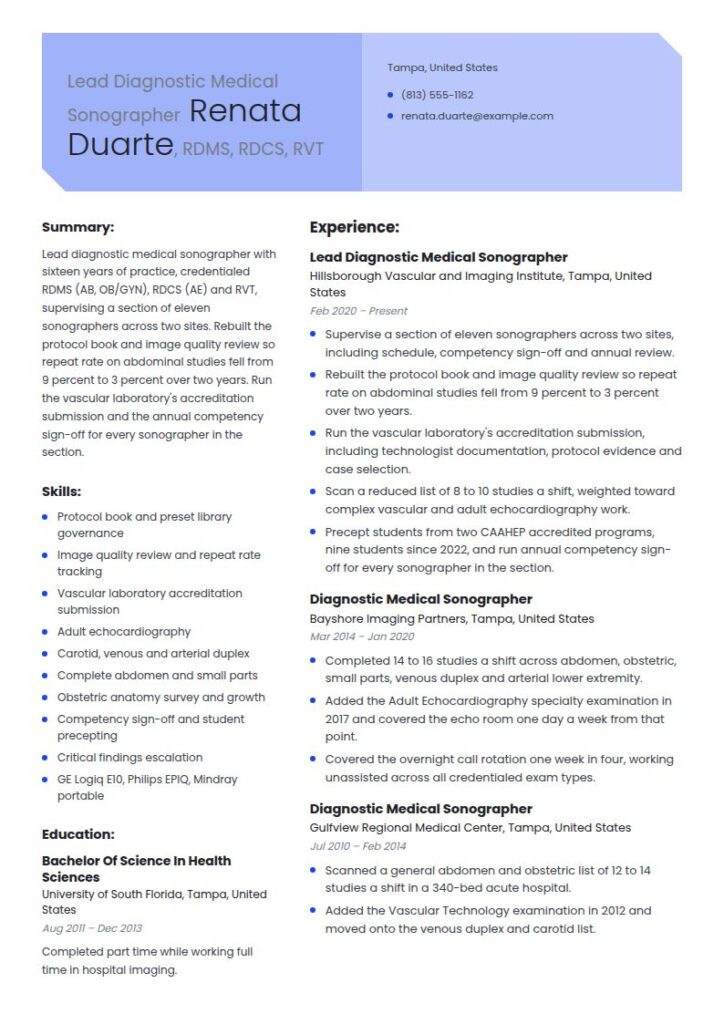
Lead diagnostic medical sonographer with sixteen years of practice, credentialed RDMS (AB, OB/GYN), RDCS (AE) and RVT, supervising a section of eleven sonographers across two sites. Rebuilt the protocol book and image quality review so repeat rate on abdominal studies fell from 9 percent to 3 percent over two years. Run the vascular laboratory's accreditation submission and the annual competency sign-off for every sonographer in the section.
Right vs wrong: the same sonographer summary, twice
| ✅ Right | ❌ Wrong |
|---|---|
| Credentialed RDMS (AB, OB/GYN) and RVT, covering abdomen, obstetric, small parts, venous duplex and arterial lower extremity lists. | Registered sonographer with experience in multiple ultrasound modalities. |
| Complete 14 to 16 studies a shift across a mixed inpatient and outpatient schedule. | Perform a high volume of quality diagnostic examinations daily. |
| Hold the department's preliminary worksheet standard for abdominal studies and cover call one week in four. | Dedicated team player committed to excellent patient care. |
The left column can be dropped into next week's schedule. On the other hand, a manager cannot schedule the right column at all until somebody asks four follow-up questions.
Outline your clinical experience
Employer, setting, city, dates, and then the shape of the work: studies per shift, exam mix, inpatient or outpatient, portable work, call. In addition, write three to five bullets, each carrying a number.
| Instead of | Use |
|---|---|
| Performed diagnostic ultrasound examinations | Complete 14 to 16 studies a shift across abdomen, OB, small parts and venous duplex, mixed inpatient and outpatient |
| Worked with radiologists | Produce preliminary worksheets on every abdominal study to the department standard, with critical findings called to the radiologist before the patient leaves |
| Used ultrasound equipment | Scan on GE Logiq E10, Philips EPIQ and Mindray portable units; lead applications contact for the 2025 Logiq rollout |
| Maintained quality standards | Cut repeat rate on abdominal studies from 9% to 3% over two years by rebuilding the protocol book and image review |
| Trained new staff | Precept students from two CAAHEP accredited programs, 9 students since 2022, and run annual competency sign-off for 11 sonographers |
Diagnostic Medical Sonographer, Bayshore Imaging Partners, Tampa, FL, June 2021 to Present
Complete 14 to 16 studies a shift across abdomen, obstetric, small parts, venous duplex and arterial lower extremity, split roughly 60 percent outpatient and 40 percent inpatient.
Cover portable examinations on the intensive care unit and the emergency department, including limited focused studies with the radiologist on call.
Produce preliminary worksheets on every abdominal and vascular study to the department standard, calling critical findings before the patient leaves the room.
Cover the overnight call rotation one week in four, working unassisted across all credentialed exam types.
Serve as applications contact for the 2025 GE Logiq E10 rollout, writing the preset library and training 14 sonographers across two sites.
Your credentials decide which exam list you can be scheduled on
Above all, this is the section that decides a sonography file, and almost every applicant writes it too loosely. The fix is to treat the credential block as a scheduling document rather than a list of achievements.
ARDMS, credential by credential. To begin with, ARDMS awards credentials in specialty areas, and each is the pairing of the shared physics examination with a named specialty examination. For example, the RDMS, Registered Diagnostic Medical Sonographer, carries the specialty examinations Abdomen (AB), Breast (BR), Fetal Echocardiography (FE), Obstetrics and Gynecology (OB/GYN) and Pediatric Sonography (PS). Likewise, the RDCS, Registered Diagnostic Cardiac Sonographer, carries Adult Echocardiography (AE), Fetal Echocardiography (FE) and Pediatric Echocardiography (PE). In addition, the RVT, Registered Vascular Technologist, is earned through the Vascular Technology (VT) examination and, as ARDMS puts it, "assesses the competency needed to perform a vascular sonography scan". Finally, the RMSKS is the musculoskeletal credential, earned through the MSKS examination. Moreover, in every case you must pass the physics examination and the specialty examination within five years of each other, in either order (ARDMS).
Therefore, that structure is why the credential line should read as a string with parentheses. In other words, RDMS (AB, OB/GYN) is three examinations, which is three lists. RDMS alone is a category.
CCI and ARRT sonographer credentials
CCI, where the credentials differ. Cardiovascular Credentialing International publishes a separate family: Registered Cardiac Sonographer (RCS), Registered Congenital Cardiac Sonographer (RCCS), Registered Vascular Specialist (RVS), Registered Phlebology Sonographer (RPhS), Advanced Cardiac Sonographer (ACS), Registered Cardiovascular Invasive Specialist (RCIS), Registered Cardiac Electrophysiology Specialist (RCES), Certified Cardiographic Technician (CCT) and Certified Rhythm Analysis Technician (CRAT) (CCI).
The eligibility structure differs too: for the RCS, CCI publishes four qualification routes, including graduation from a programmatically accredited cardiac ultrasound program, a health science degree with a year of cardiac ultrasound experience and a minimum of 600 studies performed, and a route for existing ultrasound credential holders with six months of cardiac experience and a minimum of 100 studies. Specifically, the examination itself is "a three-hour, computer-based exam that contains 170 questions", of which 150 are scored (CCI). If your credential is CCI rather than ARDMS, write it that way; the two are not interchangeable on a verification portal.
ARRT sonography. In addition, the American Registry of Radiologic Technologists offers Sonography (S) as a primary credential and Breast Sonography (BS) and Vascular Sonography (VS) as postprimary credentials, with Vascular Sonography also available through the primary pathway (ARRT). Furthermore, the primary pathway requires an associate degree or higher from an institution accredited by an agency ARRT recognizes, plus completion of an ARRT-approved educational program with documented didactic coursework and clinical competencies, and you must apply within three years of finishing the program (ARRT). Similarly, ARRT writes its credentials as R.T.(S) or R.T.(VS), and a department that already runs radiologic technologists will read that form fluently.
Sonography program accreditation and state licensure
Program accreditation, and why it appears on a resume at all. The Joint Review Committee on Education in Diagnostic Medical Sonography describes itself as "a nonprofit organization in existence to establish, maintain and promote quality standards for educational programs in Diagnostic Medical Sonography", and reviews programs for accreditation by the Commission on Accreditation of Allied Health Education Programs (JRC-DMS). In particular, accreditation is granted by concentration, and the published list is "Abdominal Sonography – Extended, Adult Cardiac Sonography, Breast Sonography, Musculoskeletal Sonography, Obstetrics and Gynecology Sonography, Pediatric Cardiac Sonography, Vascular Sonography" (JRC-DMS, Diagnostic Medical Sonography Standards).
JRC-DMS is sponsored by eight organizations, among them the American College of Cardiology, the American College of Radiology, the American Institute of Ultrasound in Medicine, the American Society of Echocardiography and the Society of Diagnostic Medical Sonography. Consequently, naming your program's accreditation and its concentration matters most early in a career, because it is what makes you eligible for the examinations in the first place.
State licensure, where it exists. However, most states do not license sonographers, and the Bureau of Labor Statistics notes only that employers may require or prefer professional certification and may require basic life support certification (BLS, Occupational Outlook Handbook). A few states do license, and where they do, they license by credential rather than by degree.
Oregon's rule is explicit: "an individual who operates ultrasound equipment for medical imaging purposes must submit evidence of current credentialing in diagnostic medical sonography from the American Registry of Diagnostic Medical Sonography (ARDMS), American Registry of Radiologic Technologists (ARRT), or Cardiac Credentialing International (CCI)" (Oregon Administrative Rules 337-010-0014, Oregon Board of Medical Imaging). Similarly, New Mexico takes the same approach and goes further by naming credentials individually: its rules list RDMS (AB), RDMS (BR), RDMS (OB), R.T.(ARRT)(S) and R.T.(ARRT)(BS) as accepted for general sonography, and (CCI)(RCS), (CCI)(RCCS) and (ARDMS)(RDCS) for cardiac (20.3.20 NMAC). If you hold or have ever held a state license, name the state and the number; if you are applying into a licensing state, say which of the three registries issued your credential, because that is the exact question the rule asks.
Keeping it current. Finally, ARDMS requires credential holders to "pay the annual renewal fee by December 31 of each year", to attest annually to its rules and compliance policies, and to earn the required continuing medical education credits within a three-year CME period (ARDMS). Therefore, put the renewal status on the page. "Renewal current, CME period closes 2027" removes a question that a credentialing office would otherwise have to ask.
Credentials: RDMS (AB, OB/GYN), ARDMS #D-2201947. RVT, ARDMS, Vascular Technology examination 2020. SPI examination passed 2018. Annual renewal current, CME period closes 2027.
Scanned unassisted: Complete abdomen, right upper quadrant, renal, aorta, small parts including thyroid, scrotal and soft tissue, first, second and third trimester obstetric, transvaginal gynecologic, venous duplex upper and lower extremity, arterial lower extremity, carotid duplex.
Assisted only: Transcranial Doppler, ultrasound-guided biopsy and paracentesis support.
Equipment: GE Logiq E10 and E9, Philips EPIQ and Affiniti, Mindray portable. Applications contact for the 2025 Logiq rollout.
Program: CAAHEP accredited, general concentration, 1,240 clinical hours.
In short, there are five blocks, and a lead sonographer can build your first week's schedule from them without a phone call.
Build a snapshot of your key skills
Similarly, list twelve to sixteen entries, grouped by exam type, technical work, and the department work that separates a staff sonographer from a lead.
Abdominal and small parts: Complete abdomen, Renal and bladder, Aorta and IVC, Thyroid and parathyroid, Scrotal and soft tissue, Appendix and bowel
Obstetric and gynecologic: First trimester dating and viability, Anatomy survey, Growth and biophysical profile, Transvaginal gynecologic, Follicle monitoring
Vascular: Venous duplex upper and lower extremity, Arterial lower extremity with segmental pressures, Carotid duplex, Dialysis access mapping
Technical and departmental: Preliminary worksheet reporting, Critical findings escalation, Protocol book and preset library management, Image quality review and repeat rate tracking, PACS and RIS workflow, Student precepting and competency sign-off
List your education and certifications
Credentials first with their examinations and numbers, then the program with its accreditation and concentration, then degree, then everything else with a date.
RDMS, Registered Diagnostic Medical Sonographer, ARDMS, #D-2201947. Specialty examinations: Abdomen 2018, Obstetrics and Gynecology 2019. SPI examination 2018.
RVT, Registered Vascular Technologist, ARDMS. Vascular Technology examination 2020. Renewal current for all credentials; CME period closes 2027.
Associate of Science, Diagnostic Medical Sonography, Hillsborough Community College, Tampa, FL, 2018. CAAHEP accredited program, general concentration, 1,240 clinical hours.
Bachelor of Science, Health Sciences, University of South Florida, Tampa, FL, 2021, completed part time while working.
Certifications: Basic Life Support, American Heart Association, current. Intersocietal Accreditation Commission vascular testing submission training, 2024.
Choose the right layout and design
Above all, use a single column, 11 or 12 point, no photograph, no skills bars. After all, hospital applicant systems parse this into a structured record, and a credential string inside a text box is a credential string the parser will lose.
Write each credential with its specialty examinations in parentheses and the registry that issued it. Give the registry number and renewal status. List exam types you scan unassisted separately from those you assist with. Give studies per shift, not "high volume". Name the equipment by manufacturer and model. Name your program's accreditation and concentration, especially in your first three years.
Do not write "ARDMS certified" and stop; it does not name a single exam list. Do not mix ARDMS and CCI credentials as if they were the same registry. Do not claim an exam type you have not scanned in three years without saying when you last did. Do not list every probe in the department as a skill. Do not use a two-column template for a hospital portal.
Sonographer job market and outlook
Overall, it is a fast-growing occupation with an associate degree entry bar and demand concentrated in hospitals.
| Measure | Value |
|---|---|
| Diagnostic medical sonographer jobs, 2025 | 92,200 |
| Projected change, 2025-35 | 14% (much faster than average) |
| Projected annual openings | About 6,000 |
| Typical entry-level education | Associate's degree |
| Median annual wage, May 2025 | $96,590, or $46.44 per hour |
Source: U.S. Bureau of Labor Statistics, Occupational Outlook Handbook, 2025-35 projections and May 2025 wage data.
The best-paid setting is the smallest one
The Bureau of Labor Statistics reports that hospitals employed 58 percent of diagnostic medical sonographers as of May 2025 at a median of $97,390, offices of physicians 21 percent at $95,220, and medical and diagnostic laboratories 11 percent at $87,580, while outpatient care centers employed 5 percent at $127,940 (BLS, Occupational Outlook Handbook, May 2025).
That outpatient figure sits roughly $30,500 above the hospital median and applies to the smallest published setting on the list. It is not a general pay rise; it reflects a narrower, higher-throughput case mix where the department is buying specific exam types rather than general coverage.
Which is the practical argument for the credential block. A department buying a specific list hires from a resume that names specific examinations, and a resume reading "registered sonographer, seven years" is not in that conversation.
Where the jobs sit:
| Setting | Share of employment | Median annual wage (May 2025) |
|---|---|---|
| Hospitals, state, local and private | 58% | $97,390 |
| Offices of physicians | 21% | $95,220 |
| Medical and diagnostic laboratories | 11% | $87,580 |
| Outpatient care centers | 5% | $127,940 |
Source: U.S. Bureau of Labor Statistics, Occupational Outlook Handbook, May 2025.
What salary you can expect as a sonographer
For instance, the median annual wage for diagnostic medical sonographers was $96,590, or $46.44 an hour, as of May 2025. The lowest 10 percent earned less than $67,820 and the highest 10 percent more than $129,370 (BLS, May 2025).
Three things move a sonographer inside that band, and all three are resume lines rather than negotiating positions. The first is credential breadth: a lead can schedule a sonographer who is RDMS (AB, OB/GYN) and RVT across more lists than one who holds a single specialty examination, which is worth real money to a manager building a rota. The second is call and off-shift coverage, which carries differentials awarded against documented independent scanning rather than willingness. Finally, the third is setting, and the table above shows how far apart those sit.
BLS projects employment to grow 14 percent between 2025 and 2035, much faster than average, with about 6,000 openings a year over the decade (BLS, Occupational Outlook Handbook, 2025-35 projections). That is a market where the constraint is credentialed supply, so the fastest route to the upper half of the band is another specialty examination rather than another year in the same room.
Key takeaways for a sonographer resume
- First, write each credential with its specialty examinations in parentheses, plus the registry and number.
- Moreover, name the registry that issued it; ARDMS, CCI and ARRT are not interchangeable.
- List exam types you scan unassisted separately from those you assist with.
- Give studies per shift and the inpatient or outpatient split.
- Name your program's accreditation and concentration, especially in your first three years.
- State renewal status and where you are in the CME period.
- If you are applying into a licensing state, say which registry credentialed you, because that is what the rule asks.
Build your sonographer resume in 15 minutes with our AI resume builder.
Related medical resume examples
- Medical technologist resume
- Surgical tech resume
- Lab technician resume
- Medical assistant resume
- Phlebotomist resume
- Respiratory therapist resume
- Nurse resume
- ICU nurse resume
- Physician assistant resume
- Clinical research coordinator resume
- Lab assistant resume
- Medical scribe resume
Furthermore, pair it with a matching sonographer cover letter.
Sonographer resume questions, answered
How long should a sonographer resume be?
One page for your first three years. Two once you hold more than one registry credential, cover call, run quality assurance, or lead a section. The credential and exam type blocks are the parts worth the extra space.
What is the difference between RDMS, RDCS and RVT?
They are three ARDMS credentials with different specialty examinations behind them. RDMS covers Abdomen, Breast, Fetal Echocardiography, Obstetrics and Gynecology, and Pediatric Sonography. RDCS covers Adult, Fetal and Pediatric Echocardiography. RVT is earned through the Vascular Technology examination. Each pairs with the SPI physics examination, which must be passed within five years of the specialty examination in either order (ARDMS).
Do I need a state license to work as a sonographer?
In most states, no. A few license the profession, and where they do they accept credentials rather than degrees: Oregon's rule requires current credentialing from ARDMS, ARRT or CCI, and New Mexico names individual credentials such as RDMS (AB) and R.T.(ARRT)(S) as qualifying. Check the state you are applying into and write your credential in the form its rule uses.
Should a new graduate list clinical hours?
Yes, with the total, the exam type breakdown and the number of supervised studies. A new registrant who writes "1,240 clinical hours, roughly 640 supervised studies, CAAHEP accredited program, general concentration" has answered the scheduling question that a manager would otherwise have to ask in an interview.
How do I show quality rather than just volume?
Use the department's own measures: repeat rate on a named exam type with a before and after, preliminary worksheet accuracy against the radiologist's report, critical findings called before the patient leaves, turnaround from study completion to images available, and accreditation submissions you contributed to. Volume shows you can work. These show your work does not have to be redone.