Medical Laboratory Technician Ezekiel Asamoah MLT(ASCP)
Medical Laboratory Technician, Night Shift
[email protected] | (585) 555-1336 | Rochester, United States
Profile
Medical laboratory technician certified by the American Society for Clinical Pathology and licensed in New York, qualified for moderate and high complexity testing, with 14 months on nights in a 240-bed community hospital core laboratory. Signed off independently on chemistry, hematology, coagulation and urinalysis, running Roche cobas c 502 and Sysmex XN-1000 across a 60 to 90 specimen night. Runs two levels of quality control each shift and works Westgard multirule evaluation before releasing a run. Completed a NAACLS-accredited associate degree program.
Work Experience
07/2025 - Present, Medical Laboratory Technician, Night Shift, Genesee Vale Hospital, Core Laboratory, Rochester, United States
- Sole technician on a 60 to 90 specimen night in a 240-bed community hospital core laboratory.
- Signed off independently on chemistry, hematology, coagulation and urinalysis; Roche cobas c 502, Sysmex XN-1000 and Stago STA Compact Max.
- Run and document two levels of quality control each shift under a Westgard multirule set, recording every rule violation and corrective action.
- Perform manual differentials and body fluid counts, and call critical results to the floor under the read-back policy.
- Hold stat turnaround inside the department target on chemistry and hematology across the last three quarters.
09/2024 - 05/2025, Clinical Laboratory Rotations, Honeoye Ridge Community College, NAACLS-accredited MLT program, Rochester, United States
- Rotated 22 weeks across chemistry, hematology, coagulation, urinalysis, microbiology and blood bank in two affiliated hospital laboratories.
- Signed off by the end of rotation on chemistry, hematology, coagulation and urinalysis.
- Completed the program's quality control, calibration verification and proficiency testing module.
06/2023 - 08/2024, Laboratory Assistant, Specimen Processing, Lakeshore Clinical Laboratory, Rochester, United States
- Accessioned, centrifuged and aliquoted roughly 700 specimens a shift for a regional reference laboratory.
- Managed courier manifests, specimen rejection logging and referral send-outs.
Education
08/2023 - 05/2025, Associate of Applied Science, Medical Laboratory Technology, Honeoye Ridge Community College, Rochester, United States
NAACLS-accredited Medical Laboratory Technician program. 22 weeks of clinical rotation across six sections.
Skills
Automated chemistry and immunoassay, 80
Automated hematology and manual differentials, 85
Coagulation testing, 75
Urinalysis and body fluid microscopy, 80
Two-level quality control and Westgard multirule evaluation, 80
Roche cobas c 502 and Sysmex XN-1000, 80
Epic Beaker laboratory information system, 75
Critical result notification and read-back, 85
Languages
English, native
Twi, native
French, intermediate
Certificates
06/2025, Medical Laboratory Technician, MLT(ASCP), American Society for Clinical Pathology, Board of Certification
Certified by Route 1: associate degree plus a NAACLS-accredited Medical Laboratory Technician program.
06/2025, Clinical Laboratory Technician license, New York State Education Department, Office of the Professions, 339417
05/2025, Basic Life Support for Healthcare Providers, American Heart Association
Current through 2027.
Summary
A lab technician resume is a one to two page document naming the CLIA complexity tier you are qualified to test at, the benches you are signed off on, the analyzers you run, and your quality control and proficiency testing record. This guide gives you three adaptable versions, the bench block almost nobody writes, and current Bureau of Labor Statistics pay and outlook.
Lab Technician resume examples by experience level
A lab technician resume is a one to two page document naming the CLIA complexity tier you are qualified to test at, the benches you have been signed off on, the analyzers you run by model, and what you do when a control fails.
In fact, a laboratory does not hire a generalist in the abstract. Instead, it hires against a schedule with a night shift short on hematology, a chemistry line nobody can troubleshoot, and a blood bank needing a second qualified person to stay staffed. As a result, the file that names its benches gets called.
Resume guide for a lab technician resume
In particular, this guide and the corresponding lab technician resume example will cover:
- First, how to write a lab technician resume, section by section
- Then what CLIA complexity means and why it belongs near the top
- Also, three adaptable summaries: new technician, generalist technologist and technical specialist
- In addition, how to write quality control, proficiency testing and Westgard rules as evidence
- Finally, what the job market looks like and what Bureau of Labor Statistics pay data shows
How to write a lab technician resume
Use six blocks: contact header, summary, certification and state license, bench and complexity, laboratory experience, and finally education. Use one page for your first five years, then two once you carry a technical specialist role or own a section's quality control.
In practice, the order follows how a laboratory manager reads. Certification and complexity come first because they are personnel standards, not preferences. The bench list comes second, because it is the only thing telling a supervisor which holes in the schedule you close.
| Section | What it is answering | Where it goes |
|---|---|---|
| Certification and state license | Does this person meet the personnel standard for our testing? | Under the summary, with numbers |
| Complexity tier | Waived, moderate or high | In the summary and the bench block |
| Bench sign-off | Which sections can I schedule them on unsupervised? | Its own block, not buried in bullets |
| Analyzers | Which instruments, by manufacturer and model | Named list in the bench block |
| Quality control | What do they do when a control fails? | One example with the rule and the outcome |
Write the bench list as a sign-off list, not a skills list
There is a difference between "experience in hematology" and "signed off on the hematology bench, independent on differentials and body fluids, Sysmex XN-1000". Only the second goes on a schedule.
Laboratories keep competency records per person per bench, because nonwaived testing carries personnel standards under the CLIA regulations at 42 CFR part 493 subpart M (Centers for Disease Control and Prevention, checked September 2026). Your sign-offs are documented facts, not claims.
So write them as facts: the bench, whether you are independent or supervised, the shift you covered it on, and the instrument by model. A supervisor reading that can put you on a rota before the interview.
Run the finished file through the ATS resume checker first. Hospital systems and national laboratory companies screen these through an applicant tracking system.
Choosing the best resume format for a lab technician resume
Reverse chronological, single column. In other words, one page for your first five years, two once you are a technical specialist, own a section's quality control, or have validated a method.
However, laboratory careers have one format quirk worth handling. Many technicians move inside one employer rather than between employers: two years on nights as a generalist, then chemistry days, then a lead role. For example, one employer heading with a flat bullet list hides the progression, which is the best thing about the file.
Instead, give each internal move its own dated heading under the one employer. After all, three headings under "Genesee Vale Hospital, 2016 to present" reads as a career; one heading with eleven bullets reads as a long shift.
Include your contact information
| ✅ Right | ❌ Wrong |
|---|---|
| Ezekiel Asamoah | Ezekiel Asamoah |
| Medical Laboratory Scientist, MLS(ASCP) | Experienced lab professional |
| NY Clinical Laboratory Technologist #078244 | Licensed laboratory technologist |
| (585) 555-1336, [email protected], Rochester, NY | (585) 555-1336, [email protected] |
Also put the license number on the page where your state licenses laboratory personnel. For instance, New York licenses clinical laboratory technologists and clinical laboratory technicians through the State Education Department's Office of the Professions (New York State Education Department, checked September 2026), and human resources verifies it before your start date.
Make use of a summary
Keep it to four lines: credential and complexity, benches and shift, one quality number, and also the platform you know best.
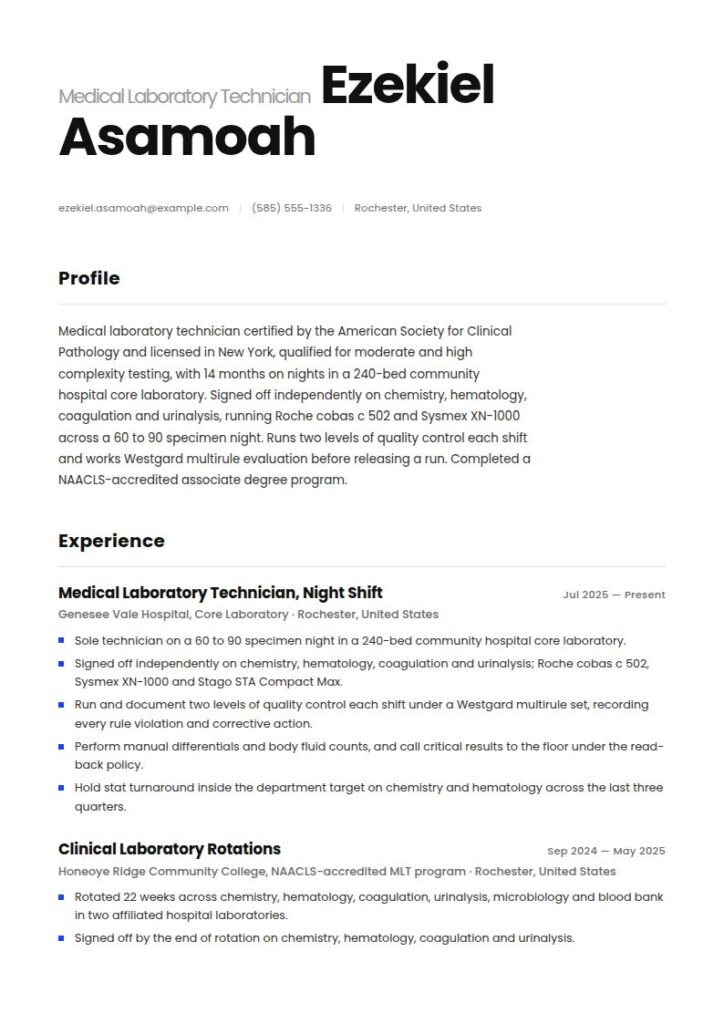
Medical laboratory technician certified by the American Society for Clinical Pathology and licensed in New York, qualified for moderate and high complexity testing, with 14 months on nights in a 240-bed community hospital core laboratory. Signed off independently on chemistry, hematology, coagulation and urinalysis, running Roche cobas c 502 and Sysmex XN-1000 across a 60 to 90 specimen night. Runs two levels of quality control each shift and works Westgard multirule evaluation before releasing a run. Completed a NAACLS-accredited associate degree program.
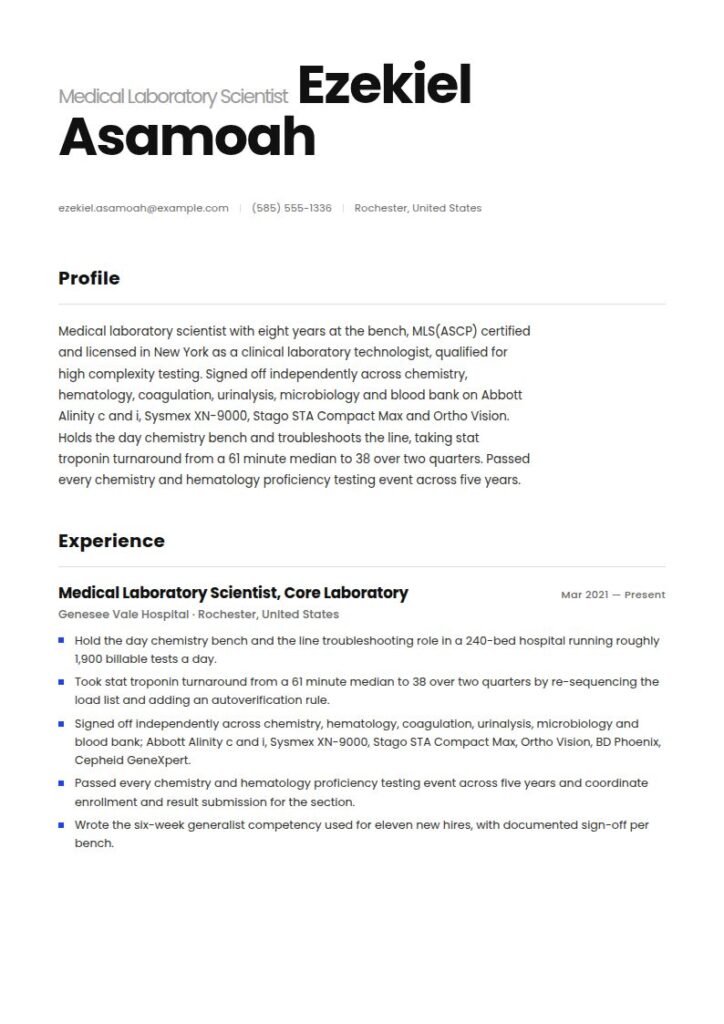
Medical laboratory scientist with eight years at the bench, MLS(ASCP) certified and licensed in New York as a clinical laboratory technologist, qualified for high complexity testing. Signed off independently across chemistry, hematology, coagulation, urinalysis, microbiology and blood bank on Abbott Alinity c and i, Sysmex XN-9000, Stago STA Compact Max and Ortho Vision. Holds the day chemistry bench and troubleshoots the line, taking stat troponin turnaround from a 61 minute median to 38 over two quarters. Passed every chemistry and hematology proficiency testing event across five years.
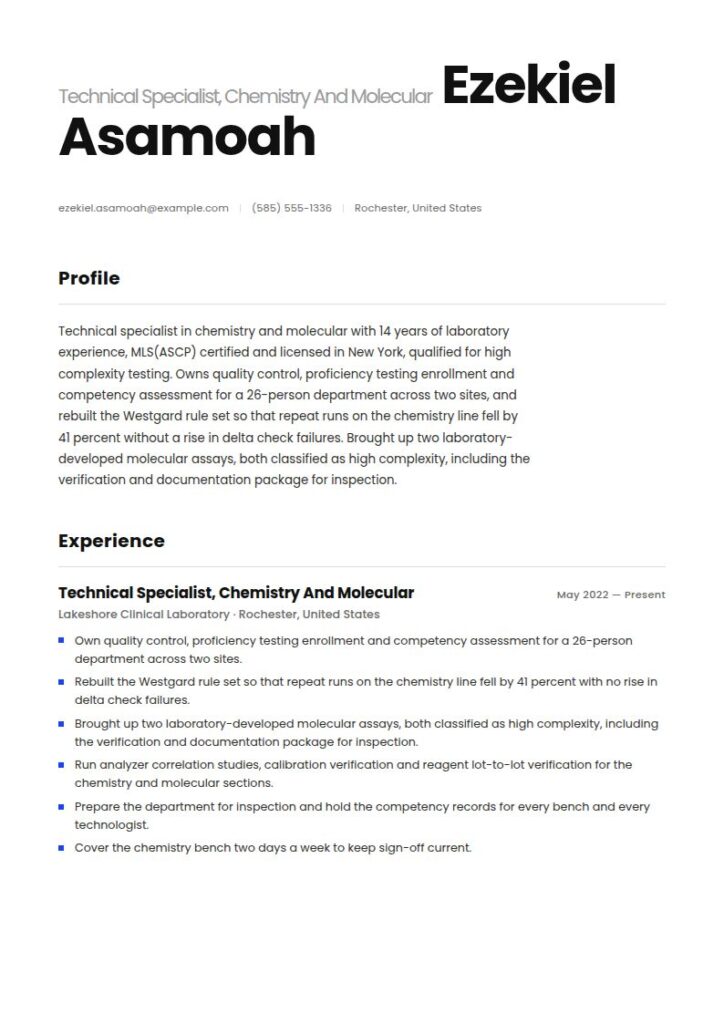
Technical specialist in chemistry and molecular with 14 years of laboratory experience, MLS(ASCP) certified and licensed in New York, qualified for high complexity testing. Owns quality control, proficiency testing enrollment and competency assessment for a 26-person department across two sites, and rebuilt the Westgard rule set so that repeat runs on the chemistry line fell by 41 percent without a rise in delta check failures. Brought up two laboratory-developed molecular assays, both classified as high complexity, including the verification and documentation package for inspection.
Right vs wrong: the same lab technician summary, twice
| ✅ Right | ❌ Wrong |
|---|---|
| MLS(ASCP) certified, licensed in New York, qualified for high complexity testing. | Experienced laboratory professional with a strong scientific background. |
| Signed off independently on chemistry, hematology, coagulation, urinalysis, microbiology and blood bank. | Skilled in a wide range of laboratory testing procedures. |
| Took stat troponin turnaround from a 61 minute median to 38 over two quarters. | Committed to accuracy and quality in all laboratory work. |
The left column, for example, can be scheduled on a bench tomorrow. The right column, on the other hand, is every other file in the folder.
Outline your laboratory experience
Employer, site type, department, shift and dates, then a scope line: bed count or specimen volume, sections covered, platforms in use. Then three to five bullets, each carrying a number.
| Instead of | Use |
|---|---|
| Performed laboratory tests on patient samples | Ran 60 to 90 specimens a night across chemistry, hematology, coagulation and urinalysis as the sole technician on shift |
| Followed quality control procedures | Ran two levels of control each shift with Westgard multirule evaluation, documenting every violation and corrective action |
| Helped reduce turnaround times | Took stat troponin turnaround from a 61 minute median to 38 over two quarters by re-sequencing the load list and adding an autoverification rule |
Medical Laboratory Scientist, Core Laboratory, Genesee Vale Hospital, Rochester, NY, March 2021 to Present
240-bed community hospital running roughly 1,900 billable tests a day across chemistry, hematology, coagulation, urinalysis, microbiology and blood bank. Abbott Alinity c and i, Sysmex XN-9000, Stago STA Compact Max, Ortho Vision, BD Phoenix, Cepheid GeneXpert.
Hold the day chemistry bench and the line troubleshooting role; took stat troponin turnaround from a 61 minute median to 38 over two quarters.
Run two levels of quality control per shift under a Westgard multirule set and write the corrective action record when a rule is violated; passed every chemistry and hematology proficiency testing event across five years, and coordinate enrollment and submission for the section.
Cross-signed on blood bank; perform ABO and D typing, antibody screens and crossmatching, and wrote the six-week generalist competency used for eleven new hires.
Name your CLIA complexity tier and the benches you are signed off on
In short, this is the block that decides between two certified applicants, and the one most laboratory resumes replace with the word "generalist".
Complexity is a regulatory category, not a description. Under the Clinical Laboratory Improvement Amendments there are three categories of test: waived, moderate complexity and high complexity (Centers for Disease Control and Prevention, CLIA test complexities, checked September 2026). Waived tests are "simple tests with a low risk for an incorrect result", and sites performing only waived testing must hold a CLIA certificate and follow the manufacturer's instructions, with other CLIA requirements not applying. Nonwaived laboratories need a certificate, must be inspected and must meet the CLIA quality standards (CDC, checked September 2026).
Laboratory-developed tests default to high. Tests developed by the laboratory, or modified from the approved manufacturer's instructions, default to high complexity (CDC, checked September 2026). If you have worked on one, that is a high complexity line with a regulatory basis behind it, so name the assay and your part in the verification.
Why it belongs near the top. Personnel standards for nonwaived testing sit at 42 CFR part 493 subpart M, and a supervisor is checking whether you meet the standard for the testing their certificate covers before anything else. "Qualified for moderate and high complexity testing" saves them the inference.
Bench sign-offs, quality control and proficiency testing
The bench sign-off list. Write each section, say whether you are independent or supervised, and name the platform. Seven sections cover nearly every laboratory: chemistry, hematology, coagulation, urinalysis and body fluids, microbiology, immunohematology or blood bank, and molecular. Say which you hold and which you do not. Honesty here reads as competence, because a supervisor knows nobody holds all seven.
Quality control, Westgard and proficiency testing. Quality control is where a technician's judgment shows. The Westgard multirule procedure, published by James O. Westgard and colleagues in Clinical Chemistry in 1981, combines rules such as 1:3s and R:4s, which detect random error, with 2:2s, 4:1s and 10:x, which detect systematic error and drift (Westgard QC, checked September 2026). Write one concrete example: the rule that flagged, what you found, what you did.
Proficiency testing is the external check. Nonwaived laboratories must enroll in an approved program for each specialty and subspecialty and must test the samples in the same manner as patient specimens; for most specialties, failing to attain an overall event score of at least 80 percent is unsatisfactory performance, and ABO and D typing in immunohematology requires 100 percent acceptable responses (42 CFR part 493 subpart H, current as checked September 2026). If you coordinate enrollment, handle submission or have written a corrective action after a graded failure, say so. That is a supervisory line in disguise.
MLT or MLS: which credential question you are answering
Specifically, the ASCP Board of Certification separates the two. An MLT(ASCP) "collects, processes, and performs routine laboratory tests in blood banking, chemistry, hematology, immunology, microbiology, molecular biology, and/or urinalysis on biologic specimens", and the main route is an associate degree or 60 semester hours plus a NAACLS or ABHES-accredited Medical Laboratory Technician program completed within the last five years. In contrast, an MLS(ASCP) conducts "a full range of laboratory tests, from routine to complex" across the same disciplines (ASCP Board of Certification, checked September 2026).
The MLS routes matter if you are planning the next step:
| Route | What it requires |
|---|---|
| Route 1 | Bachelor's degree plus a NAACLS-accredited Medical Laboratory Scientist program completed within the last five years |
| Route 2 | A valid MLT(ASCP) plus a bachelor's degree with specified chemistry and biology coursework and two years of full-time acceptable clinical experience |
| Route 4 | Bachelor's degree with specified chemistry and biology coursework plus five years of full-time acceptable clinical experience |
Source: ASCP Board of Certification, Medical Laboratory Scientist, checked September 2026.
If you are an MLT working toward MLS by Route 2, put it on the page with the date you expect to sit the examination. Therefore, a laboratory planning staffing two years out reads that as a retention argument.
Qualified for moderate and high complexity testing under 42 CFR part 493 subpart M
Chemistry: independent, day and night. Abbott Alinity c and i; previously Roche cobas c 502 and e 801. Line troubleshooting.
Hematology: independent. Sysmex XN-9000 and XN-1000, manual differentials, body fluid counts.
Coagulation: independent. Stago STA Compact Max, including mixing studies.
Urinalysis and body fluids: independent, automated and manual microscopy.
Microbiology: independent on setup, plate reading and Gram stains. BD Phoenix, BACTEC blood culture.
Immunohematology: independent on ABO and D typing, antibody screen and crossmatch. Ortho Vision. Not signed off on antibody identification panels.
Molecular: independent. Cepheid GeneXpert; verification work on two laboratory-developed assays classified as high complexity.
Build a snapshot of your key skills
In practice, use four groups: bench and analytical, quality and compliance, information systems, instrument work. Named methods and named instruments only.
Bench and analytical: chemistry and immunoassay, automated and manual hematology, manual differentials, coagulation including mixing studies, urinalysis and body fluid microscopy, Gram stain and plate reading, ABO and D typing, antibody screen and crossmatch
Quality and compliance: two-level quality control, Westgard multirule evaluation, Levey-Jennings review, delta checks, proficiency testing enrollment and submission, corrective action documentation, competency assessment, inspection readiness
Information systems: Epic Beaker, Sunquest, Cerner Millennium laboratory modules, middleware autoverification rules, instrument interfacing
Instrument work: calibration and calibration verification, maintenance schedules, analyzer correlation studies, reagent lot-to-lot verification, method verification documentation
List your education and certifications
Degree and program accreditation first, then the ASCP credential, then the state license, then continuing education.
Bachelor of Science, Clinical Laboratory Science, 2020
Associate of Applied Science, Medical Laboratory Technology, NAACLS-accredited program, Honeoye Ridge Community College, Rochester, NY, 2016
Medical Laboratory Scientist, MLS(ASCP), American Society for Clinical Pathology, certified 2021 by Route 2
Medical Laboratory Technician, MLT(ASCP), certified 2016
New York Clinical Laboratory Technologist license #078244, New York State Education Department, Office of the Professions, current. Clinical Laboratory Technician license #339417, 2016.
Continuing education: method verification and correlation studies, 2025; antibody identification, 2024
Similarly, name the accreditation on the program line. Indeed, it is the first thing a certification route check confirms, and it costs you seven characters.
Choose the right layout and design
Above all, use a single column, 11 or 12 point, clear headings, and no photograph. After all, bench lists and instrument model strings are the content most likely to break in a two-column template, and the content the laboratory is reading for.
State the complexity tier you are qualified for. Write the bench list as sign-offs, marked independent or supervised. Name instruments by manufacturer and model. Give one quality control example with the rule, the finding and the action. Say whether you coordinate proficiency testing. Put internal moves under one employer as separate dated headings. Include your state license number where laboratory personnel are licensed.
Do not write "generalist" and stop; name the sections. Do not claim a bench you have not been signed off on, because competency records are checked. Do not list an instrument you have only seen demonstrated. Do not describe a patient or an identifiable result.
Lab technician job market and outlook
Overall, it is a steady occupation with heavy replacement demand, concentrated in hospitals and reference laboratories.
| Measure | Value |
|---|---|
| Clinical laboratory technologist and technician jobs, 2025 | 343,000 |
| Projected employment, 2035 | 352,400 |
| Projected change, 2025-35 | 3 percent, +9,400 |
| Projected annual openings | About 20,800 |
| Typical entry-level education | Bachelor's degree |
| Median annual wage, May 2025 | $62,930 ($30.26 per hour) |
Source: U.S. Bureau of Labor Statistics, Occupational Outlook Handbook, Clinical Laboratory Technologists and Technicians, 2025 to 2035 projections and May 2025 wage data.
Twenty thousand openings a year against 3 percent growth
BLS projects about 20,800 openings a year for clinical laboratory technologists and technicians over the 2025 to 2035 decade, against growth of only 3 percent, from 343,000 jobs in 2025 to a projected 352,400 (BLS Occupational Outlook Handbook, 2025 to 2035 projections).
Openings at roughly one in sixteen of the occupation a year, against flat growth, means replacement hiring: retirements, moves between hospitals, people leaving the bench for industry or education.
That rewards a specific kind of resume. Nobody is building a new department around you, so the question is narrow: which bench, which shift, starting when. A file answering that in its first six lines is doing the only job it has.
Where the jobs sit:
| Setting | Share of employment | Median annual wage (May 2025) |
|---|---|---|
| General medical and surgical hospitals; private | 36% | $69,190 |
| Medical and diagnostic laboratories | 19% | $58,320 |
| Offices of physicians | 10% | $56,850 |
| Educational services; state, local, and private | 4% | $63,690 |
| Other ambulatory healthcare services | 4% | $48,140 |
Source: U.S. Bureau of Labor Statistics, May 2025.
What salary you can expect as a lab technician
Meanwhile, the median annual wage for clinical laboratory technologists and technicians was $62,930, or $30.26 an hour, as of May 2025. The lowest 10 percent earned less than $38,910 and the highest 10 percent more than $100,990 (BLS Occupational Outlook Handbook, May 2025). However, BLS publishes one median for the combined occupation and does not split technologists from technicians on that page.
The industry spread is wide: $69,190 in private general medical and surgical hospitals against $48,140 in other ambulatory healthcare services (BLS, May 2025), more than $21,000 across the published table. Where you work is a bigger lever here than in most healthcare roles.
Even so, inside a site, what moves pay is all things a resume can carry:
- Shift. Nights, evenings and weekend rotations carry differentials, and the night generalist is the hardest position in most laboratories to fill.
- Breadth of sign-off. Somebody independent on five benches can be scheduled where somebody independent on two cannot, and that is what lead and technical specialist postings screen for.
- Blood bank. Immunohematology carries the tightest proficiency requirements, including 100 percent acceptable responses for ABO and D typing, and staffing it is consistently scarce.
- Molecular and specialty sections. Laboratory-developed tests default to high complexity, and the people who can verify and document them are a small group.
- Quality ownership. Proficiency testing enrollment, competency assessment and inspection readiness is the practical route from bench to supervisor.
Key takeaways for a lab technician resume
- First, state the CLIA complexity tier you are qualified to test at, near the top.
- Write the bench list as sign-offs, marked independent or supervised.
- Then name every analyzer by manufacturer and model.
- Finally, give one quality control example: the rule, the finding, the action.
- Say whether you handle proficiency testing enrollment and corrective actions.
- Put internal moves under one employer as separate dated headings.
Build your lab technician resume in 15 minutes with our AI resume builder.
Related medical resume examples
- Medical technologist resume
- Lab assistant resume
- Phlebotomist resume
- Chemist resume
- Clinical research coordinator resume
- Epidemiologist resume
- Pharmacy technician resume
- Medical assistant resume
- Sonographer resume
- Respiratory therapist resume
- Healthcare resume
- Medical resume
Pair it with a matching lab technician cover letter.
Lab technician resume questions, answered
How long should a lab technician resume be?
One page for your first five years. Two once you are a technical specialist, own a section's quality control, have validated a method, or hold sign-offs across five or more benches with the instruments named. If the bench block is what pushed you to two pages, that is the right reason.
What is CLIA complexity and why does it belong on my resume?
CLIA sorts tests into three categories: waived, moderate complexity and high complexity. Laboratories performing moderate or high complexity testing must hold a CLIA certificate, be inspected and meet the CLIA quality standards (CDC, checked September 2026). Personnel standards for that nonwaived testing sit at 42 CFR part 493 subpart M, so the tier you are qualified for is the first thing a supervisor checks.
Should I list MLT or MLS, and how do I move between them?
List whichever you hold, with the parenthetical the ASCP Board of Certification uses. The main MLT route is an associate degree or 60 semester hours plus a NAACLS or ABHES-accredited technician program completed within the last five years. For MLS, Route 2 is a valid MLT(ASCP) plus a bachelor's degree with specified chemistry and biology coursework and two years of full-time acceptable clinical experience (ASCP Board of Certification, checked September 2026). If you are working toward it, give your expected examination date.
What do I put on a lab technician resume with no experience?
Write the clinical rotations as jobs: the site, the weeks, the sections rotated through, the instruments you ran, the specimen volume, and what you were signed off on by the end. Then the program with its NAACLS accreditation, the certification with its date, and your state license if you have one. A new technician who can cover a night generalist shift is a straightforward hire in an occupation with about 20,800 openings a year (BLS Occupational Outlook Handbook, 2025 to 2035 projections).
Do I need a state license to work as a lab technician?
It depends on the state. Some license clinical laboratory personnel and some do not. New York licenses clinical laboratory technologists and technicians through the State Education Department's Office of the Professions (New York State Education Department, checked September 2026). Check your own state before you apply, and put the license number on the page where one exists.