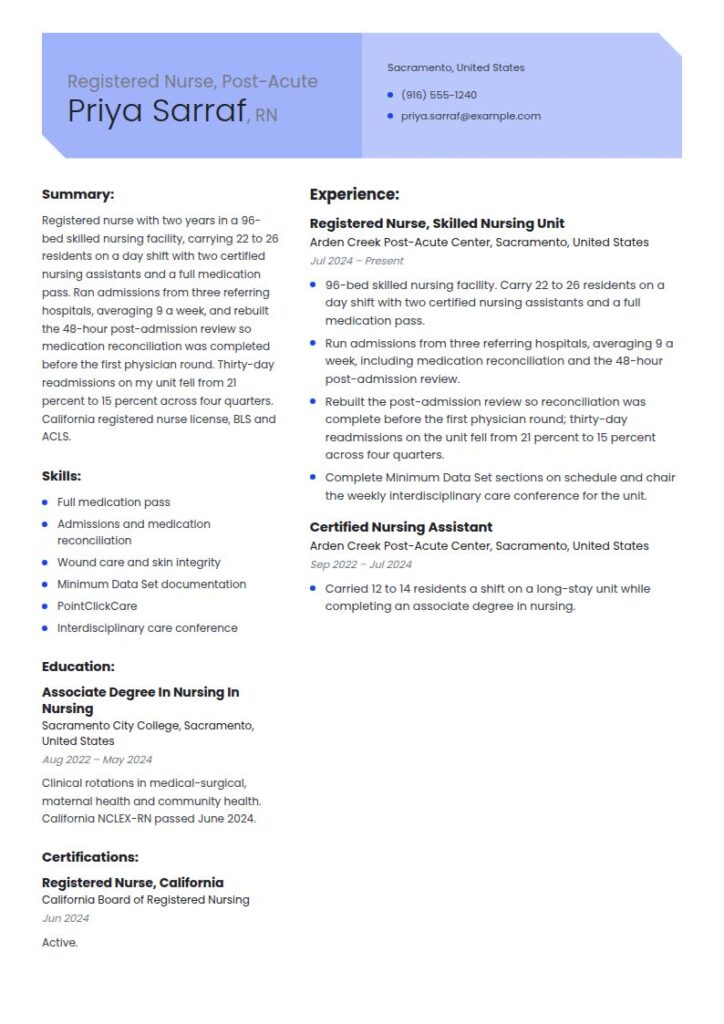
Registered Nurse, Post-Acute Priya Sarraf RN
Registered Nurse, Skilled Nursing Unit
[email protected] | (916) 555-1240 | Sacramento, United States
Profile
Registered nurse with two years in a 96-bed skilled nursing facility, carrying 22 to 26 residents on a day shift with two certified nursing assistants and a full medication pass. Ran admissions from three referring hospitals, averaging 9 a week, and rebuilt the 48-hour post-admission review so medication reconciliation was completed before the first physician round. Thirty-day readmissions on my unit fell from 21 percent to 15 percent across four quarters. California registered nurse license, BLS and ACLS.
Work Experience
07/2024 - Present, Registered Nurse, Skilled Nursing Unit, Arden Creek Post-Acute Center, Sacramento, United States
- 96-bed skilled nursing facility. Carry 22 to 26 residents on a day shift with two certified nursing assistants and a full medication pass.
- Run admissions from three referring hospitals, averaging 9 a week, including medication reconciliation and the 48-hour post-admission review.
- Rebuilt the post-admission review so reconciliation was complete before the first physician round; thirty-day readmissions on the unit fell from 21 percent to 15 percent across four quarters.
- Complete Minimum Data Set sections on schedule and chair the weekly interdisciplinary care conference for the unit.
09/2022 - 07/2024, Certified Nursing Assistant, Arden Creek Post-Acute Center, Sacramento, United States
- Carried 12 to 14 residents a shift on a long-stay unit while completing an associate degree in nursing.
Education
08/2022 - 05/2024, Associate Degree in Nursing, Nursing, Sacramento City College, Sacramento, United States
Clinical rotations in medical-surgical, maternal health and community health. California NCLEX-RN passed June 2024.
Skills
Full medication pass, 85
Admissions and medication reconciliation, 80
Wound care and skin integrity, 75
Minimum Data Set documentation, 70
PointClickCare, 80
Interdisciplinary care conference, 70
Languages
English, native
Hindi, native
Spanish, intermediate
Certificates
06/2024, Registered Nurse, California, California Board of Registered Nursing, RN-6612430
Active.
06/2024, BLS and ACLS, American Heart Association
Summary
A healthcare resume is a one to two page document naming the settings you have worked in, the acuity you carried in each, and the volume that went with it. Setting is the first filter a healthcare manager applies, so this guide shows you how to write a setting and acuity block, with three adaptable summaries and current Bureau of Labor Statistics pay by industry across the sector.
Healthcare resume examples by experience level
In short, a healthcare resume is a one to two page document that names the settings you have worked in, the acuity you carried in each of them, and the volume that came with it.
Healthcare is not one labor market. It is five of them, stacked by how sick the patient is and how fast decisions have to be made, and a manager reading your file asks one question before any other: has this person done this work in a place like mine. Two candidates with identical titles and credentials get opposite answers, because one spent three years on a telemetry floor and the other spent three years in a clinic.
However, the Bureau of Labor Statistics does not publish one figure for the sector. It publishes two bands: healthcare practitioners and technical occupations at a median annual wage of $86,530 in May 2025, and healthcare support occupations at $38,340, against $50,980 for all occupations, with about 1.9 million openings projected each year on average across healthcare occupations (BLS Occupational Outlook Handbook, Healthcare Occupations, last modified 27 August 2026).
In particular, the worked examples follow one nursing career across three settings, the shape most healthcare careers take.
Resume guide for a healthcare resume
To that end, this guide and the corresponding healthcare resume example will cover:
- To begin with, how to write a healthcare resume, section by section
- Then, the five settings in the sector, and what each screens for
- Also, three adaptable summaries: post-acute, acute inpatient and ambulatory
- In addition, how to move between settings without the file reading as a downgrade
- Finally, where the jobs sit, using BLS industry shares
How to write a healthcare resume
Overall, six blocks: contact header, summary, setting and acuity, experience with volumes, skills, and education with licensure. One page for your first five years, two once you have results in more than one setting.
The order is deliberate. Setting sits above experience because it is the filter, and the reader would rather learn in line four that you have never worked their acuity than in the second interview.
| Block | What it is answering | Where it goes |
|---|---|---|
| Setting and acuity | Has this person worked anywhere like here? | Directly under the summary |
| Experience | What volume did they carry, on what unit, for how long? | Reverse chronological, volume in the header line |
| Skills | Which of my equipment, populations and systems do they know? | Grouped by setting, not by hard and soft |
| Education and licensure | Are they licensed in my state? | Short, at the foot |
Name the setting, not only the employer
An employer name is information only to people who already know the building. A reader two counties away has no idea whether Delta Vista Medical Center is a 40-bed critical access hospital or a 600-bed teaching center, and will not look it up.
Write the setting into the header line: "Delta Vista Medical Center, 412-bed acute care hospital, 36-bed telemetry and medical unit". Three facts, and the reader knows your acuity, your unit size and the kind of organization you worked inside.
The same holds elsewhere. "Federally qualified health center, 14 sites, 61,000 patients" describes a job. The employer name alone describes nothing.
Before you submit, put the file through the ATS resume checker. Health systems parse your file into a structured record, and setting keywords are part of what they index.
Choosing the best resume format for a healthcare resume
Reverse chronological, single column, plain type. Two pages once you can show results in more than one setting; one page until then.
Functional formats fail here because setting history is chronological by nature, and hiding the sequence hides the thing the reader is trying to establish. Moves between settings are normal; even so, label them as deliberate rather than leave them to look like drift. "Moved from acute inpatient to ambulatory care to build chronic disease management experience" costs six words and removes a question the manager would otherwise raise.
Include your contact information
| ✅ Right | ❌ Wrong |
|---|---|
| Priya Sarraf, BSN, RN | Priya Sarraf |
| Ambulatory Care and Population Health Nurse | Registered nurse seeking a challenging position |
| Acute inpatient, post-acute and community settings | Various healthcare settings |
| (916) 555-1240, [email protected], Sacramento, CA | (916) 555-1240, [email protected] |
However, line three is the one almost nobody writes, even though it is the fastest summary of your candidacy that exists.
Make use of a summary
In effect, four lines: your role, the setting and its size, the ratio or volume you carried, and one measured result.
Registered nurse with two years in a 96-bed skilled nursing facility, carrying 22 to 26 residents on a day shift with two certified nursing assistants and a full medication pass. Ran admissions from three referring hospitals, averaging 9 a week, and rebuilt the 48-hour post-admission review so medication reconciliation was completed before the first physician round. Thirty-day readmissions on my unit fell from 21 percent to 15 percent across four quarters. California registered nurse license, BLS and ACLS.
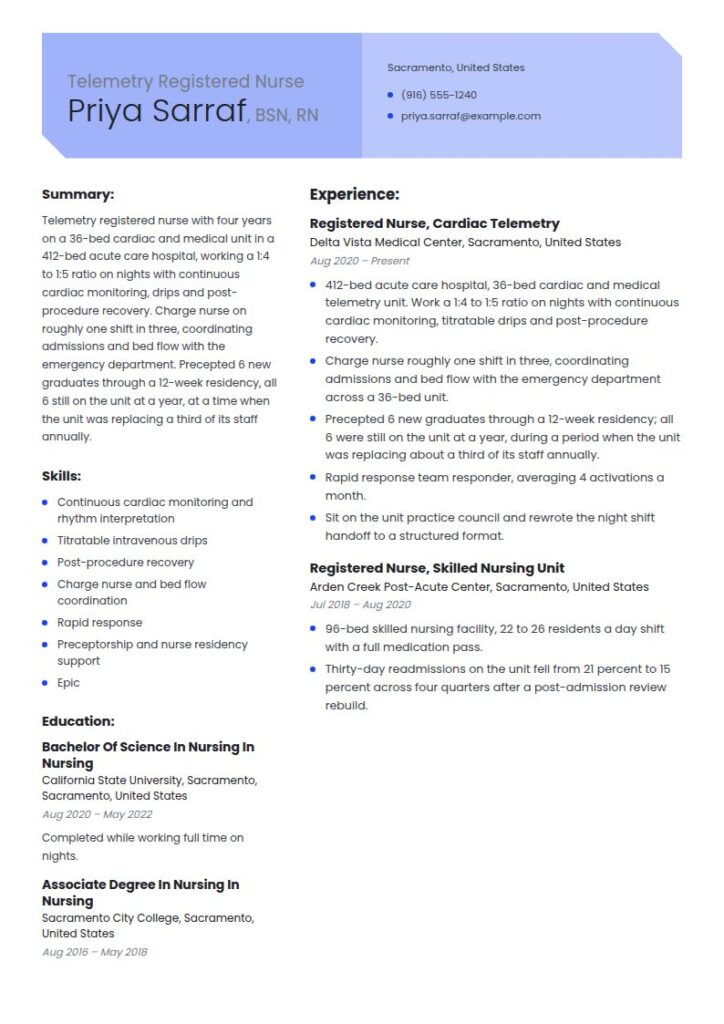
Telemetry registered nurse with four years on a 36-bed cardiac and medical unit in a 412-bed acute care hospital, working a 1:4 to 1:5 ratio on nights with continuous cardiac monitoring, drips and post-procedure recovery. Charge nurse on roughly one shift in three, coordinating admissions and bed flow with the emergency department. Precepted 6 new graduates through a 12-week residency, all 6 still on the unit at a year, at a time when the unit was replacing a third of its staff annually.
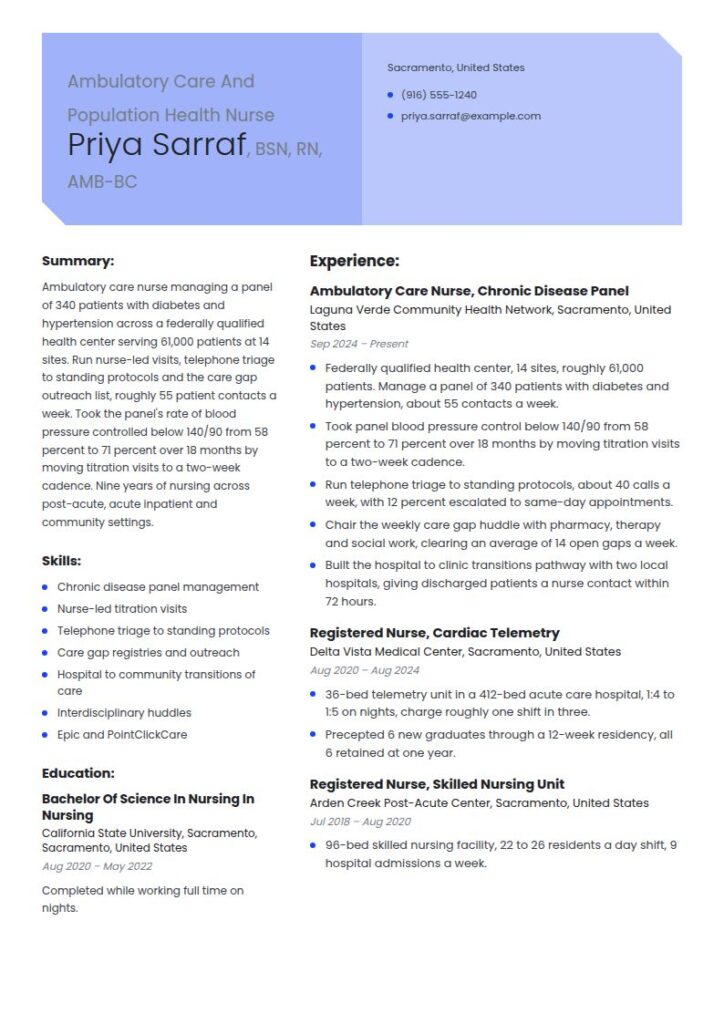
Ambulatory care nurse managing a panel of 340 patients with diabetes and hypertension across a federally qualified health center serving 61,000 patients at 14 sites. Run nurse-led visits, telephone triage to standing protocols and the care gap outreach list, roughly 55 patient contacts a week. Took the panel's rate of blood pressure controlled below 140/90 from 58 percent to 71 percent over 18 months by moving titration visits to a two-week cadence. Nine years of nursing across post-acute, acute inpatient and community settings.
Right vs wrong: the same healthcare summary, twice
| ✅ Right | ❌ Wrong |
|---|---|
| Telemetry nurse, 36-bed cardiac and medical unit, 412-bed acute care hospital. | Registered nurse with hospital experience. |
| 1:4 to 1:5 ratio on nights, continuous monitoring, drips and post-procedure recovery. | Skilled in providing care to a wide range of patients. |
| Charge on one shift in three, coordinating admissions and bed flow with the emergency department. | Strong leadership and teamwork abilities. |
On one hand, the left column places you in a building the reader can picture. On the other hand, the right column could describe millions of people.
Outline your healthcare experience
Employer, setting type, size, unit, ratio and dates in the header line, then three to five bullets carrying numbers. The header line does more work than the bullets, so spend words there.
| Instead of | Use |
|---|---|
| Provided patient care in a hospital setting | Carried a 1:4 to 1:5 assignment on a 36-bed telemetry unit in a 412-bed acute care hospital |
| Cared for elderly residents | Carried 22 to 26 residents on a day shift in a 96-bed skilled nursing facility with a full medication pass |
| Worked in an outpatient clinic | Managed a 340-patient chronic disease panel across a 14-site federally qualified health center |
| Collaborated with the interdisciplinary team | Ran a weekly huddle with pharmacy, therapy and social work, clearing an average of 14 open care gaps a week |
| Provided patient education | Delivered nurse-led titration visits on a two-week cadence; blood pressure control rose from 58 percent to 71 percent |
Ambulatory Care Nurse, Laguna Verde Community Health Network, Sacramento, CA, September 2024 to Present
Federally qualified health center, 14 sites, roughly 61,000 patients, Epic.
Manage a panel of 340 patients with diabetes and hypertension, roughly 55 contacts a week across nurse-led visits, telephone triage and outreach.
Took panel blood pressure control below 140/90 from 58 percent to 71 percent over 18 months by moving titration visits to a two-week cadence.
Run telephone triage to standing protocols, averaging 40 calls a week, with 12 percent escalated to same-day appointments and the rest resolved in the call.
Chair the weekly care gap huddle with pharmacy, therapy and social work, clearing an average of 14 open gaps a week.
The setting and acuity ladder, and who calls you back
In fact, healthcare hiring runs on a rarely stated rule: managers hire the acuity they run. As a result, a resume that does not say which settings you have worked in forces the reader to guess, and readers guess conservatively. Specifically, there are five rungs, and each screens for something different.
Acute inpatient. Hospitals, in beds. Screened on ratio, unit type and equipment: telemetry, step-down, intensive care, emergency, perioperative, medical-surgical. Give the hospital's bed count, your unit's bed count, your ratio, and whether you take charge. The largest share of nursing employment sits here: 59 percent of registered nurses worked in hospitals in May 2025, earning a median of $100,220 (BLS Occupational Outlook Handbook, last modified 27 August 2026).
Ambulatory. Physician offices, clinics, outpatient centers, surgery centers. Screened on panel size, visit volume, protocol autonomy and payer mix. Nobody in ambulatory hiring asks your ratio; they ask how many patients you are accountable for between visits. Ambulatory healthcare services employ 19 percent of registered nurses at a median of $91,230, and 56 percent of medical assistants work in offices of physicians at $45,520 (BLS, May 2025).
Post-acute, long-term care and home settings
Post-acute and long-term care. Skilled nursing, rehabilitation, assisted living. Screened on census, resident load, the medication pass, hospital admissions and readmission rates. Staffing here is heavily assistive: 36 percent of nursing assistants work in nursing care facilities at a median of $43,000 and 11 percent in assisted living and retirement communities at $39,490, while nursing and residential care facilities employ 6 percent of registered nurses at $84,300 (BLS, May 2025).
Home. Home health agencies, hospice, private duty. What is screened is autonomy, visits a week, travel radius and the ability to work without a colleague in the room. This rung is the sector's largest by headcount: home health and personal care aides held 4,677,100 jobs in 2025 and are projected to grow 18 percent through 2035 (BLS, 2025 to 2035 projections).
Community health and moving between settings
Community and public health. Health departments, federally qualified health centers, school and occupational health, population health programs. What is screened is program work: outreach, screening volume, care gaps and the population you served. Government excluding education and hospitals employs 5 percent of registered nurses at the highest industry median of the five, $110,780, with educational services at $78,620 (BLS, May 2025).
| If the posting is for | The reader is checking | The line that answers it |
|---|---|---|
| Acute inpatient | Acuity and ratio | 36-bed telemetry, 1:4 to 1:5 nights, charge one shift in three |
| Ambulatory | Panel and autonomy | 340-patient chronic disease panel, triage to standing protocols |
| Post-acute | Census and medication pass | 96-bed skilled nursing, 22 to 26 residents, full pass |
| Home | Independence and volume | 38 visits a week across a 40-mile radius, documenting in the home |
| Community and public health | Program and population | 61,000-patient network, 14 sites, outreach and care gap closure |
Settings worked: acute inpatient (4 years), post-acute and skilled nursing (2 years), ambulatory and community health (3 years).
Acuity carried: telemetry and step-down, continuous cardiac monitoring, titratable drips, post-procedure recovery, rapid response as a responder.
Ratios and volumes: 1:4 to 1:5 nights on a 36-bed unit; 22 to 26 residents on a 96-bed skilled nursing unit; 340-patient ambulatory panel, roughly 55 contacts a week.
Populations: adult cardiac and medical, post-surgical, geriatric and long-stay, chronic disease management in a safety net population.
Systems: Epic across all three settings, PointClickCare in post-acute, telephone triage to standing protocols.
Open to: ambulatory and community roles. Would return to acute inpatient for a transitions of care post.
Six lines, and a manager knows whether to call. Above all, they answer the question behind most healthcare rejections, which is not "can this person nurse" but "will this person survive my building".
Moves between rungs are common and are not read as failures unless left unexplained. For example, an unlabeled step from acute inpatient to a clinic reads as a downgrade; the same step with a reason attached and a result behind it reads as a plan. Write the reason in six words, then show what you built in the new setting.
Where the jobs are is not where the pay is
Registered nurses earn their highest industry median outside the hospital: $110,780 in government excluding education and hospitals, against $100,220 in hospitals, $91,230 in ambulatory healthcare services, $84,300 in nursing and residential care facilities and $78,620 in educational services (BLS Occupational Outlook Handbook, May 2025 wage data).
At the same time, the sector's headcount growth is concentrated at the other end. Home health and personal care aides held 4,677,100 jobs in 2025, more than registered nurses at 3,465,400, and are projected to grow 18 percent through 2035 against 6 percent for registered nurses, producing about 760,500 openings a year (BLS, 2025 to 2035 projections).
The reading for a candidate is that setting experience is becoming more valuable, not less: the settings growing fastest are furthest from the hospital, and experience in them is still scarce on most resumes.
Build a snapshot of your key healthcare skills
Generally, twelve to sixteen entries in four groups: clinical, population and setting, systems, and coordination. Group by the work, and then let the groups themselves show which settings you have lived in.
Clinical: Continuous cardiac monitoring and rhythm interpretation, Titratable intravenous drips, Post-procedure recovery, Full medication pass, Chronic disease titration protocols
Population and setting: Adult cardiac and medical, Geriatric and long-stay, Post-surgical, Safety net and uninsured populations
Systems: Epic, PointClickCare, Telephone triage to standing protocols, Care gap registries
Coordination: Admissions and bed flow, Hospital to post-acute transitions, Interdisciplinary huddles, Preceptorship and residency support
List your education and licensure
Also keep it short and dated, with the licensing state named. Licensure is state-based, so a reader elsewhere needs to know which board issued yours before anything else matters.
Registered Nurse, California Board of Registered Nursing, license #RN-6612430, active.
Bachelor of Science in Nursing, California State University, Sacramento, CA, 2022. Completed while working full time.
Associate Degree in Nursing, Sacramento City College, Sacramento, CA, 2018.
Certifications: Medical-Surgical Nursing Certification (MEDSURG-BC), American Nurses Credentialing Center, 2022. Ambulatory Care Nursing Certification (AMB-BC), American Nurses Credentialing Center, 2025. BLS and ACLS, American Heart Association.
A state nursing license is required after an approved program and a qualifying exam (BLS Occupational Outlook Handbook, last modified 27 August 2026), which is why the license line comes before the degrees.
Choose the right layout and design
Similarly, single column, 11 or 12 point, no photograph, no graphics. That is because health system portals parse into structured fields, and a two-column template with your setting history in a sidebar is where parsing drops the block you most need read.
Put the setting type and its size in the header line of every job. Give the ratio, census or panel size that went with it. Name the unit, not just the hospital. Say which settings you would move back into. Label a change of setting with the reason, in six words. Keep one measured result per setting.
Do not write "various healthcare settings"; it is the sentence that gets a file put down. Do not assume a reader knows your former employer's size. Do not let an unexplained move between settings sit on the page. Do not claim acuity you have not carried. Do not describe an individual patient or resident.
Healthcare job market and outlook
About 1.9 million openings a year are projected across healthcare occupations, which BLS expects to grow much faster than the average for all occupations from 2025 to 2035 (BLS Occupational Outlook Handbook, Healthcare Occupations, last modified 27 August 2026). However, those openings are not spread evenly across the five settings:
| Occupation | Jobs, 2025 | Projected change, 2025-35 | Projected annual openings | Median annual wage, May 2025 |
|---|---|---|---|---|
| Home health and personal care aides | 4,677,100 | 18% | ~760,500 | $35,800 |
| Registered nurses | 3,465,400 | 6% | ~180,800 | $97,550 |
| Nursing assistants and orderlies | 1,558,700 | 3% | ~203,300 | $42,260 |
| Medical assistants | 833,900 | 13% | ~109,700 | $45,690 |
Source: U.S. Bureau of Labor Statistics, Occupational Outlook Handbook, May 2025 wage data and 2025 to 2035 projections, published 27 August 2026.
Indeed, where each occupation works is the useful part. Hospitals employ 59 percent of registered nurses but only 32 percent of nursing assistants and 17 percent of medical assistants; offices of physicians employ 56 percent of medical assistants; nursing care facilities employ 36 percent of nursing assistants; individual and family services employ 51 percent of home health and personal care aides, with home healthcare services taking another 23 percent (BLS, May 2025). In short, four occupations, four centers of gravity, and a resume written for the wrong one reads as a mismatch.
What salary you can expect in healthcare
Healthcare practitioners and technical occupations had a median annual wage of $86,530 as of May 2025, and healthcare support occupations $38,340, against $50,980 for all occupations (BLS Occupational Outlook Handbook, last modified 27 August 2026).
Moreover, within a single occupation, setting moves pay by a wide margin. Registered nurses working in government excluding education and hospitals earned a median of $110,780 in May 2025, roughly 41 percent more than the $78,620 median in educational services, with hospitals at $100,220 in between (BLS, May 2025). For instance, nursing assistants earned $43,000 in nursing care facilities against $39,490 in assisted living and retirement communities, and medical assistants $48,560 in outpatient care centers against $38,400 in offices of other health practitioners (BLS, May 2025).
Same license, same scope, different building. That is the argument for writing setting onto the page: it is both what the manager screens on and what the pay band is set by, so a resume that makes setting explicit competes in the market you want rather than the one your job title implies.
Key takeaways for a healthcare resume
- Firstly, name the setting type and its size in every job header, not just the employer.
- Then give the ratio, census or panel that went with each setting.
- Also put a setting and acuity block under the summary, listing every rung you have worked.
- Similarly, label moves between settings with a six-word reason.
- Carry one measured result out of each setting, not only the most recent.
- Finally, say which settings you would return to, because managers read that as availability.
- Check where your occupation sits by industry before deciding a move is a downgrade.
Build your healthcare resume in 15 minutes with our AI resume builder.
Related medical resume examples
- Nurse resume
- ICU nurse resume
- Travel nurse resume
- School nurse resume
- Home health aide resume
- Nursing home resume
- Physical therapist resume
- Occupational therapist resume
- Respiratory therapist resume
- Medical social worker resume
- Epidemiologist resume
- Healthcare project manager resume
Pair it with a matching healthcare cover letter.
Healthcare resume questions, answered
How do I write a healthcare resume when I have worked in several settings?
Treat the range as the asset and make it legible. Put a setting and acuity block under the summary listing every rung with years attached, then carry one measured result out of each setting into the experience section. Results in three settings beat a longer run in one, as long as the reader does not have to assemble the picture themselves.
Which healthcare setting should I aim for?
Look at where your occupation employs people and what each industry pays. Registered nurses are concentrated in hospitals at 59 percent, but the highest industry median is government excluding education and hospitals at $110,780 in May 2025. Medical assistants are concentrated in offices of physicians at 56 percent, while outpatient care centers pay $48,560 (BLS, May 2025). The shortest route to a raise is often a different building rather than a different title.
Does moving from a hospital to a clinic look like a step down?
Only if you leave it unexplained. Write the reason in six words and show what you built in the new setting. Ambulatory work is screened on panel size, protocol autonomy and measured outcomes, so a sentence about a panel you manage and a control rate you moved does more than any explanation of why you left the floor.
What do I put on a healthcare resume with no experience?
The setting you trained in, with its size, and what you carried there. Clinical rotations written as jobs: the unit, the bed count, the ratio, the supervised hours and the populations you saw. Home health and personal care aides, the fastest growing large occupation in the sector at 18 percent through 2035, list a high school diploma or equivalent as typical entry-level education (BLS, 2025 to 2035 projections).
Should I list every unit I have floated to?
List the ones you would be willing to be assigned to again, and say so. Float experience is valuable in acute inpatient hiring because it tells a manager you can be moved, but a list of ten units reads as a lack of depth. Name the two or three you are competent in and the acuity each carried.
How specific should I be about a former employer's size?
As specific as the public record. Bed counts, site counts and panel sizes are published by health systems themselves, and using them is neither confidential nor contentious. Volumes you were accountable for are yours to describe. What you must not do is name an individual patient, resident or client.