Priya Sarraf Ambulatory Care and Population Health Nurse, BSN, RN Sacramento, 95818, United States [email protected] · (916) 555-1240
11 September 2026
Ms. Corinne Ashby Director of Nursing Riverbank Valley Health Sacramento, United States
Application for Transitions of Care Nurse, Riverbank Valley Health
Dear Ms. Ashby,
I am applying for the Transitions of Care Nurse post at Riverbank Valley Health. I have worked all three settings this role sits between: two years in a 96-bed skilled nursing facility, four on a 36-bed telemetry unit in a 412-bed hospital at a 1:4 to 1:5 night ratio, and two years managing a 340-patient chronic disease panel in a 14-site community health network.
The work closest to your posting is the transitions pathway I built with two local hospitals last year. Discharged patients now get a nurse contact within 72 hours, medication reconciliation before the first follow-up, and a booked appointment rather than a phone number. In post-acute I had already worked the other end of the same problem: rebuilding the 48-hour post-admission review took thirty-day readmissions on my unit from 21 percent to 15 percent across four quarters. Both came from one observation, that most of what goes wrong after a discharge goes wrong in the first three days.
I moved from inpatient to ambulatory deliberately, to learn what happens to patients between visits rather than during them, and I would take this post for the same reason. I noticed Riverbank Valley runs its own post-discharge clinic rather than contracting it out, which is unusual and is the part of the job I would most want to work on.
My California registered nurse license is active, I hold ambulatory and medical-surgical certifications through the American Nurses Credentialing Center, and I can give four weeks of notice. Thank you for your time.
Sincerely, Priya Sarraf, BSN, RN
Summary
A healthcare cover letter tells a manager which settings you have worked in, what acuity you carried there, and what you changed. It also explains any move between settings before the reader has to guess. This guide gives you a full adaptable letter, the openings that work, and how to write about a setting you have never worked in without pretending you have.
Healthcare cover letter examples by experience level
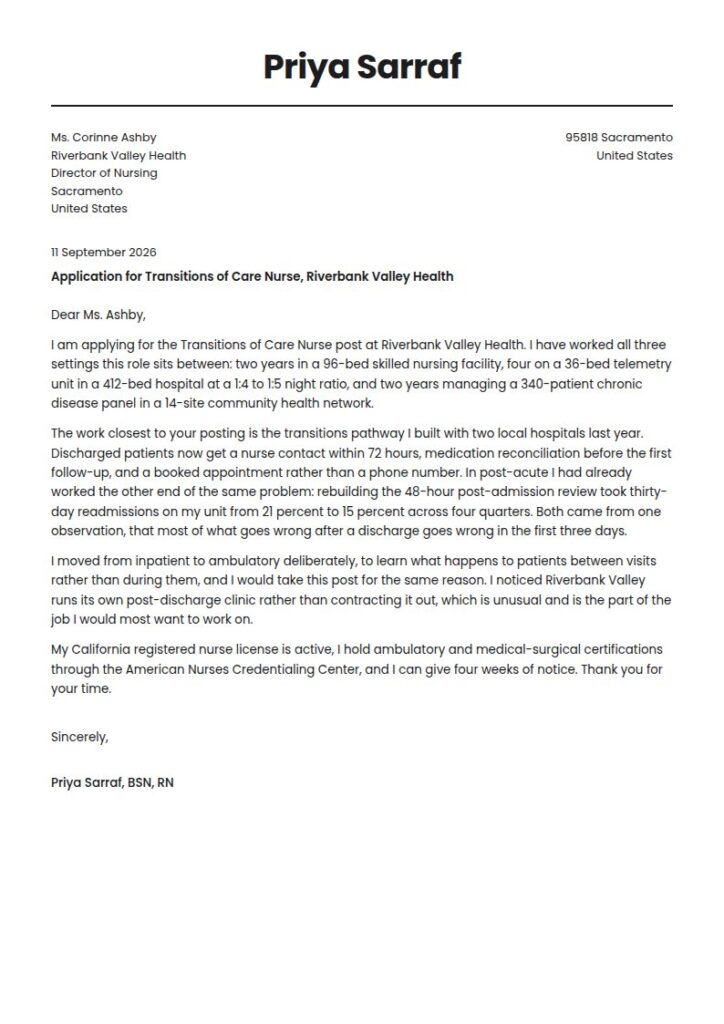
A healthcare cover letter is a one-page letter telling a manager which settings you have worked in, what acuity you carried in them, and what changed because you were there.
Healthcare managers do not read letters for warmth. They read them to answer the question the resume half answers: has this person functioned in a building like mine. A hospital manager wants ratio and unit type, a clinic wants panel size and autonomy, a home health agency wants to know whether you can work alone. Editing the first paragraph for each is the only tailoring that reliably matters.
Guide to a healthcare cover letter
This guide and the corresponding healthcare cover letter example will cover:
- How to structure the letter, paragraph by paragraph
- Why the setting belongs in the opening sentence
- How to explain a move between settings before the reader guesses
- What to write about a setting you have not worked yet
How to write a healthcare cover letter
| Paragraph | Its job | Length |
|---|---|---|
| Opening | The post, the setting you worked, the acuity or volume | 2 to 3 sentences |
| Evidence | One result from the setting closest to theirs | 4 to 5 sentences |
| Fit | Why this setting, plus one real detail about them | 3 to 4 sentences |
| Close | Licensure, availability, thank you | 2 sentences |
Match the unit of measurement to the setting
Every setting measures work differently, and the wrong unit is the fastest way to sound like an outsider.
Acute inpatient counts beds and ratios. Ambulatory counts panels, visits and control rates. Post-acute counts census, medication passes and readmissions. Home counts visits a week and travel radius. Community health counts populations, screening volume and care gaps closed.
Open with the unit the reader uses. "A 340-patient chronic disease panel across a 14-site network" tells an ambulatory manager more than three paragraphs about your commitment.
A healthcare cover letter example you can adapt
Dear Ms. Ashby,
I am applying for the Transitions of Care Nurse post at Riverbank Valley Health. I have worked all three settings this role sits between: two years in a 96-bed skilled nursing facility, four on a 36-bed telemetry unit in a 412-bed hospital at a 1:4 to 1:5 night ratio, and two years managing a 340-patient chronic disease panel in a 14-site community health network.
The work closest to your posting is the transitions pathway I built with two local hospitals last year. Discharged patients now get a nurse contact within 72 hours, medication reconciliation before the first follow-up, and a booked appointment rather than a phone number. In post-acute I had already worked the other end of the same problem: rebuilding the 48-hour post-admission review took thirty-day readmissions on my unit from 21 percent to 15 percent across four quarters. Both came from one observation, that most of what goes wrong after a discharge goes wrong in the first three days.
I moved from inpatient to ambulatory deliberately, to learn what happens to patients between visits rather than during them, and I would take this post for the same reason. I noticed Riverbank Valley runs its own post-discharge clinic rather than contracting it out, which is unusual and is the part of the job I would most want to work on.
My California registered nurse license is active, I hold ambulatory and medical-surgical certifications through the American Nurses Credentialing Center, and I can give four weeks of notice. Thank you for your time.
Sincerely, Priya Sarraf, BSN, RN
Openings that work
| Instead of | Use |
|---|---|
| I am a compassionate nurse seeking a new opportunity | I have worked all three settings this role sits between, most recently a 340-patient panel |
| I have experience in a variety of healthcare settings | Four years on a 36-bed telemetry unit at a 1:4 to 1:5 night ratio |
| I am excited to join your organization | I noticed you run your own post-discharge clinic rather than contracting it out |
Each right-hand cell is a fact the reader can place in a building. Each left-hand cell fits any application in the sector.
Write the setting into the first sentence
The opening line has one job: to stop the reader wondering whether you are plausible for their building.
Three things do that work in one sentence: the setting type, its size, and the volume or ratio you carried. "A 96-bed skilled nursing facility, 22 to 26 residents on a day shift with a full medication pass" describes a job. "Experience in long-term care" does not.
If the posting is for a setting you have worked, say so in the first ten words. If it is for one you have not, name the nearest thing you have done and say what transfers. Naming the gap yourself beats leaving a manager to find it, because managers who find gaps unaided assume there are others.
Changing settings, and how to say so
Moves between settings are ordinary, and most go unexplained, which is why they get read as retreats.
| The move | Unexplained, it reads as | What to write instead |
|---|---|---|
| Hospital to clinic | Could not handle the floor | Moved to ambulatory to learn what happens between visits, then took a panel from 58 to 71 percent control |
| Clinic to hospital | Wants the money | Returned to inpatient for acuity after three years managing the same patients post-discharge |
| Acute to post-acute | Slowing down | Took post-acute to work the readmission problem from the receiving end |
| Any setting to home health | Running out of options | Chose home health for autonomy, 38 visits a week with no colleague in the room |
Six words of reason and one result is the technique. Put it in the third paragraph; the first belongs to setting evidence.
The sector’s growth is furthest from the hospital
Healthcare practitioners and technical occupations had a median annual wage of $86,530 in May 2025 and healthcare support occupations $38,340, against $50,980 for all occupations, with about 1.9 million openings projected each year (BLS Occupational Outlook Handbook, Healthcare Occupations, last modified 27 August 2026).
The growth inside that is not evenly placed. Home health and personal care aides held 4,677,100 jobs in 2025 and are projected to grow 18 percent through 2035, while registered nurses grow 6 percent and 59 percent still work in hospitals (BLS, 2025 to 2035 projections and May 2025 wage data).
For a letter this is useful twice over. Experience outside the hospital is scarcer than experience inside it, so say so plainly, and a move toward home, community or ambulatory work is a move toward where the sector is expanding.
Pending licensure, gaps and cross-state moves
Name the setting type and its size in your opening sentence. Give the ratio, census or panel that went with it. Say which state issued your license and whether you are licensed in theirs. Explain a change of setting in six words with a result attached. Name one real thing about their organization.
Do not write "various healthcare settings". Do not claim acuity you have not carried; it is the first thing probed at interview. Do not apologize for a setting change, explain it. Do not describe a patient, resident or client. Do not send the same first paragraph to a hospital, a clinic and a home health agency.
Length, format and sending it
One page, four paragraphs, 250 to 400 words, PDF unless the portal says otherwise. Address a person: nurse managers and clinical directors are named on most organizational pages, and a generic salutation undercuts an otherwise precise letter.
Keep letter and resume telling the same story about setting. If the resume says four years of telemetry and the letter says five, the reader stops trusting both. Our healthcare resume example uses the same settings and figures as the letter above.
Key takeaways
- Put the setting type, its size and your ratio or panel in the opening sentence.
- Use the unit of measurement the target setting uses.
- Pick evidence from the setting closest to theirs, not the most recent one.
- Explain a change of setting in six words, with a result behind it.
- Name the gap yourself if you are crossing into a setting you have not worked.
- State your licensing state, and whether you hold or are seeking theirs.
- Address a named person and keep the setting facts identical to the resume.
Write your healthcare cover letter in 10 minutes with our AI cover letter builder.
Healthcare cover letter questions, answered
How long should a healthcare cover letter be?
One page, four paragraphs, 250 to 400 words. The reader is a clinical manager working through applications between shifts, and the first two sentences carry most of the decision.
Should I write a different letter for every setting?
Rewrite the first paragraph at minimum. The facts you lead with should match the unit the reader uses: beds and ratios for inpatient, panels and control rates for ambulatory, census and medication passes for post-acute, visits and radius for home. The rest can stay the same.
What do I write if I have never worked in their setting?
Name the nearest thing you have done and say what transfers and what does not. A manager will believe "the assessment work transfers and the independence is the part I have not done" long before a claim to be equally at home everywhere. Then give a reason for wanting the move.
How do I explain leaving a hospital job?
With a reason and a result. "I moved to ambulatory to learn what happens to patients between visits", followed by a control rate you shifted, reads as a plan. Silence reads as something you would rather not say.
Do I mention licensure if I am applying out of state?
Yes, in the closing line. Say which state issued your license and where you stand on theirs, including an endorsement in progress with its date. It affects the start date, and a manager who has to ask has already discounted your file by a week.