Lorraine Wickersham Coding Quality and Documentation Integrity Lead, CPC, CPMA, CCS Wichita, 67208, United States [email protected] · (316) 555-1294
11 September 2026
Ms. Adaeze Okonjo Health Information Management Cardinal Prairie Health Topeka, United States
Application for Coding Quality Specialist, Cardinal Prairie Health
Dear Ms. Okonjo,
I am applying for the Coding Quality Specialist post at Cardinal Prairie Health. I hold the CPC and CPMA from AAPC and the CCS from AHIMA, and I code ICD-10-CM, CPT, HCPCS Level II and inpatient ICD-10-PCS. I moved my book to the fiscal year 2026 ICD-10-CM edition in September 2025 and to CPT 2026 in the first week of January, ahead of both effective dates.
At Halverdene Health Partners I lead nine coders across a 62-provider multispecialty group, and the number I would point to is the audit result: 98.1 percent departmental accuracy held for six consecutive quarters against a 95 percent standard, measured on a 30-chart quarterly sample per coder. My own production is 118 outpatient and ambulatory surgery charts a day. On the orthopaedic book I cut coding-related denials from 7.1 percent to 3.4 percent across four quarters by rewriting the query templates rather than adding review steps.
Your posting mentions a risk adjustment backlog going into the 2027 sweep. That is the work I rebuilt here: annual chart completion went from 71 percent to 93 percent over two years, and we dropped from three retrospective sweeps a year to one. I would look at your query response times first, since that was our constraint rather than coder capacity.
I run 3M encoder, Epic Resolute Professional Billing and TruCode, my AAPC continuing education is current for the 2025 to 2026 cycle, and I can start with four weeks' notice. Thank you for your time.
Sincerely, Lorraine Wickersham, CPC, CPMA, CCS
Summary
A medical coder cover letter names the code sets and the edition you are working in now, gives one audited accuracy figure with the standard behind it, and shows that you have run an annual code set changeover. This guide gives you a full adaptable letter, the openings that work, and what changes when you are applying as an apprentice.
Medical Coder cover letter examples by experience level
A medical coder cover letter is a one-page letter telling a coding manager which code sets you work in, which edition you are in right now, what an auditor last measured on your charts, and what volume you hold while doing it.
Coding managers hire against a queue that is already behind. They read for whether you will need three months of training before you touch production work, and the letter that answers that up front is unusual enough to get a call.
Guide to a medical coder cover letter
This guide and the corresponding medical coder cover letter example will cover:
- How to structure the letter, paragraph by paragraph
- Why the code set edition belongs in the first two sentences
- What an audited accuracy figure looks like stated honestly
- The apprentice letter, and what changes in it
How to write a medical coder cover letter
| Paragraph | Its job | Length |
|---|---|---|
| Opening | The post, your credential, your code sets and the current edition | 2 to 3 sentences |
| Evidence | One audited number, the standard behind it, the volume, the specialty | 4 to 5 sentences |
| Fit | Something specific about their setting, and what you would take on | 3 to 4 sentences |
| Close | Systems you run, availability, thank you | 2 sentences |
Put the edition in the first paragraph, not the code set
Every applicant writes "proficient in ICD-10-CM and CPT", and the sentence has stopped carrying information. What carries information is the edition and the date you moved into it.
The Centers for Medicare and Medicaid Services publishes the annual ICD-10-CM revision for discharges and encounters occurring from 1 October through 30 September of the following year, so the diagnosis set turns over with the federal fiscal year (CMS, ICD-10 code resources, checked September 2026). The American Medical Association released CPT 2026 with 418 changes, 288 new codes, 84 deletions and 46 revisions, effective 1 January 2026 (American Medical Association, 11 September 2025).
That is two changeovers a year, three months apart. "I completed the fiscal year 2026 ICD-10-CM update review in September 2025 and moved my book to CPT 2026 in the first week of January" answers the currency question a coding manager has.
A medical coder cover letter example you can adapt
Dear Ms. Okonjo,
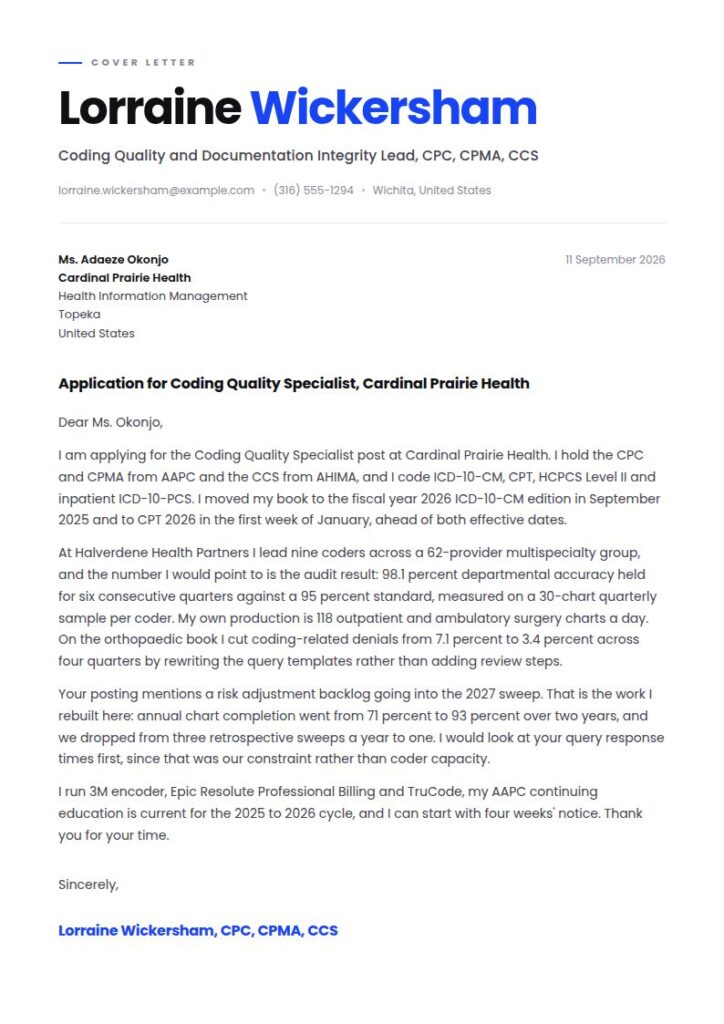
I am applying for the Coding Quality Specialist post at Cardinal Prairie Health. I hold the CPC and CPMA from AAPC and the CCS from AHIMA, and I code ICD-10-CM, CPT, HCPCS Level II and inpatient ICD-10-PCS. I moved my book to the fiscal year 2026 ICD-10-CM edition in September 2025 and to CPT 2026 in the first week of January, ahead of both effective dates.
At Halverdene Health Partners I lead nine coders across a 62-provider multispecialty group, and the number I would point to is the audit result: 98.1 percent departmental accuracy held for six consecutive quarters against a 95 percent standard, measured on a 30-chart quarterly sample per coder. My own production is 118 outpatient and ambulatory surgery charts a day. On the orthopaedic book I cut coding-related denials from 7.1 percent to 3.4 percent across four quarters by rewriting the query templates rather than adding review steps.
Your posting mentions a risk adjustment backlog going into the 2027 sweep. That is the work I rebuilt here: annual chart completion went from 71 percent to 93 percent over two years, and we dropped from three retrospective sweeps a year to one. I would look at your query response times first, since that was our constraint rather than coder capacity.
I run 3M encoder, Epic Resolute Professional Billing and TruCode, my AAPC continuing education is current for the 2025 to 2026 cycle, and I can start with four weeks' notice. Thank you for your time.
Sincerely, Lorraine Wickersham, CPC, CPMA, CCS
Openings that work
| Instead of | Use |
|---|---|
| I am a detail-oriented coding professional with a passion for accuracy | I hold the CPC and CCS and code ICD-10-CM, CPT, HCPCS Level II and inpatient ICD-10-PCS |
| I am writing to express my interest in your coding position | I am applying for the Coding Quality Specialist post, and I moved my book to CPT 2026 in the first week of January |
| I have a proven track record of coding accuracy | Audit result: 98.1 percent held for six quarters against a 95 percent standard |
The one number the letter is built on
An audited accuracy figure is the closest thing coding has to a portfolio, and most applicants either omit it or inflate it past credibility. State it with the method attached: the number, the sampling design, the standard and who ran the audit. "96.4 percent across a quarterly 30-chart internal audit against a 95 percent departmental standard" is checkable in the interview, which is why it persuades.
| Kind of evidence | What it looks like in a sentence |
|---|---|
| Audited accuracy | 97.8 percent across four quarterly 30-chart audits against a 95 percent standard |
| Volume with encounter type | 118 outpatient and ambulatory surgery charts a day, 34 inpatient records |
| Denial impact | Coding-related denials on the orthopaedic book fell from 7.1 to 3.4 percent in four quarters |
Pick one. The rest belong on the resume.
Writing the letter as an apprentice
The apprentice letter is a different document, and pretending otherwise is what sinks it.
AAPC awards the CPC-A apprentice designation to a coder who passes the examination without two years of documented on-the-job coding, and it is removed by two recommendation letters verifying two years with the code sets, or by 80 contact hours of coding preparation plus one employer letter verifying a year (AAPC, checked September 2026). Coding managers know the ladder and hire apprentices routinely, so write the designation plainly in the opening and spend the letter on what substitutes for production history: the practicum, written like a job with volume and chart types, and the edition you trained in.
Name the credential and its number in the first paragraph. Say which edition of each code set you work in now, with the month you moved. Give one audited figure with its sampling method and standard. Name the encoder and the electronic health record by product. Read the posting for the setting.
Do not claim 100 percent accuracy; no audit program produces it. Do not list ICD-10-PCS unless you have coded inpatient procedures, because most employers give a coding test. Do not describe yourself as detail-oriented. Do not send a letter with no employer name in it. Do not put a chart number or a patient initial anywhere near the file.
Where the market is growing around coding
The Bureau of Labor Statistics reports a 2025 median pay of $51,140 for medical records specialists, the group covering most medical coders, and a typical entry-level education of a postsecondary nondegree award (BLS Occupational Outlook Handbook, Healthcare Occupations, last modified 27 August 2026). The rest of the current-cycle detail for that occupation was not available at the time of writing and is not estimated here.
The published growth sits in the layer directly above: medical and health services managers, which includes coding managers, held 640,400 jobs in 2025, are projected to grow 24 percent from 2025 to 2035, much faster than average, and had a May 2025 median of $123,860 (BLS Occupational Outlook Handbook, 2025-35 projections).
The paragraph where you describe auditing, retraining or running a changeover is the one that reads as promotable, so make that your evidence paragraph rather than a list of code sets.
Length, format and sending it
One page, four paragraphs, 250 to 400 words. PDF unless the portal asks otherwise, named for yourself and the post.
Address a person. Coding leadership is usually named on the posting or the employer's site, and "Dear Hiring Manager" on an otherwise precise letter reads as a letter sent to twelve employers.
Keep the figures identical to the ones on your resume. Our medical coder resume example uses the same numbers as the letter above.
Key takeaways
- Name the credential and the code sets in the first two sentences.
- Give the edition you are working in now and the month you moved to it.
- Build the evidence paragraph on one audited figure, with the standard behind it.
- Attach the encounter type to any volume number, and name the encoder by product.
- If you are an apprentice, say so in the opening and spend the letter on the practicum.
Write your medical coder cover letter in 10 minutes with our AI cover letter builder.
Medical coder cover letter questions, answered
How long should a medical coder cover letter be?
One page, four paragraphs, 250 to 400 words. Coding managers read these between production reviews, and length does not read as effort here.
Do I need a cover letter if I am applying through a health system portal?
Attach one wherever there is a field. The portal collects the same structured data from every applicant; the letter is the only place to say which edition you work in, what your last audit returned, and which changeover you led.
What do I write with no production coding experience?
Write the practicum like a job: setting, specialties, chart types, volume, and any accuracy figure the program recorded. Then state the CPC-A designation plainly and name the editions you trained in. The letter that hides the designation fails the credential lookup anyway.
Should I mention the annual code set updates?
Yes, with dates. ICD-10-CM turns over on 1 October with the federal fiscal year (CMS, checked September 2026) and CPT 2026 took effect 1 January 2026 with 418 changes (American Medical Association, 11 September 2025). Very few applicants say which side of either changeover they are on.
How do I write to an employer I know nothing about?
Read the posting for the setting first, because that is what changes the letter: hospital inpatient, physician group, ambulatory surgery center, payer or coding vendor. Then read their site for the specialties they run and the electronic health record they name.