Callista Brubaker Critical Care Registered Nurse, RN, BSN, CCRN Dayton, 45409, United States [email protected] · (937) 555-1318
11 September 2026
Ms. Renata Okonjo Nurse Manager, Cardiovascular Intensive Care Unit Harmon Creek Medical Center Columbus, United States
Application for Cardiovascular ICU Staff Nurse, Harmon Creek Medical Center
Dear Ms. Okonjo,
I am applying for the Cardiovascular ICU staff nurse post at Harmon Creek Medical Center. I currently work a 20-bed cardiovascular ICU at Stillwater Heights Medical Center, 1:2 with 1:1 for the first 12 hours after cardiac surgery and for any patient on mechanical circulatory support, and I have held CCRN (Adult) since 2019.
I take fresh post-operative admissions as first nurse, including chest tubes, temporary epicardial pacing and four or more concurrent vasoactive and inotropic infusions, and I run continuous renal replacement therapy, intra-aortic balloon counterpulsation and targeted temperature management without a resource nurse. The piece of work I would most want to bring with me is the post-operative handover checklist I rewrote with our surgical team: the median time from chest closure to first arterial blood gas on the unit fell from 22 minutes to 11 over the following six months, and the sticking point turned out to be who carried the pump settings across, not the transfer itself.
Your posting says the unit is opening four beds and starting an extracorporeal membrane oxygenation program this year. I have run venoarterial and venovenous circuits with a resource available for two years and would want to be part of building the competence file and the orientation for it, which is the part I have done before: I wrote the two-day continuous renal replacement therapy orientation now used for every new critical care hire on my unit.
My Ohio license is active with a compact multistate privilege, my ACLS is current, and I precept, so I could take a new hire from week one. I can give six weeks' notice. Thank you for your time.
Sincerely, Callista Brubaker, RN, BSN, CCRN
Summary
An ICU nurse cover letter names the unit type and acuity you work now, the devices and infusions you run without a resource nurse, your CCRN status or accrued critical care hours, and one measured result. This guide gives you a full adaptable letter, what changes when you are moving into critical care from another unit, and the openings that get a strong file read twice.
ICU Nurse cover letter examples by experience level
An ICU nurse cover letter is a one-page letter that tells a critical care manager what kind of unit you work now, what you can run without help, and what changed on your unit because you were on it.
Nurse managers hire against a staffing grid and an orientation budget. A letter written for that reality is unusual enough to be read twice.
Guide to an ICU nurse cover letter
This guide and the corresponding ICU nurse cover letter example will cover:
- How to structure the letter, paragraph by paragraph
- Why the unit profile and the device list belong in the first two paragraphs
- What a measured result looks like in critical care
- What changes when you are moving into the ICU from another unit
- The openings that get a strong file read twice
How to write an ICU nurse cover letter
| Paragraph | Its job | Length |
|---|---|---|
| Opening | The post, your current unit type and ratio, and your certification status | 2 to 3 sentences |
| Evidence | The devices you run independently, plus one number with a period attached | 4 to 5 sentences |
| Fit | Something specific about their unit, and what you would bring to it | 3 to 4 sentences |
| Close | License and compact status, availability, thank you | 2 sentences |
Put your unit type and ratio in the first two lines
A critical care manager reading applications on a Friday afternoon is holding an orientation budget and a vacancy list. The first question is not why you love critical care; it is how long your orientation would be.
Answer it immediately: "I work a 20-bed cardiovascular ICU at 1:2, with 1:1 for the first 12 hours after cardiac surgery and for any patient on mechanical circulatory support." That one sentence tells them your acuity, your population and roughly what you would need to be ready on their unit.
Then add the certification line in the same breath, whether or not you hold it yet. "CCRN certified since 2019" and "1,180 direct critical care hours accrued toward CCRN eligibility, applying in early 2027" are both good sentences. Silence is the only bad one.
An ICU nurse cover letter example you can adapt
Dear Ms. Okonjo,
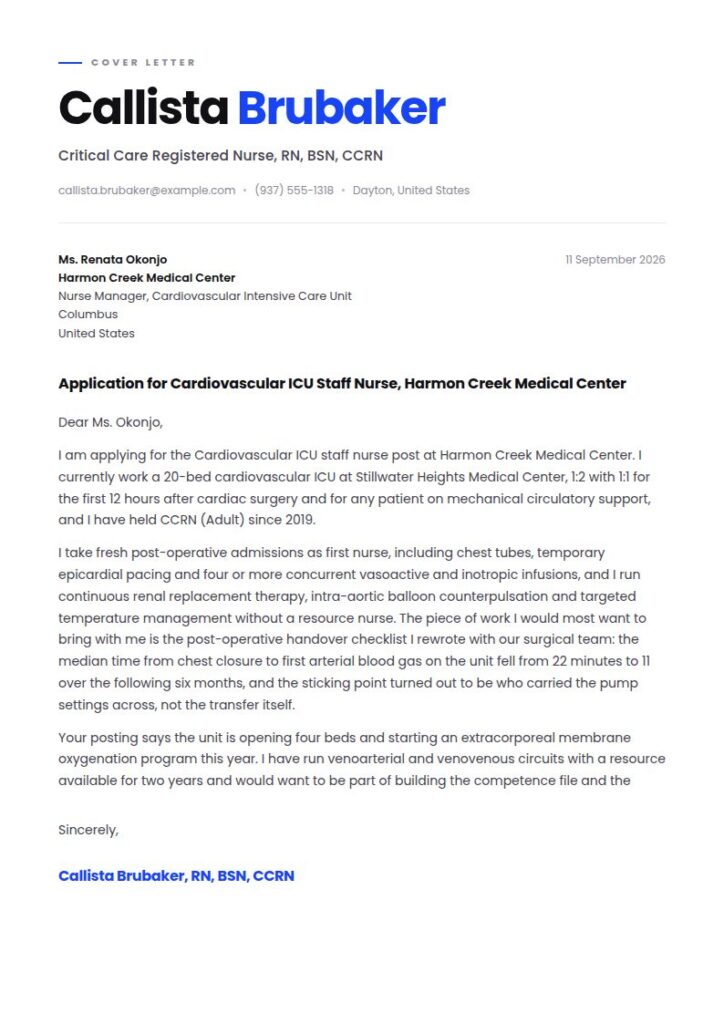
I am applying for the Cardiovascular ICU staff nurse post at Harmon Creek Medical Center. I currently work a 20-bed cardiovascular ICU at Stillwater Heights Medical Center, 1:2 with 1:1 for the first 12 hours after cardiac surgery and for any patient on mechanical circulatory support, and I have held CCRN (Adult) since 2019.
I take fresh post-operative admissions as first nurse, including chest tubes, temporary epicardial pacing and four or more concurrent vasoactive and inotropic infusions, and I run continuous renal replacement therapy, intra-aortic balloon counterpulsation and targeted temperature management without a resource nurse. The piece of work I would most want to bring with me is the post-operative handover checklist I rewrote with our surgical team: the median time from chest closure to first arterial blood gas on the unit fell from 22 minutes to 11 over the following six months, and the sticking point turned out to be who carried the pump settings across, not the transfer itself.
Your posting says the unit is opening four beds and starting an extracorporeal membrane oxygenation program this year. I have run venoarterial and venovenous circuits with a resource available for two years and would want to be part of building the competence file and the orientation for it, which is the part I have done before: I wrote the two-day continuous renal replacement therapy orientation now used for every new critical care hire on my unit.
My Ohio license is active with a compact multistate privilege, my ACLS is current, and I precept, so I could take a new hire from week one. I can give six weeks' notice. Thank you for your time.
Sincerely, Callista Brubaker, RN, BSN, CCRN
Openings that work
| Instead of | Use |
|---|---|
| I am passionate about caring for critically ill patients | I work a 20-bed cardiovascular ICU at 1:2 with 1:1 for the first 12 hours post-operatively |
| I am writing to express my interest in your ICU position | I am applying for the Cardiovascular ICU staff nurse post and I have held CCRN since 2019 |
| I have strong critical care skills and work well under pressure | I run CRRT, intra-aortic balloon counterpulsation and targeted temperature management without a resource nurse |
| I would be a great addition to your team | Your posting says the unit is opening four beds and starting an ECMO program this year |
What counts as evidence in critical care
| Kind of evidence | What it looks like in a sentence |
|---|---|
| Acuity | Twenty-four bed medical ICU, 1:2 with regular 1:1, roughly 40 percent of patients ventilated |
| Device volume | Roughly 60 continuous renal replacement therapy circuit days a year, including filter changes |
| A protocol you changed | Median chest closure to first arterial blood gas fell from 22 minutes to 11 across six months |
| Teaching | Precepted 11 nurses through a 14-week orientation, 9 still on the unit |
| Competence spread | Independent CRRT competence across unit nurses rose from 34 percent to 81 percent in two years |
| Hours | 1,180 direct critical care hours accrued toward CCRN eligibility as of September 2026 |
Your employer pool is smaller than the occupation suggests
Hospitals, state, local and private, employ 59 percent of registered nurses at a median annual wage of $100,220, against 19 percent in ambulatory healthcare services at $91,230 and 6 percent in nursing and residential care facilities at $84,300 (BLS Occupational Outlook Handbook, Registered Nurses, May 2025).
Registered nursing overall is projected to grow 6 percent from 2025 to 2035, with about 180,800 openings a year (BLS, 2025 to 2035 projections). The occupation is large and growing, but intensive care exists almost entirely inside that 59 percent, and within it inside a handful of units per hospital.
Moving into critical care from another unit
Say in the first paragraph that you are applying for a critical care orientation, because that is the budget line the manager is weighing. List the critical care content you already have: ventilated or tracheostomy patients, titrated infusions, arterial lines, telemetry, rapid response and code attendance. Name any critical care course you have completed and any ICU shifts you have floated. Give the ratio you carry now so they can compare it to theirs.
Do not apologize for your background; step-down and emergency nursing are the two most common routes into an ICU. Do not claim device independence you cannot evidence, because a competence file follows you. Do not describe yourself as a fast learner in place of naming what you have already learned. Do not send the same letter to a medical, a neurological and a cardiovascular ICU without changing the device list.
Length, format and sending it
One page, four paragraphs, 250 to 400 words. PDF unless the portal insists otherwise, named for yourself and the post: callista-brubaker-cvicu-staff-nurse-cover-letter.pdf.
Address the nurse manager by name. Unit leadership is usually public on the posting itself, and "Dear Hiring Manager" on an otherwise specific letter reads like a file sent to twelve hospitals.
Keep the figures identical to the ones on your resume. Our ICU nurse resume example is written with the same unit profile, device block and numbers used here.
Key takeaways
- Name the unit type, bed count and ratio in the first two lines.
- Give your CCRN status, or your accrued critical care hours and the date you will apply.
- List the devices you run without a resource nurse, and be honest about the rest.
- Pick one number that moved and say over what period it moved.
- Name one real thing about their unit, taken from the posting or their own pages.
- Say whether your license carries a compact multistate privilege and when you can start.
- Address the nurse manager by name and keep it to one page.
Write your ICU nurse cover letter in 10 minutes with our AI cover letter builder.
ICU nurse cover letter questions, answered
How long should an ICU nurse cover letter be?
One page, four paragraphs, 250 to 400 words. Managers read these between rounds and handovers, and length does not read as effort.
Do I need a cover letter if the hospital application is a portal?
Attach one wherever there is a field for it. The portal collects the same structured data from every applicant. The letter is the only place you can say what you run independently, what you do not, and how long your orientation would realistically be.
What do I write if I am not CCRN certified yet?
Write the hours. The American Association of Critical-Care Nurses requires either 1,750 direct care hours with acutely or critically ill adult patients in the previous two years, with 875 in the most recent year, or 2,000 such hours in the previous five years with 144 in the most recent year, alongside a current unencumbered United States RN or APRN license (AACN, CCRN Adult eligibility, checked September 2026). Stating where you are against that bar is a stronger sentence than certification silence.
How do I write to a unit I have never seen?
Read the posting properly, then the unit's own page. Bed count, program lines such as mechanical circulatory support or targeted temperature management, any recent expansion, and whether they are a referral center for anything. One accurate sentence about what they actually do beats a paragraph of admiration, and it is the part nobody can copy into their next letter.
Should I mention pay or shift preference in the letter?
Shift yes, pay no. Saying you will work nights, weekends or a rotating schedule answers a real staffing question and is often the reason a file gets a call. Pay belongs in the conversation with the recruiter, after the manager has decided they want you.