Home Health Aide Perpetua Navarrete
Home Health Aide
[email protected] | (520) 555-1342 | Tucson, United States
Profile
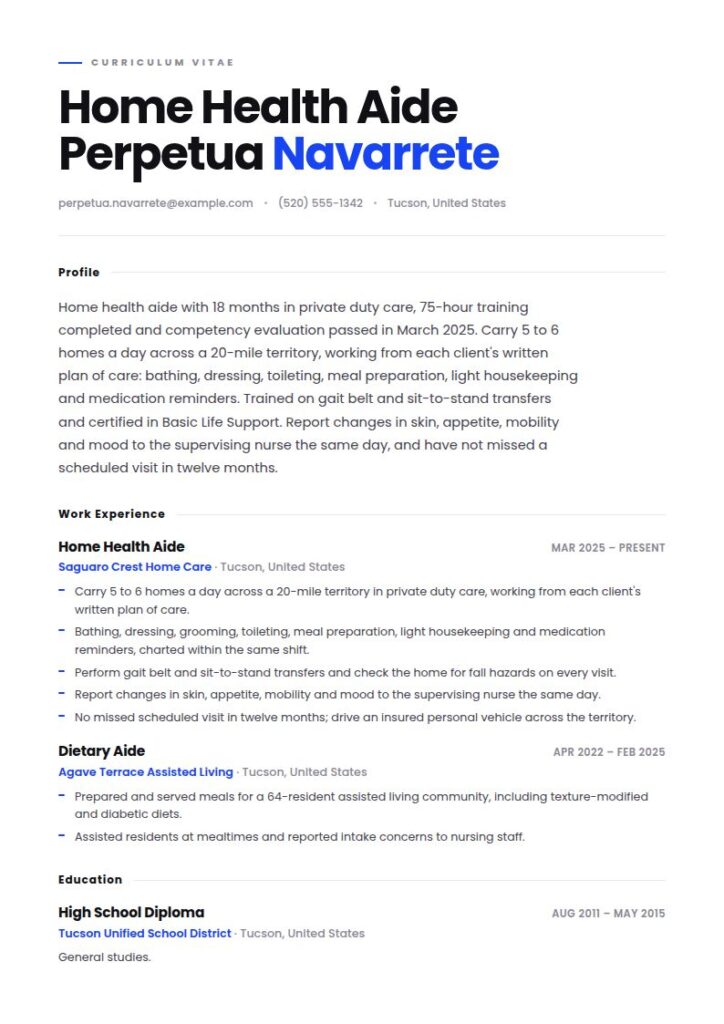
Home health aide with 18 months in private duty care, 75-hour training completed and competency evaluation passed in March 2025. Carry 5 to 6 homes a day across a 20-mile territory, working from each client's written plan of care: bathing, dressing, toileting, meal preparation, light housekeeping and medication reminders. Trained on gait belt and sit-to-stand transfers and certified in Basic Life Support. Report changes in skin, appetite, mobility and mood to the supervising nurse the same day, and have not missed a scheduled visit in twelve months.
Work Experience
03/2025 - Present, Home Health Aide, Saguaro Crest Home Care, Tucson, United States
- Carry 5 to 6 homes a day across a 20-mile territory in private duty care, working from each client's written plan of care.
- Bathing, dressing, grooming, toileting, meal preparation, light housekeeping and medication reminders, charted within the same shift.
- Perform gait belt and sit-to-stand transfers and check the home for fall hazards on every visit.
- Report changes in skin, appetite, mobility and mood to the supervising nurse the same day.
- No missed scheduled visit in twelve months; drive an insured personal vehicle across the territory.
04/2022 - 02/2025, Dietary Aide, Agave Terrace Assisted Living, Tucson, United States
- Prepared and served meals for a 64-resident assisted living community, including texture-modified and diabetic diets.
- Assisted residents at mealtimes and reported intake concerns to nursing staff.
Education
08/2011 - 05/2015, High School Diploma, Tucson Unified School District, Tucson, United States
General studies.
Skills
Plan of care charting, 70
Bathing, dressing and toileting assistance, 85
Gait belt and sit-to-stand transfers, 75
Medication reminders and recording, 75
Meal preparation and special diets, 85
Change in condition reporting, 70
Infection control in the home, 75
Languages
English, native
Spanish, native
Certificates
11/2024, Home Health Aide Training Program, 75 hours, Tucson Allied Health Institute
16 hours of classroom training preceding 16 hours of supervised practical training, meeting the 75-hour total at 42 CFR 484.80.
03/2025, Home Health Aide Competency Evaluation, Saguaro Crest Home Care, registered nurse evaluator
Competency evaluation program completed as required at 42 CFR 484.80, including observed performance of transfers, vital signs and personal hygiene tasks.
01/2026, Basic Life Support Provider, American Heart Association
Summary
A home health aide resume is a one page document proving two things: that you clear the federal training floor at 42 CFR 484.80, and that you can be trusted alone in someone's home. This guide gives you three adaptable versions, the charting, transfer and escalation lines that agencies hire on, and current Bureau of Labor Statistics pay and outlook.
Home Health Aide resume examples by experience level
In short, a home health aide resume is a one page document proving two separate things: that you clear the federal training floor, and that an agency can trust you alone in a house where nobody is watching.
Most healthcare jobs, for example, happen in a building with colleagues down the corridor. This one, however, happens in a kitchen, a bathroom and a bedroom, with a schedule, a car and a plan of care. In practice, the scheduler reading your resume is deciding whether to send you into somebody's home alone on Monday morning, so the page should answer that question.
Resume guide for a home health aide resume
Specifically, this guide and the corresponding home health aide resume example will cover:
- How to write a home health aide resume, section by section
- The federal training requirements an agency has to document for you
- Three adaptable summaries: new, experienced and lead aide
- What the job market looks like and what you can expect to earn
How to write a home health aide resume
Overall, it takes six sections: contact header, summary, training and competency, home care experience, the skills block, and driving and availability. One page, almost always.
Training goes near the top because it is a gate. An agency that bills Medicare cannot send you out until your file is complete, so a resume that answers that question first moves ahead of one that does not.
| Section | What it is answering | Where it goes |
|---|---|---|
| Training and competency evaluation | Can this person be put on a Medicare-certified case? | Directly under the summary |
| Caseload and setting | How many homes, how far apart, what kind of care? | In every employer line |
| Transfers and mobility | Can they move someone safely alone? | Its own bullet, with the equipment named |
| Driving and territory | Can they cover the schedule we have? | Own block near the end |
Put the training hours and the competency date on the page
Federal rules set a floor. Under 42 CFR 484.80, "classroom and supervised practical training must total at least 75 hours," with a minimum of 16 hours of classroom training preceding a minimum of 16 hours of supervised practical training, and an individual may furnish home health services on behalf of an agency "only after that individual has successfully completed a competency evaluation program" (Code of Federal Regulations, current September 2026).
The same section requires "at least 12 hours of in-service training during each 12-month period." So write three lines: the program and its hours, the month you passed the competency evaluation, and your current in-service year with the hours completed.
States may require more than the federal floor and some run their own registry, so name your state's requirement too. What you must not do is leave it blank, because the agency has to ask before they can do anything else with your file.
Run the finished file through the ATS resume checker before you send it. Larger agencies parse applications into a structured record before a person reads them.
Choosing the best resume format for a home health aide resume
Reverse chronological, one page. Agency name, city, the kind of agency, your caseload and dates, then three to five bullets that each name a task and carry a number.
First, say what kind of agency it was. After all, a Medicare-certified home health agency, a private duty agency, a hospice, a Medicaid waiver program and an assisted living community use the same job title for very different days.
Include your contact information
| ✅ Right | ❌ Wrong |
|---|---|
| Perpetua Navarrete | Perpetua Navarrete |
| Home Health Aide, 75-hour training and competency evaluation | Caring and compassionate caregiver |
| Valid driver's license, insured vehicle, 40-mile territory | Reliable transportation |
| (520) 555-1342, [email protected], Tucson, AZ | (520) 555-1342, [email protected] |
Similarly, "reliable transportation" is the most common line on these resumes and the least useful. Because a scheduler is building a route, give the license, the insurance, the radius and the days you will drive it.
Make use of a summary
Overall, use four lines: training status, the caseload you carry, two or three things you do that need judgment, and one thing nobody has had to tell you twice.
Home health aide with 18 months in private duty care, 75-hour training completed and competency evaluation passed in March 2025. Carry 5 to 6 homes a day across a 20-mile territory, working from each client's written plan of care: bathing, dressing, toileting, meal preparation, light housekeeping and medication reminders. Trained on gait belt and sit-to-stand transfers and certified in Basic Life Support. Report changes in skin, appetite, mobility and mood to the supervising nurse the same day, and have not missed a scheduled visit in twelve months.
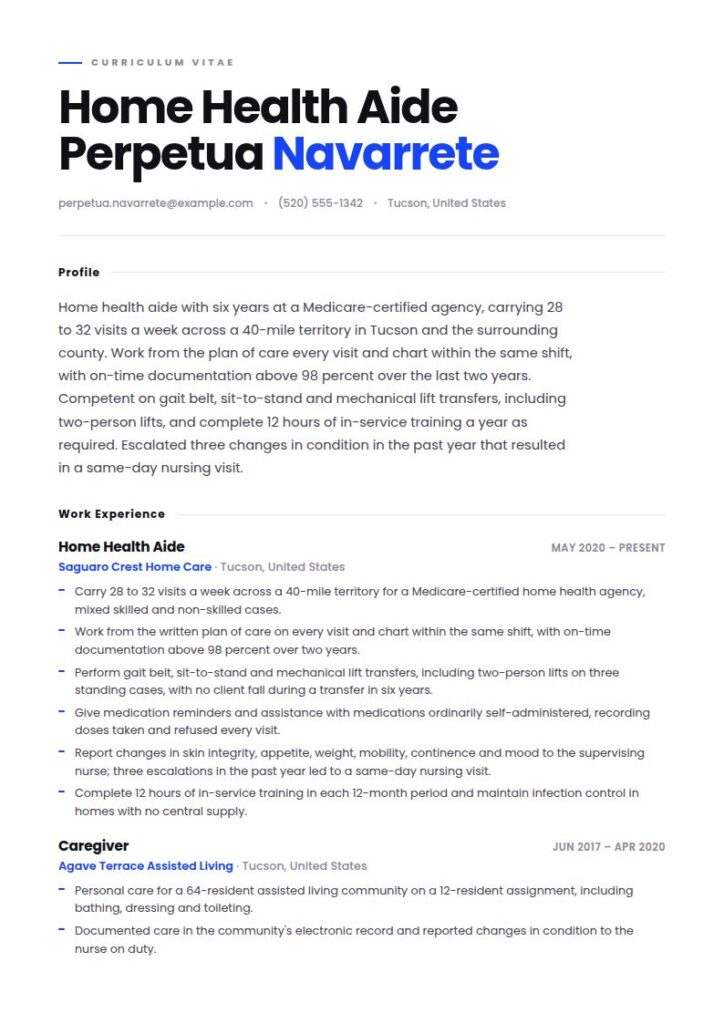
Home health aide with six years at a Medicare-certified agency, carrying 28 to 32 visits a week across a 40-mile territory in Tucson and the surrounding county. Work from the plan of care every visit and chart within the same shift, with on-time documentation above 98 percent over the last two years. Competent on gait belt, sit-to-stand and mechanical lift transfers, including two-person lifts, and complete 12 hours of in-service training a year as required. Escalated three changes in condition in the past year that resulted in a same-day nursing visit.
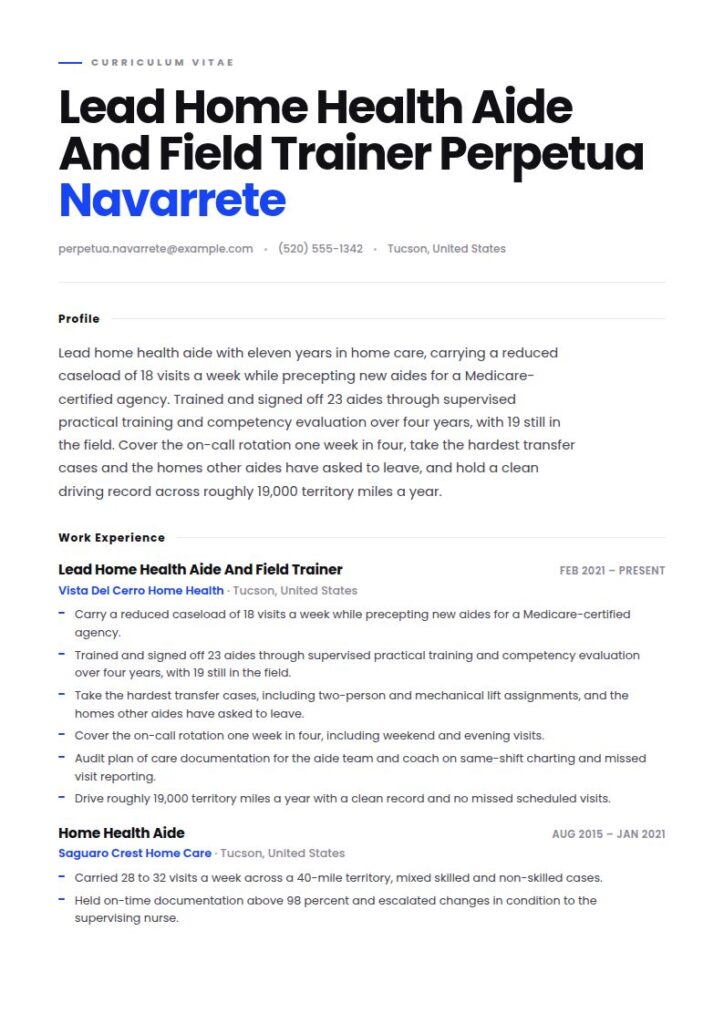
Lead home health aide with eleven years in home care, carrying a reduced caseload of 18 visits a week while precepting new aides for a Medicare-certified agency. Trained and signed off 23 aides through supervised practical training and competency evaluation over four years, with 19 still in the field. Cover the on-call rotation one week in four, take the hardest transfer cases and the homes other aides have asked to leave, and hold a clean driving record across roughly 19,000 territory miles a year.
Right vs wrong: the same home health aide summary, twice
| ✅ Right | ❌ Wrong |
|---|---|
| 75-hour training completed and competency evaluation passed in March 2025. | Certified home health aide with proper training. |
| Carry 28 to 32 visits a week across a 40-mile territory. | Provide care to multiple clients in their homes. |
| Competent on gait belt, sit-to-stand and mechanical lift transfers, including two-person lifts. | Assist clients with mobility and daily living activities. |
| Escalated three changes in condition in the past year that resulted in a same-day nursing visit. | Report concerns to the nursing supervisor as needed. |
The right column tells a scheduler what happens when an agency sends you to a house alone. By contrast, someone who has never done a solo visit could have written the left column.
Outline your experience
Then list agency, city, kind of agency, caseload and territory, dates. Then three to five bullets, each naming a task and carrying a number, a frequency or an outcome.
| Instead of | Use |
|---|---|
| Provided personal care to clients | Carry 28 to 32 visits a week, working from each written plan of care |
| Traveled between clients | Drive a 40-mile territory, roughly 19,000 miles a year, no missed visits in twelve months |
Home Health Aide, Saguaro Crest Home Care, Tucson, AZ, Medicare-certified home health agency, 28 to 32 visits a week across a 40-mile territory, May 2020 to Present
Work from the written plan of care every visit: bathing, dressing, toileting, transfers, ambulation, meal preparation, light housekeeping and medication reminders.
Chart against the plan of care within the same shift, on-time documentation above 98 percent over two years, and report any missed visit the same day.
Perform gait belt, sit-to-stand and mechanical lift transfers, including two-person lifts on three standing cases, with no client fall during a transfer in six years.
Report changes in skin integrity, appetite, weight, mobility, continence and mood to the supervising nurse; three escalations in the past year led to a same-day nursing visit.
Maintain infection control in homes with no central supply: hand hygiene, clean bag technique, glove use by task, separate laundry and sharps kept in the client's own container.
Clear the federal training floor, then show you can be trusted alone in a house
In fact, this is the section no other healthcare resume needs, and it is six things. Five come out of the federal rule that surveyors check an agency against, while the sixth is the car.
One: the training floor and the competency evaluation. Under 42 CFR 484.80, classroom and supervised practical training "must total at least 75 hours," a minimum of 16 hours of classroom training must precede a minimum of 16 hours of supervised practical training, and nobody may furnish home health services on behalf of an agency until they have "successfully completed a competency evaluation program" (Code of Federal Regulations, current September 2026). Write the program name, the hours, the month you passed, and your state's requirement if it sits above the floor.
Two: in-service hours and supervision, with dates. The same section requires "at least 12 hours of in-service training during each 12-month period." Supervision is also on a clock: for patients receiving skilled services a registered nurse or other appropriate skilled professional must complete a supervisory assessment "no less frequently than every 14 days," for patients not receiving skilled services "the registered nurse must make an onsite, in person visit every 60 days," and each aide must be observed on site at least annually. Put your in-service hours on the page and say when a supervisor last observed you. Surveyors check agencies on exactly these dates, and an applicant who volunteers them has clearly worked from a compliant file before.
Plan of care and medication boundaries
Three: the plan of care, and charting against it. In a home there is no chart on a wall and no colleague to ask. The plan of care is the instruction set, and your notes are the only record that the visit happened as written. Say how quickly you chart, what you do when you cannot complete a task, and how you report a missed visit. On-time documentation is a number your agency tracks, so use it.
Four: reminders versus administration. This boundary separates an aide who has been trained from one who has not, and it belongs in plain words on the page. The federal duties list includes "assistance in administering medications ordinarily self-administered" (42 CFR 484.80). That is not the same as administering medication, and not the same as deciding a dose. Write what you do: reminders at the scheduled time, opening a container where permitted, reading a label aloud, recording what was taken and refused, and telling the nurse when the client keeps missing doses. Never imply you make clinical decisions in the home.
Five: transfers, infection control and escalation. Name the equipment, because "assisted with mobility" tells nobody anything: gait belt, sit-to-stand, mechanical lift, one-person versus two-person, and what you decline to attempt alone. Then infection control in a house with no central supply: hand hygiene, bag technique, glove use by task, laundry and sharps. Then escalation, the most valuable judgment an aide has. Say what you report to the supervising nurse and how fast, by type rather than by person: skin breakdown, a change in appetite or weight, a new confusion, a near fall, an empty fridge, a family caregiver who is no longer coping.
Six: driving, mileage and territory. The car is part of the job and belongs on the page as a fact, not an afterthought. Give the license and state, the insurance, the radius, the miles a year and your reliability record. If an agency reimburses your mileage, know the number: the Internal Revenue Service set the 2026 business standard mileage rate at 72.5 cents per mile, effective 1 January 2026 (IRS, Notice 2026-10). An aide who can say what a territory costs to drive will not quietly leave in month three.
Training: 75-hour program, 16 hours classroom before 16 hours supervised practical; competency evaluation passed March 2025; 12 hours in-service completed this period; last on-site supervisory observation January 2026
Caseload: 28 to 32 visits a week, 6 to 7 homes a day, Medicare-certified agency, mixed skilled and non-skilled cases
Personal care: bathing, dressing, grooming, toileting and continence care, feeding assistance, ambulation
Transfers: gait belt, sit-to-stand, mechanical lift, two-person lifts on three standing cases; no client fall during a transfer in six years
Medications: reminders and assistance with medications ordinarily self-administered; doses taken and refused recorded every visit
Infection control: hand hygiene, clean bag technique, glove use by task, separate laundry, sharps in the client's own container
Driving: valid Arizona license, insured vehicle, 40-mile territory, roughly 19,000 miles a year, no missed scheduled visits in twelve months
Build a snapshot of your key skills
In practice, that means twelve to sixteen entries in four groups. Use concrete tasks and named equipment instead of adjectives.
Personal care: Bathing and showering assistance, Dressing and grooming, Toileting and continence care, Feeding assistance, Oral care, Skin checks
Mobility and safety: Gait belt transfers, Sit-to-stand transfers, Mechanical lift operation, Two-person transfers, Fall prevention and home hazard checks
Home and household: Meal preparation and special diets, Light housekeeping, Laundry, Errands, Infection control without central supply
Documentation and reporting: Plan of care charting, Same-shift documentation, Change in condition reporting, Missed visit reporting, HIPAA privacy in a home
List your education and training
High school diploma or equivalent is the typical entry requirement and the typical on-the-job training is short-term (BLS Occupational Outlook Handbook, 27 August 2026), so the training block is where this resume is won.
Home Health Aide Training Program, 75 hours, Tucson Allied Health Institute, Tucson, AZ, 2020. Competency evaluation passed March 2025.
High School Diploma, Tucson, AZ, 2015
Training and certifications: Basic Life Support Provider, American Heart Association, 2026. Mechanical lift and two-person transfer training, 2022, renewed 2025. Dementia care in the home, 16 hours, 2024. Infection control in home settings, 2023. Annual HIPAA privacy training, current. Background check and fingerprint clearance, current.
In-service: 12 hours completed in the current 12-month period, as required at 42 CFR 484.80.
Choose the right layout and design
Finally, keep a single column, plain type at 11 or 12 point, clear headings, no photograph. Agency portals parse the file before a scheduler opens it, and two columns, text boxes and graphics are where that parsing breaks. Put availability near the top: home care schedules are built around weekends, early mornings, evenings and on-call, and the applicant who states real availability in one line is easier to hire than the one the office has to phone.
Put the 75-hour training and competency evaluation date near the top. State your in-service hours and when you were last observed on site. Name the transfer equipment you are competent on. Write medication reminders and assistance precisely. Give the territory in miles and the days you drive it. Say what you report to the supervising nurse and how fast.
Do not describe yourself as compassionate, caring or a natural caregiver; every resume for this job does. Do not write "administered medications" unless that is genuinely within your scope, because it is the line an interviewer checks first. Do not name a client, give initials, name a street or describe a household well enough to identify it. Do not claim nursing tasks such as wound care, injections or catheter changes.
Home health aide job market and outlook
One of the largest and fastest-growing occupations in the federal projections, and the source of more annual openings than almost any other.
| Measure, home health and personal care aides | Value |
|---|---|
| Jobs, 2025 | 4,677,100 |
| Projected employment, 2035 | 5,524,400 |
| Projected change, 2025-35 | 18 percent, much faster than average, +847,300 |
| Projected annual openings | About 760,500 |
| Typical entry-level education | High school diploma or equivalent |
| Typical on-the-job training | Short-term on-the-job training |
| Median annual wage, May 2025 | $35,800, or $17.21 per hour |
Source: U.S. Bureau of Labor Statistics, Occupational Outlook Handbook, May 2025 wages and 2025-35 projections, 27 August 2026.
760,500 openings a year, and the trained half is a different market
Employment of home health and personal care aides is projected to grow 18 percent from 2025 to 2035, much faster than average, adding 847,300 jobs, with about 760,500 openings a year over the decade (BLS Occupational Outlook Handbook, 2025-35 projections, published 27 August 2026).
That volume is why the training line matters. BLS notes that aides working for certified home health or hospice agencies must complete formal training and pass a standardized test (BLS Occupational Outlook Handbook, May 2025), and most of the 4,677,100 people in this occupation are not in that group. A documented 75-hour program and a passed competency evaluation puts you in a smaller pool than the headline number suggests.
It also changes which jobs you can take: home healthcare services pays a median of $36,230 against $34,900 in individual and family services, the largest employer at 51 percent of the occupation (BLS, May 2025).
Where the jobs sit:
| Industry | Share of employment | Median annual wage (May 2025) |
|---|---|---|
| Individual and family services | 51% | $34,900 |
| Home healthcare services | 23% | $36,230 |
| Residential intellectual and developmental disability facilities | 6% | $37,340 |
| Continuing care retirement communities and assisted living facilities | 6% | $37,060 |
Source: U.S. Bureau of Labor Statistics, Occupational Outlook Handbook, May 2025.
What salary you can expect as a home health aide
Overall, the median annual wage for home health and personal care aides was $35,800 as of May 2025, or $17.21 an hour, with the lowest 10 percent under $27,040 and the highest 10 percent over $45,040 (BLS Occupational Outlook Handbook, May 2025).
The band is narrow, but the ways through it are specific. Work for a certified agency rather than a private arrangement, since home healthcare services pays a median of $36,230 against $34,900 in individual and family services (BLS, May 2025). First, take the shifts that are hard to fill: weekends, early mornings, evenings, on-call and the long-drive rural cases. Take the harder cases, because an aide competent on mechanical lift and two-person transfers can go where others cannot.
Then check what sits around the pay. Also, mileage reimbursement is real money here, and the Internal Revenue Service set the 2026 business standard mileage rate at 72.5 cents per mile, effective 1 January 2026 (IRS, Notice 2026-10). Paid travel time between visits, guaranteed hours, paid in-service training and agency-funded lift training change what the job is worth more than a fifty-cent difference in the hourly rate.
Key takeaways for a home health aide resume
- Above all, put the 75-hour training total and the competency evaluation date near the top.
- State current in-service hours and when a supervisor last observed you on site.
- Then give caseload and territory: visits a week, homes a day, miles.
- Also name the transfer equipment you are competent on, and what you decline to do alone.
- Similarly, write medication reminders and assistance precisely; never claim administration.
- In addition, show escalation to the supervising nurse with a frequency and an outcome type.
- Finally, give the license, insurance, radius and reliability record instead of "reliable transportation".
Build your home health aide resume in 15 minutes with our AI resume builder.
Related medical resume examples
- CNA resume
- Nursing assistant resume
- Licensed practical nurse resume
- LVN resume
- Nursing home resume
- Medical assistant resume
- Medical social worker resume
- Physical therapist assistant resume
- Occupational therapist resume
- Health educator resume
- Nurse resume
- Healthcare resume
Pair it with a matching home health aide cover letter.
Home health aide resume questions, answered
How long should a home health aide resume be, and do I need certification?
One page: the training block, one or two agencies with caseload and territory, the skills block and availability will fill it. Whether you need certification depends on who is paying. For an aide working for a Medicare-certified home health agency, 42 CFR 484.80 requires at least 75 hours of classroom and supervised practical training, a successfully completed competency evaluation program, and at least 12 hours of in-service training each 12-month period (Code of Federal Regulations, current September 2026). Private pay arrangements may not require it, and some states set higher requirements or run a registry.
What do I put on a home health aide resume with no experience?
The training first: the program, the hours, the competency evaluation date. Then any unpaid caregiving, written as work rather than family history: hours a week, the tasks, how long it ran. Then the facts a scheduler needs, which are license, insurance, territory and the days and hours you can work. An agency will train tasks; it cannot train someone who does not turn up.
Can I write about a client on my resume?
No name, no initials, no street, no household detail specific enough to identify anyone. Describe the work and the group: number of homes, types of case, the equipment, the tasks. "Three standing two-person transfer cases" is useful and anonymous. A story about somebody's living room is neither.
Should I say I can administer medication?
Only if it is genuinely within your scope, and most aides should not write it. The federal duties list at 42 CFR 484.80 includes "assistance in administering medications ordinarily self-administered," which is reminders, assistance and recording, not deciding or giving a dose. Writing it accurately shows you were trained properly; overstating it is the fastest way to fail an interview question.
Does an employer care how far I will drive?
More than almost anything else on the page. Home care schedules are routes, and an aide who covers a wide territory reliably is worth more than one who is slightly better at the care and only takes visits within two miles. Give the radius, the miles a year and your record of missed visits.