Physical Therapist, Skilled Nursing Rafael Duquesne PT, DPT
Physical Therapist, Skilled Nursing
[email protected] | (503) 555-0793 | Gresham, United States
Profile
Physical therapist licensed in Oregon since August 2019, DPT from a CAPTE-accredited program, working a skilled nursing caseload of 9 to 11 treatment visits a day at a 90% productivity standard. Document Section GG self-care and mobility items, Berg Balance Scale and Timed Up and Go at evaluation and discharge. Supervise one physical therapist assistant and co-treat with occupational therapy twice weekly. BLS current; completed 54 hours of manual therapy continuing education in the first year of practice.
Work Experience
08/2019 - Present, Physical Therapist, Skilled Nursing, Thornfield Post-Acute Center, Gresham, United States
- 44-bed skilled nursing unit, 9 to 11 treatment visits a day against a 90% productivity standard.
- Document Section GG self-care and mobility items, Berg Balance Scale and Timed Up and Go at evaluation and discharge.
- Direct one physical therapist assistant and co-treat with occupational therapy twice weekly.
- Completed 54 hours of manual therapy continuing education in the first year of practice.
06/2014 - 05/2016, Rehabilitation Aide, Fernhollow Physical Therapy, Portland, United States
- Worked 16 hours a week through the kinesiology degree in a four-therapist outpatient clinic.
- Set up treatment areas, managed equipment cleaning and turnover, and handled scheduling at the front desk.
Education
08/2016 - 05/2019, Doctor of Physical Therapy, Physical Therapy, Greenlaw University, Portland, United States
CAPTE-accredited program. Terminal clinical education in outpatient orthopedics and skilled nursing.
09/2012 - 06/2016, Bachelor of Science, Kinesiology, Quarrier State University, Eugene, United States
Worked as a rehabilitation aide throughout the degree.
Skills
Gait and transfer training, 80
Balance and fall risk assessment, 78
Section GG self-care and mobility items, 80
Berg Balance Scale and Timed Up and Go, 82
Therapeutic exercise progression, 75
Durable medical equipment fitting, 72
Defensible documentation, 70
PTA direction and supervision, 65
Languages
English, native
French, native
Spanish, intermediate
Certificates
08/2019, Physical Therapy License, Oregon #PT-10442, Oregon Board of Physical Therapy, PT-10442
Current through March 2027. National Physical Therapy Examination passed July 2019.
06/2019, Basic Life Support (BLS) for Healthcare Providers, American Heart Association
Renewed 2025, expires May 2027.
Summary
A physical therapist resume is a one to two page document naming your DPT and its accreditation, your license and compact status, the setting you practice in, the caseload you carry and the outcome measures you use. This guide gives you three adaptable versions, a setting block most applicants leave out, and current Bureau of Labor Statistics pay and outlook for the occupation.
Physical Therapist resume examples by experience level
A physical therapist resume is a one to two page document that names your DPT and where it was accredited, your license and any compact privilege, the setting you practice in, the caseload you carry at what productivity expectation, and the standardized outcome measures you actually document.
However, what it is not is a collection of recovery stories. In other words, nothing that could identify anyone you have treated belongs on the page: no age, no diagnosis, no sport, no occupation, no timeline of a single episode of care, and no anonymized version of any of those. Instead, describe the caseload, not anyone in it. That rule comes before everything else here.
Resume guide for a physical therapist resume
To help, this guide and the corresponding physical therapist resume example will cover:
- How to write a physical therapist resume, section by section
- Why the setting block belongs on the page and where to put it
- Three adaptable summaries: new graduate, practicing clinician and clinic lead
- Caseload, productivity and the outcome measures each setting wants
- What the job market looks like and what you can expect to earn
How to write a physical therapist resume
Overall, it takes six sections: contact header, summary, license and certifications, setting and caseload, clinical experience, and education. As for length, use one page for your first three years, two once you carry a specialist certification, a mentorship load or a clinic.
License and degree come before experience because they are gates. In fact, all states require physical therapists to be licensed, which includes passing a qualifying exam (BLS Occupational Outlook Handbook, accessed September 2026), and the qualifying exam is the National Physical Therapy Examination administered by the Federation of State Boards of Physical Therapy.
| Section | What it is answering | Where it goes |
|---|---|---|
| License and compact privilege | Can this person be credentialed, and in which states? | Directly under the summary |
| Degree and accreditation | Did they graduate from a CAPTE-accredited program? | With the license, not at the bottom |
| Setting and caseload | Have they carried a load like ours, at our productivity? | Its own block above the bullets |
| Clinical experience | What did they measure, and what moved? | Reverse chronological, with measures named |
Describe the caseload, never anyone in it
Physical therapy is an outcomes profession, and the outcomes that feel most persuasive are the ones attached to a single person. Those are exactly the ones you cannot write down.
Anything identifying about anyone you have treated is protected health information. A resume is an uncontrolled document: it goes through vendor portals, recruiter inboxes and forwarded email. An age plus a diagnosis plus a sport is an identification in a small town, and so is a photograph from a clinic, a date of surgery, or a story detailed enough that one person could recognize themselves in it.
Write in aggregate and in instruments instead. "Outpatient orthopedic caseload of 12 to 14 visits a day, roughly 60% post-operative knee and shoulder, with LEFS and QuickDASH collected at evaluation, four weeks and discharge; 78% of episodes met the minimal clinically important difference on the primary measure over the last two quarters" is far stronger than any single account, and it identifies nobody.
Run the finished file through the ATS resume checker before you submit. Large rehabilitation groups and hospital systems parse applications into a structured record first.
Choosing the best resume format for a physical therapist resume
Reverse chronological. In practice, use one page for your first three years, two once you hold a specialist certification, supervise physical therapist assistants or students, or run a clinic.
By contrast, a functional format fails here for a specific reason: settings are not interchangeable, and a clinic director reads your history to work out which ones you have carried and in what order. For example, outpatient orthopedic, acute care, inpatient rehabilitation, skilled nursing, home health and neurologic rehabilitation each have different visit structures, documentation burdens and productivity expectations. As a result, a format that blurs which you were in hides the only thing the reader wanted.
Include your contact information
| ✅ Right | ❌ Wrong |
|---|---|
| Rafael Duquesne, PT, DPT, OCS | Rafael Duquesne |
| Outpatient Orthopedic Physical Therapist | Caring therapist devoted to helping people move again |
| Oregon PT License #PT-10442; PT Compact privilege | Licensed physical therapist |
| (503) 555-0793, [email protected], Portland, OR | (503) 555-0793, [email protected] |
Credentials go after your name in the order the American Physical Therapy Association uses: profession, then degree, then specialist certification. Also, put the license number on the page; state boards verify it publicly, and a credentialing team that can check it in ten seconds moves your file first.
Make use of a summary
First, write four lines: license and specialist certification, setting, caseload with productivity, and one aggregate outcome with the instrument named.
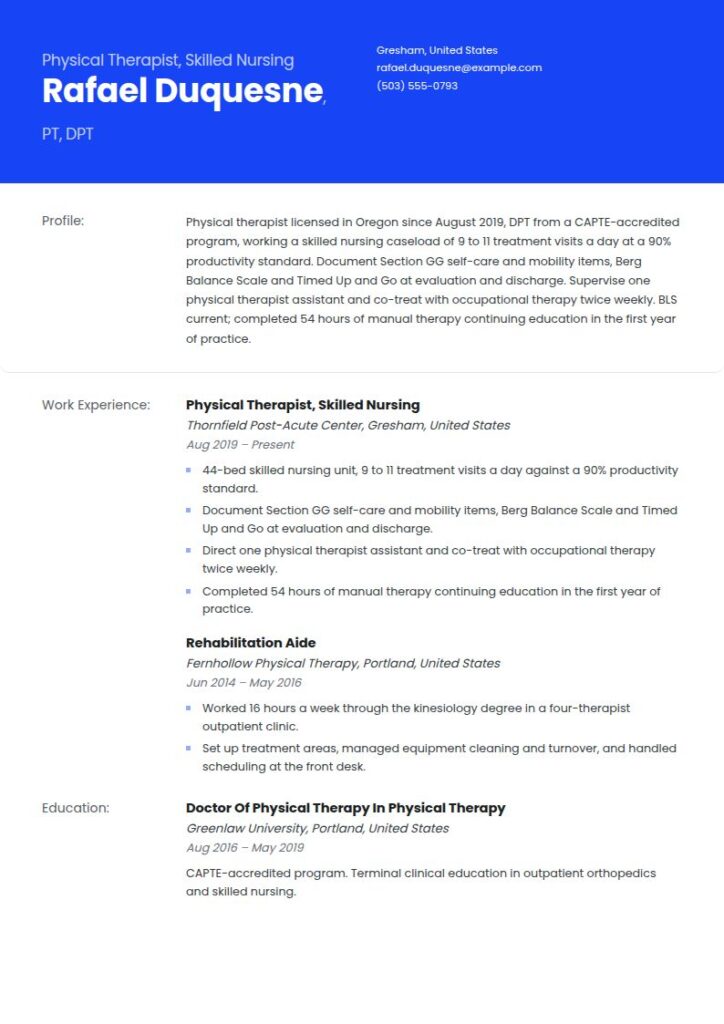
Physical therapist licensed in Oregon since August 2019, DPT from a CAPTE-accredited program, working a skilled nursing caseload of 9 to 11 treatment visits a day at a 90% productivity standard. Document Section GG self-care and mobility items, Berg Balance Scale and Timed Up and Go at evaluation and discharge. Supervise one physical therapist assistant and co-treat with occupational therapy twice weekly. BLS current; completed 54 hours of manual therapy continuing education in the first year of practice.
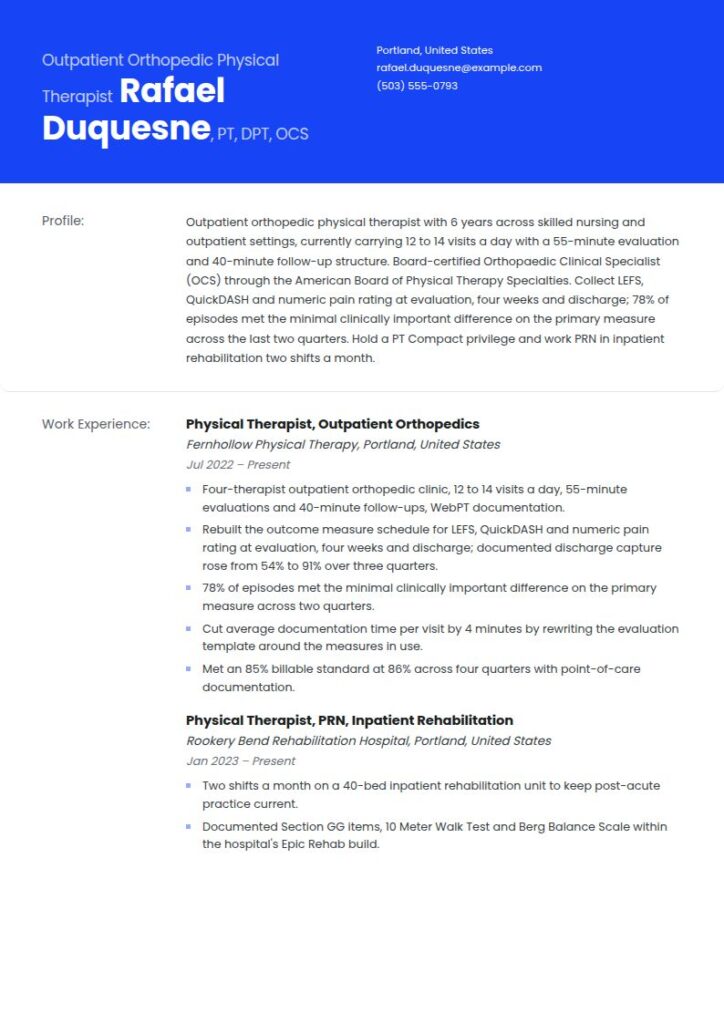
Outpatient orthopedic physical therapist with 6 years across skilled nursing and outpatient settings, currently carrying 12 to 14 visits a day with a 55-minute evaluation and 40-minute follow-up structure. Board-certified Orthopaedic Clinical Specialist (OCS) through the American Board of Physical Therapy Specialties. Collect LEFS, QuickDASH and numeric pain rating at evaluation, four weeks and discharge; 78% of episodes met the minimal clinically important difference on the primary measure across the last two quarters. Hold a PT Compact privilege and work PRN in inpatient rehabilitation two shifts a month.
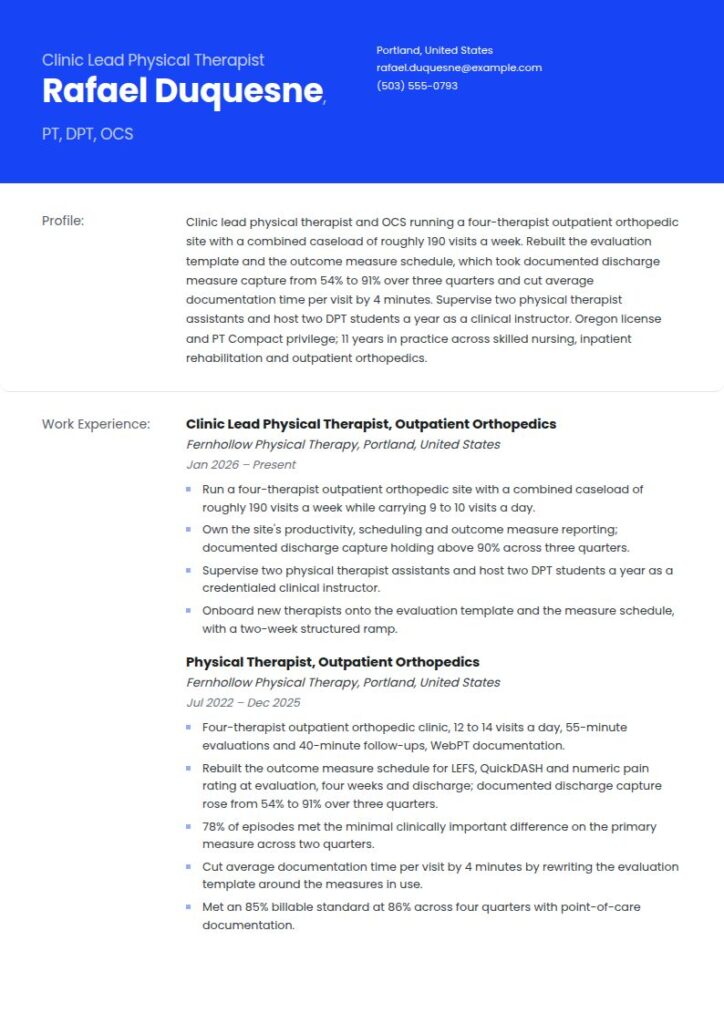
Clinic lead physical therapist and OCS running a four-therapist outpatient orthopedic site with a combined caseload of roughly 190 visits a week. Rebuilt the evaluation template and the outcome measure schedule, which took documented discharge measure capture from 54% to 91% over three quarters and cut average documentation time per visit by 4 minutes. Supervise two physical therapist assistants and host two DPT students a year as a clinical instructor. Oregon license and PT Compact privilege; 11 years in practice across skilled nursing, inpatient rehabilitation and outpatient orthopedics.
Right vs wrong: the same physical therapist summary, twice
| ✅ Right | ❌ Wrong |
|---|---|
| Outpatient orthopedic PT carrying 12 to 14 visits a day with a 55-minute evaluation structure. | Passionate physical therapist dedicated to restoring function and improving quality of life. |
| OCS through the American Board of Physical Therapy Specialties; LEFS, QuickDASH and NPRS at evaluation, four weeks and discharge. | Skilled in a wide range of manual and therapeutic exercise techniques. |
| 78% of episodes met the minimal clinically important difference on the primary measure over two quarters. | A single recovery written out in full: the age, the procedure, the sport and the week they returned. |
By contrast, the right column is auditable and identifies nobody. The third is an identification, because an age plus a procedure plus a sport narrows to very few people, and it is weaker evidence too: one episode is an anecdote, two quarters of measure capture is a practice.
Outline your clinical experience
Employer, setting, city, dates. Then the setting and caseload block, then three to five bullets. In short, every bullet names a volume, a measure, a system or a process.
| Instead of | Use |
|---|---|
| Treated a variety of orthopedic conditions | Carried 12 to 14 outpatient orthopedic visits a day, roughly 60% post-operative knee and shoulder |
| Developed individualized treatment plans | Evaluated 6 to 8 new episodes a week with a 55-minute evaluation and a standing measure schedule at evaluation, four weeks and discharge |
| Documented in the electronic medical record | Documented in WebPT, with point-of-care completion above 95% of visits across the last four quarters |
| Achieved excellent patient outcomes | 78% of episodes met the minimal clinically important difference on the primary outcome measure across two quarters |
| Worked with the rehabilitation team | Ran weekly interdisciplinary rounds with nursing, occupational therapy and speech across a 44-bed skilled nursing unit |
| Supervised support staff | Directed two physical therapist assistants and hosted two DPT students a year as a clinical instructor |
Physical Therapist, Outpatient Orthopedics, Fernhollow Physical Therapy, Portland, OR, July 2022 to Present
Four-therapist outpatient orthopedic clinic, 12 to 14 visits a day, 55-minute evaluations and 40-minute follow-ups, WebPT documentation.
Rebuilt the outcome measure schedule so LEFS, QuickDASH and numeric pain rating are collected at evaluation, four weeks and discharge; documented discharge measure capture rose from 54% to 91% over three quarters.
78% of episodes met the minimal clinically important difference on the primary measure across the last two quarters, against a clinic caseload of roughly 60% post-operative knee and shoulder.
Cut average documentation time per visit by 4 minutes by rewriting the evaluation template around the measures actually used.
Direct two physical therapist assistants and serve as clinical instructor for two DPT students a year.
Write the setting you can step into: caseload, productivity and outcome measures
This is the block almost nobody includes, and it answers the three questions a clinic director or rehabilitation manager actually has. After all, settings are not interchangeable, and a therapist who has only ever worked one of them is a different hire from one who has worked three.
Setting: Outpatient orthopedics, four-therapist site; previously skilled nursing (44-bed unit) and inpatient rehabilitation PRN
Caseload: 12 to 14 visits a day, 6 to 8 new evaluations a week, roughly 60% post-operative knee and shoulder
Visit structure: 55-minute evaluation, 40-minute follow-up, one-on-one
Productivity expectation: 85% billable, met at 86% across the last four quarters without unpaid documentation time
Outcome measures: LEFS, QuickDASH, Neck Disability Index, Oswestry Disability Index, numeric pain rating scale; Section GG self-care and mobility items, Berg Balance Scale, Timed Up and Go and 10 Meter Walk Test in post-acute settings
Systems: WebPT, Epic Rehab, Raintree at a previous employer
Supervision: Directs two physical therapist assistants; clinical instructor for two DPT students a year
Even so, two of those lines deserve saying out loud.
Productivity is the honest tension in this job, and the page can say so. Most employers set a billable percentage or a visits-per-day target, and most therapists have at some point met it by documenting after hours. Writing your productivity number is the opposite of surrendering to that. A line reading "85% billable standard, met at 86% across four quarters without unpaid documentation time" tells a director you can hold the number and how, which is a better position than arriving at the interview to be told the target. If you moved employers because a target was unachievable at the acuity you were carrying, that is a reasonable thing to explain in an interview, and a reason to put your actual numbers on the page rather than leave them to be assumed.
Direct access and physical therapist scope
Direct access is a scope question, not a marketing line. Whether you may evaluate and treat without a physician referral, for how long, and with what conditions attached is set by your state practice act and administered by your state board. If your practice act permits it and you have carried direct access episodes, write the volume: "roughly 20% of episodes entered under direct access". If it does not, do not imply otherwise. The same discipline applies to the PT Licensure Compact, an interstate agreement administered by the PT Compact Commission that lets eligible therapists practice in member states under a compact privilege rather than a separate license (PT Compact, accessed September 2026). Check the current member list before you claim a privilege on a resume.
Build a snapshot of your key skills
For skills, list twelve to sixteen entries in four groups: examination, intervention, measures and documentation, and the administrative work.
Examination: Orthopedic special testing, Gait and movement analysis, Joint mobility and end-feel assessment, Neurological screening, Balance and fall risk assessment, Return-to-activity criteria testing
Intervention: Manual therapy and joint mobilization, Therapeutic exercise progression, Neuromuscular re-education, Blood flow restriction training, Gait and transfer training, Durable medical equipment fitting and education
Measures and documentation: LEFS, QuickDASH, Neck Disability Index, Oswestry Disability Index, Numeric pain rating scale, Berg Balance Scale, Timed Up and Go, 10 Meter Walk Test, Section GG self-care and mobility items, Defensible documentation and medical necessity
Practice and administration: WebPT, Epic Rehab, Raintree, CPT coding and the 8-minute rule, Plan of care certification and progress notes, PTA direction and supervision, Clinical instruction
Then leave out what every licensed therapist can do. "Therapeutic exercise" alone is a line a director skims past to find whether you have run blood flow restriction or carried a Section GG caseload.
List your education, license and certifications
License first with its number and expiry, then specialist certification with the issuing board, then the DPT with its accreditation, then continuing education.
Oregon Physical Therapy License #PT-10442, issued August 2019, current through March 2027. PT Compact privilege held.
Board-Certified Clinical Specialist in Orthopaedic Physical Therapy (OCS), American Board of Physical Therapy Specialties, 2024
Doctor of Physical Therapy, Greenlaw University, Portland, OR, 2019. CAPTE-accredited program. National Physical Therapy Examination passed July 2019.
Bachelor of Science, Kinesiology, Quarrier State University, Eugene, OR, 2016
Continuing education: 54 hours manual therapy, 24 hours vestibular rehabilitation, 16 hours blood flow restriction training, 2021 to 2026. BLS, American Heart Association, expires May 2027.
The specialist certification line is worth understanding, because it is the credential that most reliably separates two otherwise similar files. ABPTS specialist certification requires a current unrestricted United States physical therapy license, plus either 2,000 hours of direct patient care as a licensed United States physical therapist within the last ten years with at least 25% of those hours in the last three, or completion of an APTA-accredited post-professional clinical residency in the specialty within the last ten years, and then a written examination (American Board of Physical Therapy Specialties, accessed September 2026). In other words, those are hours nobody can talk their way into.
Choose the right layout and design
For layout, use a single column, plain type at 11 or 12 point, clear headings, no photograph, no skills bar charts. Hospital and rehabilitation group applicant systems parse the file before a person opens it, and two columns, text boxes and graphics break that parsing.
Put the license number, the compact privilege and the expiry in the first block. Name the setting explicitly and give the caseload, visit structure and productivity number. Name the outcome measures you actually document and when you collect them. Give results in aggregate over a stated period. Name the documentation system by product. State your supervision and clinical instruction load.
Do not describe anyone you have treated, in any form; no ages, diagnoses, sports, occupations or single-episode timelines, even anonymized. Do not write "improved patient outcomes" where a measure and a period would go. Do not imply direct access authority your state practice act does not give you. Do not claim a compact privilege you do not currently hold. Do not use a two-column template for a hospital portal.
Physical therapist job market and outlook
A mid-sized occupation growing much faster than average, with a doctoral entry bar that keeps the pipeline narrow.
| Measure | Value |
|---|---|
| Physical therapist jobs, 2025 | 283,700 |
| Projected change, 2025-35 | 12% (much faster than average), +33,800 |
| Projected annual openings | ~13,400 |
| Typical entry-level education | Doctoral or professional degree |
| Median annual wage, May 2025 | $102,760 |
Source: U.S. Bureau of Labor Statistics, Occupational Outlook Handbook, 2025-35 projections and May 2025 wage data, published 27 August 2026.
The setting you choose is worth more than the state you choose
Physical therapist employment is projected to grow 12 percent between 2025 and 2035, adding 33,800 jobs, with about 13,400 openings projected each year over the decade (BLS Occupational Outlook Handbook, 2025-35 projections).
The pay spread across settings is wide and it does not follow prestige. Home healthcare services pays a median of $114,740 and nursing and residential care facilities $110,460, against $106,800 in hospitals and $97,160 in offices of physical, occupational and speech therapists and audiologists, which is where 36% of the occupation works (BLS, May 2025).
That inversion is the single most useful fact on this page for anyone planning a move. The largest employing setting is also the lowest paid, and the two highest paid settings are post-acute. A resume that translates your caseload into the receiving setting's vocabulary, using Section GG items and gait speed rather than LEFS scores, is what makes that move possible.
Where the jobs sit:
| Setting | Share of employment | Median annual wage (May 2025) |
|---|---|---|
| Offices of physical, occupational and speech therapists, and audiologists | 36% | $97,160 |
| Hospitals; state, local and private | 26% | $106,800 |
| Home healthcare services | 11% | $114,740 |
| Nursing and residential care facilities | 6% | $110,460 |
| Self-employed workers | 4% | Not published |
Source: U.S. Bureau of Labor Statistics, May 2025.
What salary you can expect as a physical therapist
Overall, the median annual wage for physical therapists was $102,760 as of May 2025. The lowest 10 percent earned less than $77,140 and the highest 10 percent more than $135,140 (BLS, May 2025). That is a narrow spread, reflecting an occupation where a doctoral degree is the entry point.
For scale, meanwhile, the median for all healthcare practitioner and technical occupations was $86,530 and the median for all occupations was $50,980 in the same cycle (BLS, May 2025).
Setting moves the number more than seniority does. The gap between home healthcare services at $114,740 and outpatient offices at $97,160 is about $17,600 a year (BLS, May 2025), which is larger than most promotions inside a single clinic. What a resume can add on top of setting is specialist certification, clinical instructor status, PTA supervision and a documented productivity record, because those are the things a director can attach a differential or a lead rate to without inventing a new role.
Key takeaways for a physical therapist resume
- Above all, describe the caseload, never anyone in it, and never an anonymized single episode.
- First, lead with the license, its number, the compact privilege and the expiry.
- Name the setting explicitly; they are not interchangeable and the reader knows it.
- Then give caseload, visit structure and your actual productivity number over a stated period.
- Name the outcome measures you document and when you collect them.
- Finally, put the specialist certification with its issuing board; it is the clearest separator.
- State supervision and clinical instruction load, because those carry differentials.
Build your physical therapist resume in 15 minutes with our AI resume builder.
Related medical resume examples
- Physical therapist assistant resume
- Occupational therapist resume
- Athletic trainer resume
- Speech language pathologist resume
- Respiratory therapist resume
- Massage therapist resume
- Physician assistant resume
- Medical assistant resume
- Home health aide resume
- Nursing home resume
- Clinical research coordinator resume
- Healthcare project manager resume
Pair it with a matching physical therapist cover letter.
Physical therapist resume questions, answered
How long should a physical therapist resume be?
One page for your first three years. Two once you hold a specialist certification, supervise physical therapist assistants, act as a clinical instructor, or run a site. The license, the certification and the setting detail genuinely take room, so two pages at mid-career is normal rather than padded.
Can I describe a case on my physical therapist resume?
No. Not by name, not by initials, not by age plus diagnosis, not by sport, and not as an anonymized composite. An age, a procedure and a sport together are frequently enough to identify someone, and a resume travels through portals and inboxes you do not control. Write aggregate outcomes with the instrument and the period named; they are stronger evidence anyway.
Which outcome measures should I list?
The ones you actually collect, matched to the setting you are applying to. Outpatient orthopedics reads LEFS, QuickDASH, the Neck Disability Index, the Oswestry Disability Index and a numeric pain rating. Post-acute and inpatient settings read Section GG self-care and mobility items, the Berg Balance Scale, the Timed Up and Go and gait speed. Listing measures you do not use is the fastest way to lose an interview, because the follow-up question is always about your schedule for collecting them.
Should I put my productivity number on the page?
Yes, with the standard, your actual figure and the period. "85% billable standard, met at 86% across four quarters" is a strong line because it shows you can hold a target and gives the director something concrete to discuss. It also moves the productivity conversation to the point where you still have leverage rather than to your first week.
How do I change settings as a physical therapist?
Translate. A clinician moving from outpatient orthopedics into home health should write visit volume, drive radius, documentation system, Section GG familiarity and the safety and equipment work that setting turns on, because those are the terms the receiving manager thinks in. The pay makes the move worth planning: home healthcare services pays a median of $114,740 against $97,160 in outpatient offices (BLS, May 2025).
Does board certification actually change hiring?
It changes it most in outpatient orthopedics and in systems that pay a certification differential, and it is the clearest single separator between two similar files. ABPTS requires either 2,000 hours of direct patient care in the specialty within ten years with a quarter of them in the last three, or an APTA-accredited residency, plus a written examination (ABPTS, accessed September 2026). Put the credential after your name, and put the issuing board next to it.