Rafael Duquesne Outpatient Orthopedic Physical Therapist Portland, 97214, United States [email protected] · (503) 555-0793
16 September 2026
Dr. Ngozi Iwuchukwu Clinic Director Stavely Sports & Spine Portland, United States
Application for Outpatient Orthopedic Physical Therapist, Stavely Sports & Spine
Dear Dr. Iwuchukwu,
I am applying for the outpatient orthopedic physical therapist post at Stavely Sports & Spine. I am licensed in Oregon with a PT Compact privilege and board-certified in orthopaedics through ABPTS, and I currently carry 12 to 14 visits a day in a four-therapist clinic on a 55-minute evaluation and 40-minute follow-up structure, with a caseload that runs about 60% post-operative knee and shoulder.
The work I would most want to bring with me is a measurement rebuild. Our discharge outcome measure capture was sitting at 54%, which made it impossible to say anything defensible about whether episodes were working, so I rewrote the evaluation template around the measures we actually use and set a fixed schedule of evaluation, four weeks and discharge for LEFS, QuickDASH and numeric pain rating. Capture rose to 91% over three quarters and average documentation time per visit fell by 4 minutes. With the measures reliable, we could finally report that 78% of episodes met the minimal clinically important difference on the primary measure across the last two quarters.
I applied to Stavely specifically because you publish your return-to-sport testing criteria rather than treating them as clinician preference, which is the direction I have been pushing my own clinic. I would want to work on the same for post-operative shoulder, and I am happy to keep taking DPT students; I have hosted two a year as a clinical instructor since 2023 and direct two physical therapist assistants.
I have met an 85% billable standard at 86% across the last four quarters with point-of-care documentation, my Oregon license runs through March 2027, and I can give four weeks. Thank you for your time.
Sincerely, Rafael Duquesne, PT, DPT, OCS
Summary
A physical therapist cover letter names the setting you have carried, the caseload and visit structure behind it, the productivity standard you have held and the outcome measures you document. This guide gives you a full adaptable letter, the rule about never describing anyone you have treated, and how to raise productivity honestly before the interview does.
Physical Therapist cover letter examples by experience level
A physical therapist cover letter is a one-page letter that tells a clinic director which setting you have carried, at what caseload and visit structure, against what productivity standard, and which outcome measures you document.
Directors hire against a schedule and a budget. A therapist who states the caseload they can hold and the productivity number they have actually met is answering the two questions the interview was going to be about, which is unusual enough to stand out.
One rule comes before all of it. Write nothing about anyone you have treated. No age, no diagnosis, no sport, no occupation, no single-episode timeline, and no anonymized version of any of those. Aggregate outcomes with the instrument named are both safer and more persuasive.
Guide to a physical therapist cover letter
This guide and the corresponding physical therapist cover letter example will cover:
- How to structure the letter, paragraph by paragraph
- Why the setting and the caseload belong in the first paragraph
- How to raise productivity honestly before the interview raises it
- What evidence looks like when you cannot describe a single episode of care
- The openings that get a therapist file called first
How to write a physical therapist cover letter
| Paragraph | Its job | Length |
|---|---|---|
| Opening | The post, your license and certification, the setting and caseload you carry | 2 to 3 sentences |
| Evidence | One measure, one aggregate result, one period of time | 4 to 5 sentences |
| Fit | Something specific about their clinic, and what you would take on | 3 to 4 sentences |
| Close | Productivity, compact privilege, availability, thank you | 2 sentences |
Put the caseload and the productivity number in writing
A clinic director reading applications is holding a schedule with unfilled slots and a budget with a billable target attached. Their two questions are whether you can carry the volume and whether you can document it without unpaid hours.
Answer both: "I carry 12 to 14 visits a day on a 55-minute evaluation and 40-minute follow-up structure, and I have met an 85% billable standard at 86% across the last four quarters with point-of-care documentation." That sentence does more than a paragraph of enthusiasm.
It also moves the productivity conversation to the point where you still have leverage. Raised in your letter, it is a credential. Raised in your first week, it is a target someone else set.
A physical therapist cover letter example you can adapt
Dear Dr. Iwuchukwu,
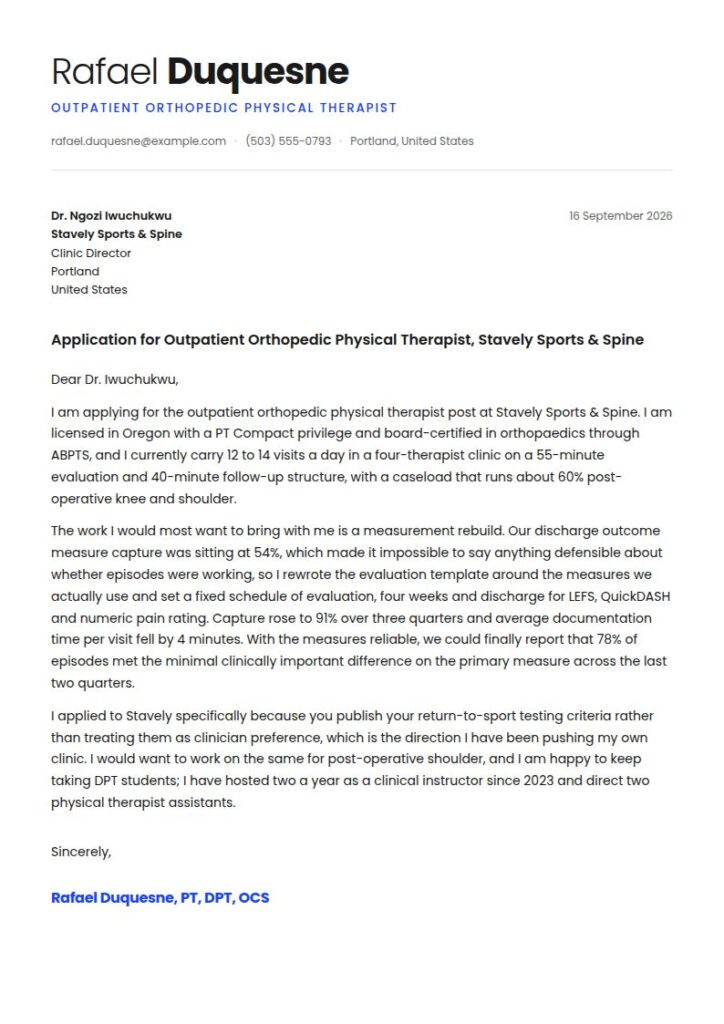
I am applying for the outpatient orthopedic physical therapist post at Stavely Sports & Spine. I am licensed in Oregon with a PT Compact privilege and board-certified in orthopaedics through ABPTS, and I currently carry 12 to 14 visits a day in a four-therapist clinic on a 55-minute evaluation and 40-minute follow-up structure, with a caseload that runs about 60% post-operative knee and shoulder.
The work I would most want to bring with me is a measurement rebuild. Our discharge outcome measure capture was sitting at 54%, which made it impossible to say anything defensible about whether episodes were working, so I rewrote the evaluation template around the measures we actually use and set a fixed schedule of evaluation, four weeks and discharge for LEFS, QuickDASH and numeric pain rating. Capture rose to 91% over three quarters and average documentation time per visit fell by 4 minutes. With the measures reliable, we could finally report that 78% of episodes met the minimal clinically important difference on the primary measure across the last two quarters.
I applied to Stavely specifically because you publish your return-to-sport testing criteria rather than treating them as clinician preference, which is the direction I have been pushing my own clinic. I would want to work on the same for post-operative shoulder, and I am happy to keep taking DPT students; I have hosted two a year as a clinical instructor since 2023 and direct two physical therapist assistants.
I have met an 85% billable standard at 86% across the last four quarters with point-of-care documentation, my Oregon license runs through March 2027, and I can give four weeks. Thank you for your time.
Sincerely, Rafael Duquesne, PT, DPT, OCS
Openings that work
| Instead of | Use |
|---|---|
| I have always been passionate about helping people move | I carry 12 to 14 visits a day in a four-therapist outpatient orthopedic clinic |
| I am writing to express my interest in your physical therapy position | I am applying for the outpatient orthopedic post, and I hold a PT Compact privilege |
| I consistently achieve excellent outcomes for my patients | Discharge outcome measure capture rose from 54% to 91% over three quarters |
| I would love the opportunity to join your wonderful team | I applied here because you publish your return-to-sport testing criteria |
Evidence when you cannot describe a single episode
This is the part therapists find hardest, because the proof that feels real is a person who walked out differently than they walked in. Everything below is evidence about your practice rather than about anybody in it.
| Kind of evidence | What it looks like in a sentence |
|---|---|
| Aggregate over a period | 78% of episodes met the minimal clinically important difference on the primary measure over two quarters |
| Measure capture | Discharge outcome measure capture rose from 54% to 91% across three quarters |
| Volume and structure | 12 to 14 visits a day, 6 to 8 new evaluations a week, 55-minute evaluations |
| Productivity held | 85% billable standard met at 86% across four quarters with point-of-care documentation |
| Process built | Rewrote the evaluation template around the measures in use; documentation time per visit fell by 4 minutes |
| Teaching | Clinical instructor for two DPT students a year; direct two physical therapist assistants |
Not one of those requires an episode of care, and every one of them is more specific than a story would be.
Raising productivity and direct access honestly
State the productivity standard you have held, your actual figure, and the period. Say whether you achieved it with point-of-care documentation, because that is the real question. Name the setting explicitly, since outpatient, acute, inpatient rehabilitation, skilled nursing and home health are different jobs. If your state practice act permits direct access and you have carried those episodes, give the share. Read the clinic's own pages and name one real thing they do.
Do not describe anyone you have treated, including an anonymized composite or a single-episode timeline. Do not imply direct access authority your practice act does not give you, and do not claim a compact privilege you do not currently hold. Do not call yourself passionate or dedicated, which every letter in the folder does. Do not send a letter that never names the setting. Do not attack a previous employer's productivity target; give your numbers and let them speak.
The largest setting is the lowest paid
Physical therapist employment is projected to grow 12 percent from 2025 to 2035, adding 33,800 jobs, with about 13,400 openings a year over the decade, and the median annual wage was $102,760 in May 2025 (BLS Occupational Outlook Handbook, 2025-35 projections and May 2025 wage data, published 27 August 2026).
The setting spread is what a letter should be written against. Home healthcare services pays a median of $114,740 and nursing and residential care facilities $110,460, against $106,800 in hospitals and $97,160 in the outpatient offices that employ 36% of the occupation (BLS, May 2025).
If you are writing across settings, the letter has to do the translating. A director in home health reads Section GG items, gait speed and drive radius; a director in outpatient orthopedics reads LEFS, QuickDASH and visits per day. Same career, different vocabulary, and the letter that uses theirs gets read.
Length, format and sending it
One page, four paragraphs, 250 to 400 words. PDF unless the portal says otherwise, named for yourself and the post: rafael-duquesne-outpatient-ortho-pt-cover-letter.pdf.
Address a person. Clinic directors and rehabilitation managers are usually named on a clinic page or a system directory, and "Dear Hiring Manager" on a file that is otherwise specific reads as a letter sent to twelve clinics.
Use the same figures as your resume so the two agree. Our physical therapist resume example is written with the numbers used here.
Key takeaways
- Write nothing about anyone you have treated, in any form, at any level of disguise.
- Name the setting in the first line; the settings are not interchangeable.
- Give the caseload, the visit structure and the number of new evaluations a week.
- State the productivity standard, your actual figure and the period.
- Give one aggregate outcome with the instrument and the period named.
- Name one real thing about their clinic, taken from their own pages.
- Address a named person and keep it to one page.
Write your physical therapist cover letter in 10 minutes with our AI cover letter builder.
Physical therapist cover letter questions, answered
How long should a physical therapist cover letter be?
One page, four paragraphs, 250 to 400 words. Clinic directors read these between treatment blocks, and length does not read as effort.
Can I describe a case in a physical therapist cover letter?
No. Not with the name removed, not with the details changed, not as a composite. An age plus a procedure plus a sport is frequently an identification, and a cover letter travels through portals, recruiters and forwarded email. The aggregate evidence in the table above is both safer and stronger, because two quarters of measure capture is a practice while one episode is an anecdote.
Should I mention productivity if I left a job because of it?
Mention productivity, not the grievance. Give the standard you held, your actual figure and the period, and say that you achieved it with point-of-care documentation if you did. If the target at a previous employer was unachievable at the acuity you carried, that is a reasonable interview answer, but a letter that argues with a former employer reads as a warning regardless of who was right.
Do I need a cover letter for a hospital or rehabilitation group application?
Attach one wherever there is a field for it. The portal collects the same structured data from every applicant. The letter is the only place you can name the setting you want, the caseload you can hold and the teaching or supervision you would take on.
What do I write as a new graduate physical therapist?
Write your clinical education rotations as jobs: setting, facility type and bed count or clinic size, weeks, caseload carried by the final weeks, documentation system and outcome measures used. Then give the license or the NPTE date, the setting you are applying for, and why that setting rather than any setting. A new graduate who can say "I carried eight to ten visits a day by week ten of my outpatient rotation" is far ahead of one describing what they learned.