Pharmacy Technician Latrice Esquivel CPhT
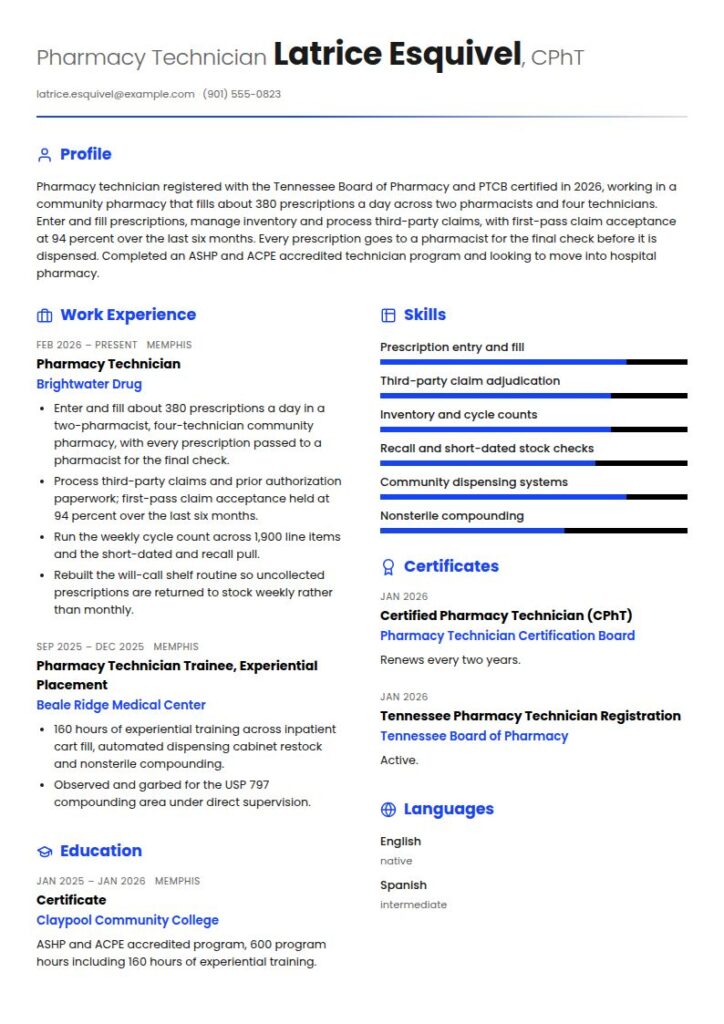
Pharmacy Technician
[email protected] | (901) 555-0823 | Memphis, United States
Profile
Pharmacy technician registered with the Tennessee Board of Pharmacy and PTCB certified in 2026, working in a community pharmacy that fills about 380 prescriptions a day across two pharmacists and four technicians. Enter and fill prescriptions, manage inventory and process third-party claims, with first-pass claim acceptance at 94 percent over the last six months. Every prescription goes to a pharmacist for the final check before it is dispensed. Completed an ASHP and ACPE accredited technician program and looking to move into hospital pharmacy.
Work Experience
02/2026 - Present, Pharmacy Technician, Brightwater Drug, Memphis, United States
- Enter and fill about 380 prescriptions a day in a two-pharmacist, four-technician community pharmacy, with every prescription passed to a pharmacist for the final check.
- Process third-party claims and prior authorization paperwork; first-pass claim acceptance held at 94 percent over the last six months.
- Run the weekly cycle count across 1,900 line items and the short-dated and recall pull.
- Rebuilt the will-call shelf routine so uncollected prescriptions are returned to stock weekly rather than monthly.
09/2025 - 12/2025, Pharmacy Technician Trainee, Experiential Placement, Beale Ridge Medical Center, Memphis, United States
- 160 hours of experiential training across inpatient cart fill, automated dispensing cabinet restock and nonsterile compounding.
- Observed and garbed for the USP 797 compounding area under direct supervision.
Education
01/2025 - 01/2026, Certificate, Pharmacy Technology, Claypool Community College, Memphis, United States
ASHP and ACPE accredited program, 600 program hours including 160 hours of experiential training.
Skills
Prescription entry and fill, 80
Third-party claim adjudication, 75
Inventory and cycle counts, 75
Recall and short-dated stock checks, 70
Community dispensing systems, 80
Nonsterile compounding, 60
Languages
English, native
Spanish, intermediate
Certificates
01/2026, Certified Pharmacy Technician (CPhT), Pharmacy Technician Certification Board
Renews every two years.
01/2026, Tennessee Pharmacy Technician Registration, Tennessee Board of Pharmacy, TN-PT-48210
Active.
Summary
A pharmacy technician resume is a one page document naming your certification, your state registration, the tasks you own and the volume and accuracy you run them at. This guide gives you three adaptable versions, a clear line between your work and the pharmacist's final check, and current Bureau of Labor Statistics pay and outlook for pharmacy technicians.
Pharmacy Technician resume examples by experience level
A pharmacy technician resume is a one page document that names your certification, your state registration, the tasks you own, the volume you run them at and the accuracy you hold.
It is the largest pharmacy occupation by a wide margin. The Bureau of Labor Statistics counts 471,200 pharmacy technician jobs in 2025 against 325,200 pharmacist jobs, with about 44,700 technician openings projected each year over the decade (BLS Occupational Outlook Handbook, Pharmacy Technicians and Pharmacists, published 27 August 2026). A hiring manager is reading a large stack quickly, for three things: whether you are certified and registered, whether you have run the volume they run, and whether you understand where your work ends.
Before anything else, one rule applies to every line of this page.
No patient goes on a pharmacy technician resume, ever
No name, no initials, no age, no diagnosis, no prescription belonging to someone, no story about a person at the counter or on a unit. Not a de-identified one either, because a reader has no way to verify it.
Describe the work by type, volume, setting and process instead: "about 380 prescriptions a day across two pharmacists and four technicians," never a narrative about an individual.
This is a HIPAA problem before it is a taste problem, and technicians are trained on it from the first week, which is why a lapse on a resume is read as a serious one. A manager who sees a person described on an application thinks about an audit.
Resume guide for a pharmacy technician resume
This guide and the corresponding pharmacy technician resume example will cover:
- How to write a pharmacy technician resume, section by section
- Certification and state registration, and why they are two separate lines
- Three adaptable summaries: new technician, hospital technician and lead sterile compounding technician
- Where the pharmacist's verification line falls, and how to write up to it
- What the job market looks like and what you can expect to earn
How to write a pharmacy technician resume
Five blocks: contact header, summary, certification and registration, pharmacy experience, then education and training. One page; a two-page technician resume is usually the same task list under three employers.
Certification and registration go above experience because most employers screen on them first. "Most states regulate pharmacy technicians in some way," and requirements can include a high school diploma, a formal education or training program, an examination, continuing education and a criminal background check (BLS Occupational Outlook Handbook, Pharmacy Technicians, published 27 August 2026).
| Block | The question it answers | Where it goes |
|---|---|---|
| Certification and registration | Can this technician be put on the schedule legally, and when? | Directly under the summary |
| Setting and volume | Have they run the throughput we run? | Named in every role, with a number |
| Task ownership | What can they be given without supervision beyond the pharmacist check? | Inside the experience bullets |
| Specialization | Sterile compounding, controlled substances, billing, inventory | Its own line when it applies |
Run the finished file through the ATS resume checker first. Chain pharmacies and health systems both parse applications into a structured record before a person opens them.
Choosing the best resume format for a pharmacy technician resume
Reverse chronological, one page. The reader is checking continuity: which setting, how long, what volume, why you left. A skills-first format removes the timeline, and in an occupation with high turnover a hidden timeline reads as a reason to hide it.
Date any gap in one neutral line. Waiting on a state registration, a background check or a certification result is ordinary and looks ordinary once written down.
Include your contact information
| ✅ Right | ❌ Wrong |
|---|---|
| Latrice Esquivel, CPhT | Latrice Esquivel |
| Certified Pharmacy Technician, PTCB certified 2020 | Experienced pharmacy technician |
| Tennessee registration #TN-PT-48210, active | Registered with the state board |
| (901) 555-0823, [email protected], Memphis, TN | (901) 555-0823, [email protected] |
Put the certification body and the registration number on the page. They are two different approvals, checked by two different people, and a file that answers both in the header can be scheduled this month rather than next.
Make use of a summary
Four lines: certification and registration, setting and years, the volume you run, and one thing you own or improved.
Pharmacy technician registered with the Tennessee Board of Pharmacy and PTCB certified in 2026, working in a community pharmacy that fills about 380 prescriptions a day across two pharmacists and four technicians. Enter and fill prescriptions, manage inventory and process third-party claims, with first-pass claim acceptance at 94 percent over the last six months. Every prescription goes to a pharmacist for the final check before it is dispensed. Completed an ASHP and ACPE accredited technician program and looking to move into hospital pharmacy.
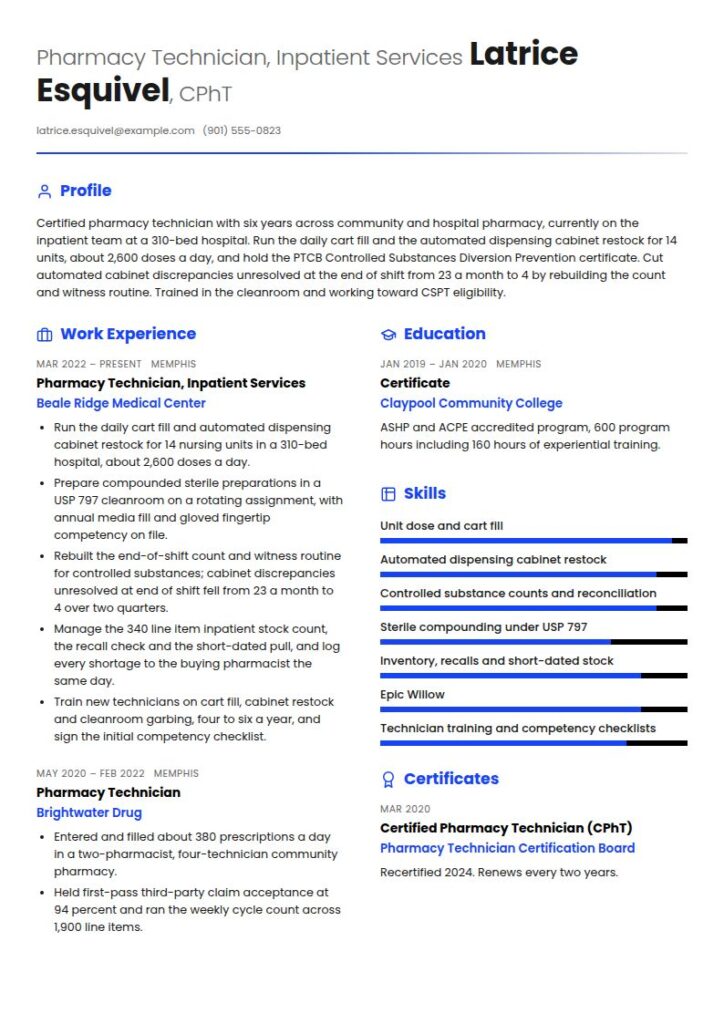
Certified pharmacy technician with six years across community and hospital pharmacy, currently on the inpatient team at a 310-bed hospital. Run the daily cart fill and the automated dispensing cabinet restock for 14 units, about 2,600 doses a day, and hold the PTCB Controlled Substances Diversion Prevention certificate. Cut automated cabinet discrepancies unresolved at the end of shift from 23 a month to 4 by rebuilding the count and witness routine. Trained in the cleanroom and working toward CSPT eligibility.
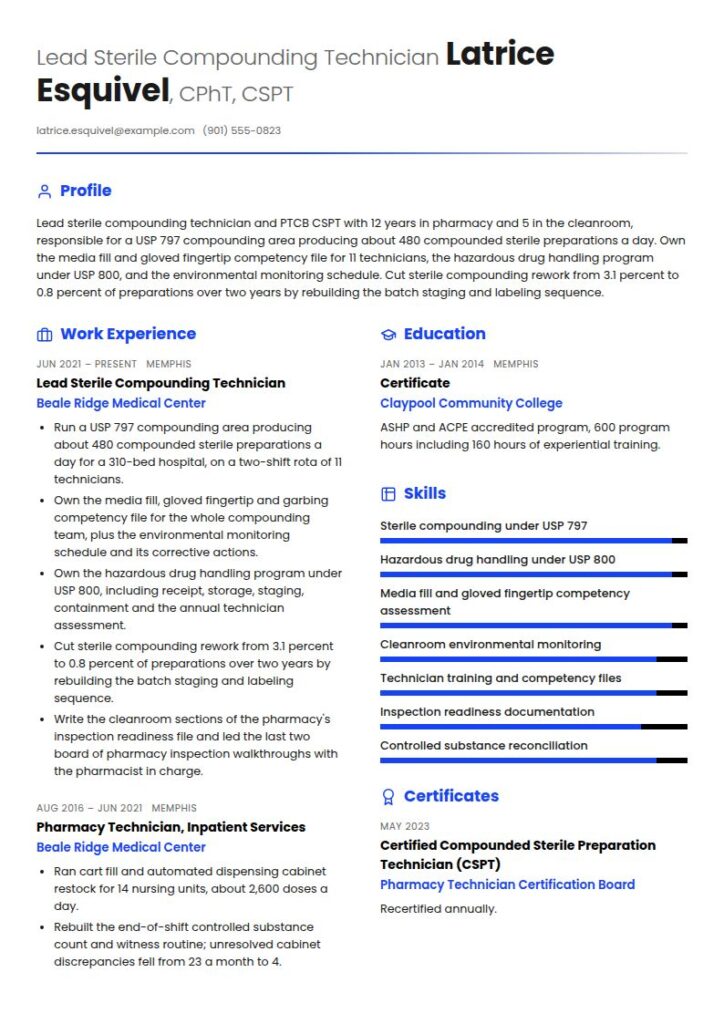
Lead sterile compounding technician and PTCB CSPT with 12 years in pharmacy and 5 in the cleanroom, responsible for a USP 797 compounding area producing about 480 compounded sterile preparations a day. Own the media fill and gloved fingertip competency file for 11 technicians, the hazardous drug handling program under USP 800, and the environmental monitoring schedule. Cut sterile compounding rework from 3.1 percent to 0.8 percent of preparations over two years by rebuilding the batch staging and labeling sequence.
Right vs wrong: the same pharmacy technician summary, twice
| ✅ Right | ❌ Wrong |
|---|---|
| Certified pharmacy technician, six years across community and hospital pharmacy. | Hardworking pharmacy technician with a passion for helping people. |
| Run the daily cart fill and cabinet restock for 14 units, about 2,600 doses a day. | Responsible for filling medications and maintaining pharmacy stock. |
| Cut cabinet discrepancies unresolved at end of shift from 23 a month to 4. | Known for accuracy and attention to detail in a fast-paced environment. |
The right column can be put on a shift tomorrow. Accuracy claimed as an adjective is the one claim a pharmacy will not take on trust.
Outline your pharmacy experience
Employer, city, setting, the size of it, dates, then three to five bullets. Every bullet has a number and none of them has a person.
| Instead of | Use |
|---|---|
| Filled prescriptions accurately and efficiently | Filled about 380 prescriptions a day in a two-pharmacist, four-technician community pharmacy |
| Handled insurance and billing | Processed third-party claims with first-pass acceptance at 94 percent over six months |
| Maintained inventory | Ran the cycle count for 1,900 line items and cut expired stock write-offs from $3,100 to $900 a quarter |
| Prepared IV medications | Compounded about 480 sterile preparations a day in a USP 797 cleanroom, with annual media fill and gloved fingertip competency |
| Any bullet that only works as a story about one person | Delete it and write the process or the volume instead |
The last row is the rule in practice. A bullet that only makes sense as a story about a person cannot be on the page, however good the day was.
Pharmacy Technician, Inpatient Services, Beale Ridge Medical Center, Memphis, TN, March 2022 to Present
Run the daily cart fill and automated dispensing cabinet restock for 14 nursing units in a 310-bed hospital, about 2,600 doses a day.
Prepare compounded sterile preparations in a USP 797 cleanroom on a rotating assignment, with annual media fill and gloved fingertip competency on file.
Rebuilt the end-of-shift count and witness routine for controlled substances; cabinet discrepancies unresolved at end of shift fell from 23 a month to 4 over two quarters.
Manage the 340 line item inpatient stock count, the recall check and the short-dated pull, and log every shortage to the buying pharmacist the same day.
Train new technicians on cart fill, cabinet restock and cleanroom garbing, four to six a year, and sign the initial competency checklist.
Where the pharmacist's verification line falls, and what sits on your side of it
This is what separates a technician resume from one that reads as a junior pharmacist, and it is the most useful thing on the page.
The Handbook states the boundary plainly: "Pharmacy technicians work under the supervision of pharmacists, who must review prescriptions before they are dispensed to patients" (BLS Occupational Outlook Handbook, Pharmacy Technicians, published 27 August 2026). A technician does not verify. That is not a limit on your value, it is the definition of the role, and a hiring manager is watching for whether you know it.
| Yours | The pharmacist's |
|---|---|
| Collecting the information needed to fill a prescription, and entering it | The clinical review and the final check before dispensing |
| Measuring, packaging and labeling | Approving the completed prescription |
| Inventory, ordering, recalls and short-dated stock | Clinical judgment on therapy |
| Third-party claims, prior authorization paperwork and payment | Counseling on use, side effects and storage |
| Cart fill, cabinet restock, sterile and nonsterile compounding | Releasing a compounded preparation |
| Recording, reconciling and escalating a discrepancy | Deciding what the discrepancy means |
Write your bullets up to that line and no further. Three rules keep a technician resume on the right side of it.
Name the task, not the judgment. "Entered and filled about 380 prescriptions a day for pharmacist verification" is precise and safe. "Reviewed prescriptions for accuracy and appropriateness" claims something a board would not recognize, and an experienced reader hears it immediately.
Put the volume where the judgment would go. Volume, turnaround and rework rates are yours to claim, and they are what a staffing model is built from.
Say what you escalate. "Log every shortage to the buying pharmacist the same day" describes exactly the judgment a manager wants: knowing what is yours and handing over what is not.
Technician product verification exists, and it is not the same as verifying
Some states and health systems operate a technician product verification model, in which a trained technician checks another technician's product against the order. PTCB offers an assessment-based certificate in Technician Product Verification, described as demonstrating "your skill in safeguarding patients from dispensing errors" (Pharmacy Technician Certification Board, retrieved 16 September 2026).
If you work under such a model, write it exactly as your state board and your employer define it, name the certificate, and keep the pharmacist's clinical review as a separate line. If you do not, do not borrow the language.
The same care applies to vaccination. PTCB offers an Immunization Administration certificate, and technician vaccination authority differs by jurisdiction (PTCB, retrieved 16 September 2026; National Alliance of State Pharmacy Associations, vaccination authority resource updated January 2025). Name your state, the certificate and the season volume.
Build a snapshot of your key skills
Ten to fourteen entries in three groups. Concrete enough that a reference could confirm every one.
Dispensing and preparation: Prescription entry and fill, Unit dose and cart fill, Automated dispensing cabinet restock, Nonsterile compounding, Sterile compounding under USP 797, Hazardous drug handling under USP 800
Operations: Inventory and cycle counts, Purchasing and shortage management, Recall and short-dated stock checks, Controlled substance counts and reconciliation, Cleanroom environmental monitoring, Technician training and competency checklists
Systems and billing: Epic Willow, Community dispensing systems, Automated dispensing cabinet software, Third-party claim adjudication, Prior authorization paperwork, Prescription drug monitoring program data entry
Leave out fast-paced, reliable and detail-oriented. The volume and rework numbers already say it, and those three words appear in every competing application.
List your education, certifications and registration
Registration first, then certification with the body and the year, then the training program, then dated specialty certificates.
Registration: Tennessee Board of Pharmacy pharmacy technician registration #TN-PT-48210, active through 2027.
Certification: Certified Pharmacy Technician (CPhT), Pharmacy Technician Certification Board, 2020, recertified 2024. Certified Compounded Sterile Preparation Technician (CSPT), PTCB, 2023, recertified annually.
Certificates: Controlled Substances Diversion Prevention, PTCB, 2022. Hazardous Drug Management, PTCB, 2024.
Pharmacy Technician Program, Claypool Community College, Memphis, TN, 2019 to 2020. ASHP and ACPE accredited, 600 program hours including 160 hours of experiential training.
The two national certifications are not interchangeable. PTCB requires either a PTCB-recognized education or training program or equivalent work experience of at least 500 hours, plus a passing score on the Pharmacy Technician Certification Examination, which has 90 multiple-choice questions with 80 scored, a passing scaled score of 1,400, and a two-year renewal cycle (Pharmacy Technician Certification Board, retrieved 16 September 2026). The National Healthcareer Association ExCPT requires a high school diploma plus either training completed within the last five years or one year of work experience including at least 1,200 supervised hours in the last three; the examination has 100 questions and renews every two years with at least 20 hours of continuing education, including at least one hour in pharmacy law and one in patient safety (National Healthcareer Association, retrieved 16 September 2026).
Write whichever you hold, with the body, the year earned and the year last renewed. Write the state registration separately with its number, because it decides whether you can be on the schedule at all.
Sterile compounding is the specialization that changes the job
USP General Chapter 797 sets requirements for compounded sterile preparations including "responsibilities of compounding personnel, training, facilities, environmental monitoring, and storage and testing of finished preparations" (United States Pharmacopeia, retrieved 16 September 2026). USP General Chapter 800 covers "standards for safe handling of hazardous drugs to minimize the risk of exposure to healthcare personnel, patients and the environment" and applies to "all healthcare personnel who receive, prepare, administer, transport or otherwise come in contact with hazardous drugs"; it became official on 1 December 2019 and compendially applicable on 1 November 2023 (USP, retrieved 16 September 2026).
The credential that maps to that work is PTCB's CSPT. It requires an active CPhT plus either a PTCB-recognized CSPT program with one year of full-time continuous sterile compounding experience, or three years of full-time continuous sterile compounding experience within the last eight years, and it recertifies every year rather than every two (PTCB, retrieved 16 September 2026).
The point for a resume is that these are auditable programs with competency files behind them. Media fill, gloved fingertip testing, garbing competency, environmental monitoring and hazardous drug handling are documented, dated and countable, which makes them the strongest lines a technician can write.
Choose the right layout and design
Single column, 11 or 12 point, clear headings, one page, no photograph. Chain and health system portals parse before a person reads, and two-column templates with icons are where that parsing fails.
Write certification and state registration as two separate lines, each with its number or body and year. Name the setting and size it in prescriptions a day, beds or units. Give volume with the staffing it ran with. Say what you escalate and to whom. Date every specialty certificate. Keep it to one page.
Do not describe a patient or a prescription belonging to someone. Do not write that you reviewed prescriptions for appropriateness or verified anything; that is the pharmacist's line. Do not claim accuracy as an adjective when you can give a rework or claim acceptance rate. Do not list a lapsed certification without saying it lapsed. Do not pad to two pages.
Pharmacy technician job market and outlook
A very large occupation growing faster than average, with a high opening count driven by turnover as much as by growth.
| Measure | Value |
|---|---|
| Pharmacy technician jobs, 2025 | 471,200 |
| Projected change, 2025-35 | 6% (faster than average), +30,100 |
| Projected annual openings | ~44,700 |
| Typical entry-level education | High school diploma or equivalent |
| On-the-job training | Moderate-term on-the-job training |
| Median annual wage, May 2025 | $45,750 |
Source: U.S. Bureau of Labor Statistics, Occupational Outlook Handbook, Pharmacy Technicians, 2025-35 projections and May 2025 wage data, published 27 August 2026.
Where the jobs sit:
| Setting | Share of employment | Median annual wage (May 2025) |
|---|---|---|
| Pharmacies and drug retailers | 51% | $39,240 |
| Hospitals; state, local, and private | 18% | $50,760 |
| General merchandise retailers | 9% | $48,150 |
| Grocery and specialty food retailers | 8% | $41,430 |
| Ambulatory healthcare services | 5% | $48,860 |
Source: U.S. Bureau of Labor Statistics, Occupational Outlook Handbook, Pharmacy Technicians, May 2025.
The Handbook attributes growth to the number of older people, the rising prevalence of chronic conditions, and technicians taking on a greater role as pharmacists move further into patient care work (BLS, published 27 August 2026). That last clause is the one to write to: the tasks moving toward technicians are the documented ones, such as compounding, inventory, controlled substance reconciliation, billing and medication history collection.
What salary you can expect as a pharmacy technician
The median annual wage for pharmacy technicians was $45,750 as of May 2025, or $22.00 an hour. The lowest 10 percent earned less than $36,020 and the highest 10 percent more than $61,040 (BLS Occupational Outlook Handbook, May 2025 wage data, published 27 August 2026). For comparison, healthcare support occupations as a group had a median of $38,340 in May 2025 (BLS Occupational Outlook Handbook, Healthcare Occupations, published 27 August 2026).
Setting explains most of the spread. Hospitals paid a median of $50,760 against $39,240 in pharmacies and drug retailers, a gap of about $11,500 a year, while 51 percent of technicians work in the lower-paying setting and 18 percent in the higher-paying one (BLS, May 2025). The retail to hospital move is the main pay decision in this occupation, and it is made on paper.
That is also what a resume can move. Certification, a registration in good standing, documented sterile compounding competency and a volume figure you can defend are what a hospital pharmacy asks about, and writing them in specifics is how a retail application gets read for an inpatient post.
Key takeaways for a pharmacy technician resume
- Never describe a patient or a prescription belonging to someone.
- Write certification and state registration as two separate lines with numbers, bodies and years.
- Name the setting and size it in prescriptions a day, doses a day, beds or units.
- Give volume with the staffing it ran with, plus a rework or claim acceptance rate.
- Write up to the pharmacist's verification line and never across it.
- Say what you escalate and to whom; that is the judgment a manager is buying.
- Put sterile compounding competency in specifics, since it is the specialization that changes the pay.
Build your pharmacy technician resume in 15 minutes with our AI resume builder.
Related medical resume examples
- Pharmacist resume
- Medical assistant resume
- Phlebotomist resume
- Lab technician resume
- Lab assistant resume
- CNA resume
- Medical coder resume
- Medical biller resume
- Medical receptionist resume
- Surgical tech resume
- Medical administrative assistant resume
- Healthcare resume
Pair it with a matching pharmacy technician cover letter.
Pharmacy technician resume questions, answered
How long should a pharmacy technician resume be?
One page. With about 44,700 openings a year (BLS, published 27 August 2026), managers read in batches, and a second page is almost always the same task list repeated under a different employer.
Do I need to be certified to work as a pharmacy technician?
It depends where you are. "Most states regulate pharmacy technicians in some way," and requirements may include a training program, an examination, continuing education and a background check (BLS Occupational Outlook Handbook, published 27 August 2026). Check your own board, then write registration and certification as two separate lines, because they are two separate approvals.
PTCB or NHA: which certification should I put on my resume?
Whichever you hold, named with the body and the year. PTCB requires a recognized program or at least 500 hours of equivalent experience and a 90-question examination with a two-year renewal; NHA's ExCPT requires a 100-question examination and 20 hours of continuing education every two years, including one hour of law and one of patient safety (PTCB and NHA, retrieved 16 September 2026). Boards and employers differ on which they accept, so check the posting.
How do I move from retail to hospital pharmacy?
Write the parts of your retail job a hospital recognizes: throughput under staffing, inventory and cycle counts, controlled substance records, and any compounding you have done. Then add what a hospital cannot assume: cleanroom training, hazardous drug handling, and cart fill or cabinet experience. The pay difference is about $11,500 a year at the median (BLS, May 2025).
What do I write with no pharmacy experience yet?
Your training program as a job: the program, its accreditation, the hours, the experiential placement, the setting and the volume you worked in. Then your certification or exam date, your registration or its application date, and any retail work described in terms of volume, accuracy and cash handling.
Should I say that a pharmacist checks my work?
Yes, in exactly those terms. "Every prescription goes to a pharmacist for the final check before it is dispensed" shows you understand the boundary the board draws. A resume that blurs it, with words like reviewed, approved or verified, reads as careless or overstated.