Latrice Esquivel Lead Sterile Compounding Technician, CPhT, CSPT Memphis, 38112, United States [email protected] · (901) 555-0823
16 September 2026
Mr. Desmond Gadsby Pharmacy Operations Manager Larkspur Health System Memphis, United States
Application for Sterile Compounding Technician, Larkspur Health System
Dear Mr. Gadsby,
I am applying for the Sterile Compounding Technician post at Larkspur Health System. I am PTCB certified and hold the CSPT credential, I am registered with the Tennessee Board of Pharmacy through 2027, and I currently run a USP 797 compounding area producing about 480 compounded sterile preparations a day for a 310-bed hospital.
The work I would bring across is mostly about documentation holding up under pressure. I rebuilt our batch staging and labeling sequence, and sterile compounding rework fell from 3.1 percent of preparations to 0.8 percent over two years. I own the media fill, gloved fingertip and garbing competency file for 11 technicians, along with the environmental monitoring schedule and its corrective actions, and I wrote the cleanroom sections of our inspection readiness file. Every preparation is released by a pharmacist, and keeping that line visible in the record is part of why the file survives an inspection.
I noticed Larkspur is consolidating compounding into a single central site next year. The part I would want to work on is the competency file during the move, because that is where a consolidation usually slips: two teams with two sets of documented assessments and no single schedule. I have run a two-shift rota of 11 technicians through one, and I would rather build it before the move than reconstruct it after.
My CSPT recertifies annually and is current, my CPhT was last recertified in 2024, my state registration is active through 2027, and I can give four weeks of notice. Thank you for reading.
Sincerely, Latrice Esquivel, CPhT, CSPT
Summary
A pharmacy technician cover letter names your certification, your state registration, the setting and volume you work at now, and what you escalate rather than decide. This guide gives you a full adaptable letter, how the letter changes between retail, hospital and compounding posts, and the rule that keeps every patient off the page.
Pharmacy Technician cover letter examples by experience level
A pharmacy technician cover letter is a one-page letter that names your certification, your state registration, the setting and volume you work at now, and one measured thing you changed.
It also has to show something a resume can only imply: that you know where your work stops. A manager hiring a technician is buying reliable volume and a clear boundary, and both of those can be demonstrated in four paragraphs.
One rule comes before all of it.
Never put a patient in a pharmacy technician cover letter
No name, no initials, no age, no diagnosis, no prescription belonging to someone, no story about a person at the counter or on a unit. Not a de-identified one either, because the reader cannot verify it.
This matters more in a cover letter than on a resume, because a letter invites narrative and the natural story a technician wants to tell is a personal one from the counter. Tell the process story instead: what you rebuilt, how often it runs, and what the number did afterwards.
Describe the work by type, volume, setting and process, and nothing else. A manager reading a described person on an application thinks about an audit, not about your care.
Guide to a pharmacy technician cover letter
This guide and the corresponding pharmacy technician cover letter example will cover:
- How to structure the letter, paragraph by paragraph
- Why certification and registration belong in the first two sentences
- What counts as evidence when you cannot describe a patient
- How the letter changes between retail, hospital and compounding posts
- The closing lines that turn a letter into a start date
How to write a pharmacy technician cover letter
| Paragraph | Its job | Length |
|---|---|---|
| Opening | The post, your certification and registration, your setting and volume | 2 to 3 sentences |
| Evidence | One process you rebuilt, one number, one period | 4 to 5 sentences |
| Fit | Something specific about the employer, and what you would take on | 3 to 4 sentences |
| Close | Certification and registration status, notice period, thank you | 2 sentences |
Certification and registration are two sentences, not one
They are separate approvals granted by different bodies, and a manager checks both. Certification comes from PTCB or the National Healthcareer Association. Registration or licensure comes from your state board, and "most states regulate pharmacy technicians in some way," with rules that can include a training program, an examination, continuing education and a background check (BLS Occupational Outlook Handbook, Pharmacy Technicians, published 27 August 2026).
Write them as two facts with numbers and dates: "PTCB certified since 2020, recertified 2024, and registered with the Tennessee Board of Pharmacy through 2027." That is a candidate who can be scheduled, and it takes one line.
If either is pending, give the date rather than leaving it out. A dated pending line reads as organized; a silence reads as a phone call the reader has to make.
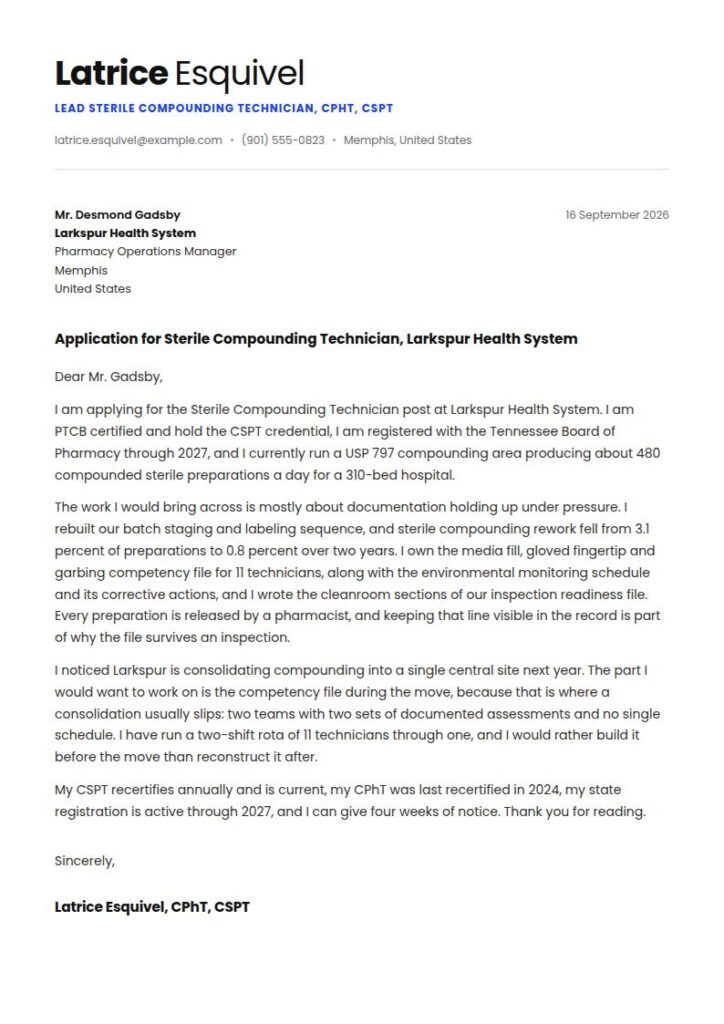
A pharmacy technician cover letter example you can adapt
Dear Mr. Gadsby,
I am applying for the Sterile Compounding Technician post at Larkspur Health System. I am PTCB certified and hold the CSPT credential, I am registered with the Tennessee Board of Pharmacy through 2027, and I currently run a USP 797 compounding area producing about 480 compounded sterile preparations a day for a 310-bed hospital.
The work I would bring across is mostly about documentation holding up under pressure. I rebuilt our batch staging and labeling sequence, and sterile compounding rework fell from 3.1 percent of preparations to 0.8 percent over two years. I own the media fill, gloved fingertip and garbing competency file for 11 technicians, along with the environmental monitoring schedule and its corrective actions, and I wrote the cleanroom sections of our inspection readiness file. Every preparation is released by a pharmacist, and keeping that line visible in the record is part of why the file survives an inspection.
I noticed Larkspur is consolidating compounding into a single central site next year. The part I would want to work on is the competency file during the move, because that is where a consolidation usually slips: two teams with two sets of documented assessments and no single schedule. I have run a two-shift rota of 11 technicians through one, and I would rather build it before the move than reconstruct it after.
My CSPT recertifies annually and is current, my CPhT was last recertified in 2024, my state registration is active through 2027, and I can give four weeks of notice. Thank you for reading.
Sincerely, Latrice Esquivel, CPhT, CSPT
Openings that work
| Instead of | Use |
|---|---|
| I am writing to apply for the pharmacy technician position | I am applying for the Sterile Compounding Technician post, PTCB certified and CSPT credentialed |
| I am a hardworking technician with a passion for helping people | I run a USP 797 compounding area producing about 480 preparations a day for a 310-bed hospital |
| I have strong attention to detail and work well under pressure | Sterile compounding rework fell from 3.1 percent to 0.8 percent over two years |
| I believe I would be a great fit for your pharmacy | I noticed Larkspur is consolidating compounding into a single central site next year |
Evidence a pharmacy already keeps
Every line below is a number your employer records anyway, which is what makes it safe to write and easy to verify.
| Kind of evidence | What it looks like in a sentence |
|---|---|
| Fill volume | About 380 prescriptions a day across two pharmacists and four technicians |
| Dose volume | Cart fill and cabinet restock for 14 units, roughly 2,600 doses a day |
| Compounding volume | About 480 compounded sterile preparations a day on a two-shift rota |
| Accuracy | Sterile compounding rework down from 3.1 percent to 0.8 percent over two years |
| Billing | First-pass third-party claim acceptance held at 94 percent over six months |
| Controls | Cabinet discrepancies unresolved at end of shift down from 23 a month to 4 |
| People | Competency file for 11 technicians, four to six new technicians trained a year |
Retail, hospital and compounding letters are not the same letter
For a retail post, lead with prescriptions a day under staffing, claim acceptance, inventory work and your availability. For a hospital post, lead with beds, units, doses a day, controlled substance reconciliation and any cleanroom training. For a compounding post, lead with the chapter you work under, the daily preparation count, your competency file and your rework rate. In all three, say plainly that a pharmacist performs the final check.
Do not send one letter to all three; the vocabulary gives it away in a sentence. Do not describe a patient or a prescription belonging to someone. Do not write that you reviewed, approved or verified a prescription. Do not claim accuracy as an adjective when you can give a rate. Do not leave a pending registration unmentioned.
The setting you are writing to is worth about $11,500 a year
Pharmacy technicians are 51 percent in pharmacies and drug retailers, 18 percent in hospitals, 9 percent in general merchandise retailers, 8 percent in grocery and specialty food retailers and 5 percent in ambulatory healthcare services (BLS Occupational Outlook Handbook, Pharmacy Technicians, published 27 August 2026).
The medians follow the setting rather than the task: hospitals $50,760, ambulatory healthcare services $48,860, general merchandise retailers $48,150, grocery and specialty food retailers $41,430 and pharmacies and drug retailers $39,240 in May 2025, against an occupation-wide median of $45,750 (BLS, May 2025).
That is a gap of roughly $11,500 a year between the setting where half the occupation works and the one where the pay is highest. A cover letter cannot close it on its own, but it is the document where a retail technician translates fill volume, inventory control and claim work into the language a hospital pharmacy screens on.
Length, format and sending it
One page, four paragraphs, 250 to 350 words. PDF unless the portal says otherwise, named for yourself and the post: latrice-esquivel-sterile-compounding-technician-cover-letter.pdf.
Address a person where you can find one. Pharmacy managers and pharmacists in charge are often named in the posting, and a named letter on an otherwise specific file reads as deliberate.
Keep every figure identical to your resume. Our pharmacy technician resume example uses the same numbers as the letter above.
Key takeaways
- Name certification and state registration as two separate facts with dates.
- Give the setting and the volume you run, with the staffing attached.
- Pick one process you rebuilt, one number and one period as your evidence.
- Say plainly that a pharmacist performs the final check.
- Never describe a patient or a prescription belonging to someone.
- Rewrite the letter for retail, hospital or compounding rather than sending one version.
- Close with certification status, registration status and a notice period.
Write your pharmacy technician cover letter in 10 minutes with our AI cover letter builder.
Pharmacy technician cover letter questions, answered
How long should a pharmacy technician cover letter be?
One page, four paragraphs, 250 to 350 words. This is a high-volume occupation with about 44,700 openings projected a year (BLS Occupational Outlook Handbook, published 27 August 2026), so letters are read in batches and length is not read as effort.
Do I need a cover letter for a pharmacy technician job?
Attach one wherever there is a field for it, and always for a hospital or compounding post. The application form already collects your certification and dates. The letter is where you show that you understand the boundary of the role and can name a process you improved.
Should the letter mention that a pharmacist checks my work?
Yes. "Every preparation is released by a pharmacist" or "every prescription goes to a pharmacist for the final check" tells a manager you know where your responsibility ends. The Handbook puts it the same way: technicians "work under the supervision of pharmacists, who must review prescriptions before they are dispensed to patients" (BLS, published 27 August 2026).
What do I write with no pharmacy experience?
Write the training program as the experience. Name the program and its accreditation, the total hours, the experiential placement, the setting and the volume you worked in. Then give your certification or exam date and your registration or application date, and one number from any previous job that shows volume and accuracy, such as transactions handled or a count variance you kept low.
How do I ask for a hospital job from a retail one?
Translate, then name the gap. Prescriptions a day becomes throughput under staffing, cycle counts become inventory control, and controlled substance logs become reconciliation. Then say what you are doing about the difference: cleanroom training completed, a PTCB certificate earned, or CSPT eligibility you are working toward. Managers hire retail technicians into hospitals routinely; they just need the translation done for them.