Medical Administrative Assistant Idris Ndiaye CMAA
Medical Administrative Assistant
[email protected] | (225) 555-1324 | Baton Rouge, United States
Profile
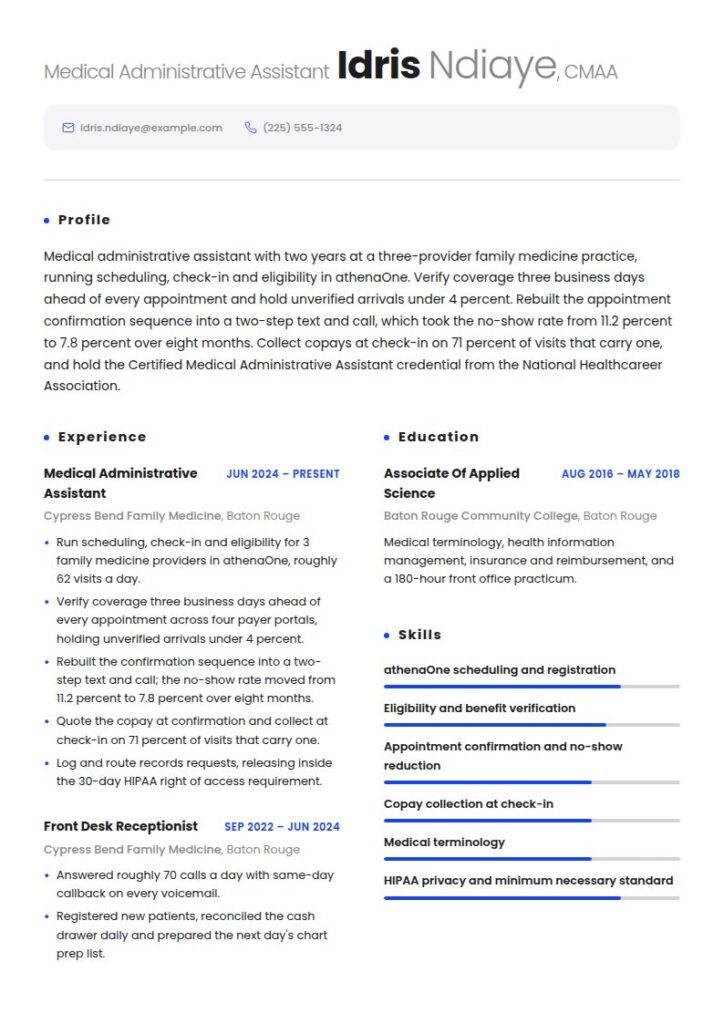
Medical administrative assistant with two years at a three-provider family medicine practice, running scheduling, check-in and eligibility in athenaOne. Verify coverage three business days ahead of every appointment and hold unverified arrivals under 4 percent. Rebuilt the appointment confirmation sequence into a two-step text and call, which took the no-show rate from 11.2 percent to 7.8 percent over eight months. Collect copays at check-in on 71 percent of visits that carry one, and hold the Certified Medical Administrative Assistant credential from the National Healthcareer Association.
Work Experience
06/2024 - Present, Medical Administrative Assistant, Cypress Bend Family Medicine, Baton Rouge, United States
- Run scheduling, check-in and eligibility for 3 family medicine providers in athenaOne, roughly 62 visits a day.
- Verify coverage three business days ahead of every appointment across four payer portals, holding unverified arrivals under 4 percent.
- Rebuilt the confirmation sequence into a two-step text and call; the no-show rate moved from 11.2 percent to 7.8 percent over eight months.
- Quote the copay at confirmation and collect at check-in on 71 percent of visits that carry one.
- Log and route records requests, releasing inside the 30-day HIPAA right of access requirement.
09/2022 - 06/2024, Front Desk Receptionist, Cypress Bend Family Medicine, Baton Rouge, United States
- Answered roughly 70 calls a day with same-day callback on every voicemail.
- Registered new patients, reconciled the cash drawer daily and prepared the next day's chart prep list.
Education
08/2016 - 05/2018, Associate of Applied Science, Medical Office Administration, Baton Rouge Community College, Baton Rouge, United States
Medical terminology, health information management, insurance and reimbursement, and a 180-hour front office practicum.
Skills
athenaOne scheduling and registration, 80
Eligibility and benefit verification, 75
Appointment confirmation and no-show reduction, 70
Copay collection at check-in, 70
Medical terminology, 70
HIPAA privacy and minimum necessary standard, 80
Languages
English, native
French, fluent
Wolof, native
Certificates
03/2019, Certified Medical Administrative Assistant (CMAA), National Healthcareer Association, NHA-CMAA-4471203
Renewed every two years with 10 continuing education credits.
02/2026, Basic Life Support Provider, American Heart Association
Summary
A medical administrative assistant resume is a one page document showing that you can run the measured part of a clinic front office: the scheduling template and its no-show rate, eligibility verified with a lead time, prior authorization turnaround, referral tracking, copay collected at check-in and records requests released on the clock. This guide gives you three adaptable versions and current Bureau of Labor Statistics pay data.
Medical Administrative Assistant resume examples by experience level
In short, a medical administrative assistant resume is a one page document showing you can run the part of a clinic front office that somebody already counts every month.
That is the difference between this job and general administrative work. An office assistant is judged on whether the office runs. After all, you are judged on numbers in a report: unused slots, patients who arrived with coverage nobody had checked, authorizations that sat open, referrals sent and never closed, and how much of what was owed at the visit was taken at the visit.
Resume guide for a medical administrative assistant resume
In particular, this guide and the corresponding medical administrative assistant resume example will cover:
- How to write a medical administrative assistant resume, section by section
- The six access and revenue measures that belong on the page with numbers attached
- Three adaptable summaries: new, experienced and lead
- What the job market looks like and what you can expect to earn
How to write a medical administrative assistant resume
Use six sections: contact header, summary, the systems you operate, front office experience, the measures block, and finally education with certifications. In practice, one page works for almost everyone in this role.
Also put the electronic health record in the header. For example, a clinic running Epic does not want to spend six weeks teaching you where the work queues live, and the recruiter screening forty files searches for the system name first.
| Section | What it is answering | Where it goes |
|---|---|---|
| EHR and practice management system | Can this person work my schedule and my work queues on day one? | Header line, then its own block |
| Eligibility verification | Will patients arrive with coverage checked? | First experience bullet, with a lead time |
| Scheduling template | Do they design slots, or book the next opening? | With the no-show rate attached |
Write the front office in the numbers the clinic already reports
Every clinic produces the same reports without anyone asking: slot utilization, no-show and cancellation rates, unverified arrivals, aged authorization queues, open referrals, and point of service collection. Write your resume in those six, because your reader already reads them.
If nobody ever handed you a report, count it yourself: visits a day, providers supported, authorizations open at once, records requests a month, days between the request and the release. Use your own clinic's figures and say what period they cover, because there is no national no-show benchmark worth quoting and a manager who runs the report every Monday will know that.
Run the finished file through the ATS resume checker before you send it. Health systems and large groups parse applications into a structured record before a human opens them.
Choosing the best resume format for a medical administrative assistant resume
Reverse chronological, one page. Practice name, city, specialty, providers and sites, dates, then three to five bullets that each carry a number.
Similarly, put the provider count and specialty in the employer line instead of in a bullet. Supporting three family medicine physicians at one site is a different job from supporting twenty-two clinicians across four sites, and the authorization burden in orthopedics is nothing like the one in general practice. A functional format fails here, because progression is the argument: front desk, then access coordinator, then lead.
Include your contact information
| ✅ Right | ❌ Wrong |
|---|---|
| Idris Ndiaye | Idris Ndiaye |
| Medical Administrative Assistant, CMAA | Healthcare administrative professional |
| Epic Cadence and Prelude, athenaOne, 9 years in clinic access | Proficient in medical software |
| (225) 555-1324, [email protected], Baton Rouge, LA | (225) 555-1324, [email protected] |
The systems line under your name does more work than the summary. After all, adverts for this role name the EHR in the first three lines, and applicant tracking systems match on it.
Make use of a summary
Four lines: scale and specialty, the systems you run, two or three measures you own, and one result with a before, an after and a period.
Medical administrative assistant with two years at a three-provider family medicine practice, running scheduling, check-in and eligibility in athenaOne. Verify coverage three business days ahead of every appointment and hold unverified arrivals under 4 percent. Rebuilt the appointment confirmation sequence into a two-step text and call, which took the no-show rate from 11.2 percent to 7.8 percent over eight months. Collect copays at check-in on 71 percent of visits that carry one, and hold the Certified Medical Administrative Assistant credential from the National Healthcareer Association.
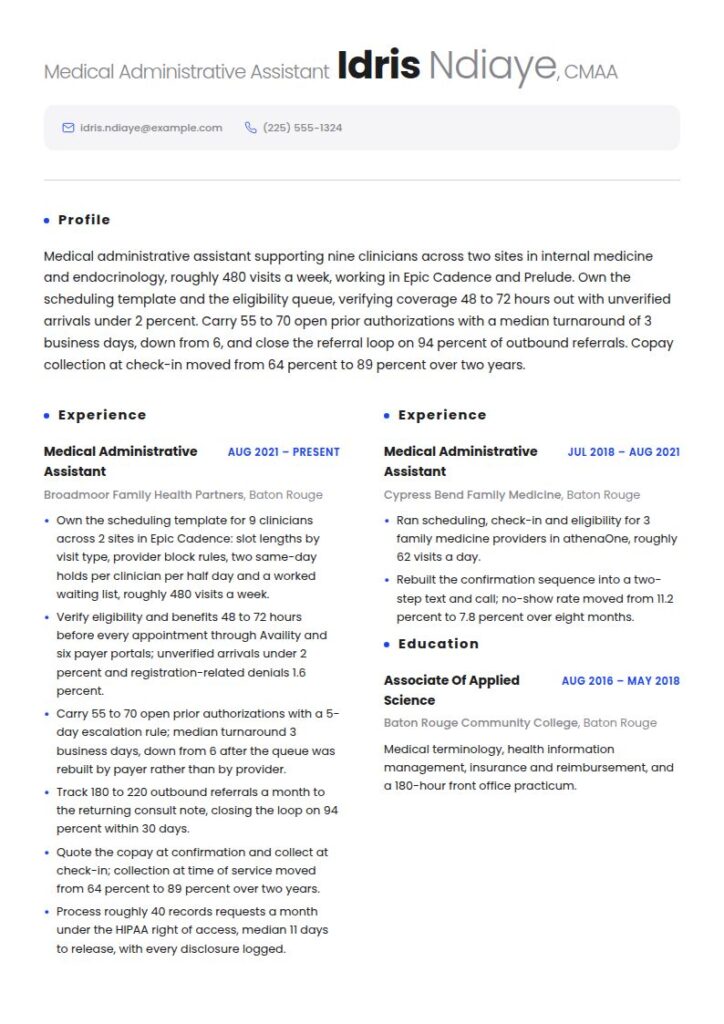
Medical administrative assistant supporting nine clinicians across two sites in internal medicine and endocrinology, roughly 480 visits a week, working in Epic Cadence and Prelude. Own the scheduling template and the eligibility queue, verifying coverage 48 to 72 hours out with unverified arrivals under 2 percent. Carry 55 to 70 open prior authorizations with a median turnaround of 3 business days, down from 6, and close the referral loop on 94 percent of outbound referrals. Copay collection at check-in moved from 64 percent to 89 percent over two years.
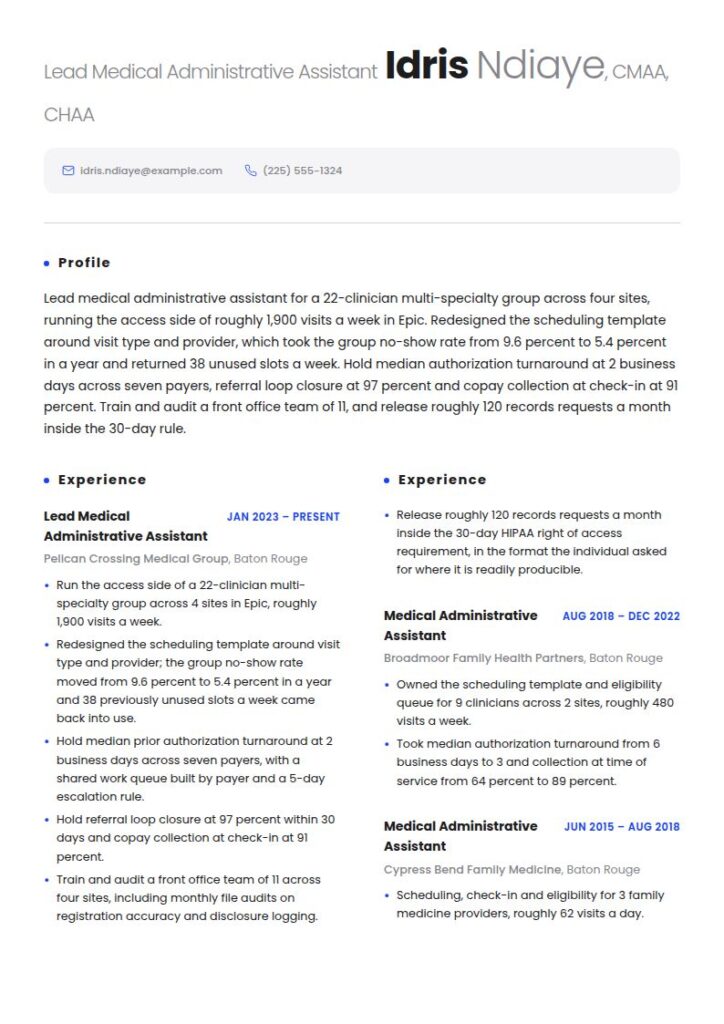
Lead medical administrative assistant for a 22-clinician multi-specialty group across four sites, running the access side of roughly 1,900 visits a week in Epic. Redesigned the scheduling template around visit type and provider, which took the group no-show rate from 9.6 percent to 5.4 percent in a year and returned 38 unused slots a week. Hold median authorization turnaround at 2 business days across seven payers, referral loop closure at 97 percent and copay collection at check-in at 91 percent. Train and audit a front office team of 11, and release roughly 120 records requests a month inside the 30-day rule.
Right vs wrong: the same medical administrative assistant summary, twice
| ✅ Right | ❌ Wrong |
|---|---|
| Supporting nine clinicians across two sites, roughly 480 visits a week, in Epic Cadence and Prelude. | Experienced medical administrative assistant in a busy healthcare setting. |
| Verify coverage 48 to 72 hours out with unverified arrivals under 2 percent. | Responsible for insurance verification and patient registration. |
| Carry 55 to 70 open prior authorizations with a median turnaround of 3 business days, down from 6. | Assisted with prior authorizations and referrals. |
| Copay collection at check-in moved from 64 percent to 89 percent over two years. | Excellent communication skills and strong attention to detail. |
The right column, for instance, can be checked against a report the reader already has open. The left column cannot.
Outline your experience
Then give the practice, city, specialty, providers and sites, dates. Then three to five bullets, each naming one function and carrying a number with a period attached.
| Instead of | Use |
|---|---|
| Scheduled patient appointments | Own the scheduling template for 9 clinicians across 2 sites, roughly 480 visits a week, with slot lengths set by visit type |
| Verified insurance | Verify eligibility and benefits 48 to 72 hours before the visit through Availity and six payer portals, unverified arrivals under 2 percent |
| Obtained prior authorizations | Carry 55 to 70 open prior authorizations in a shared work queue with a 5-day escalation rule, median turnaround 3 business days |
Medical Administrative Assistant, Broadmoor Family Health Partners, Baton Rouge, LA, internal medicine and endocrinology, 9 clinicians across 2 sites, roughly 480 visits a week, August 2021 to Present
Own the scheduling template for both sites in Epic Cadence: slot lengths by visit type, provider block rules, two same-day holds per clinician per half day, and a worked waiting list.
Run eligibility verification 48 to 72 hours ahead of every appointment through Availity and six payer portals, holding unverified arrivals under 2 percent and registration-related denials at 1.6 percent.
Carry 55 to 70 open prior authorizations with a 5-day escalation rule; median turnaround is 3 business days, down from 6 after the queue was rebuilt by payer rather than by provider, and the referral loop closes on 94 percent within 30 days.
Quote the copay at confirmation and collect at check-in; collection at time of service moved from 64 percent to 89 percent over two years, and release roughly 40 records requests a month inside the 30-day rule.
Put a number on every step from the scheduling template to the records release
In fact, this is the section that turns a general administrative resume into a clinic one, and it is six specific things, each with a number that already sits in a report somebody runs.
One: the scheduling template, and the no-show rate that proves it works. A template is design, not a calendar: slot lengths by visit type, units held for new patients, block rules, same-day holds, overbook policy, and a waiting list that is worked. Give the no-show rate with its period and say what you changed to move it. The rate alone is context; the rate with an intervention attached is evidence.
Two: eligibility verification, and the lead time. Anyone can say they verify insurance. The information is when. Coverage checked at the counter is a problem found in front of a queue; coverage checked at booking and re-verified 48 or 72 hours out is a problem solved by phone in a quiet hour. Give the lead time, the route and the unverified arrival rate. Then say what you check beyond active or inactive: plan type, in-network status for that specific clinician, deductible remaining, copay by visit type, whether the plan requires a referral, and whether the service needs authorization at all.
Prior authorization and referral tracking
Three: prior authorization turnaround. The least visible and most valuable thing on the page. Say how many you hold open at once, how you track them, your escalation rule, and what your median turnaround became. The regulatory floor is worth naming: under the CMS Interoperability and Prior Authorization final rule, impacted payers must "send prior authorization decisions within 72 hours for expedited (i.e., urgent) requests and seven calendar days for standard (i.e., non-urgent) requests," beginning 1 January 2026, and must give a specific reason for a denial (Centers for Medicare and Medicaid Services, final rule CMS-0057-F fact sheet, 17 January 2024). Someone who knows what the payer owes them, and when, chases rather than waits.
Four: referral tracking, and closing the loop. Sending a referral is the easy half. The measured half is whether the consult note came back, was filed to the right encounter and reached the ordering clinician. Write it as a closure rate over a window: how many outbound referrals, how many closed within 30 days, what you did with the rest. Add the network check, since a referral to an unchecked out-of-network specialist becomes a bill the patient never agreed to.
Copay collection and records requests
Five: copay collection at check-in. Money taken while the patient is at the desk, against money that becomes a statement someone has to chase. Give the percentage and the movement, and say what made it move: quoting the amount at the confirmation call, offering a card on file, or having the exact copay in the record because eligibility ran three days ago rather than three minutes ago.
Six: records requests, on the clock. Under the HIPAA right of access at 45 CFR 164.524, a covered entity "must act on a request for access no later than 30 days after receipt of the request," with a single extension of no more than 30 days and written notice to the individual (Code of Federal Regulations, 45 CFR 164.524(b)(2), current September 2026). The same section requires the copy in "the form and format requested by the individual, if it is readily producible in such form and format." Say how many requests you handle a month, your median days to release, and how you log the disclosure. Almost nobody applying mentions records, which is why it separates a file.
Template: 9 clinicians across 2 sites, slot lengths by visit type, 2 same-day holds per clinician per half day; no-show rate 6.9 percent, down from 12.4 percent
Eligibility: verified 48 to 72 hours ahead through Availity and 6 payer portals; unverified arrivals under 2 percent, registration-related denials 1.6 percent
Authorizations: 55 to 70 open at a time, 5-day escalation rule, median turnaround 3 business days, down from 6
Referrals: 180 to 220 outbound a month, loop closed on 94 percent within 30 days
Collection: 89 percent at time of service, up from 64 percent
Records: roughly 40 requests a month, median 11 days to release
Systems: Epic Cadence and Prelude, athenaOne, eClinicalWorks, Availity, Waystar
Build a snapshot of your key skills
In practice, list twelve to sixteen entries in four groups. Named systems beat adjectives.
Access: Scheduling template design, Slot and block rules, Waiting list and same-day fill, Confirmation sequences, No-show reduction, New patient intake, Interpreter scheduling
Coverage and authorization: Eligibility and benefit verification, Plan type and network checking, Prior authorization submission and appeal, Work queue management, Referral loop closure
Money and records: Copay quoting, Collection at time of service, Good faith estimates, HIPAA right of access requests, Identity verification, Disclosure logging
Systems: Epic Cadence and Prelude, athenaOne, eClinicalWorks, NextGen, Availity, Waystar, Microsoft 365
List your education and certifications
Typical entry-level education for secretaries and administrative assistants is a high school diploma or equivalent (BLS Occupational Outlook Handbook, 27 August 2026), so the credential is what separates two files.
The Certified Medical Administrative Assistant credential from the National Healthcareer Association requires a high school diploma or equivalent plus either a training program completed within the last five years or one year of supervised work experience within the last three, and it renews every two years with 10 continuing education credits (National Healthcareer Association, checked September 2026). Meanwhile, on the hospital side the National Association of Healthcare Access Management certifies the same work as Certified Healthcare Access Associate and, above it, Certified Healthcare Access Manager (NAHAM, checked September 2026).
Associate of Applied Science, Medical Office Administration, Baton Rouge Community College, Baton Rouge, LA, 2018
High School Diploma, Baton Rouge, LA, 2016
Certifications: Certified Medical Administrative Assistant (CMAA), National Healthcareer Association, #NHA-CMAA-4471203, current through 2027. Certified Healthcare Access Associate (CHAA), National Association of Healthcare Access Management, #NAHAM-CHAA-20894. Basic Life Support Provider, American Heart Association, 2026.
Training: Epic Cadence and Prelude end user certification, 2022. Annual HIPAA privacy and security training, current.
Choose the right layout and design
Above all, use a single column, plain type at 11 or 12 point, clear headings, and no photograph or icons for skills. Health system portals parse the file into a structured record before a human sees it, and two columns, text boxes and graphics are where that parsing breaks. Therefore, spell the system names the way the advert does: a resume that says "electronic medical records software" will not be found by a search looking for "Cadence".
Name the EHR in the header. Give providers, sites and specialty in every employer line. Attach a lead time to eligibility verification, not just the word verified. State authorization volume and median turnaround in days. Give the referral closure rate and its window. Report copay collection as a movement. Say how fast you release records.
Do not write "answered phones and scheduled appointments" as a bullet; that is the floor of the job, not the job. Do not describe yourself as detail-oriented or a team player. Do not claim clinical duties you do not perform, because rooming patients, taking vitals and giving injections belong to a differently trained role. Do not put a patient name, initial, account number or date of birth anywhere on a resume.
Medical administrative assistant job market and outlook
The occupation is large and shrinking overall, and the medical slice of it is the one part that is not. That split is the whole market.
| Measure | Value |
|---|---|
| Medical secretaries and administrative assistants, jobs 2025 | 979,000 |
| Projected employment, 2035 | 1,026,100 |
| Projected change, 2025-35 | 5 percent, a gain of 47,100 jobs |
| Median annual wage, medical subgroup, May 2025 | $45,930 |
| All secretaries and administrative assistants, jobs 2025 | 3,515,600 |
| All, projected change, 2025-35 | Decline of 2 percent, a change of -75,300 |
| All, projected annual openings | About 314,400 |
| Typical entry-level education | High school diploma or equivalent |
Source: U.S. Bureau of Labor Statistics, Occupational Outlook Handbook, May 2025 wages and 2025-35 projections, published 27 August 2026.
Read that table carefully, because the two halves move in opposite directions. The medical subgroup is projected to grow 5 percent from 2025 to 2035, adding 47,100 jobs to reach 1,026,100, while the occupation containing it declines 2 percent (BLS Occupational Outlook Handbook, 2025-35 projections, published 27 August 2026). However, quoting 3,515,600 jobs as the size of the medical administrative assistant workforce uses the wrong denominator, and quoting the 2 percent decline as your own outlook understates it.
The medical subgroup is the only one of the four that grows
BLS breaks secretaries and administrative assistants into four groups and projects three of them down between 2025 and 2035: executive flat at 489,200, legal down 5 percent, and all others down 6 percent, a loss of 114,100 jobs. Medical is the exception, projected up 5 percent to 1,026,100 (BLS Occupational Outlook Handbook, 2025-35 projections, published 27 August 2026). The occupation as a whole still opens roughly 314,400 positions a year, almost all from workers leaving it (BLS, 2025-35 projections).
The pay table tells you where inside that churn to stand. Medical secretaries and administrative assistants had a median of $45,930 as of May 2025, against $76,590 for executive, $55,570 for legal and $47,540 for all others (BLS Occupational Outlook Handbook, May 2025).
What is being automated out of this occupation is the work with no judgment in it: typing, routing a call, filing a form. What is not is deciding whether a plan covers a service, arguing an authorization denial, and knowing which referral has gone unanswered for three weeks. Write the resume that belongs to the second group.
What salary you can expect as a medical administrative assistant
Specifically, medical secretaries and administrative assistants had a median annual wage of $45,930 as of May 2025 (BLS Occupational Outlook Handbook, May 2025). In contrast, across all secretaries and administrative assistants the median was $48,310, or $23.23 an hour, with the lowest 10 percent under $35,360 and the highest 10 percent over $77,720 (BLS, May 2025).
The spread inside that subgroup is scope rather than tenure. However, a desk that books appointments and answers a phone prices at the bottom. A desk that owns the template, runs eligibility with a lead time, carries an authorization queue and collects at check-in is doing work a clinic would otherwise buy from a vendor, and it prices near the top.
Three levers, in particular, show up repeatedly in adverts for this role. Depth in a named system, because a group standardizing on Epic or athenaOne will pay for someone who does not need six weeks of training. Authorization competence, because a specialty practice loses real money to a slow queue. Finally, a credential, since CMAA or CHAA converts "I have done this" into something a recruiter can check. Then the next step up is patient access lead, authorization specialist or practice coordinator.
Key takeaways for a medical administrative assistant resume
- First, name the EHR in the header, because it is the most searched term on these postings.
- Give providers, sites and specialty in every employer line so the reader can size the desk.
- Next, attach a lead time to eligibility verification and report the unverified arrival rate.
- Also state authorization volume, your escalation rule and the median turnaround in days.
- Similarly, give referral loop closure as a rate over a defined window.
- In addition, report copay collection at check-in as a movement, and say what made it move.
- Finally, show that you release records inside the 30-day rule.
Build your medical administrative assistant resume in 15 minutes with our AI resume builder.
Related medical resume examples
- Medical receptionist resume
- Medical office manager resume
- Medical support assistant resume
- Clinic coordinator resume
- Medical scribe resume
- Medical biller resume
- Medical coder resume
- Medical assistant resume
- Dental receptionist resume
- Health care administration resume
- Healthcare project manager resume
- Nursing home resume
Pair it with a matching medical administrative assistant cover letter.
Medical administrative assistant resume questions, answered
How long should a medical administrative assistant resume be?
One page. The only thing that earns a second page is a block of measures long enough to need the room: template and no-show, eligibility lead time, authorization turnaround, referral closure and collection, across more than one practice. Name the systems in the header, in order of depth, and say what you do inside each rather than listing it.
What do I put on a medical administrative assistant resume with no clinic experience?
Translate the desk you have already run. Call volume, scheduling systems, payment handling and reconciliation, and any benefits or claims work count directly. Then close the gap in one block: the medical terminology course, the CMAA credential if you hold it, and a sentence proving you know what eligibility, authorization and a referral loop are.
Is the CMAA certification worth getting?
For an entry or early career file, usually yes. It requires a high school diploma or equivalent plus either a training program completed within the last five years or one year of supervised experience within the last three, and renewal every two years with 10 continuing education credits (National Healthcareer Association, checked September 2026). It is the cheapest way to turn experience nobody can verify into a line a recruiter can check.
Can I put patient numbers on my resume?
Aggregate figures only. Visits a week, authorizations open, records requests a month and percentages are fine. A patient name, initial, date of birth or account number is not, and the HIPAA minimum necessary standard at 45 CFR 164.502(b) limits use and disclosure of protected health information to what the purpose requires (U.S. Department of Health and Human Services).
How is this different from a medical receptionist or a medical office manager?
A receptionist is measured at the counter, on arrival and greeting. A medical office manager owns the practice's operations and its compliance program. A medical administrative assistant sits between them and owns the access chain: template, verification, authorization, referral and record.