Idris Ndiaye Medical Administrative Assistant, CMAA Baton Rouge, 70808, United States [email protected] · (225) 555-1324
11 September 2026
Ms. Ines Thibodaux Practice Manager Oak Bayou Medical Partners Baton Rouge, United States
Application for Medical Administrative Assistant, Oak Bayou Medical Partners
Dear Ms. Thibodaux,
I am applying for the Medical Administrative Assistant post at Oak Bayou Medical Partners. I run Epic Cadence and Prelude and have owned the scheduling template, the eligibility queue and the prior authorization work queue for nine clinicians across two sites, roughly 480 visits a week in internal medicine and endocrinology. I also work athenaOne, which I used for six years before this role.
The measure I would most want to bring with me is authorization turnaround. When I took the queue on it was organized by provider, which meant nobody learned any single payer's rules well. I rebuilt it by payer, added a five-day escalation rule and a weekly aging review, and the median turnaround went from six business days to three across two years. Over the same period eligibility moved to a 48 to 72 hour lead time, unverified arrivals fell under 2 percent, and copay collection at check-in went from 64 percent to 89 percent because patients were being quoted an accurate number at the confirmation call rather than a guess at the counter.
Your posting mentions a new endocrinology service line opening in the spring. That is the part of the schedule where authorization volume tends to rise fastest, and I would want to spend my first month building the payer-specific checklists before the volume arrives rather than after. I would also want to look at your referral tracking, since closing the loop on outbound referrals is the measure most clinics have no owner for.
I hold the Certified Medical Administrative Assistant credential from the National Healthcareer Association and I am current on annual HIPAA privacy and security training. I can start with four weeks' notice. Thank you for your time.
Sincerely, Idris Ndiaye, CMAA
Summary
A medical administrative assistant cover letter names the electronic health record you run, the access measures you personally own, and one number that moved while you held it. This guide gives you a full adaptable letter, the openings that work, what to write when you are coming from outside healthcare, and how to keep the letter and the resume agreeing with each other.
Medical Administrative Assistant cover letter examples by experience level
A medical administrative assistant cover letter is a one page letter telling a clinic manager which system you run, which parts of the access chain you have owned, and one number that moved while you were holding it.
Clinic managers hire this role under pressure, usually because a desk is short-staffed and the authorization queue is aging. A letter written for that reality stands out by being about the job rather than the applicant.
Guide to a medical administrative assistant cover letter
This guide and the corresponding medical administrative assistant cover letter example will cover:
- How to structure the letter, paragraph by paragraph
- Why the EHR belongs in your first two sentences
- What counts as evidence when nobody gave you a report
- How to write the letter with no clinic experience yet
How to write a medical administrative assistant cover letter
| Paragraph | Its job | Length |
|---|---|---|
| Opening | The post, the system you run, the size of desk you held | 2 to 3 sentences |
| Evidence | One measure, a before, an after and a period | 4 to 5 sentences |
| Fit | Something specific about their clinic, and what you would take on first | 3 to 4 sentences |
| Close | Credential, availability, thank you | 2 sentences |
Name the system in the first two sentences
Adverts for this job almost always name the electronic health record, and the manager reading applications has one silent question: how many weeks of training does this person need before they are useful?
"I run Epic Cadence and Prelude and have owned the template for nine clinicians across two sites" answers it in one line. "Proficient in electronic medical records" does not, and it appears in every other letter in the folder.
If you run more than one system, say which you are strongest in. Groups acquiring practices have to merge two builds, and someone who has worked both sides is worth an interview on its own.
A medical administrative assistant cover letter example you can adapt
Dear Ms. Thibodaux,
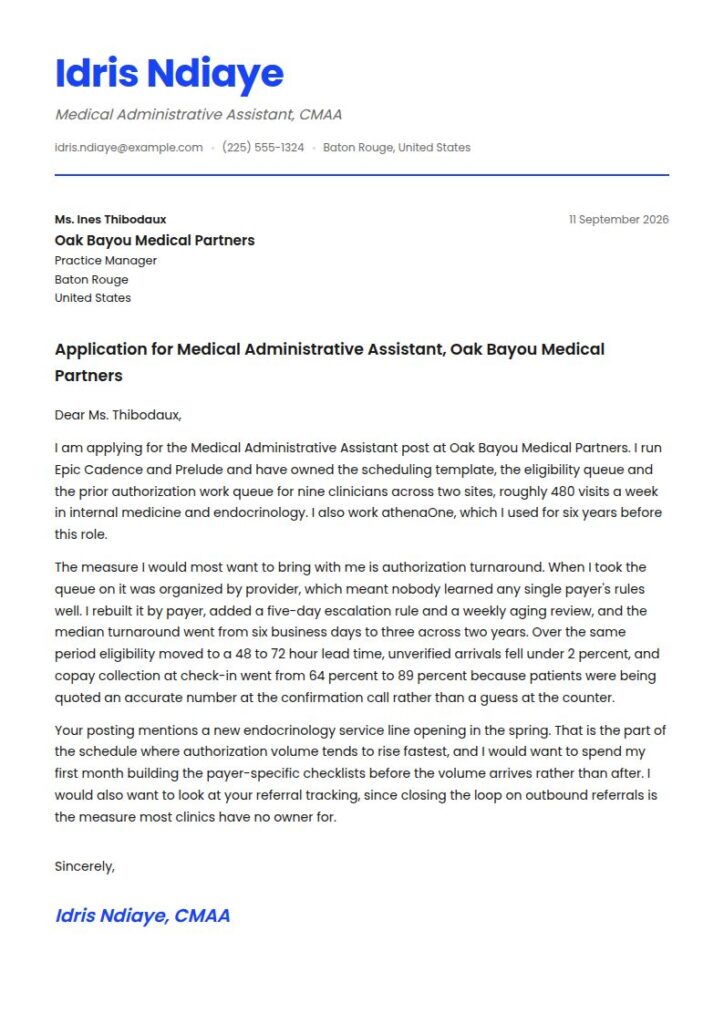
I am applying for the Medical Administrative Assistant post at Oak Bayou Medical Partners. I run Epic Cadence and Prelude and have owned the scheduling template, the eligibility queue and the prior authorization work queue for nine clinicians across two sites, roughly 480 visits a week in internal medicine and endocrinology. I also work athenaOne, which I used for six years before this role.
The measure I would most want to bring with me is authorization turnaround. When I took the queue on it was organized by provider, which meant nobody learned any single payer's rules well. I rebuilt it by payer, added a five-day escalation rule and a weekly aging review, and the median turnaround went from six business days to three across two years. Over the same period eligibility moved to a 48 to 72 hour lead time, unverified arrivals fell under 2 percent, and copay collection at check-in went from 64 percent to 89 percent because patients were being quoted an accurate number at the confirmation call rather than a guess at the counter.
Your posting mentions a new endocrinology service line opening in the spring. That is the part of the schedule where authorization volume tends to rise fastest, and I would want to spend my first month building the payer-specific checklists before the volume arrives rather than after. I would also want to look at your referral tracking, since closing the loop on outbound referrals is the measure most clinics have no owner for.
I hold the Certified Medical Administrative Assistant credential from the National Healthcareer Association and I am current on annual HIPAA privacy and security training. I can start with four weeks' notice. Thank you for your time.
Sincerely, Idris Ndiaye, CMAA
Openings that work
| Instead of | Use |
|---|---|
| I am writing to express my interest in your medical office position | I am applying for the Medical Administrative Assistant post, and I run Epic Cadence and Prelude |
| I have excellent organizational skills | I have owned the scheduling template and eligibility queue for nine clinicians across two sites |
| I am familiar with insurance verification | Median authorization turnaround went from six business days to three after I rebuilt the queue by payer |
| I would be a valuable asset to your team | Your posting mentions a new endocrinology service line opening in the spring |
What counts as evidence when nobody gave you a report
Plenty of clinics never hand the front desk a number. That does not mean there is nothing to write; it means you count it yourself, and counting it is worth saying.
| Kind of evidence | What it looks like in a sentence |
|---|---|
| Lead time | Moved eligibility verification from the visit morning to 72 hours ahead |
| Volume | Carry 55 to 70 open prior authorizations at a time across seven payers |
| Money at the desk | Copay collection at check-in went from 64 percent to 89 percent |
| Something you fixed | Rewrote the confirmation sequence; the no-show rate fell from 11.2 percent to 7.8 percent |
Writing the letter with no clinic experience yet
The honest version is stronger than the padded one. Say what you have run, name the gap, and say what you did about it.
Translate the desk you have held, with call volume, booking systems, payment handling and reconciliation. Say which medical terminology or front office training you completed and when. Show that you know what the words mean, with one accurate sentence about eligibility, prior authorization or a referral loop. Offer what nobody else offers, such as evening or Saturday clinic cover. Name the clinic and one real thing about it.
Do not claim an EHR you have only seen demonstrated; the interview will find out in one question. Do not describe yourself as detail-oriented, organized or a fast learner. Do not write about wanting to help people without saying what you would do at the desk. Do not send a letter with no clinic name in it. Do not mention any patient, even without a name, because the story is never as anonymous as it feels.
The medical desks are the ones BLS projects upward
Secretaries and administrative assistants overall are projected to decline 2 percent from 2025 to 2035, but the medical subgroup is the one BLS projects upward, growing 5 percent and 47,100 jobs to 1,026,100 (BLS Occupational Outlook Handbook, 2025-35 projections, published 27 August 2026).
Medical secretaries and administrative assistants had a median of $45,930 as of May 2025, against $48,310 across all secretaries and administrative assistants (BLS Occupational Outlook Handbook, May 2025).
The letter's job is to put you in the part of the occupation that needs judgment. Anyone can be taught to book an appointment. Deciding whether a plan covers a service, appealing a denial and noticing an unanswered referral is what is still being hired for.
Length, format and sending it
One page, four paragraphs, 250 to 400 words. PDF unless the portal says otherwise, named for yourself and the post.
Address a person. Practice managers are usually named on the practice website or the posting itself, and "Dear Hiring Manager" on a file that is otherwise specific reads as a letter sent to twelve clinics.
Use the same figures as your resume so the two agree. Our medical administrative assistant resume example is written with the numbers used here. A manager who sees 89 percent in the letter and 91 percent on the resume will spend your first two minutes on arithmetic instead of the job.
Key takeaways
- Name the electronic health record in the first two sentences.
- Give the size of the desk you held: clinicians, sites and visits a week.
- Pick one measure and give a before, an after and a period.
- Say what you changed to make it move, not just that it moved.
- Name one real thing about their clinic, taken from their own posting.
- Close with the credential and your availability.
- Keep the letter's numbers identical to the resume's.
Medical administrative assistant cover letter questions, answered
How long should a medical administrative assistant cover letter be?
One page, four paragraphs, 250 to 400 words. Clinic managers read these between patients, and length is not effort.
Do I need a cover letter if the application is a portal?
Attach one wherever there is a field for it. The portal collects the same structured fields from everyone. The letter is the only place you can say which system you run, which measures you owned and what you would do in your first month.
What if my clinic never measured anything?
Then say you built the measurement, which is a better sentence than any number. "The practice did not report authorization turnaround, so I logged submission and decision dates for a quarter; the median was six business days, and after I reorganized the queue by payer it was three.
Should I mention prior authorization rules in the letter?
One sentence, if it is relevant to the specialty. Under the CMS Interoperability and Prior Authorization final rule, impacted payers must send prior authorization decisions within 72 hours for expedited requests and seven calendar days for standard ones, beginning 1 January 2026, and must give a specific reason for a denial (Centers for Medicare and Medicaid Services, final rule CMS-0057-F fact sheet, 17 January 2024). Knowing what the payer owes you separates chasing from waiting.
Is it worth naming a certification in the letter?
Yes, in the closing line, with the issuing body. The Certified Medical Administrative Assistant credential from the National Healthcareer Association requires a high school diploma or equivalent plus either a training program completed within the last five years or one year of supervised experience within the last three, and renews every two years with 10 continuing education credits (National Healthcareer Association, checked September 2026).