Medical Scribe, Emergency Medicine Renske Dekker B.S.
Medical Scribe, Emergency Department
[email protected] | (330) 555-1450 | Akron, United States
Profile
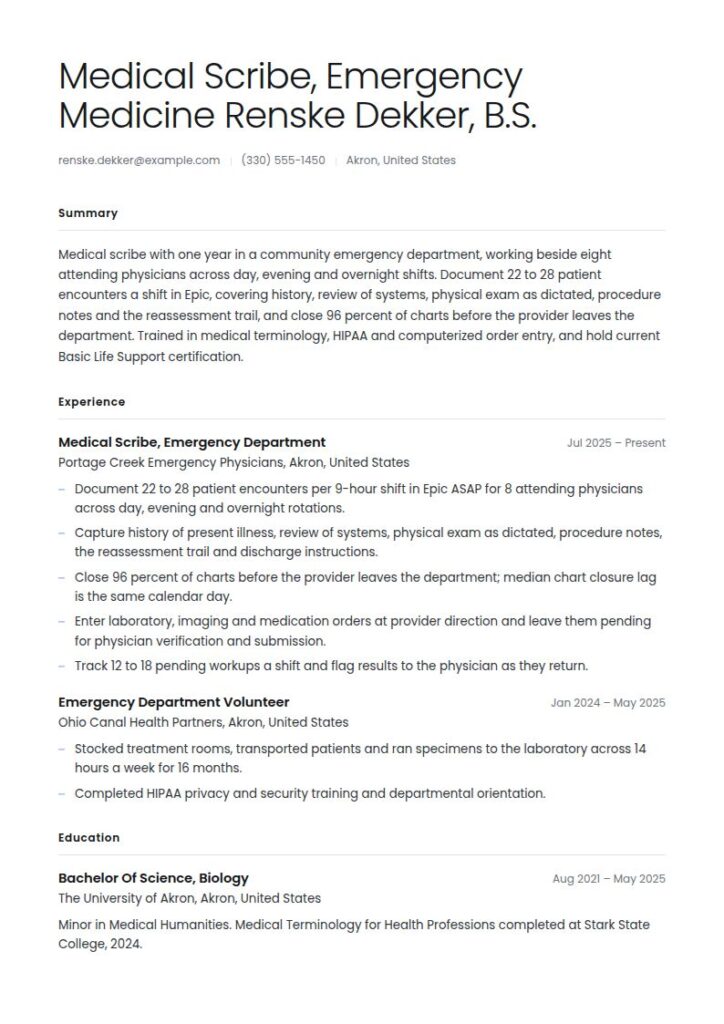
Medical scribe with one year in a community emergency department, working beside eight attending physicians across day, evening and overnight shifts. Document 22 to 28 patient encounters a shift in Epic, covering history, review of systems, physical exam as dictated, procedure notes and the reassessment trail, and close 96 percent of charts before the provider leaves the department. Trained in medical terminology, HIPAA and computerized order entry, and hold current Basic Life Support certification.
Work Experience
07/2025 - Present, Medical Scribe, Emergency Department, Portage Creek Emergency Physicians, Akron, United States
- Document 22 to 28 patient encounters per 9-hour shift in Epic ASAP for 8 attending physicians across day, evening and overnight rotations.
- Capture history of present illness, review of systems, physical exam as dictated, procedure notes, the reassessment trail and discharge instructions.
- Close 96 percent of charts before the provider leaves the department; median chart closure lag is the same calendar day.
- Enter laboratory, imaging and medication orders at provider direction and leave them pending for physician verification and submission.
- Track 12 to 18 pending workups a shift and flag results to the physician as they return.
01/2024 - 05/2025, Emergency Department Volunteer, Ohio Canal Health Partners, Akron, United States
- Stocked treatment rooms, transported patients and ran specimens to the laboratory across 14 hours a week for 16 months.
- Completed HIPAA privacy and security training and departmental orientation.
Education
08/2021 - 05/2025, Bachelor of Science, Biology, The University of Akron, Akron, United States
Minor in Medical Humanities. Medical Terminology for Health Professions completed at Stark State College, 2024.
Skills
Real-time encounter documentation, 80
Epic ASAP and SmartPhrases, 75
Medical terminology, 80
Review of systems and physical exam capture, 75
Order pend-and-verify workflow, 70
HIPAA privacy and security, 85
Typing, 96 words per minute at 99 percent accuracy, 90
Languages
English, native
Dutch, native
Spanish, beginner
Certificates
01/2026, Basic Life Support Provider, American Heart Association
Current through 2028.
07/2025, Epic ASAP End User Training, Portage Creek Emergency Physicians
Departmental end user training and competency sign-off.
Summary
A medical scribe resume is a one page document showing that you can carry a provider's note in real time without ever owning it. This guide gives you three adaptable versions, the documentation boundary that decides whether you are hired, the throughput numbers a practice already counts, and current Bureau of Labor Statistics pay and outlook for the published occupations closest to scribe work.
Medical Scribe resume examples by experience level
In short, a medical scribe resume is a one page document showing that you can build a provider's note while the visit is happening, in their system, to their standard, and hand it back for them to sign.
However, the job has an unusual shape and most applicants write past it. In other words, you produce the record of an encounter you are not clinically responsible for, and you own none of it. Therefore, a resume that says "assisted physicians with documentation" has given a hiring manager nothing. One that says how many encounters a shift, in which system, and how many charts closed before the provider walked out has given them everything.
Resume guide for a medical scribe resume
Specifically, this guide and the corresponding medical scribe resume example will cover:
- How to write a medical scribe resume, section by section
- The documentation boundary: what you may enter and who must sign it
- Three adaptable summaries: new scribe, experienced scribe and program lead
- The throughput numbers that belong on the page, and where to find yours
- What the job market looks like and what the published wage data says
How to write a medical scribe resume
Overall, it takes six blocks: contact header, summary, the systems and specialties you have scribed in, experience with numbers, the documentation record, and education with certifications. One page. Put the electronic health record and the specialty in the header line, because a cardiology practice is not hiring a generalist.
| Section | What it is answering | Where it goes |
|---|---|---|
| EHR and specialty | Can this person sit down beside my provider on Monday? | Header line, then its own block |
| Encounter volume | How much load have they carried? | First experience bullet, with a shift length |
| Chart closure | Do notes leave with the provider, or follow them home? | Its own measure, in days |
Write the note record, not the job description
Every scribe posting lists the same duties, because the duties are the same everywhere: accompany the provider, document in real time, record orders and results, prepare the chart for signature. Repeating them back tells the reader nothing.
What separates two scribe files is the record of the notes themselves: encounters per shift with the shift length, the specialty and setting, the system by name and module, the share of charts closed in session, the median lag between the encounter and the provider's signature, and the addendum rate. If nobody has handed you those figures, count them from the provider schedule and ask for the chart closure report. Say what period they cover, because a reader who runs that report every Monday knows a guess when they see one.
Run the file through the ATS resume checker before you send it. Scribe companies and health systems parse applications into a structured record before a human opens them.
Choosing the best resume format for a medical scribe resume
Reverse chronological, one page. Scribing is often the first job after a science degree, so the temptation is a functional format led by skills. Resist it. The reader wants to know how long you lasted and in what setting, because attrition here is real, and a scribe who stayed two years in an emergency department has already answered the question the hiring manager privately has.
Include your contact information
| ✅ Right | ❌ Wrong |
|---|---|
| Renske Dekker | Renske Dekker |
| Medical Scribe, Emergency Medicine and Cardiology, Epic | Motivated pre-health professional |
| 4 years scribing, 3 EHR systems, B.S. Biology | Fast typist with attention to detail |
| (330) 555-1450, [email protected], Akron, OH | (330) 555-1450, [email protected] |
The second line does more work than the summary. Scribe postings name the specialty and the system in the first three lines and the tracking system matches on both, so if you have scribed in three systems, name the three.
Make use of a summary
In short, use four lines: setting and specialty, providers and volume, the system, one measure of how notes moved.
Medical scribe with one year in a community emergency department, working beside eight attending physicians across day, evening and overnight shifts. Document 22 to 28 patient encounters a shift in Epic, covering history, review of systems, physical exam as dictated, procedure notes and the reassessment trail, and close 96 percent of charts before the provider leaves the department. Trained in medical terminology, HIPAA and computerized order entry, and hold current Basic Life Support certification.
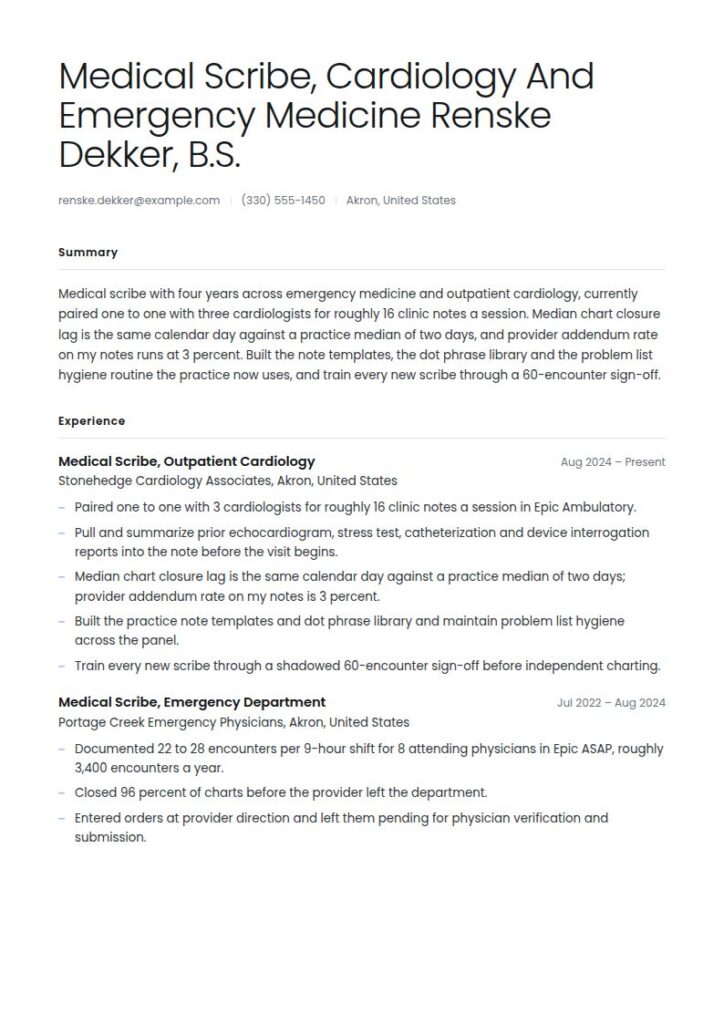
Medical scribe with four years across emergency medicine and outpatient cardiology, currently paired one to one with three cardiologists for roughly 16 clinic notes a session. Median chart closure lag is the same calendar day against a practice median of two days, and provider addendum rate on my notes runs at 3 percent. Built the note templates, the dot phrase library and the problem list hygiene routine the practice now uses, and train every new scribe through a 60-encounter sign-off.
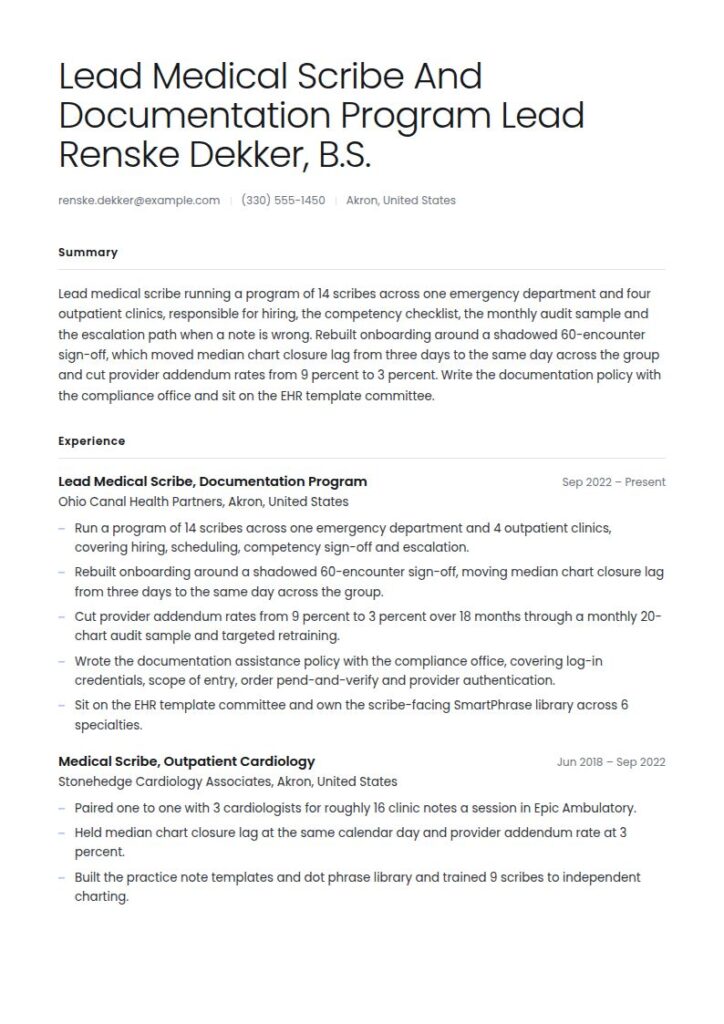
Lead medical scribe running a program of 14 scribes across one emergency department and four outpatient clinics, responsible for hiring, the competency checklist, the monthly audit sample and the escalation path when a note is wrong. Rebuilt onboarding around a shadowed 60-encounter sign-off, which moved median chart closure lag from three days to the same day across the group and cut provider addendum rates from 9 percent to 3 percent. Write the documentation policy with the compliance office and sit on the EHR template committee.
Right vs wrong: the same medical scribe summary, twice
| ✅ Right | ❌ Wrong |
|---|---|
| Document 22 to 28 patient encounters a shift in Epic across eight attending physicians. | Assisted physicians with documentation in a fast-paced environment. |
| Close 96 percent of charts before the provider leaves the department. | Ensured accurate and timely completion of medical records. |
| Provider addendum rate on my notes runs at 3 percent. | Known for accuracy and attention to detail. |
| Built the note templates and dot phrase library the practice now uses. | Proficient in electronic health record software. |
For example, the right column can be checked against a report the practice runs.
Outline your experience
Then list department or practice, city, specialty, providers scribed for, dates. Then three to five bullets, each naming one part of the note and carrying a number.
| Instead of | Use |
|---|---|
| Documented patient encounters for physicians | Documented 22 to 28 encounters per 9-hour shift for 8 emergency physicians in Epic, including procedure notes and the reassessment trail |
| Entered orders as directed | Entered laboratory, imaging and medication orders at provider direction and left them pending for physician verification |
| Maintained accurate medical records | Held provider addendum rate at 3 percent across roughly 3,400 encounters a year |
| Trained new staff | Trained 9 scribes through a shadowed 60-encounter sign-off |
Medical Scribe, Stonehedge Cardiology Associates, Akron, OH, outpatient cardiology, 3 cardiologists, August 2024 to Present
Document roughly 16 clinic notes a session in Epic: history of present illness, interval change, medication reconciliation against the active list, physical exam as dictated, and an assessment and plan written as a numbered problem list.
Pull and summarize prior echocardiogram, stress test, catheterization and device interrogation reports into the note before the visit begins.
Median chart closure lag is the same calendar day against a practice median of two days; provider addendum rate on my notes is 3 percent.
Enter laboratory, imaging and referral orders at provider direction and leave them pending for physician verification, and train every new scribe through a shadowed 60-encounter sign-off.
What you may document, and what only the provider may sign
In fact, this is the section that separates a scribe resume from every other administrative file, and almost nobody writes it. After all, a scribe is defined by a boundary: you produce the note and are never its author of record. As a result, a practice that hires someone who does not know where that line sits has bought a compliance problem.
One: the provider signs, and the signature is the claim. The Medicare Program Integrity Manual instructs that "CMS does not require the scribe to sign/date the documentation," that "Reviewers are only required to look for the signature (and date) of the treating physician/NPP on the note," that "Scribes are not providers of items or services," and that "The treating physician's/NPP's signature on a note indicates that the physician/NPP affirms the note adequately documents the care provided" (Centers for Medicare and Medicaid Services, Medicare Program Integrity Manual chapter 3, section 3.3.2.4, Transmittal 713, 5 May 2017). That cuts both ways: you are not exposed on the claim, and the only thing between your typing and a signed legal record is the provider's review. Which is why the addendum rate belongs on a resume.
Log-ins and orders for medical scribes
Two: your own log-in, every time. Joint Commission guidance requires organizations to set log-in protocols in policy, prohibiting scribes from working under the physician's credentials, and to require physician verification of what the assistant entered (The Joint Commission, standards FAQ on documentation assistance provided by scribes, published 26 July 2018 and last reviewed 17 November 2022). One line saying you documented under your own credentials beats a paragraph about accuracy.
Three: orders are the sharpest edge. The same guidance states that "All types of personnel performing documentation assistance may, at the direction of a physician or another LP, enter orders into an EMR," and that documentation assistants not authorized to submit orders "should leave the order as pending for a certified or licensed personnel to activate or submit the orders after verification" (The Joint Commission, checked September 2026). If your workflow was pend-and-verify, use those words; they tell a hiring manager you were trained by someone who read the standard.
Four: who a scribe may be. The same FAQ notes that "A documentation assistant or scribe may be an unlicensed, certified, (MA, ophthalmic tech) or licensed person (RN, LPN, PA)," and lists the competencies an organization must train and assess: medical terminology, HIPAA, billing, coding and reimbursement principles, EMR navigation and computerized order entry (The Joint Commission, checked September 2026). That is a ready-made skills block.
Five: the throughput numbers, which are the whole argument. A scribe is hired to buy a provider back time, so write in the currency of time and volume: encounters per shift with the shift length, providers scribed for and whether the pairing was one to one or floating, chart closure lag as a median, the share of charts closed before the provider left, the addendum rate, and turnaround on coding queries.
Setting: Emergency department, 38 beds, roughly 62,000 annual visits, and outpatient cardiology, 3 physicians
Volume: 22 to 28 encounters per 9-hour emergency shift; 16 clinic notes a session in cardiology; roughly 3,400 documented encounters a year
Systems: Epic (ASAP, Ambulatory, SmartPhrases and SmartLinks), Cerner PowerChart, athenaOne
Note scope: History of present illness, review of systems, physical exam as dictated, procedure notes, reassessment trail, discharge instructions, assessment and plan as a numbered problem list
Boundary: Documented under my own credentials; orders entered at provider direction and left pending for physician verification; every note authenticated by the treating physician
Quality: Median chart closure lag same calendar day; 96 percent of emergency charts closed in session; provider addendum rate 3 percent
Build a snapshot of your key skills
Then list twelve to sixteen entries in four groups. Named systems beat adjectives.
Documentation: Real-time encounter documentation, History of present illness, Review of systems, Physical exam capture as dictated, Procedure notes, Assessment and plan structuring, Discharge instructions
Systems: Epic ASAP and Ambulatory, SmartPhrases and SmartLinks, Cerner PowerChart, athenaOne, Dragon dictation clean-up
Clinical literacy: Medical terminology, Anatomy and physiology, Laboratory and imaging results, Medication names and routes, Emergency and cardiology abbreviation conventions
Compliance: HIPAA privacy and security, Documentation and authentication policy, Order pend-and-verify workflow, Coding principles, Addendum and correction handling
List your education and certifications
There is no license to practice as a medical scribe and no certification an employer must recognize, which is unusual in health care and worth knowing before you spend money on one.
In addition, the best known credential is the Certified Medical Scribe Specialist, awarded by the American College of Medical Scribe Specialists through its MSCAT examination. However, the organization has changed hands: acmss.org now redirects to an acquisition announcement from Rheum4us, which states that it acquired the College and describes the CMSS credential and the MSCAT examination (Rheum4us, checked 16 September 2026). Therefore, treat it as one line, not as a gate. What every employer recognizes is the competency list, so document each: the terminology course, your annual HIPAA training, EHR end user training with its date, and any coding coursework.
Meanwhile, many scribes are working toward medicine, physician assistant or nursing programs and hiring managers know it. Say so in one line: a two-year commitment stated honestly reads better than an unexplained gap on the next resume.
Bachelor of Science, Biology, The University of Akron, Akron, OH, 2024. Minor in Medical Humanities.
Certifications and training: Basic Life Support Provider, American Heart Association, 2026. Medical Terminology for Health Professions, Stark State College, 2023. Epic ASAP and Ambulatory end user training, 2024 and 2025. Annual HIPAA privacy and security training, current.
Assessments: Typing 96 words per minute at 99 percent accuracy, verified 2026.
Choose the right layout and design
Finally, keep a single column, plain type at 11 or 12 point, clear headings, no photograph, no rating bars. After all, two columns, text boxes and graphics are where parsing breaks. Also, spell the system the way the advert spells it: a file that says "electronic medical records software" will not be found by a search for "Epic", and module names matter, since ASAP is emergency and Ambulatory is clinic.
Name the EHR and the module in the header. Give the specialty, setting and provider count in every employer line. State encounters per shift with the shift length. Report chart closure lag in days or hours. Give the provider addendum rate if you know it. Say you documented under your own credentials and that the treating provider authenticated every note. Describe the order workflow as pend-and-verify if that is what it was.
Do not write "assisted physicians with documentation" and stop there. Do not claim you signed, authenticated or finalized a note; a reader in this field will notice immediately. Do not claim clinical duties you did not perform, since rooming, vitals and injections belong to a differently trained role. Do not put a patient name, initial or date of birth on a resume.
Medical scribe job market and outlook
The Bureau of Labor Statistics publishes no Occupational Outlook Handbook profile for medical scribes, so there is no official wage, employment count or projection under that name. Overall, the two published occupations that bracket the work are medical records specialists, who handle the record after the encounter, and medical assistants, the most common lateral move out of scribing.
| Measure | Value |
|---|---|
| Medical scribes, Occupational Outlook Handbook profile | None published |
| Medical records specialists, jobs 2025 | 200,700 |
| Medical records specialists, projected change 2025-35 | 8 percent |
| Medical records specialists, projected annual openings | About 14,000 |
| Medical records specialists, median annual wage May 2025 | $51,140, or $24.59 an hour |
| Medical assistants, jobs 2025 | 833,900 |
| Medical assistants, projected change 2025-35 | 13 percent |
| Medical assistants, median annual wage May 2025 | $45,690 |
Source: U.S. Bureau of Labor Statistics, Occupational Outlook Handbook, May 2025 wages and 2025-35 projections, published 27 August 2026.
In practice, setting decides the pay inside that proxy. For instance, medical records specialists in hospitals had a median of $59,120 as of May 2025 against $47,120 in offices of physicians, with 28 percent of the occupation in hospitals and 18 percent in physician offices (BLS Occupational Outlook Handbook, May 2025).
What a scribe is measured on is now measured against software
The case for a scribe has always been provider time, and that case is now tested against ambient documentation software in published research.
A study of virtual scribes across 144 physicians found scribe use associated with a decrease in total electronic health record time per appointment of 5.6 minutes, in note time of 1.3 minutes, and in after-hours time of 1.1 minutes, with the largest gains among physicians carrying the heaviest baseline burden (JAMA Network Open, 24 May 2024).
A larger study of artificial intelligence scribes covering 8,581 ambulatory clinicians across five health systems found adoption associated with 13.4 fewer minutes of total electronic health record time and 16 fewer minutes of documentation time per eight hours of scheduled patient care, and no association with reduced after-hours record work (JAMA, 1 April 2026).
The number that survives this shift is the one about correction, not the one about typing, because a note that needs no addendum is a human judgment. And if you have edited and finalized an ambient software draft rather than typing from scratch, that belongs on the page by name.
What salary you can expect as a medical scribe
There is no Bureau of Labor Statistics median wage for medical scribes, because the Handbook publishes no profile for the occupation. Instead, the honest framing is the two published neighbors: medical records specialists had a median annual wage of $51,140, or $24.59 an hour, as of May 2025, and medical assistants $45,690, or $21.97 an hour (BLS Occupational Outlook Handbook, May 2025). Scribe work commonly sits below both, because much of it is part time, shift based and contracted through a staffing company.
Even so, what moves an offer is which of three things you bring. Specialty depth, because a cardiology or orthopedics practice will pay to avoid teaching the vocabulary. System depth, because a group standardized on Epic does not want to spend four weeks training you. And supervision, because the step up from scribe is running the program. Hospital record work pays a median of $59,120 against $47,120 in physician offices (BLS, May 2025), so if you intend to stay in documentation, aim at the hospital side and at the titles above scribe: clinical documentation specialist, documentation integrity, coding, and health information management.
Key takeaways for a medical scribe resume
- Name the EHR and the module in the header, then the specialty and setting.
- First, give encounters per shift with the shift length, not a vague volume.
- Then report chart closure lag and the share of charts closed in session.
- Similarly, put the provider addendum rate on the page, because it is the quality measure.
- Also show the boundary: your own credentials, provider authentication, orders pended for verification.
- Finally, name the five competencies a documentation program must train, and evidence each.
- Keep it single column and one page, because the file is parsed before it is read.
Build your medical scribe resume in 15 minutes with our AI resume builder.
Related medical resume examples
- Medical administrative assistant resume
- Medical assistant resume
- Medical coder resume
- Medical receptionist resume
- Medical support assistant resume
- Clinic coordinator resume
- Medical student resume
- Physician assistant resume
- Emergency medical technician resume
- Phlebotomist resume
- Clinical research coordinator resume
- Health care administration resume
Pair it with a matching medical scribe cover letter.
Medical scribe resume questions, answered
How long should a medical scribe resume be?
One page. The reader is scanning for setting, volume and system. The only thing that earns a second page is running a program: hiring, competency sign-off, audit sampling and policy work across more than one site.
What do I put on a medical scribe resume with no scribe experience?
A medical terminology course with the institution and the year. A typing and accuracy result you can name, because speed under dictation is the hard floor of this job. Any job where you produced an accurate written record under time pressure, with its volume attached. Then a line showing you know the boundary: the provider authenticates the note, and orders are pended rather than submitted.
Do I need a certification to work as a medical scribe?
No. There is no license for medical scribes and no certification an employer must recognize. The Certified Medical Scribe Specialist credential and its MSCAT examination come from the American College of Medical Scribe Specialists, whose site now redirects to an acquisition announcement from Rheum4us (checked 16 September 2026). Employers assess against the competency list instead: medical terminology, HIPAA, billing, coding and reimbursement principles, EMR navigation and computerized order entry (The Joint Commission, checked September 2026).
Can I say I signed or completed the note?
No, and it is an error of fact rather than style. Medicare guidance states that "Scribes are not providers of items or services" and that the treating physician's signature "indicates that the physician/NPP affirms the note adequately documents the care provided" (CMS, Medicare Program Integrity Manual chapter 3, section 3.3.2.4, Transmittal 713, 5 May 2017). Write that you documented the encounter and the treating provider authenticated it.
How do I show quality rather than just speed?
Use correction, not throughput: the provider addendum rate on your notes, the share of charts closed without amendment, coding queries returned to your charts in a quarter, and your result on any audit sample the practice ran. Speed is assumed here; being right the first time is not.