Medical Receptionist Yelena Kozlowski
Front Desk Coordinator
[email protected] | (330) 555-0853 | Akron, United States
Profile
Medical receptionist with two years on an urgent care front desk handling 70 to 110 arrivals a shift, all of them walk in, with registration, identity and coverage checks completed at the counter. Runs eligibility on every arrival before the encounter opens and collects copays at check in, holding a 78 percent point of service collection rate on a walk in population. Works one practice management system daily and holds the Certified Medical Administrative Assistant credential.
Work Experience
06/2018 - Present, Front Desk Coordinator, Pinehollow Urgent Care, Akron, United States
- Worked an urgent care front desk handling 70 to 110 arrivals a shift, all walk in, covering registration, identity and coverage verification at the counter.
- Ran eligibility on every arrival before the encounter opened, and collected copays at check in at a 78 percent point of service collection rate.
- Reconciled the daily cash and card drawer and produced the end of shift collection report.
- Maintained the sign in process so no names appeared on the counter, and kept screens angled away from the queue.
07/2016 - 05/2018, Retail Sales Associate, Trailhead Outfitters, Akron, United States
- Handled a register and a queue in a store taking 200 to 400 transactions on a weekend day.
- Reconciled the till and produced the daily takings report.
Education
08/2016 - 05/2018, Certificate, Medical Office Administration, Stark State College, North Canton, United States
Coursework in medical terminology, insurance and reimbursement, scheduling systems and health information privacy.
08/2012 - 05/2016, High School Diploma, General, Ellet High School, Akron, United States
Skills
Registration and identity verification, 80
Insurance eligibility verification, 70
Copay and balance collection, 80
Check in and arrival workflow, 85
Practice management system data entry, 70
HIPAA minimum necessary and reasonable safeguards, 75
De-escalation at the counter, 70
Languages
English, native
Polish, conversational
Certificates
04/2019, Certified Medical Administrative Assistant (CMAA), National Healthcareer Association, NHA-CMAA-2019
Renewed 2025. Covers scheduling, insurance and reimbursement basics and HIPAA privacy at the front desk.
03/2025, Basic Life Support, American Heart Association
Summary
A medical receptionist resume is a one page document showing what the front end of a practice runs on: insurance eligibility verified before the visit, prior authorizations chased and closed, money collected at the counter, and a schedule template that fills. This guide gives you three adaptable versions, the four numbers a practice manager reads for, and current Bureau of Labor Statistics pay.
Medical Receptionist resume examples by experience level
A medical receptionist resume is a one page document showing what the front end of a practice's revenue cycle looks like when you are the one running it: coverage verified before the visit, authorizations chased and closed, money taken at the counter, and a schedule template that fills.
A general front desk resume does not survive here. A practice manager is not hiring greeting. They are hiring the person who decides whether a day of clinic work gets paid for, and whether tomorrow's empty slots are still empty at four o'clock.
Resume guide for a medical receptionist resume
This guide and the corresponding medical receptionist resume example will cover:
- How to write a medical receptionist resume, section by section
- The one rule that outranks everything else on a medical front desk resume
- Three adaptable summaries: first clinic desk, established desk and front office lead
- The four front end numbers a practice manager actually reads for
- What separates a medical receptionist, a medical secretary and a patient access representative
- What the market looks like and what you can expect to earn
How to write a medical receptionist resume
Six sections: contact header, summary, front end scope, experience, education and certifications, and skills. One page, months in every date.
| Section | What it is answering | Where it goes |
|---|---|---|
| Front end scope | Which parts of the revenue cycle did this desk own? | Directly under the summary |
| Systems | Practice management system, clearinghouse, payer portals | Same block, its own line |
| Experience | Volume, and the numbers that moved because of it | Reverse chronological |
| Education and certifications | What shortens onboarding and payer portal training | Near the bottom |
Write volumes and processes, never people
This is the rule that outranks every other piece of advice on this page. A medical receptionist resume never references a patient. Not a name, not initials, not an age, not a condition, not a visit, not a circumstance that would let anyone work out who was meant. Not in a bullet, not in a summary, not in an interview story, and not in a bad example you write to show contrast.
No version of that detail is safe, because the identifying part is what makes a story readable. The U.S. Department of Health and Human Services HIPAA Privacy Rule treats an incidental disclosure as permitted only where reasonable safeguards and the minimum necessary standard are applied, and a resume is neither (HHS, HIPAA Privacy Rule guidance on incidental uses and disclosures, accessed September 2026).
Describe the work by type, volume, setting and process instead: "a six provider family medicine practice running about 220 appointments a day", "180 to 240 inbound calls a day across three queues", "60 to 75 open authorizations tracked weekly". Those sentences are stronger evidence than any anecdote, and they cost you nothing.
Run the finished file through the ATS resume checker before you send it. Health systems and large groups parse applications into a structured record before a human opens them.
Choosing the best resume format for a medical receptionist resume
Reverse chronological, one page, months in every date. Then work out which of three adjacent jobs the posting is describing, because the title on the advert is unreliable and the three hire on different evidence.
| Medical receptionist | Medical secretary | Patient access representative | |
|---|---|---|---|
| Where you sit | The front counter, facing the door | Behind the counter, attached to one or more providers | Registration, usually inside a hospital or a group's central team |
| The core work | Arrival and check in, copay collection, scheduling, phones, the template | Correspondence, records requests, referral packets, dictation, provider calendars | Registration accuracy, insurance verification, financial clearance, estimates, authorization status |
| Measured on | Arrivals handled, collection rate, schedule fill and no-show rate | Turnaround on referrals, records and letters | Registration error rate, point of service collection, front end denial rate |
| Named systems | Practice management system, payer portals, phone platform | Practice management system, transcription, document management | Registration and eligibility modules, estimate tools, authorization queues |
| How BLS counts it | Receptionists | Medical secretaries and administrative assistants | Varies by employer and duties |
That last row is worth money. Receptionists had a median annual wage of $38,010 as of May 2025, against $45,930 for medical secretaries and administrative assistants in the same cycle (BLS Occupational Outlook Handbook, May 2025). The work overlaps heavily, and the classification follows the duties you can evidence.
Include your contact information
| ✅ Right | ❌ Wrong |
|---|---|
| Yelena Kozlowski | Yelena Kozlowski |
| Medical Receptionist, Eligibility and Point of Service Collection | Friendly front desk professional with great people skills |
| athenahealth, Availity, Epic front desk workflows | Familiar with computer systems and insurance |
| (330) 555-0853, [email protected], Akron, OH | (330) 555-0853, [email protected] |
Put the specialty of the front end work in the header line. A practice manager and a hospital patient access supervisor read for different things, and those two lines answer both without making either of them guess.
Make use of a summary
Four lines: the setting and its size, the volume through your desk, the systems, and one front end number with a direction and a period attached.
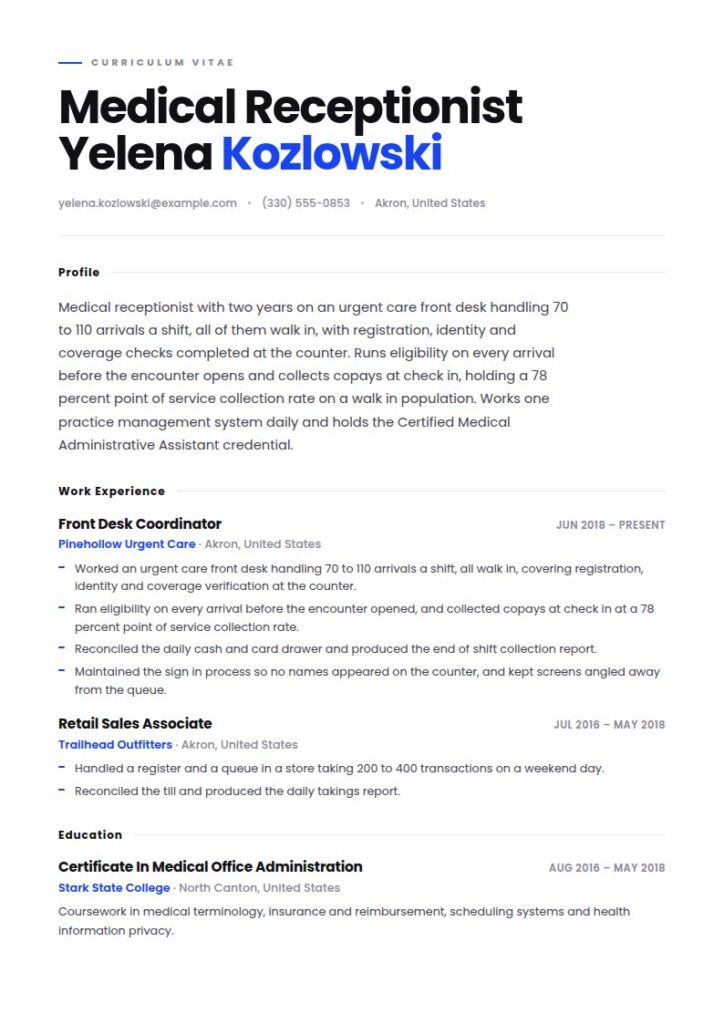
Medical receptionist with two years on an urgent care front desk handling 70 to 110 arrivals a shift, all of them walk in, with registration, identity and coverage checks completed at the counter. Runs eligibility on every arrival before the encounter opens and collects copays at check in, holding a 78 percent point of service collection rate on a walk in population. Works one practice management system daily and holds the Certified Medical Administrative Assistant credential.
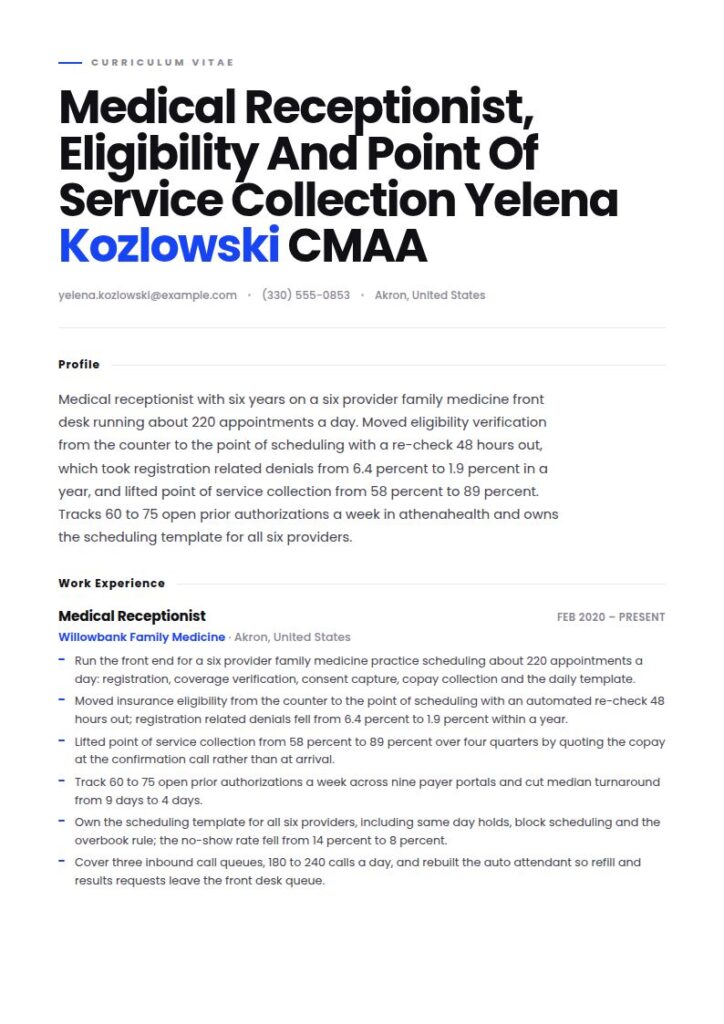
Medical receptionist with six years on a six provider family medicine front desk running about 220 appointments a day. Moved eligibility verification from the counter to the point of scheduling with a re-check 48 hours out, which took registration related denials from 6.4 percent to 1.9 percent in a year, and lifted point of service collection from 58 percent to 89 percent. Tracks 60 to 75 open prior authorizations a week in athenahealth and owns the scheduling template for all six providers.
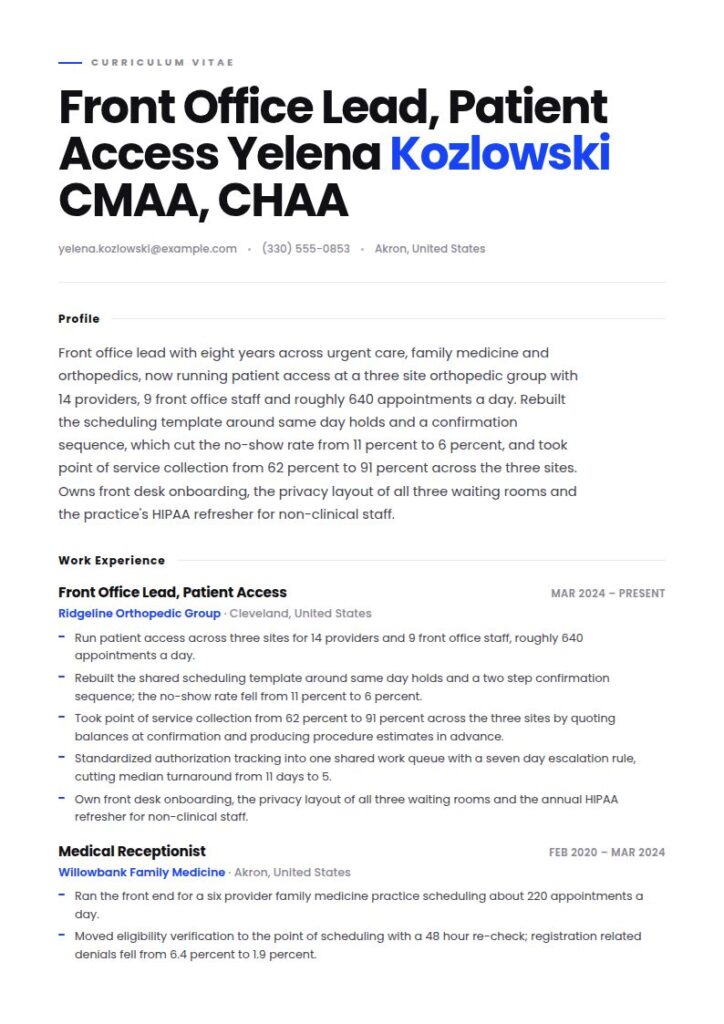
Front office lead with eight years across urgent care, family medicine and orthopedics, now running patient access at a three site orthopedic group with 14 providers, 9 front office staff and roughly 640 appointments a day. Rebuilt the scheduling template around same day holds and a confirmation sequence, which cut the no-show rate from 11 percent to 6 percent, and took point of service collection from 62 percent to 91 percent across the three sites. Owns front desk onboarding, the privacy layout of all three waiting rooms and the practice's HIPAA refresher for non-clinical staff.
Right vs wrong: the same medical receptionist summary, twice
| ✅ Right | ❌ Wrong |
|---|---|
| Medical receptionist on a six provider family medicine desk running about 220 appointments a day. | Friendly and organized receptionist with excellent interpersonal skills. |
| Moved eligibility from the counter to scheduling with a 48 hour re-check. | Verified insurance information and handled billing questions. |
| Registration related denials fell from 6.4 percent to 1.9 percent in a year. | Committed to providing outstanding care and a welcoming environment. |
The right column tells a practice manager what happens to their collections when you sit down. The left column describes a personality, and every other file in the stack describes the same one.
Outline your medical receptionist experience
Employer, setting, number of providers, size and dates, then three to five bullets. Every bullet carries a volume or a number that moved.
| Instead of | Use |
|---|---|
| Answered a busy multi line phone | Covered three inbound queues, 180 to 240 calls a day, with a 92 percent same day callback rate on the clinical message queue |
| Verified insurance | Moved eligibility to the point of scheduling with a 48 hour re-check; registration related denials fell from 6.4 percent to 1.9 percent |
| Handled prior authorizations | Tracked 60 to 75 open authorizations a week and cut median turnaround from 9 days to 4 by working payer portals directly |
| Collected copays | Lifted point of service collection from 58 percent to 89 percent over four quarters |
| Managed the schedule | Rebuilt a six provider template around 15 and 30 minute slots and two same day holds per half day; the no-show rate fell from 14 percent to 8 percent |
Medical Receptionist, Willowbank Family Medicine, Akron, OH, February 2020 to Present
Run the front end for a six provider family medicine practice scheduling about 220 appointments a day: registration, coverage verification, consent capture, copay collection and the daily template.
Moved insurance eligibility from the counter to the point of scheduling with an automated re-check 48 hours before the visit; registration related denials fell from 6.4 percent to 1.9 percent within a year.
Lifted point of service collection from 58 percent to 89 percent over four quarters by quoting the copay at confirmation rather than at arrival.
Track 60 to 75 open prior authorizations a week across nine payer portals and cut median turnaround from 9 days to 4 days.
Own the scheduling template for all six providers, including same day holds, block scheduling for physicals and the overbook rule; the no-show rate fell from 14 percent to 8 percent after a two step confirmation sequence was added.
The four front end numbers a practice manager reads for
Everything above is duties. These four numbers are what the practice manager is measured on, and what they will ask you about in the first ten minutes.
One: eligibility, and when you run it. Verifying coverage is table stakes. The information is when. Coverage checked at the counter is a problem found at the worst possible moment, with a queue behind it. Coverage checked at scheduling and re-checked 48 or 72 hours out is a problem solved by phone in a quiet hour. Say which one you ran, name the clearinghouse or the payer portals, and give the denial rate that moved.
Two: prior authorizations, and what you did with them. The least visible and most valuable part of the job. Say how many you carry open at once, how you track them, whether you work payer portals directly or by phone and fax, and what your median turnaround is. If you cut it, say from what to what.
Three: point of service collection. The share of what was owed at the visit that was actually taken at the visit. Practice managers watch this weekly, because money not collected at the counter costs more to chase than it is worth. If you raised it, say by how much and how.
Four: the schedule template and the no-show rate. The template is a real piece of work: slot lengths by visit type, block scheduling, same day holds, overbook rules and the recall list. The no-show rate is the number that proves the template and the confirmation sequence are working. Use your own practice's figure and the period it covers; there is no national benchmark worth quoting, and a practice manager will know that.
Authorization work is most of a clinic day now
The 2025 AMA Prior Authorization Physician Survey, fielded in December 2025 among 1,000 practicing physicians, found an average of 40 prior authorizations per physician per week and 13 hours a week of physician and staff time spent completing them. Forty percent of physicians reported having staff who work exclusively on prior authorization (American Medical Association, 2025).
Read that as a hiring signal rather than a complaint. Two in five practices have already decided this work needs a dedicated person, and in a small practice that person is the front desk. A resume showing authorization volume, tracking method and turnaround is applying for a job the practice has already budgeted for, whatever the advert calls it.
Eligibility: verified at scheduling with automated re-check 48 hours out, nine payer portals plus clearinghouse batch; registration related denials 1.9 percent.
Authorizations: 60 to 75 open at any time, tracked in a shared work queue with a seven day escalation rule; median turnaround 4 days.
Collection: copay quoted at confirmation, card on file offered at check in, estimates produced for procedures; point of service collection 89 percent.
Schedule: template owner for six providers, 15 and 30 minute slots, two same day holds per provider per half day, recall list worked weekly; no-show rate 8 percent.
Privacy: sign in process carries no names, screens angled away from the queue, a separate side counter for any conversation about money or coverage.
Build a snapshot of your key medical receptionist skills
Twelve to sixteen entries in four groups. Named systems beat adjectives.
Front end: Registration and identity verification, Check in and arrival workflow, Copay and balance collection, Scheduling template design, Recall and waitlist management
Revenue cycle: Insurance eligibility verification, Prior authorization tracking and appeals, Referral management, Estimate preparation, Front end denial analysis
Systems: athenahealth, Epic front desk workflows, eClinicalWorks, NextGen, Availity, payer web portals, RingCentral queues, Microsoft Outlook
Compliance: HIPAA minimum necessary and reasonable safeguards, Waiting room privacy layout, Records release routing, Consent and financial responsibility forms
List your education and certifications
The typical entry route is a high school diploma or equivalent with short term on the job training (BLS Occupational Outlook Handbook, published 27 August 2026), so a credential is the cheapest way to separate the file.
Certificate, Medical Office Administration, Stark State College, North Canton, OH, 2018
High School Diploma, Ellet High School, Akron, OH, 2016
Certifications: Certified Medical Administrative Assistant (CMAA), National Healthcareer Association (2019, renewed 2025). Certified Healthcare Access Associate (CHAA), National Association of Healthcare Access Management (2023). HIPAA privacy and security training, employer delivered under the HHS Privacy Rule (2026). Basic Life Support, American Heart Association (2025).
Choose the right layout and design
Single column, plain type at 11 or 12 point, no photograph, no icons, no skill bars. Applicant systems read the file into a structured record before a person sees it, and two column layouts, text boxes and graphics are where that breaks.
Say how many providers and how many appointments a day your desk carried. Name the practice management system, the clearinghouse and the payer portals. Give one number from each of the four front end measures if you have them. State when eligibility ran, not just that it ran. Say who owned the scheduling template. Keep months in every date.
Never reference a patient, in any form, anywhere on the resume or in the interview: no name, no initials, no age, no condition, no appointment, no situation, not even as a hypothetical or an example of something handled well. Do not write "greeted arrivals and answered phones", which describes a desk from thirty years ago. Do not claim a system you have watched someone else use. Do not list a certification without its issuing body and year.
Medical receptionist job market and outlook
The job sits across two BLS occupations, and which one your employer reports you under changes both the outlook and the pay band.
| Measure | Receptionists | Medical secretaries and administrative assistants |
|---|---|---|
| Employment, 2025 | 947,500 | 979,000 |
| Projected change, 2025-35 | -2 percent, -16,000 jobs | +5 percent, +47,100 jobs |
| Median annual wage, May 2025 | $38,010 ($18.27 per hour) | $45,930 |
| Typical entry-level education | High school diploma or equivalent | High school diploma or equivalent |
Source: U.S. Bureau of Labor Statistics, Occupational Outlook Handbook, May 2025 wage data and 2025-35 projections, published 27 August 2026.
The medical half of the front desk is the half that is growing
Receptionists as a whole are projected to decline 2 percent from 2025 to 2035, a loss of about 16,000 jobs, though the occupation still opens roughly 105,100 positions a year through replacement (BLS Occupational Outlook Handbook, 2025-35 projections). Medical secretaries and administrative assistants are projected to grow 5 percent over the same decade, adding 47,100 jobs (BLS, 2025-35 projections).
Healthcare and social assistance already employs 42 percent of all receptionists, more than three times the next largest industry, and pays them a median of $19.00 an hour against an all industry median of $18.27 (BLS Occupational Outlook Handbook, May 2025).
The parts of this desk that are shrinking are the ones automation absorbs, such as answering and routing a call. The parts that are growing need judgment about coverage, authorization and money. Write the resume around the second group.
Where receptionist jobs sit by industry:
| Industry | Share of employment | Median hourly wage (May 2025) |
|---|---|---|
| Healthcare and social assistance | 42 percent | $19.00 |
| Professional, scientific and technical services | 11 percent | $18.56 |
| Personal care services | 7 percent | $16.57 |
| Administrative and support services | 3 percent | $19.13 |
Source: U.S. Bureau of Labor Statistics, Occupational Outlook Handbook, May 2025.
What salary you can expect as a medical receptionist
The median annual wage for receptionists was $38,010 as of May 2025, or $18.27 an hour, with the lowest 10 percent under $13.83 an hour and the highest 10 percent over $24.01 (BLS Occupational Outlook Handbook, May 2025).
The medical end of that range pays better than the average: healthcare and social assistance pays receptionists a median of $19.00 an hour against $16.57 in personal care services (BLS, May 2025). What makes that move possible is a credential plus evidence you can handle eligibility and collection.
The larger step is out of the receptionist classification altogether. Medical secretaries and administrative assistants had a median of $45,930 as of May 2025, and all secretaries and administrative assistants a median of $48,310 with about 314,400 openings a year (BLS Occupational Outlook Handbook, May 2025 and 2025-35 projections). Further along the same line, medical records specialists had a median of $51,140 in May 2025 (BLS Occupational Outlook Handbook, healthcare occupations, May 2025).
Those are not different careers. They are the same front end work with more of the revenue cycle attached, and the file that gets you across the line is the one already showing authorization tracking and collection numbers rather than arrivals alone.
Key takeaways for a medical receptionist resume
- Never reference a patient anywhere, in any form; describe work by type, volume, setting and process.
- Give the size of the practice and the appointment volume your desk carried.
- Say when eligibility ran, not only that it ran.
- Put authorization volume, tracking method and turnaround on the page.
- Give your point of service collection rate and the period it covers.
- Say who owned the scheduling template, and pair it with your no-show rate.
- Name the practice management system, the clearinghouse and the payer portals.
- Keep it single column, one page, with months in every date.
Build your medical receptionist resume in 15 minutes with our AI resume builder.
Related medical resume examples
- Medical administrative assistant resume
- Medical office manager resume
- Medical support assistant resume
- Medical assistant resume
- Medical biller resume
- Medical coder resume
- Medical scribe resume
- Dental receptionist resume
- Clinic coordinator resume
- Health care administration resume
- Healthcare resume
- CNA resume
Pair it with a matching medical receptionist cover letter.
Medical receptionist resume questions, answered
How long should a medical receptionist resume be?
One page. Two only if you lead a multi site front office, and even then the second page should be scope and results, not more duties.
Can I mention a patient on a medical receptionist resume?
No. Not a name, not initials, not an age, not a condition, not an appointment, not a circumstance, and not as an anonymized story that still describes one person. The same rule applies in the interview. Describe volume, setting and process instead: "about 220 appointments a day across six providers" does the work an anecdote would do.
What is the difference between a medical receptionist and a medical secretary?
Position and product. A medical receptionist works the counter: arrival, registration, coverage, copay, scheduling and the phones. A medical secretary works behind it, attached to providers, producing correspondence, referral packets, records responses and calendars. The pay bands differ too: $38,010 against $45,930 in May 2025 (BLS Occupational Outlook Handbook, May 2025).
Do I need a certification to be a medical receptionist?
No. The typical entry route is a high school diploma or equivalent with short term on the job training (BLS Occupational Outlook Handbook, published 27 August 2026). A credential such as the Certified Medical Administrative Assistant from the National Healthcareer Association is what separates two otherwise identical files.
What do I put on a medical receptionist resume with no clinic experience?
Volumes, money and systems from whatever you have done. Retail, hotel and call center work all involve a queue, a payment, a scheduling system and a phone platform, and those transfer. Then name every system you have operated and any privacy or compliance training you hold. Add a credential if you can; it closes most of the remaining gap.
Is medical reception a shrinking job?
Not the medical half of it. Receptionists overall are projected to decline 2 percent from 2025 to 2035 while medical secretaries and administrative assistants grow 5 percent, adding 47,100 jobs (BLS Occupational Outlook Handbook, 2025-35 projections). The desks that survive are the ones doing eligibility, authorization and collection work, which is exactly the material this resume should be built from.