Yelena Kozlowski Medical Receptionist, CMAA Akron, 44312, United States [email protected] · (330) 555-0853
16 September 2026
Ms. Rosalind Achterberg Practice Manager Summit Hollow Medical Group Cleveland, United States
Application for Medical Receptionist, Summit Hollow Medical Group
Dear Ms. Achterberg,
I am applying for the Medical Receptionist post at Summit Hollow Medical Group. For the last six years I have run the front end of a six provider family medicine practice scheduling about 220 appointments a day, covering registration, coverage verification, copay collection, three call queues and the daily template.
The change I would most want to bring with me is where eligibility happens. When I started, coverage was checked at the counter, which meant every problem surfaced with a queue behind it and a session about to start. I moved verification to the point of scheduling with an automated re-check 48 hours before the visit, and registration related denials fell from 6.4 percent to 1.9 percent within a year. Quoting the copay on the confirmation call rather than at arrival took point of service collection from 58 percent to 89 percent over four quarters. I also carry 60 to 75 open prior authorizations a week across nine payer portals, and cut median turnaround from 9 days to 4 by working the portals directly instead of by fax.
Your posting mentions a second site opening in the spring and a move to a shared scheduling template across both. That is the part of the job I would want, because the template is where the no-show rate lives: adding a two step confirmation sequence and two same day holds per provider per half day took ours from 14 percent to 8 percent. I would also be glad to run front desk onboarding, which I did for three new staff last year.
I hold the Certified Medical Administrative Assistant credential from the National Healthcareer Association, work athenahealth daily and have used Epic front desk workflows and Availity. I can give four weeks of notice. Thank you for your time.
Sincerely, Yelena Kozlowski, CMAA
Summary
A medical receptionist cover letter tells a practice manager when you verify coverage, how you track authorizations, and what share of what is owed you collect at the counter. This guide gives you a full adaptable letter, the rule about never referencing a patient, the front end number to lead with in each setting, and the openings that get a strong file read before the rest of the stack of applications.
Medical Receptionist cover letter examples by experience level
A medical receptionist cover letter is a one page letter telling a practice manager three things: when you verify coverage, how you track authorizations, and what share of what patients owe you collect at the counter.
In practice, most of the stack will say warm, organized and a great communicator. None of that is checkable. The letter that gives a number and names a system gets the call, because the person reading it is answerable for collections and for a schedule that has to fill.
Guide to a medical receptionist cover letter
Specifically, this guide and the corresponding medical receptionist cover letter example will cover:
- First, how to structure the letter, paragraph by paragraph
- Then, the rule that governs everything you write about the work
- Also, which front end number to lead with, depending on the setting
- Finally, a full adaptable letter, and the openings that work
The rule that comes before anything else
Never reference a patient. In other words, not a name, not initials, not an age, not a condition, not an appointment, not a circumstance that would let anyone work out whom you meant, and not as a softened story with the identifying details supposedly removed.
This matters more in a cover letter than on a resume, because a letter invites narrative and narrative invites exactly the sentence you must not write. In fact, a practice manager who reads a specific situation here reads it as a preview of how you will talk in the break room.
Say the volume, not the story
Every point you want to make with a story can be made with a volume, a process and a result, and the second version is stronger.
Instead of describing something that happened at the counter, write the system that stops it happening: "moved eligibility from arrival to scheduling with a re-check 48 hours out, and registration related denials fell from 6.4 percent to 1.9 percent in a year". Instead of describing a difficult conversation, write the design that prevents it: "a separate side counter so no conversation about coverage or money happens at the open front desk". The U.S. Department of Health and Human Services describes reasonable safeguards of that kind as the condition on which an incidental disclosure is permitted at all (HHS, HIPAA Privacy Rule guidance on incidental uses and disclosures, accessed September 2026).
How to write a medical receptionist cover letter
| Paragraph | Its job | Length |
|---|---|---|
| Opening | The post, the setting you have worked, and the size of the desk | 2 to 3 sentences |
| Evidence | One front end number, how you moved it, over what period | 4 to 5 sentences |
| Fit | Something real about their practice, and what you would take on | 3 to 4 sentences |
| Close | Credential, systems, availability, thank you | 2 sentences |
Next, pick the number in the second paragraph to match the setting: authorizations for a single specialty practice, the no-show rate and the template for a high volume primary care group, registration accuracy and collection for a hospital based patient access team.
A medical receptionist cover letter example you can adapt
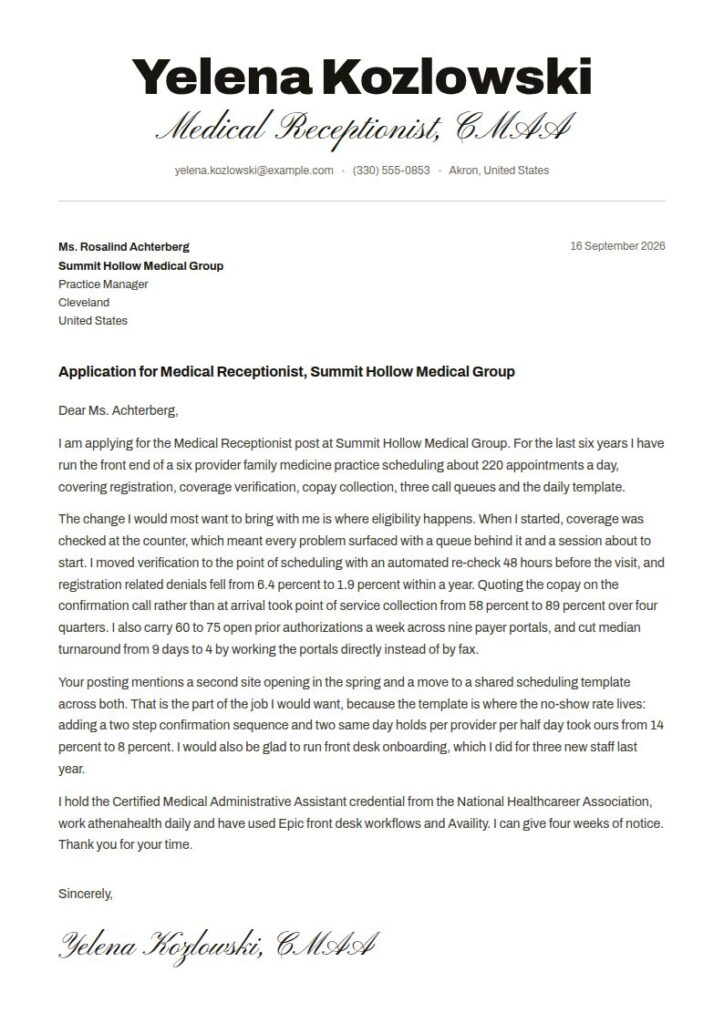
Dear Ms. Achterberg,
I am applying for the Medical Receptionist post at Summit Hollow Medical Group. For the last six years I have run the front end of a six provider family medicine practice scheduling about 220 appointments a day, covering registration, coverage verification, copay collection, three call queues and the daily template.
The change I would most want to bring with me is where eligibility happens. When I started, coverage was checked at the counter, which meant every problem surfaced with a queue behind it and a session about to start. I moved verification to the point of scheduling with an automated re-check 48 hours before the visit, and registration related denials fell from 6.4 percent to 1.9 percent within a year. Quoting the copay on the confirmation call rather than at arrival took point of service collection from 58 percent to 89 percent over four quarters. I also carry 60 to 75 open prior authorizations a week across nine payer portals, and cut median turnaround from 9 days to 4 by working the portals directly instead of by fax.
Your posting mentions a second site opening in the spring and a move to a shared scheduling template across both. That is the part of the job I would want, because the template is where the no-show rate lives: adding a two step confirmation sequence and two same day holds per provider per half day took ours from 14 percent to 8 percent. I would also be glad to run front desk onboarding, which I did for three new staff last year.
I hold the Certified Medical Administrative Assistant credential from the National Healthcareer Association, work athenahealth daily and have used Epic front desk workflows and Availity. I can give four weeks of notice. Thank you for your time.
Sincerely, Yelena Kozlowski, CMAA
Openings that work
| Instead of | Use |
|---|---|
| I am passionate about helping people in a healthcare setting | For six years I have run the front end of a six provider practice scheduling about 220 appointments a day |
| I am writing to express my interest in the receptionist position | I am applying for the Medical Receptionist post, and the change I would bring is where eligibility happens |
| I have excellent communication and organizational skills | I carry 60 to 75 open prior authorizations a week across nine payer portals |
Also, every sentence in the right column is checkable in an interview.
Which number to lead with
| Setting | The number that lands | Why |
|---|---|---|
| Primary care group | No-show rate and schedule fill | Empty slots are the largest recoverable loss in a full template |
| Single specialty practice | Authorization volume and turnaround | The visit cannot happen until the authorization closes |
| Hospital based patient access | Registration accuracy and point of service collection | Front end fields drive downstream denials |
| Urgent care | Arrivals per shift and collection on a walk in population | Nothing is scheduled, so throughput and collection are the job |
Two in five practices already staff authorization work separately
The 2025 AMA Prior Authorization Physician Survey, fielded in December 2025 among 1,000 practicing physicians, found an average of 40 prior authorizations per physician per week and 13 hours a week of physician and staff time spent on them, with 40 percent of physicians reporting staff who work exclusively on prior authorization (American Medical Association, 2025).
That work has to sit somewhere, and in a practice too small for a dedicated authorization coordinator it sits at the front desk. A letter naming authorization volume, tracking method and turnaround answers a need the practice already has, whatever the advert is titled, and it is where the pay difference shows up: receptionists had a median annual wage of $38,010 as of May 2025, against $45,930 for medical secretaries and administrative assistants (BLS Occupational Outlook Handbook, May 2025).
What to do when you have no clinic experience
Write the transferable half and name it as transferable, rather than hoping the reader translates for you.
| What you did | How it reads to a practice manager |
|---|---|
| Retail or hotel front counter | Queue management, payment handling, throughput under pressure |
| Call center queues | Call volume, routing, escalation rules, same day callback discipline |
| Handling payments or a till | Cash and card handling, reconciliation, a collection rate you can quote |
Then close the gap with a credential. In particular, postings most often name the Certified Medical Administrative Assistant from the National Healthcareer Association, and it carries the HIPAA content a practice manager wants to see.
Name the setting, the number of providers and the daily appointment volume in the first paragraph. Give one front end number with a direction and a period. Say when eligibility runs. Name the practice management system, the clearinghouse and at least one payer portal. Read the practice's own pages and name one real thing they are doing. Address a named person.
Never reference a patient in any form, including a story with the details taken out, and do not do it in the interview either. Do not describe yourself as compassionate, organized or a people person; every letter in the folder does. Do not send a letter with no practice name in it. Do not claim a system you have only watched someone else use. Do not run past one page.
Length, format and sending it
One page, four paragraphs, 250 to 400 words. PDF unless the portal says otherwise, named for yourself and the post: yelena-kozlowski-medical-receptionist-cover-letter.pdf.
Address a person. The practice website or the posting usually names the practice manager; as a result, "Dear Hiring Manager" on a letter that is otherwise specific is the one weak line in it.
Keep every figure identical to the one on your resume. Our medical receptionist resume example is written with the numbers used here, and a mismatch between the two is the fastest way to lose the benefit of both.
Key takeaways
- Above all, never reference a patient, in any form, anywhere in the letter or the interview.
- First, open with the setting, the provider count and the daily appointment volume.
- Then lead the evidence paragraph with the number that matches the setting.
- Say when eligibility runs, not only that it runs.
- In addition, give authorization volume, tracking method and turnaround.
- After that, name the practice management system, the clearinghouse and the payer portals.
- Finally, name one real thing about the practice, taken from their own pages.
Write your medical receptionist cover letter in 10 minutes with our AI cover letter builder.
Medical receptionist cover letter questions, answered
How long should a medical receptionist cover letter be?
One page, four paragraphs, 250 to 400 words. Practice managers read these between sessions, and length does not read as effort.
Can I use a story from the front desk in the letter?
No. Any story specific enough to be worth telling is specific enough to identify someone, and the reader will treat it as evidence of how you talk about the work. Write the volume, the process and the result instead.
What if the job advert is vague about duties?
Cover all four front end measures briefly: eligibility timing, authorization tracking, point of service collection and the scheduling template. A vague advert usually means a small practice where one person carries the whole front end.
Do I need a certification to be taken seriously?
No, but it helps. The typical entry route is a high school diploma or equivalent with short term on the job training (BLS Occupational Outlook Handbook, published 27 August 2026), so a named credential is one of the few things separating two similar letters.
Should I write a different letter for a hospital patient access job?
Yes. Hospital patient access teams hire on registration accuracy, insurance verification depth, financial clearance and estimates, and they train on their own system, so system familiarity matters less than accuracy. A practice front desk hires on the whole front end at once, phones and template included. The two letters share a paragraph at most.