Renske Dekker Medical Scribe, Cardiology and Emergency Medicine Akron, 44313, United States [email protected] · (330) 555-1450
11 September 2026
Ms. Adaeze Okonjo Cardiology Service Brimfield Ridge Health Network Akron, United States
Application for Medical Scribe, Cardiology Service, Brimfield Ridge Health Network
Dear Ms. Okonjo,
I am applying for the Medical Scribe post with the cardiology service at Brimfield Ridge Health Network. I currently scribe for three cardiologists at Stonehedge Cardiology Associates in Epic Ambulatory, roughly 16 clinic notes a session, and before that I documented 22 to 28 encounters per nine-hour shift in an emergency department using Epic ASAP.
The number I would point you to is chart closure. My median lag between the encounter and the physician's signature is the same calendar day, against a practice median of two days, and the provider addendum rate on my notes runs at 3 percent. That comes from preparation rather than typing speed: I pull and summarize the prior echocardiogram, stress test and device interrogation reports into the note before the visit begins, so the physician opens a chart that is already current. I also built the note templates and dot phrase library the practice now uses, and I train every new scribe through a shadowed 60-encounter sign-off.
I understand the boundary and I work inside it without being asked. I document under my own credentials, never the physician's, and every note is authenticated by the treating provider. Orders go in at provider direction and stay pending for the physician to verify and submit. I saw that your cardiology service has been expanding its structural heart clinic, and that is exactly the kind of documentation I would want to learn properly rather than approximate.
I hold current Basic Life Support certification, completed medical terminology at Stark State College and annual HIPAA training, and I can give four weeks' notice. Thank you for your time.
Sincerely, Renske Dekker
Summary
A medical scribe cover letter names the specialty and system you already work in, the volume you have carried, and one number showing how fast the notes closed. This guide gives you a full adaptable letter, the openings that work, what to write with no scribe experience yet, and how to show the documentation boundary without lecturing the reader about it.
Medical Scribe cover letter examples by experience level
A medical scribe cover letter is a one-page letter telling a practice which specialty and system you work in, how many encounters a shift you have carried, and how fast those notes reached the provider's signature.
The reader is usually the physician you would sit beside. They do not want a paragraph about your passion for medicine. They want to know whether the first two weeks cost them time, and whether their charts close faster afterwards.
Guide to a medical scribe cover letter
This guide and the medical scribe cover letter example below will cover:
- How to structure the letter, paragraph by paragraph
- Why the specialty and the system belong in the first sentence
- The one number that carries a scribe letter, and how to find yours
- What to write when you have no scribe experience yet
How to write a medical scribe cover letter
| Paragraph | Its job | Length |
|---|---|---|
| Opening | The post, your specialty and setting, the system | 2 to 3 sentences |
| Evidence | Volume, a throughput number, one thing you built | 4 to 5 sentences |
| Fit | Something specific about their practice, and the boundary | 3 to 4 sentences |
| Close | Availability and certifications | 2 sentences |
Open with the specialty and the system, not with your degree
Almost every scribe letter opens the same way: a biology degree, a plan to apply to medical school, an interest in clinical exposure. That tells the reader what you want from the job, not what they get.
Open with what you already do: "I currently scribe for three cardiologists in Epic Ambulatory, roughly 16 clinic notes a session." One sentence, and the reader knows your vocabulary, system, pace and setting. If the practice runs a system you have not used, say what you have used and how fast you reached full speed in it.
A medical scribe cover letter example you can adapt
Dear Ms. Okonjo,
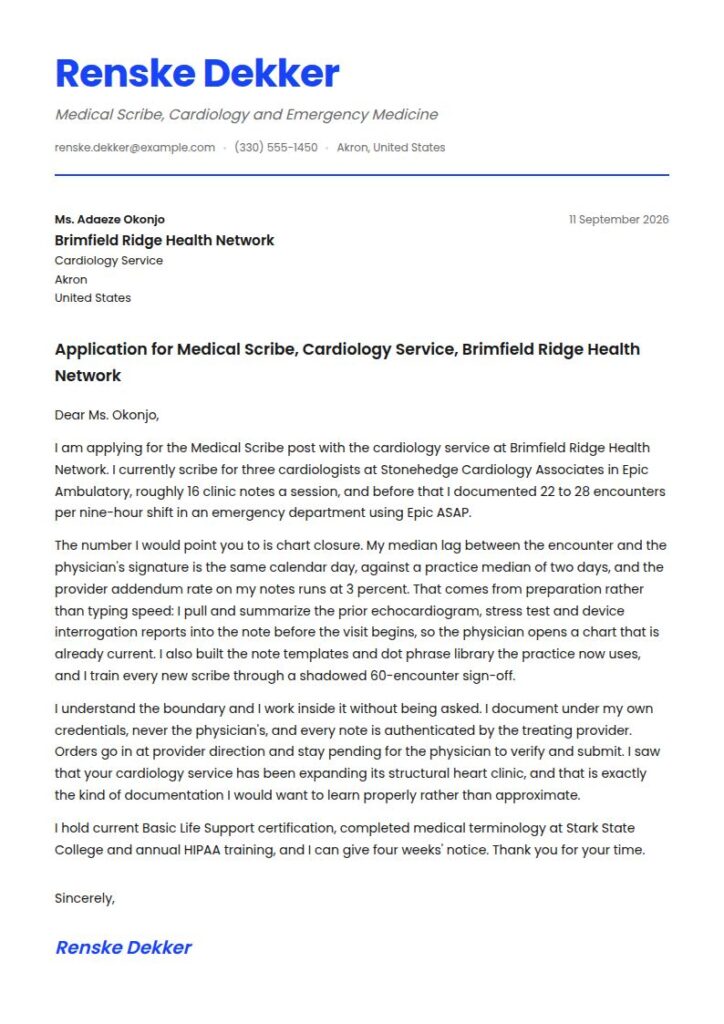
I am applying for the Medical Scribe post with the cardiology service at Brimfield Ridge Health Network. I currently scribe for three cardiologists at Stonehedge Cardiology Associates in Epic Ambulatory, roughly 16 clinic notes a session, and before that I documented 22 to 28 encounters per nine-hour shift in an emergency department using Epic ASAP.
The number I would point you to is chart closure. My median lag between the encounter and the physician's signature is the same calendar day, against a practice median of two days, and the provider addendum rate on my notes runs at 3 percent. That comes from preparation rather than typing speed: I pull and summarize the prior echocardiogram, stress test and device interrogation reports into the note before the visit begins, so the physician opens a chart that is already current. I also built the note templates and dot phrase library the practice now uses, and I train every new scribe through a shadowed 60-encounter sign-off.
I understand the boundary and I work inside it without being asked. I document under my own credentials, never the physician's, and every note is authenticated by the treating provider. Orders go in at provider direction and stay pending for the physician to verify and submit. I saw that your cardiology service has been expanding its structural heart clinic, and that is exactly the kind of documentation I would want to learn properly rather than approximate.
I hold current Basic Life Support certification, completed medical terminology at Stark State College and annual HIPAA training, and I can give four weeks' notice. Thank you for your time.
Sincerely, Renske Dekker
Openings that work
| Instead of | Use |
|---|---|
| I am writing to express my interest in the medical scribe position | I currently scribe for three cardiologists in Epic Ambulatory, roughly 16 clinic notes a session |
| I am a recent biology graduate hoping to gain clinical experience | I have documented roughly 3,400 encounters a year across emergency medicine and cardiology |
| I am a fast learner with strong attention to detail | My median chart closure lag is the same calendar day, against a practice median of two |
The one number that carries the letter
One figure should carry the letter: how fast a note reached a signature, not how fast you type.
| Kind of evidence | What it looks like in a sentence |
|---|---|
| Chart closure lag | Median lag from encounter to signature is the same calendar day, against a practice median of two |
| Closed in session | 96 percent of emergency charts closed before the provider left the department |
| Addendum rate | Provider addendum rate on my notes runs at 3 percent |
If nobody has shown you a chart closure report, ask. Most practices run it and most scribes have never seen it.
Show the boundary without lecturing
A hiring physician has usually had one bad experience with documentation help and is scanning for another. Two sentences do the work: one saying you document under your own credentials and that the treating provider authenticates every note, one saying orders go in at provider direction and stay pending for verification. Do not quote regulations at the reader.
They land because they match the guidance. Medicare's manual states that "Reviewers are only required to look for the signature (and date) of the treating physician/NPP on the note" (CMS, Medicare Program Integrity Manual chapter 3, section 3.3.2.4, Transmittal 713, 5 May 2017), and Joint Commission guidance states that documentation assistants not authorized to submit orders "should leave the order as pending for a certified or licensed personnel to activate or submit the orders after verification" (The Joint Commission, standards FAQ on scribes, last reviewed 17 November 2022).
Writing the letter with no scribe experience yet
Name the medical terminology course, where and when. Give a typing and accuracy result, because speed under dictation is the floor of the job. Describe one role where you produced an accurate record under time pressure, with its volume. Name any system you have touched, even in training. State that the provider authenticates the note.
Do not build the letter around your application to medical school; the reader is hiring for the next two years. Do not call yourself a fast learner, detail-oriented or passionate. Do not claim clinical duties, since rooming, vitals and injections belong to a differently trained role. Do not say you completed or signed notes. Do not send a letter with no practice name in it.
The job is being measured against software, so measure yourself on correction
A study of virtual scribes across 144 physicians found scribe use associated with a decrease in total electronic health record time per appointment of 5.6 minutes (JAMA Network Open, 24 May 2024). A larger study of artificial intelligence scribes across 8,581 ambulatory clinicians found adoption associated with 13.4 fewer minutes of total electronic health record time and 16 fewer minutes of documentation time per eight hours of scheduled patient care (JAMA, 1 April 2026).
The Bureau of Labor Statistics publishes no Handbook profile for medical scribes. The closest published occupation, medical records specialists, had a median annual wage of $51,140 as of May 2025 with 8 percent projected growth from 2025 to 2035 (BLS Occupational Outlook Handbook, May 2025 wages and 2025-35 projections). Typing speed is table stakes. What a practice buys from a human is judgment: a note that needs no addendum, and a chart that was current when the physician opened it.
Length, format and sending it
One page, four paragraphs, 250 to 400 words, as a PDF named for yourself and the post. Address a person: practice managers and physician leads are named on the practice's own site. Use the same figures as your resume. Our medical scribe resume example is written with the numbers used here.
Key takeaways
- Open with the specialty, the setting and the system, not your degree.
- Give volume with the shift length in the first paragraph.
- Pick one throughput number: chart closure lag or addendum rate.
- Name one thing you built: a template, a dot phrase library, an onboarding routine.
- Show the boundary in two sentences, without quoting regulations.
- Name one real thing about their practice, from their own pages.
- Address a named person and keep it to one page.
Write your medical scribe cover letter in 10 minutes with our AI cover letter builder.
Medical scribe cover letter questions, answered
How long should a medical scribe cover letter be?
One page, four paragraphs, 250 to 400 words. The reader is often the physician you would sit beside, reading between clinics. Precision reads as effort; length does not.
Should I say I am applying to medical school?
One line near the end, if it is true. Hiding it is worse, because the reader assumes it anyway. What you must not do is build the letter around it.
What do I write with no scribe experience at all?
Lead with the checkable things: a medical terminology course with its institution and year, and a typing and accuracy result. Then one job where you produced an accurate record under time pressure, with its volume. Then one sentence showing you know the provider authenticates the note.
Do I need a certification to be hired as a scribe?
No. There is no license and no certification an employer must recognize. The Certified Medical Scribe Specialist credential and its MSCAT examination come from the American College of Medical Scribe Specialists, whose site now redirects to an acquisition announcement from Rheum4us (checked 16 September 2026). Employers assess against the competency set instead (The Joint Commission, checked September 2026).
How do I write to a practice whose system I have never used?
Say so, then say what you have used and how quickly you reached full speed in it. "I reached independent charting in Cerner PowerChart in three weeks" answers the real question: how much of the physician's time your first month costs.