Veterinary Assistant Tobin Beaulac AVA
Veterinary Assistant
[email protected] | (406) 555-1300 | Missoula, United States
Profile
Veterinary assistant with 14 months in a three-doctor small animal general practice, working canine and feline at 38 to 45 appointments a day. Restrains for examinations, vaccinations and venipuncture, runs in-house haematology and chemistry, positions for radiographs under the veterinarian's direct supervision, and maintains the controlled substance log to a twice-daily count. Completed a NAVTA-approved veterinary assistant program and hold the Approved Veterinary Assistant designation.
Work Experience
07/2025 - Present, Veterinary Assistant, Ponderosa Gap Veterinary Center, Missoula, United States
- Three-doctor small animal general practice, canine and feline, 38 to 45 appointments a day; four ten-hour shifts plus one Saturday in three.
- Restrain for examination, vaccination, venipuncture and nail trims, and take patient history and weights at intake.
- Run in-house haematology, chemistry, faecal flotation and urinalysis, roughly 25 samples a day.
- Position and restrain for radiographs under the veterinarian's direct supervision, 10 to 14 studies a week.
- Maintain the controlled substance log to a twice-daily count, with no discrepancy recorded in 12 months.
- Run the autoclave cycle and pack log, and the daily kennel and isolation cleaning protocol for 22 runs.
05/2023 - 07/2025, Kennel Technician, Clearwater Bend Boarding and Daycare, Missoula, United States
- Cared for 40 to 60 boarded dogs and cats a day including feeding, medication administration by mouth, exercise and sanitation.
- Handled reactive and fractious dogs using structured introduction and separation protocols; no bite incident recorded in two years.
Education
09/2024 - 06/2025, Veterinary Assistant Certificate, Veterinary Assisting, Big Sky Veterinary Education Center, Missoula, United States
NAVTA-approved veterinary assistant program, including a 120-hour clinical placement in small animal general practice.
08/2019 - 05/2023, High School Diploma, Sentinel High School, Missoula, United States
Skills
Low-stress handling and restraint, 80
Venipuncture restraint and vital signs, 75
In-house haematology and chemistry, 70
Faecal flotation and urinalysis, 75
Radiographic positioning under direct supervision, 65
Controlled substance logging, 80
Autoclave and sterilization log, 80
Languages
English, native
French, intermediate
Certificates
08/2025, Approved Veterinary Assistant (AVA), National Association of Veterinary Technicians in America
Renewal due August 2027, with at least ten hours of veterinary continuing education.
02/2026, Fear Free Certified Professional, Level 1, Fear Free
Summary
A veterinary assistant resume is a one page document naming the tasks your state veterinary practice act allows you to perform, the species and case volume you handle, and your restraint and handling training. This guide gives you three adaptable versions, the scope line that decides what belongs on the page, and current Bureau of Labor Statistics pay and outlook.
Veterinary Assistant resume examples by experience level
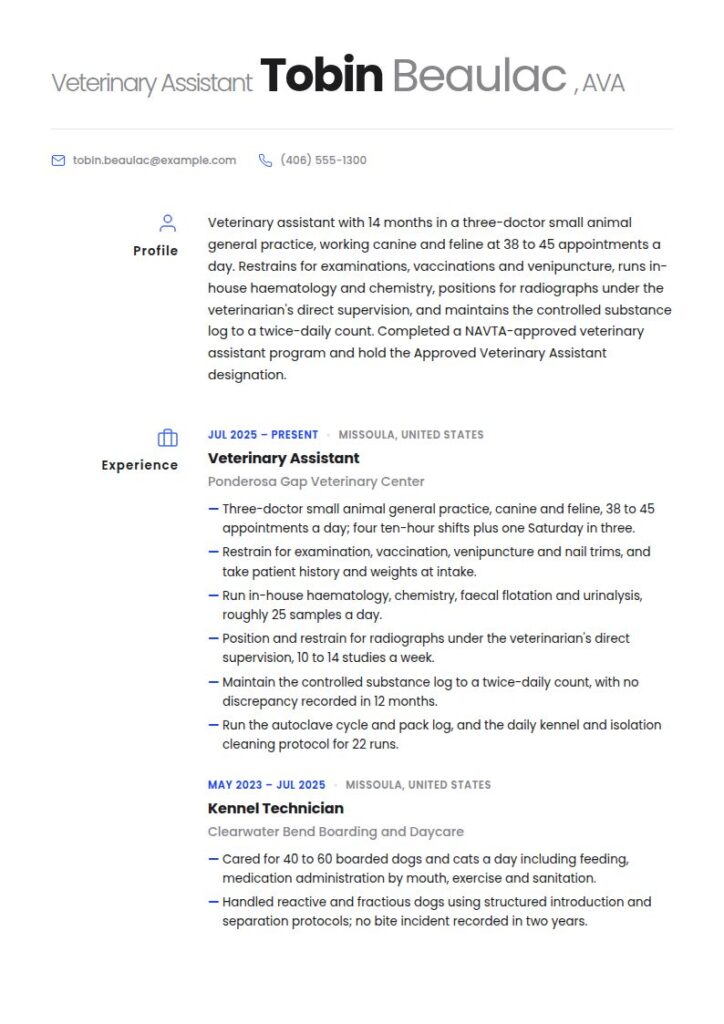
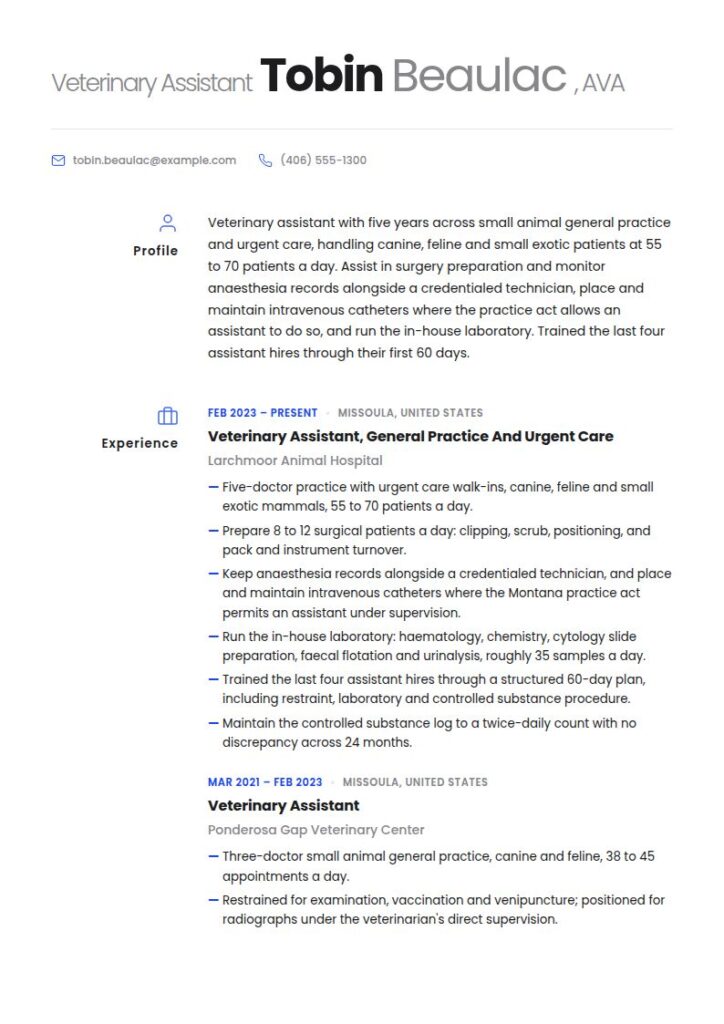
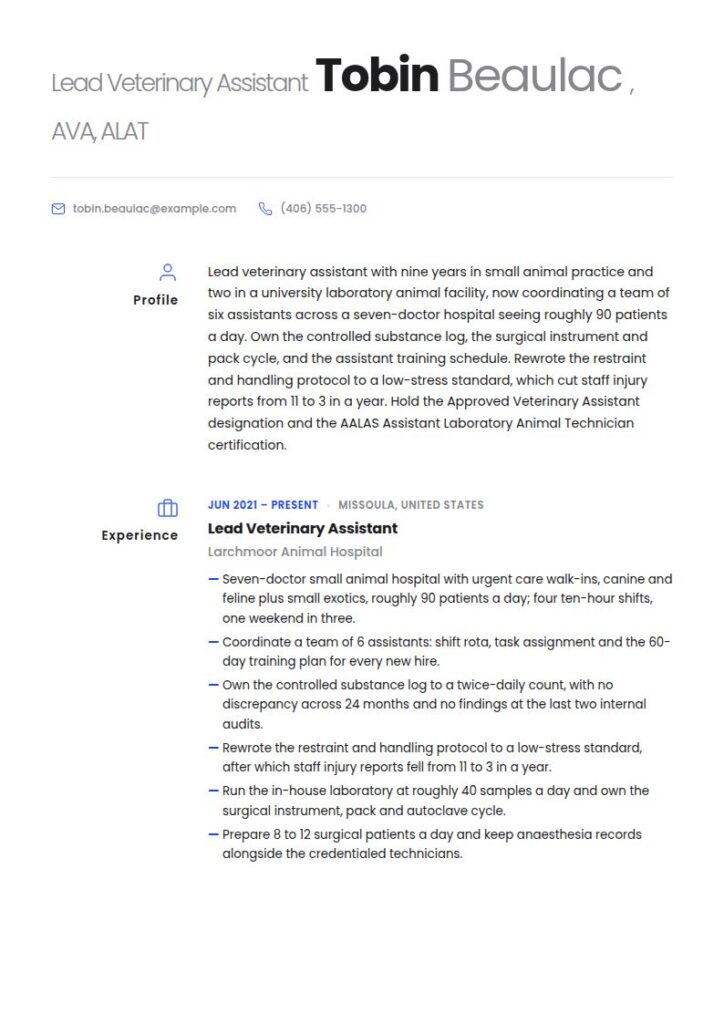
In short, a veterinary assistant resume is a one page document that names the species you handle, the volume you handle them at, and the tasks your state's veterinary practice act actually permits you to do.
That last part is the whole job of the page. In practice, practice managers read veterinary assistant resumes with one question in mind: which of these tasks can this person legally do here, without a credentialed technician standing over them, and which ones am I going to have to take back? As a result, an applicant who has already answered that has done something almost nobody does.
Resume guide for a veterinary assistant resume
In addition, this guide and the corresponding veterinary assistant resume example will cover:
- First, how to write a veterinary assistant resume, section by section
- Next, where the legal line sits between an assistant, a credentialed technician and the veterinarian
- In addition, three adaptable summaries: new assistant, practice assistant and lead assistant
- How to write restraint, handling and controlled substance work so a practice manager trusts it
- Finally, what the job market looks like and what Bureau of Labor Statistics data shows on pay
How to write a veterinary assistant resume
Overall, six blocks: contact header, summary, scope and clinical tasks, experience, skills, and training. One page, almost always. After all, this is a hands-on job with a short credential ladder, and a two page assistant resume usually means the experience section has been padded.
| Section | What it is answering | Where it goes |
|---|---|---|
| Scope and tasks | For example, which tasks can this person do here, under which supervision? | Its own block, directly under the summary |
| Species and volume | Similarly, have they handled what we see, at the rate we see it? | In the scope line of each job |
| Experience | What did they actually do on shift, and how much of it? | Reverse chronological, with numbers |
| Training | Program, credential, and any species or handling certification | Last block, with dates |
Write your species mix and daily volume into the first line of every job
"Veterinary assistant" covers wildly different jobs. A small animal general practice seeing 40 appointments a day is not an emergency and critical care hospital, and neither is a research vivarium.
BLS counts veterinary assistants and laboratory animal caretakers as one occupation, and the split between them is visible in the industry data: veterinary services employ 86 percent of the occupation at a May 2025 median of $37,930, educational services employ 5 percent at $47,860, and scientific research and development services employ 1 percent at $49,230 (BLS Occupational Outlook Handbook, Veterinary Assistants and Laboratory Animal Caretakers, last modified 27 August 2026).
So write the setting, the species and the volume in the first line of each role. "Small animal general practice, canine and feline, 38 to 45 appointments a day across 3 doctors" tells a practice manager more in one line than three bullets of duties.
Run the finished file through the ATS resume checker before you send it. For instance, corporate veterinary groups screen through an applicant tracking system even for hourly roles.
Choosing the best resume format for a veterinary assistant resume
In general, reverse chronological, one page, single column. Practices hire for shift coverage and they read the timeline for stability: how long you stayed, whether you moved up, and whether there are gaps a night shift explains.
However, a functional format is worth considering in exactly one case: you are moving in from kennel work, grooming, a shelter, a farm, a stable or a pet retail role and you have no clinical title yet. Even then, keep the dates visible and put the animal handling hours into the summary rather than rebuilding the page. After all, animal experience counts in this occupation, and practice managers know it.
Include your contact information
| ✅ Right | ❌ Wrong |
|---|---|
| Tobin Beaulac | Tobin Beaulac |
| Veterinary Assistant, NAVTA Approved Veterinary Assistant | Animal lover seeking veterinary opportunity |
| Fear Free Certified Professional, Level 3, 2026 | Great with animals |
| (406) 555-1300, [email protected], Missoula, MT | (406) 555-1300, [email protected] |
Put the credential on the line under your name if you hold one. However, most assistants do not, which is precisely why it reads.
Make use of a summary
In short, four lines: setting and species, volume, the scope you work at, and one number that shows reliability.
Veterinary assistant with 14 months in a three-doctor small animal general practice, working canine and feline at 38 to 45 appointments a day. Restrains for examinations, vaccinations and venipuncture, runs in-house haematology and chemistry, positions for radiographs under the veterinarian's direct supervision, and maintains the controlled substance log to a twice-daily count. Completed a NAVTA-approved veterinary assistant program and hold the Approved Veterinary Assistant designation.
Veterinary assistant with five years across small animal general practice and urgent care, handling canine, feline and small exotic patients at 55 to 70 patients a day. Assist in surgery preparation and monitor anaesthesia records alongside a credentialed technician, place and maintain intravenous catheters where the practice act allows an assistant to do so, and run the in-house laboratory. Trained the last four assistant hires through their first 60 days.
Lead veterinary assistant with nine years in small animal practice and two in a university laboratory animal facility, now coordinating a team of six assistants across a seven-doctor hospital seeing roughly 90 patients a day. Own the controlled substance log, the surgical instrument and pack cycle, and the assistant training schedule. Rewrote the restraint and handling protocol to a low-stress standard, which cut staff injury reports from 11 to 3 in a year. Hold the Approved Veterinary Assistant designation and the AALAS Assistant Laboratory Animal Technician certification.
Right vs wrong: the same veterinary assistant summary, twice
| ✅ Right | ❌ Wrong |
|---|---|
| Five years across small animal general practice and urgent care at 55 to 70 patients a day. | Experienced animal care professional with a love for helping pets. |
| Restrain for examination, vaccination and venipuncture; run in-house haematology and chemistry. | Assist veterinarians with a variety of clinical duties. |
| Maintain the controlled substance log to a twice-daily count with no discrepancy in 24 months. | Responsible for medication and inventory tasks. |
Above all, the left column is a shift that can be scheduled. By contrast, the right column is a personality, and a practice manager covering a Saturday is scheduling.
Outline your veterinary experience
Practice, type, city, dates, then the scope line: species, doctor count, daily patient volume, and your shift pattern. Then three to five bullets, each with a number or a named task.
| Instead of | Use |
|---|---|
| Assisted veterinarians with animal care | Restrained for 38 to 45 examinations a day across 3 doctors, canine and feline |
| Performed lab work | Ran in-house CBC, chemistry, cytology, faecal flotation and urinalysis, roughly 25 samples a day |
| Helped with surgery | Prepared 8 to 12 surgical patients a day: clipping, scrub, positioning, and pack and instrument turnover |
| Handled medications | Maintained the controlled substance log to a twice-daily count with no discrepancy across 24 months |
| Took X-rays | Positioned and restrained for radiographs under the veterinarian's direct supervision, 10 to 14 studies a week |
| Cleaned and maintained the clinic | Ran the autoclave cycle and pack log, and the daily kennel and isolation cleaning protocol for 22 runs |
Lead Veterinary Assistant, Larchmoor Animal Hospital, Missoula, MT, June 2021 to Present
Seven-doctor small animal hospital, canine and feline plus small exotics, roughly 90 patients a day including urgent care walk-ins. Four ten-hour shifts, one weekend in three.
Coordinate a team of 6 assistants: shift rota, task assignment and the 60-day training plan for every new hire.
Restrain for examination, vaccination, venipuncture and nail trims; assist with surgical preparation for 8 to 12 procedures a day.
Own the controlled substance log to a twice-daily count, with no discrepancy recorded across 24 months and no findings at the last two internal audits.
Rewrote the restraint and handling protocol to a low-stress standard, including species-specific approach and towel technique, after which staff injury reports fell from 11 to 3 in a year.
Run the in-house laboratory: haematology, chemistry, cytology, faecal flotation and urinalysis, roughly 40 samples a day.
Write to the scope line your state veterinary practice act draws
This is the section that separates a veterinary assistant resume from a veterinary technician resume, and getting it wrong is the fastest way to lose a job you would otherwise have.
In practice, three roles sit inside a veterinary practice and the boundary between them is statutory, not cultural. First, the veterinarian alone may diagnose, prescribe and perform surgery. Second, a credentialed veterinary technician may perform a defined list of delegated tasks under stated supervision levels. An assistant sits below both, and what an assistant may do is narrower, differently defined in every state, and sometimes not defined at all.
How California draws the veterinary assistant line
For example, California is the clearest published example of how tight that boundary can be. Specifically, the California Veterinary Medical Board states that licensed veterinarians alone diagnose medical problems, prescribe therapies and perform surgery. Meanwhile, a Registered Veterinary Technician may, under direct supervision, induce anaesthesia, suture tissue, extract teeth, apply splints or casts and place intravascular catheters, and under indirect supervision may operate radiographic equipment, administer medications, change bandages and draw blood. By contrast, an unregistered assistant may perform supporting duties under veterinarian or technician oversight, and may operate radiographic equipment only after specific training and under direct supervision (California Veterinary Medical Board, checked September 2026).
In contrast, other states write the line differently and some delegate it entirely to board rule. Montana Code Annotated 37-18-104 exempts an employee of a licensed veterinarian performing activities determined by board rule to be acceptable when performed under direct, immediate or indirect supervision, and permits emergency activities that exclude surgery and diagnosis (Montana Code Annotated, checked September 2026). In other words, the practical consequence is that the same sentence on a resume is accurate in one state and a red flag in the next.
Three things to write on your veterinary assistant resume
So do three things on the page.
Name the supervision level with the task. For example, "Placed intravenous catheters under direct supervision" is a different claim from "placed intravenous catheters", and the first one is the one a practice manager can act on.
Separate what you have done from what you are trained for. For instance, if you have assisted in anaesthesia monitoring but your current state only allows that under a credentialed technician's direct supervision, write it that way. Above all, practice managers are not looking for someone who will freelance past the statute; they are looking for someone who knows where it is.
Say where you are licensed to work and where you have worked. Similarly, if you are applying across a state line, say that you will check the receiving state's practice act. In fact, it reads as professionalism, and in a job whose whole shape is set by state rules, it is.
Performed independently or under indirect supervision: restraint for examination, vaccination and venipuncture; in-house haematology, chemistry, cytology, faecal flotation and urinalysis; patient intake and history taking; kennel, isolation and biosecurity protocols; surgical instrument cleaning, packing and autoclave cycle; controlled substance log maintenance
Performed under the veterinarian's direct supervision: radiographic positioning and restraint; surgical patient preparation including clipping and scrub; anaesthesia record keeping alongside a credentialed technician; intravenous catheter placement where the practice act permits an assistant
Not within assistant scope in this state and referred to the veterinarian or credentialed technician: induction of anaesthesia, dental extraction, suturing, diagnosis, prescribing
Species handled: canine, feline, small exotic mammals, laboratory rodent species
That last block is unusual on a resume and it is the single strongest thing you can put on this page. Indeed, it reads as someone who has read the practice act, and almost nobody applying has.
Build a snapshot of your key skills
Overall, ten to fourteen entries in four groups: handling, clinical, laboratory, and facility. Named techniques, not adjectives.
Handling and restraint: low-stress handling, species-specific approach, towel and muzzle technique, fractious patient handling, aggressive dog safety protocol
Clinical support: venipuncture restraint, vital signs, weight and body condition scoring, medication administration by mouth and topically, bandage changes, patient monitoring and charting
Laboratory: in-house haematology, chemistry, urinalysis, faecal flotation, cytology slide preparation, sample handling and courier packaging
Surgery and facility: surgical pack assembly, autoclave cycle and sterilization log, instrument care, isolation and biosecurity, kennel and run sanitation
Administration: controlled substance logging and reconciliation, practice management software, client communication and discharge instructions, appointment triage
List your education and certifications
Program, then credential with the awarding body and date, then any handling or species training. Most veterinary assistants come in with a high school diploma, which is what BLS lists as the typical entry-level education for the occupation (BLS Occupational Outlook Handbook, last modified 27 August 2026), so anything above that is a differentiator worth naming.
Approved Veterinary Assistant (AVA), National Association of Veterinary Technicians in America, awarded March 2022, renewed March 2026
Assistant Laboratory Animal Technician (ALAT), American Association for Laboratory Animal Science, awarded August 2019
Fear Free Certified Professional, Level 3, 2026
NAVTA-approved Veterinary Assistant Program, Big Sky Veterinary Education Center, Missoula, MT, 2021
High School Diploma, Sentinel High School, Missoula, MT, 2015
Two credential notes, verified with the issuing bodies rather than assumed.
Specifically, NAVTA's Approved Veterinary Assistant designation goes to someone who completes a NAVTA-approved veterinary assistant program and passes the examination administered through VetMedTeam. The designation must be renewed every two years with at least ten hours of veterinary continuing education, and it lapses if it is not renewed within 90 days of expiry (NAVTA, checked September 2026). Write the award date and the renewal date, because a lapsed designation is checkable.
Meanwhile, AALAS certification is the laboratory animal branch of the same occupation. The Assistant Laboratory Animal Technician is the entry tier of a three-level ladder, ALAT then LAT then LATG, and eligibility combines formal education with documented hands-on animal care experience, with more experience required where there is less schooling. In particular, the examination covers husbandry, common laboratory species, sanitation and facility operations, handling and restraint, occupational health and safety, and the regulatory and welfare framework (AALAS, checked September 2026). If you have ever worked in a vivarium, this is the credential that makes that experience legible.
Choose the right layout and design
In general, single column, 11 or 12 point, one page, clear headings, no photograph, no paw print graphics. Therefore, corporate veterinary groups parse applications into a structured record, and decorative templates are where that parsing fails.
Name the species you have handled and the daily patient volume. State the supervision level with every clinical task. Separate tasks you perform from tasks you assist with. Give the controlled substance log record if it is clean, with the period. Name the practice management software. Say which state's practice act you have worked under.
Do not claim tasks that sit outside assistant scope in the state you are applying to; the interview will surface it. Do not call yourself a veterinary technician unless you are credentialed, since the title is protected in most states. Do not open with "animal lover", which is what every other file says. Do not name a client or describe an identifiable animal and owner. Do not put a photograph of a patient on the page.
Veterinary assistant job market and outlook
In short, a fast-growing occupation with heavy replacement demand, concentrated almost entirely in private practice.
| Measure | Value |
|---|---|
| Veterinary assistant and laboratory animal caretaker jobs, 2025 | 132,100 |
| Projected change, 2025-35 | 9 percent, much faster than average |
| Projected annual openings | About 23,200 |
| Typical entry-level education | High school diploma or equivalent |
| Median annual wage, May 2025 | $38,150 ($18.34 per hour) |
Source: U.S. Bureau of Labor Statistics, Occupational Outlook Handbook, Veterinary Assistants and Laboratory Animal Caretakers, 2025-35 projections and May 2025 wage data, last modified 27 August 2026.
Nearly nine in ten of these jobs are in one industry
Veterinary services employ 86 percent of veterinary assistants and laboratory animal caretakers, at a May 2025 median of $37,930. The two next largest employers pay noticeably more: educational services, state, local and private, employ 5 percent at $47,860, and scientific research and development services employ 1 percent at $49,230 (BLS Occupational Outlook Handbook, last modified 27 August 2026).
The occupation as a whole held 132,100 jobs in 2025 and is projected to grow 9 percent from 2025 to 2035, much faster than average, with about 23,200 openings a year (BLS, 2025-35 projections).
Two things follow for a resume. The overwhelming majority of postings you will see are private practice, so the page should be written for a practice manager first. But the laboratory animal and university settings, which together are a small share of employment, carry the higher published medians, and the credential that opens them is a specific one. If a vivarium or a university teaching hospital is anywhere in your history, name it and name the AALAS certification.
What salary you can expect as a veterinary assistant
The median annual wage for veterinary assistants and laboratory animal caretakers was $38,150, or $18.34 an hour, as of May 2025. The lowest 10 percent earned less than $30,120 and the highest 10 percent more than $49,150 (BLS Occupational Outlook Handbook, last modified 27 August 2026). For comparison, the median annual wage for all occupations was $50,980 in May 2025.
The spread between the 10th and 90th percentile is roughly $19,000, which is narrow, and most of it is explained by setting rather than by negotiation. What a resume can move sits in four places:
- Setting. Educational services at a $47,860 median and scientific research and development at $49,230 both sit above the veterinary services median of $37,930 (BLS, May 2025). The AALAS certification is what makes you a plausible applicant there.
- Shift. Emergency and overnight coverage carries a differential in most hospitals. Saying plainly that you work nights, weekends or on-call is worth stating.
- Scope. An assistant who can be scheduled for surgical preparation, radiographic positioning and laboratory work covers more of the day than one who cannot, and practices pay for coverage.
- The credential ladder. The AVA designation, and eventually credentialed technician training, is the only structural move upward in this occupation. Naming the AVA shows you are on the ladder rather than beside it.
Key takeaways for a veterinary assistant resume
- Put the species, the doctor count and the daily patient volume in the first line of every job.
- Write the scope block: what you do, what you assist with, and what you refer.
- State the supervision level alongside every clinical task.
- Give the controlled substance log record with its period if it is clean.
- Name the credential, the awarding body and the renewal date.
- Name the AALAS certification if you have ever worked in a vivarium.
- Keep it to one page, single column and parseable.
Build your veterinary assistant resume in 15 minutes with our AI resume builder.
Related medical resume examples
- Veterinarian resume
- Vet tech resume
- Lab technician resume
- Lab assistant resume
- Medical assistant resume
- CNA resume
- Nursing assistant resume
- Home health aide resume
- Phlebotomist resume
- Surgical tech resume
- Medical receptionist resume
- Healthcare resume
Pair it with a matching veterinary assistant cover letter.
Veterinary assistant resume questions, answered
How long should a veterinary assistant resume be?
One page. This is a hands-on role with a short credential ladder, and a practice manager reading applications between appointments will not turn to a second page. If you have nine years and a lead role, tighten the early jobs to two lines each rather than adding a page.
Can I call myself a veterinary technician on my resume?
Not unless you hold the credential. The title is protected under most state veterinary practice acts and it is the single most common reason a veterinary assistant resume is withdrawn at reference stage. Write "veterinary assistant" and let the task list show your range.
What do I put on a veterinary assistant resume with no clinical experience?
Every hour of animal handling you have: kennel work, shelter volunteering, grooming, a boarding facility, a stable, a farm, wildlife rehabilitation, pet retail. Write it as a job with species, numbers and hours. BLS lists a high school diploma or equivalent as the typical entry-level education for the occupation (BLS, last modified 27 August 2026), so experience and a NAVTA-approved program are what differentiate a new applicant.
Is the NAVTA Approved Veterinary Assistant designation worth it?
It is the only widely recognized national credential for the role. It requires a NAVTA-approved program and an examination, and it is renewed every two years with at least ten hours of veterinary continuing education (NAVTA, checked September 2026). Most assistants do not hold it, which is exactly what makes it useful on a page.
How do I write about a job I left quickly?
Give the dates plainly and let the scope line carry the value: setting, species, volume. Practices know this occupation has turnover, and an unexplained three-month gap reads worse than a three-month job. What they are checking for is whether the next job lasted longer.