Ingrid Halvorsen Dr. Missoula, 59801, United States [email protected] · (406) 555-1120
16 September 2026
Ms. Rosalind Okafor Practice Owner Cedar Bluff Animal Hospital Bozeman, United States
Application for Associate Veterinarian, Cedar Bluff Animal Hospital
Dear Ms. Okafor,
I am applying for the Associate Veterinarian post at Cedar Bluff Animal Hospital. I hold an active Montana veterinary license, #MT-VM-8417, with a current DEA registration, and my caseload for the last four years has been about 85% canine and feline, 10% small mammal and 5% backyard poultry. I also worked four years in mixed practice before that, so a beef cow-calf spring would not be new to me if you still take herd work.
At Garnet Range I carry 18 to 22 appointments a day and a weekly surgery block of 6 to 9 procedures: spays, neuters, mass removals, cystotomies, enucleations and dental extractions with full-mouth radiographs. The piece of work I would most want to bring to Cedar Bluff is the anaesthetic monitoring protocol I rewrote two years ago. We retrained the technician team around it, and recovery incidents fell from 7 to 1 across a year of 480 procedures. I also brought abdominal ultrasound in house, roughly 5 scans a week, which kept imaging revenue in the building instead of sending it four hours east.
Your advertisement mentions that the surgery day has been covered by relief since the spring, and that you are Fear Free certified as a practice. I would take the surgery day from the start, and I hold Fear Free Level 3, so the handling protocols would not need explaining. I am happy to take a full share of the after-hours rota on whatever cycle the team is running.
My license and DEA registration are current in Montana, and I can start with four weeks of notice. Thank you for reading.
Sincerely, Ingrid Halvorsen, DVM
Summary
A veterinarian cover letter names the species mix you can take, the surgery and on-call capacity you bring, and the license and DEA registration that make both legal. This guide gives you a full adaptable letter, the openings that work and the ones that do not, what changes between a small animal post and a mixed, equine or emergency one, and how to show a result without describing an identifiable patient.
Veterinarian cover letter examples by experience level
In short, a veterinarian cover letter is a one-page letter that tells a practice which part of their week you can take off them: which species, how many appointments, how much surgery, and what share of the after-hours rota.
In practice, veterinary hiring is almost never about a vacancy in the abstract. A practice advertises because someone left the surgery day uncovered, because the dairy contract needs a second body in spring, or because locums have held the overnight block together since March. For this reason, the letter that names the gap is the one a reader goes through twice.
Guide to a veterinarian cover letter
Specifically, this guide and the corresponding veterinarian cover letter example will cover:
- First, how to structure the letter, paragraph by paragraph
- Then, why your species mix belongs in the first two sentences
- What counts as evidence when you cannot discuss individual patients
- Also, how the letter changes between small animal, mixed, equine and emergency posts
- Finally, the openings that keep a reader on a strong file to the end
How to write a veterinarian cover letter
| Paragraph | Its job | Length |
|---|---|---|
| Opening | The post, your license, and the species mix you can take | 2 to 3 sentences |
| Evidence | One caseload number, one procedure volume, one measured change | 4 to 5 sentences |
| Fit | Something specific about their practice, and the rota you would take | 3 to 4 sentences |
| Close | License and DEA status, start date, thank you | 2 sentences |
Name the species mix and the on-call in the first paragraph
The AVMA classifies practicing veterinarians by the animals they see rather than by job title, using the categories companion animal, mixed animal, equine, food animal and laboratory animal, and counted an estimated 133,475 United States veterinarians as of 31 December 2025 (American Veterinary Medical Association, U.S. veterinarian numbers, data as of 31 December 2025).
Those categories behave like separate professions, so a reader cannot assume anything about you from the word veterinarian alone.
Write the sentence they need: "I am licensed in Montana and my current caseload is about 85% canine and feline, 10% small mammal and 5% backyard poultry, with a weekly surgery block of 6 to 9 procedures." Then say what you will do about nights, because that is the second question and nobody asks it out loud.
A veterinarian cover letter example you can adapt
Dear Ms. Okafor,
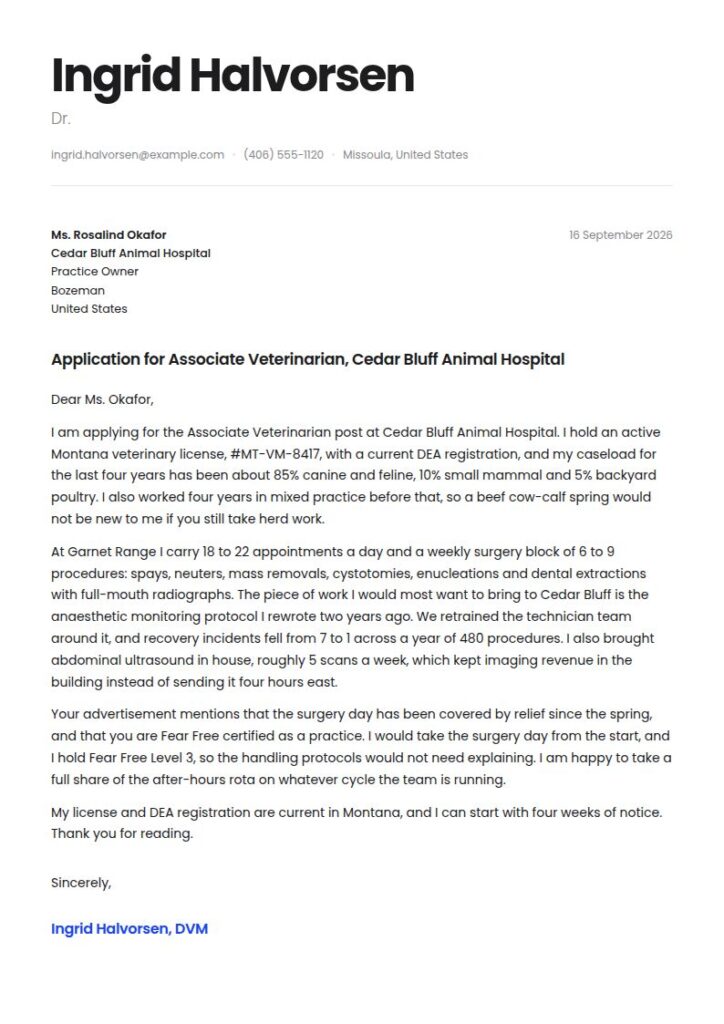
I am applying for the Associate Veterinarian post at Cedar Bluff Animal Hospital. I hold an active Montana veterinary license, #MT-VM-8417, with a current DEA registration, and my caseload for the last four years has been about 85% canine and feline, 10% small mammal and 5% backyard poultry. I also worked four years in mixed practice before that, so a beef cow-calf spring would not be new to me if you still take herd work.
At Garnet Range I carry 18 to 22 appointments a day and a weekly surgery block of 6 to 9 procedures: spays, neuters, mass removals, cystotomies, enucleations and dental extractions with full-mouth radiographs. The piece of work I would most want to bring to Cedar Bluff is the anaesthetic monitoring protocol I rewrote two years ago. We retrained the technician team around it, and recovery incidents fell from 7 to 1 across a year of 480 procedures. I also brought abdominal ultrasound in house, roughly 5 scans a week, which kept imaging revenue in the building instead of sending it four hours east.
Your advertisement mentions that the surgery day has been covered by relief since the spring, and that you are Fear Free certified as a practice. I would take the surgery day from the start, and I hold Fear Free Level 3, so the handling protocols would not need explaining. I am happy to take a full share of the after-hours rota on whatever cycle the team is running.
My license and DEA registration are current in Montana, and I can start with four weeks of notice. Thank you for reading.
Sincerely, Ingrid Halvorsen, DVM
Openings that work
| Instead of | Use |
|---|---|
| I have been passionate about animals since I was a child | I hold an active Montana license and my caseload is about 85% canine and feline, 10% small mammal, 5% backyard poultry |
| I am writing to express my interest in your veterinarian position | I am applying for the Associate Veterinarian post, and I would take the surgery day from the start |
| I have a proven track record of excellent patient care | Anaesthetic recovery incidents fell from 7 to 1 across a year of 480 procedures after I rewrote the monitoring protocol |
What counts as evidence in a practice
However, you cannot write about an individual animal or an identifiable owner, and you should not try. Everything below describes the work rather than a patient.
| Kind of evidence | What it looks like in a sentence |
|---|---|
| Caseload | 18 to 22 appointments a day across a four-doctor small animal practice |
| Surgical volume | Weekly block of 6 to 9 procedures, named by procedure class |
| Safety | Anaesthetic recovery incidents fell from 7 to 1 across a year of 480 procedures |
| Service built | Brought abdominal ultrasound in house, about 5 scans a week, cutting outbound imaging referrals by 62% |
How the letter changes by practice type
For a small animal post, lead with appointment volume, surgery block and dentistry, and say what you can do in house. For a mixed post, give the split as a percentage and name the season you can carry: spring herd health, calving, breeding soundness. For an equine post, say ambulatory or hospital, lameness or reproduction, and how far you will drive. For emergency, say the shift pattern you have actually worked and the stabilisation and transfer arrangement you are used to. For shelter or high-volume spay and neuter, give the procedures-per-day figure, because that is the whole job.
Do not write "all species" or "any caseload"; it reads as no caseload. Do not describe a named client or a recognisable patient, however good the story. Do not leave the after-hours question unanswered, because the reader will assume the worst. Do not claim a procedure you have done twice. Do not send the same letter to a dairy practice and a feline-only clinic, since the two are hiring for different careers.
Fast growth, very few openings
The Occupational Outlook Handbook puts veterinarian employment at 91,100 in 2025, projects 9 percent growth through 2035, much faster than the average for all occupations, and expects only about 3,100 openings a year on average over the decade (BLS Occupational Outlook Handbook, 2025 to 2035 projections and May 2025 wage data). The median wage was $130,100 in May 2025, with the lowest 10 percent under $73,920 and the highest 10 percent over $215,700.
Fast growth against a small absolute number of openings means most practices are not hiring most of the time, and the ones that are have one specific hole. Your letter's job is to identify it from the advertisement and say in the first paragraph that you can stand in it, which is why a targeted file beats a strong generic one in this occupation.
Length, format and sending it
In short, one page, four paragraphs, 250 to 400 words. PDF unless the portal says otherwise, named for yourself and the post.
Use the same numbers as your resume so the two agree. Our veterinarian resume example uses the figures here, and you can check the finished file with the free ATS checker.
Key takeaways
- First, put the license state, the license number and the DEA status in the first paragraph.
- Then give your species mix as percentages, not as "mixed" or "all species".
- Next, name your appointment volume and your surgery block per week.
- Answer the after-hours question before the reader asks it.
- After that, pick one measured change with a time frame as your evidence.
- In addition, name one real thing from their advertisement or their site.
- Above all, describe the work, never an identifiable animal or owner.
Write your veterinarian cover letter in 10 minutes with our AI cover letter builder.
Veterinarian cover letter questions, answered
How long should a veterinarian cover letter be?
One page, four paragraphs, 250 to 400 words. Practice owners read applications between appointments, and length does not read as care. Save the detail for the resume.
Do I need a cover letter if the practice only asks for a resume?
Attach one wherever there is a field for it. The resume tells the reader what you have done; the letter tells them what you would take off their hands next month. In a market with roughly 3,100 openings a year nationally (BLS Occupational Outlook Handbook, 2025 to 2035 projections), the letter is often the only place the specific gap in that practice gets addressed.
What do I write as a new graduate with no associate experience?
Write your clinical year as the job: the rotations, the institution, the dates, and a surgical log summary with procedure counts by type. Then your NAVLE year, your license, your DEA status, the species mix you are seeking and the on-call share you will take. A new graduate who states a mix and offers a rota share is straightforward to schedule.
Should I mention board certification or a residency?
Yes, in the first paragraph. The American Board of Veterinary Specialties recognizes 22 specialty organizations covering 48 distinct specialties, with more than 16,500 diplomates nationally (AVMA, accessed September 2026). If you are mid-residency, name the college, the program and the expected examination year, since a practice planning a referral service will want to know the date.
How do I write about a case without identifying a patient?
Write the class of work rather than the case. "Roughly 5 abdominal ultrasound scans a week" and "480 anaesthetic procedures across the year" describe your capability without describing an animal or an owner. To show clinical judgement, describe a protocol you changed and what happened to the numbers afterwards; it is stronger evidence anyway and carries no confidentiality risk.