Devika Zaveri Columbus, 43214, United States [email protected] · (614) 555-0703
11 September 2026
Dr. Marta Reinholt Chief of Hospital Medicine Kingsmere Health Network Columbus, United States
Application for Hospitalist, Kingsmere Health Network
Dear Dr. Reinholt,
I am applying for the hospitalist post with the Kingsmere Health Network. I am board certified in internal medicine through the American Board of Internal Medicine with maintenance current, licensed in Ohio and Indiana, and I hold an Interstate Medical Licensure Compact Letter of Qualification, so credentialing in a third state would not be the limiting step on a start date.
I have spent seven years on a 310-bed community hospital service, carrying an average daily census of 16 to 18 and roughly 1,700 discharges a year on a 7-on, 7-off block with rotating nights. The work I would most want to bring with me is not clinical: I rebuilt the discharge summary template and the medication reconciliation step for a 24-physician group, and median discharge summary completion moved from 52 hours to under 24 within two quarters. I also chair our sepsis bundle workgroup, where compliance across the service moved from 61% to 88% over four quarters.
Your posting describes a service that has grown from two campuses to three in the last two years, which is the point at which cross-cover handoffs usually start to cost you. That is the problem I would want to work on first, and I would be glad to keep teaching; I currently precept 14 residents and 20 third-year students a year.
I hold independent privileges for central venous access, arterial lines, lumbar puncture, paracentesis and thoracentesis, and I can provide the full procedure log with my application. I could start within 90 days of an offer. Thank you for your time.
Sincerely, Devika Zaveri, MD
Summary
A doctor cover letter names your specialty and board status, the states you are licensed in, the setting and volume you practice at, and one thing you built or ran. This guide gives you a full adaptable letter, the rule that keeps patient detail off the page, and what changes when you write for a non-clinical role.
Doctor cover letter examples by experience level
In short, a doctor cover letter is a one-page letter that tells a hiring physician or a recruiter your board certification, the states that license you, what setting and volume you practice at, and what you can take responsibility for beyond your own service list.
In most cases, the reader is solving two problems at once: a rota with a hole in it, and a credentialing timeline measured in months. As a result, a letter that answers both in the first paragraph is unusual enough that the reader finishes it.
One rule governs everything below it.
Do not put a patient in the letter
No name, no initials, no age, no diagnosis, no case, no outcome, no circumstance specific enough to identify anyone. Not even a case you believe is fully de-identified, because the reader cannot verify that and the memorable cases are the identifiable ones.
The pull to do it is strong. A cover letter asks you to be vivid, and the vivid material in a clinical career is almost always a person. Resist it, and use what your service measures instead: census, discharges, procedure volume, clinic throughput, a compliance rate you moved, a protocol you wrote.
A letter that opens with a case tells a medical staff office something about your records habits before it tells them anything about your medicine.
Guide to a doctor cover letter
Specifically, this guide and the corresponding doctor cover letter example will cover:
- First, how to structure the letter, paragraph by paragraph
- Then, why license status and board status belong in the first three lines
- What counts as evidence when you cannot describe a single case
- What changes when the role is non-clinical
- Finally, the openings that send a strong file to the wrong pile
How to write a doctor cover letter
| Paragraph | Its job | Length |
|---|---|---|
| Opening | The post, your specialty, board status and license state | 2 to 3 sentences |
| Evidence | One setting, one volume, one number, one period of time | 4 to 5 sentences |
| Fit | Something specific about their service, and what you would take on | 3 to 4 sentences |
| Close | Credentialing readiness, availability, thank you | 2 sentences |
However, the credentialing sentence is the one most physicians leave out and the one a recruiter is looking for. Whether you already hold a license in the state, whether you hold an Interstate Medical Licensure Compact Letter of Qualification, and when you could realistically start are three facts that change how a recruiter triages a file.
A doctor cover letter example you can adapt
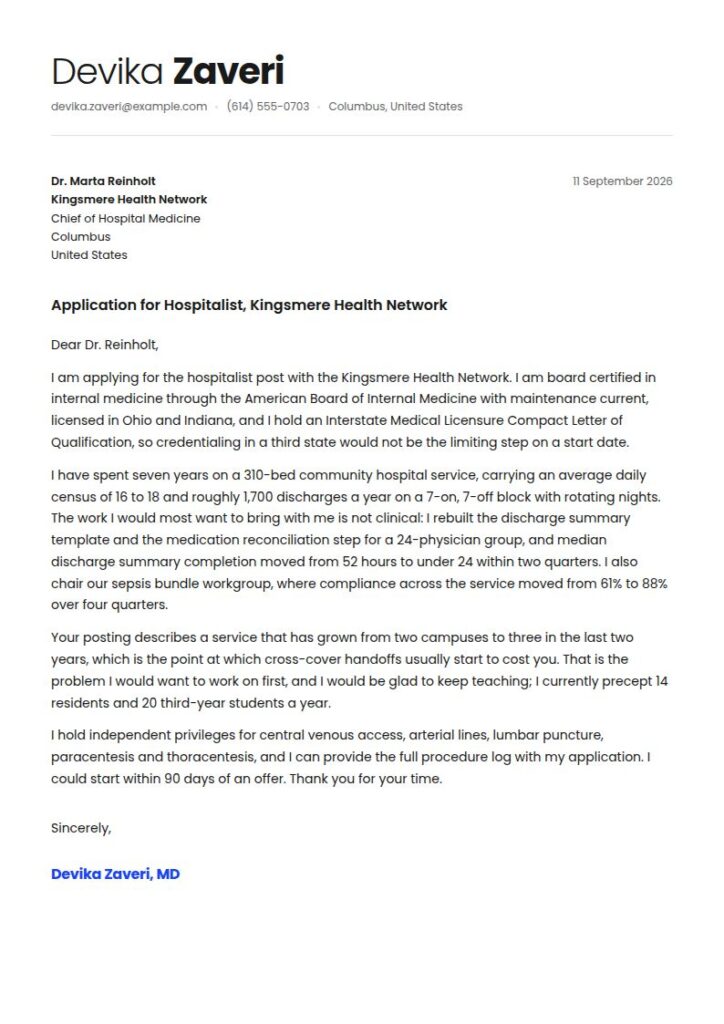
Dear Dr. Reinholt,
I am applying for the hospitalist post with the Kingsmere Health Network. I am board certified in internal medicine through the American Board of Internal Medicine with maintenance current, licensed in Ohio and Indiana, and I hold an Interstate Medical Licensure Compact Letter of Qualification, so credentialing in a third state would not be the limiting step on a start date.
I have spent seven years on a 310-bed community hospital service, carrying an average daily census of 16 to 18 and roughly 1,700 discharges a year on a 7-on, 7-off block with rotating nights. The work I would most want to bring with me is not clinical: I rebuilt the discharge summary template and the medication reconciliation step for a 24-physician group, and median discharge summary completion moved from 52 hours to under 24 within two quarters. I also chair our sepsis bundle workgroup, where compliance across the service moved from 61% to 88% over four quarters.
Your posting describes a service that has grown from two campuses to three in the last two years, which is the point at which cross-cover handoffs usually start to cost you. That is the problem I would want to work on first, and I would be glad to keep teaching; I currently precept 14 residents and 20 third-year students a year.
I hold independent privileges for central venous access, arterial lines, lumbar puncture, paracentesis and thoracentesis, and I can provide the full procedure log with my application. I could start within 90 days of an offer. Thank you for your time.
Sincerely, Devika Zaveri, MD
Openings that work
| Instead of | Use |
|---|---|
| I am a compassionate physician dedicated to patient-centered care | I am board certified in internal medicine, licensed in Ohio and Indiana, and hold an IMLC Letter of Qualification |
| I am writing to express my interest in the hospitalist position | I am applying for the hospitalist post; credentialing would not be the limiting step on a start date |
| I have extensive experience managing complex patients | Seven years on a 310-bed service, average daily census 16 to 18, roughly 1,700 discharges a year |
| I would be a valuable addition to your team | Your service has grown from two campuses to three, which is where cross-cover handoffs start to cost you |
What counts as evidence when you cannot describe a case
In practice, everything a service already counts is available to you, and none of it describes a person.
| Kind of evidence | What it looks like in a sentence |
|---|---|
| Volume | Average daily census of 16 to 18 and roughly 1,700 discharges a year |
| Procedures | Roughly 90 central venous catheter placements a year under independent privileges |
| Rate you moved | Sepsis bundle compliance across the service from 61% to 88% over four quarters |
| Process you built | Rebuilt the discharge summary template for a 24-physician group |
| Turnaround | Median discharge summary completion from 52 hours to under 24 |
| Teaching | Precept 14 residents and 20 third-year students a year |
| Committee work | Chair the sepsis workgroup; sit on pharmacy and therapeutics |
Give the before, the after and the period. In other words, a number with a time frame is evidence. By contrast, a number on its own is decoration, and a story is a compliance question.
Clinical roles and non-clinical roles need different letters
For a clinical post, put specialty, board status, license states and credentialing readiness in the first paragraph, then volume, then one process you changed. For a non-clinical post in medical affairs, payer work, health technology, public health or industry, translate: a census becomes an operating scale, a bundle compliance rate becomes a measurable improvement program you owned, and residency teaching becomes training delivery. Name the specific team or product you are writing to. Send a resume with it, not a CV.
Do not describe a patient, a case or a diagnosis, in either kind of letter. Do not open with a philosophy of medicine. Do not attach an eleven-page CV when the posting asked for a resume and a letter. Do not leave your license and board status to the second page. Do not claim a procedure you have not been privileged for, because privileging is verified.
More licensed physicians than physician jobs
The Federation of State Medical Boards counted 1,082,187 licensed physicians in the United States in its 2024 census, up 27 percent since 2010, with US medical graduates at 77 percent of the workforce and international medical graduates at 23 percent (FSMB, released 15 August 2025 in the Journal of Medical Regulation).
The Bureau of Labor Statistics counts 862,800 physician and surgeon jobs in 2025, growing 4 percent through 2035 with about 22,100 openings a year (BLS Occupational Outlook Handbook, published 27 August 2026).
The difference is multi-state licensure and the large number of physicians working in administrative, industry, research and public health roles that are counted elsewhere. Through 31 July 2026 the Interstate Medical Licensure Compact had issued 227,966 licenses to 65,558 physician members across 44 member states and 2 US territories (Interstate Medical Licensure Compact Commission, page updated 6 August 2026). Both facts point the same way for your letter: say where you are licensed and how fast you can be credentialed, because for a growing share of physician hiring that is the decision.
Length, format and sending it
One page, four paragraphs, 250 to 400 words. PDF unless the portal says otherwise, named for yourself and the post: devika-zaveri-hospitalist-cover-letter.pdf.
Address a person. Service line leadership is public on nearly every health system site, and a generic salutation on an otherwise specific letter reads as a file sent to twelve systems at once.
Use the same figures as your resume so the two agree, and make sure both agree with the CV the service will ask for next. Our doctor resume example is written with the numbers used here.
Key takeaways
- Above all, never describe a patient, a case, a diagnosis or an outcome.
- First, put specialty, board status and license states in the first paragraph.
- Say plainly how fast you can be credentialed and when you could start.
- Then use volume, rates and process changes as your evidence, with a period attached.
- Next, name one specific thing about their service, taken from their own material.
- Finally, translate the same facts into operational language for a non-clinical role.
- One page, four paragraphs, addressed to a named person, sent with a resume rather than a CV.
Write your doctor cover letter in 10 minutes with our AI cover letter builder.
Doctor cover letter questions, answered
How long should a doctor cover letter be?
One page, four paragraphs, 250 to 400 words. The reader is usually a practicing physician doing this between shifts, and length does not read as effort.
Can I include a case if I take out the identifying details?
No. Leave cases out entirely, in the letter and on the resume. A reader has no way to confirm that a case is de-identified, and the ones physicians want to tell are usually the ones that could still be recognized. Write the volume, the procedure count, the rate you moved or the process you rebuilt instead.
Do I need a cover letter if I am applying through a recruiter?
Write one anyway. Recruiters forward it, and it is the only document in the packet where you can state credentialing readiness, the start date you could realistically hit and the responsibility you want next. The CV cannot say any of that.
What do I write with no attending experience yet?
Write residency as a job. The institution, the service, the bed count, the census you carried, total admissions and consults, the procedures you were signed off for, and any quality or committee work with a number attached. Then license status with its date and board eligibility with the date you sit. A new attending who can state a census, a procedure list and a license date is easy to plan around.
Should the letter mention board certification if I am not certified yet?
Yes, and say exactly where you are. Board eligible with the sitting date, or certification lapsed with the date you regain it, is a fact the reader will establish in credentialing anyway. As of 30 June 2025 there were 1,025,104 physicians actively certified by one of the 24 ABMS Member Boards (American Board of Medical Specialties, Board Certification Report 2024-2025, published 12 December 2025), so the reader will assume certification unless you say otherwise.