Ravindra Kulkarni MS4, Doctor of Medicine Expected May 2027 Birmingham, 35222, United States [email protected] · (205) 555-1384
11 September 2026
Dr. Sunita Rajagopal Division of Nephrology Sandhill Regional Medical Center Charlotte, United States
Application for the November nephrology research elective, Sandhill Regional Medical Center
Dear Dr. Rajagopal,
I am a fourth-year medical student at Red Mountain University School of Medicine, Doctor of Medicine expected May 2027, applying for the four-week nephrology research elective advertised for November. I rotated on your consult service in August and have been thinking about the registry question ever since.
Since June 2024 I have been the data quality lead on a chronic kidney disease registry at my own institution, now 1,410 patients. I wrote the data dictionary, run a quarterly completeness audit across 42 fields, and train the first-year abstractors. I was third author of five on a poster on progression to dialysis at a regional research day in March 2026, and first author of four on a manuscript on registry completeness accepted in August 2026.
What drew me to your group is the linkage between your dialysis initiation records and outpatient follow-up, which our registry has never managed. In four weeks I would expect a cleaned analysis dataset and a drafted results section rather than a finished paper, and I would rather agree that scope with you now than overpromise.
I am free for the whole of November and the first two weeks of December, and my curriculum vitae and a letter from my research supervisor are attached. Thank you for considering this.
Sincerely, Ravindra Kulkarni
Summary
A medical student cover letter names your stage in the four-year calendar, what you are applying for, and the one piece of your record that matches it. This guide gives you a full adaptable letter, the three kinds of application that each need a different letter, and a plain account of why the residency application uses a personal statement instead of a cover letter.
Medical Student cover letter examples by experience level
In short, a medical student cover letter is a one-page letter telling the reader what year you are in, what you are applying for, and which part of your record makes you right for it.
It is a short document with a narrow job, because your reader already knows the shape of your life. They know what a third-year does. However, what they do not know is why you wrote to them and not to eleven others running similar projects.
Guide to a medical student cover letter
That is why this guide and the corresponding medical student cover letter example will cover:
- First, how to structure the letter, paragraph by paragraph
- Then, why your stage and expected degree date belong in the first line
- What counts as evidence when you are a trainee, not a practitioner
- Also, how research posts, electives and paid jobs need different letters
- Finally, why the residency application does not use a cover letter
How to write a medical student cover letter
| Paragraph | Its job | Length |
|---|---|---|
| Opening | Your stage, expected degree date, and the exact post | 2 sentences |
| Evidence | One thing you have done that matches this post, with a number | 4 to 5 sentences |
| Fit | Something specific about their work, and what you want from it | 3 sentences |
| Close | Availability, what is attached, thank you | 2 sentences |
Name the post and your stage in the first sentence
Faculty and coordinators read these in batches, often forwarded from a shared inbox. The first sentence answers both questions: which advertisement is this, and what year is this person in.
"I am a fourth-year medical student at Red Mountain University School of Medicine, Doctor of Medicine expected May 2027, applying for the four-week nephrology research elective advertised for November." That is one sentence, and it removes every reason to put your letter aside for later.
Then be exact about dates. A student's availability is set by a block schedule the reader cannot see, so write the weeks you are free. An application needing three emails to fix a start date loses to an equally good one that said so.
The letter the Match does not ask for
To begin with, residency applications do not use a cover letter. Instead, they reach programs through the Electronic Residency Application Service, and the document carrying your argument is the personal statement, alongside your Medical Student Performance Evaluation and letters of recommendation. In addition, the National Resident Matching Program fills the positions; it announced its 2026 Main Residency Match on 20 March 2026, with 44,344 training positions offered against 53,373 registered applicants (National Resident Matching Program, 2026 Main Residency Match).
On the other hand, everything else in medical school does want a letter: research posts, visiting electives, scholarships, teaching assistantships and paid clinical jobs.
A medical student cover letter example you can adapt
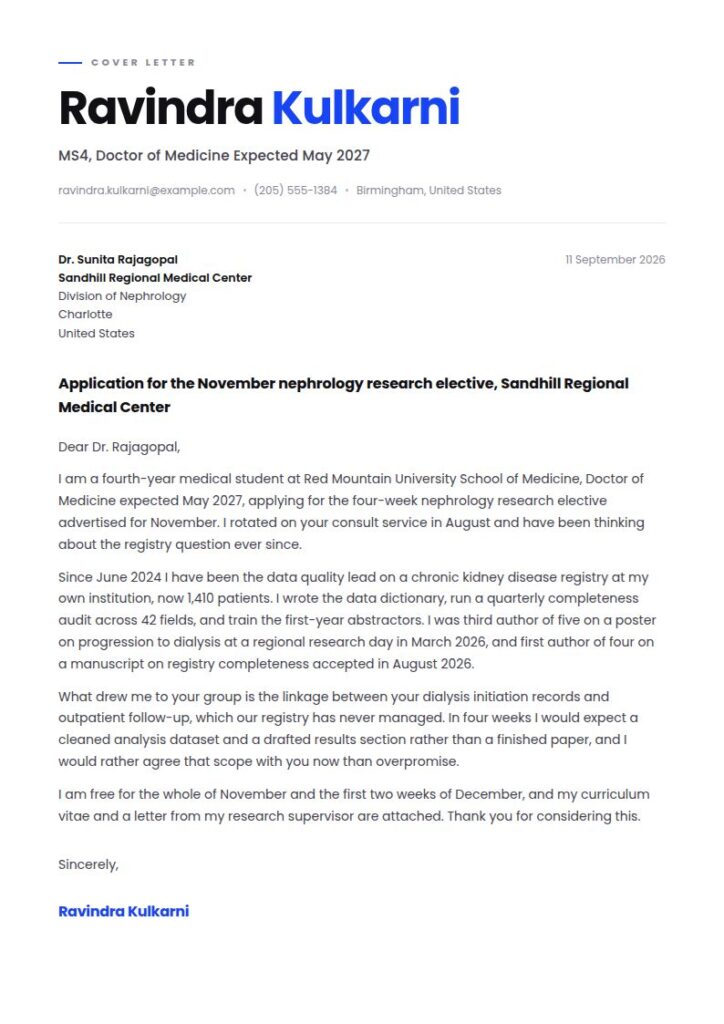
Dear Dr. Rajagopal,
I am a fourth-year medical student at Red Mountain University School of Medicine, Doctor of Medicine expected May 2027, applying for the four-week nephrology research elective advertised for November. I rotated on your consult service in August and have been thinking about the registry question ever since.
Since June 2024 I have been the data quality lead on a chronic kidney disease registry at my own institution, now 1,410 patients. I wrote the data dictionary, run a quarterly completeness audit across 42 fields, and train the first-year abstractors. I was third author of five on a poster on progression to dialysis at a regional research day in March 2026, and first author of four on a manuscript on registry completeness accepted in August 2026.
What drew me to your group is the linkage between your dialysis initiation records and outpatient follow-up, which our registry has never managed. In four weeks I would expect a cleaned analysis dataset and a drafted results section rather than a finished paper, and I would rather agree that scope with you now than overpromise.
I am free for the whole of November and the first two weeks of December, and my curriculum vitae and a letter from my research supervisor are attached. Thank you for considering this.
Sincerely, Ravindra Kulkarni
Openings that work
| Instead of | Use |
|---|---|
| I am writing to express my strong interest in your research program | I am a fourth-year medical student applying for the nephrology research elective advertised for November |
| I have always been passionate about nephrology | I rotated on your consult service in August and have been thinking about the registry question since |
| I have experience with clinical research | I have been data quality lead on a 1,410-patient kidney disease registry since June 2024 |
| I would be a valuable addition to your team | In four weeks I would expect a cleaned analysis dataset and a drafted results section |
The right column commits to something. In contrast, one naming a deliverable and a scope is a proposal, and people answer proposals.
What counts as evidence when you are still a student
You cannot claim an outcome, because you were not responsible for one. For example, you can claim scope, volume, duration and a specific contribution, all checkable in a way enthusiasm is not.
| Kind of evidence | What it looks like in a sentence |
|---|---|
| Volume | Wrote 18 admission histories and 11 discharge summaries in one four-week block |
| Duration | Two clinic sessions a month at the same student-run clinic for three years |
| Scope | Own the data dictionary and audit for a 1,410-patient registry |
| Authorship | Third author of five on the dialysis progression poster, March 2026 |
State your authorship position exactly as it stands. Also, an honest middle authorship survives an interview; an inflated one does not.
Research posts, electives and clinical jobs need different letters
For a research post, lead with method and a deliverable: what you can run, on what data, and what you could finish in the time available. For a visiting elective, lead with your stage, the exact weeks you are free, and one honest reason for that service. For a paid clinical job such as scribing, lead with the hours you can work around your block schedule, because reliability is what that reader is buying.
Do not send a residency personal statement to a laboratory. Do not call yourself passionate, driven or eager to learn; every letter in the pile does. Do not claim a technique you used once under supervision. Do not leave your availability vague. Do not name or describe an identifiable patient.
The destination occupation, and why the letter is worth the hour
Employment of physicians and surgeons stood at 862,800 jobs in 2025 and is projected to grow 4 percent from 2025 to 2035, with about 22,100 openings projected each year and a median annual wage of $275,930 in May 2025 (BLS Occupational Outlook Handbook, physicians and surgeons, May 2025 with 2025 to 2035 projections). The same Handbook puts training after the degree at 3 to 9 years of internship and residency, with a subspecialty fellowship adding 1 to 3 years more.
That runway is why small applications matter. The elective you write this letter for becomes a poster, the poster becomes a letter writer, and the letter writer becomes part of an application two years later.
Length, format and sending it
One page, four paragraphs, 250 to 400 words. PDF, named for yourself and the post: ravindra-kulkarni-nephrology-research-elective.pdf.
Address a person by name. In practice, faculty pages, directories and recent papers give you the right person in five minutes, and "Dear Sir or Madam" on an otherwise specific letter reads as a circular sent to twenty departments.
Attach the document they asked for. A laboratory that wanted a one-page resume does not want your CV. Our medical student resume example uses the same record as this letter.
Key takeaways
- First, put your stage and expected degree date in the first sentence with the exact post.
- Then say which weeks you are free; the reader cannot see your block schedule.
- Also, give one matching piece of your record with a number attached.
- Commit to a deliverable and a scope rather than to enthusiasm.
- State your authorship position exactly as it stands.
- In addition, remember that residency uses a personal statement, not a cover letter.
- Finally, send the document the program asked for and address a named person.
Write your medical student cover letter in 10 minutes with our AI cover letter builder.
Medical student cover letter questions, answered
Do medical students need a cover letter for residency applications?
No. Residency applications go through the Electronic Residency Application Service, and the argument is carried by your personal statement, your Medical Student Performance Evaluation and your letters, with positions filled through the National Resident Matching Program. Cover letters belong to research posts, electives, scholarships and paid jobs.
How long should a medical student cover letter be?
One page, four paragraphs, 250 to 400 words. Faculty read these between clinic and teaching, and a second page reads as a failure to choose.
What do I write with almost no experience yet?
Write what you are doing and how long you have done it. A first-year with one clinic shift a month, a tutoring group and completed human subjects research training has a real letter available. Say what you can do now, what you want to learn and the hours you can commit.
Should I mention my USMLE results in a cover letter?
Only if the post asks. Step 1 has been reported as pass or fail for examinations taken on or after 26 January 2022 (USMLE), so there is no number to lead with, and a research supervisor is not selecting on it. Put examination status on the CV; use the letter for the work.
How do I ask a department for an away rotation or a research elective?
Write the same four paragraphs and be concrete about time: the weeks you are free, the level you are at, and what you would realistically finish. Then ask one clear question, such as whether the block is still open, so the reply is a single line rather than a project.