Yuki Haraguchi Art Therapist, ATR-BC, ATCS Tacoma, 98405, United States [email protected] · (253) 555-1276
11 September 2026
Ms. Adaeze Okonjo Clinical Director Thistledown Children's Behavioral Health Seattle, United States
Application for Art Therapist, Thistledown Children's Behavioral Health
Dear Ms. Okonjo,
I am applying for the Art Therapist post on the child and adolescent unit at Thistledown Children's Behavioral Health. I am a board certified art therapist, ATR-BC #24-06188, and I have spent the past six years running individual and group art therapy on a 20-bed inpatient child and adolescent unit at Kestrel Grove Children's Hospital, with a current load of 9 individual sessions and 6 groups a week.
The piece of that work I would most want to bring to Thistledown is what happened to group attendance. Groups were being referred late and clients arrived without any idea what the session was, so I rebuilt the referral route with the charge nurse and added a short orientation at admission. Attendance moved from 69% to 86% over two years, and the slots that did open were redirected into individual sessions rather than lost. Over the same period I wrote the unit's artwork storage, consent and retention procedure to the American Art Therapy Association ethical principles, including a locked store, a stated retention period and a documented discharge conversation about what happens to the work.
Your job description mentions a new step-down program running alongside the inpatient beds, which is the transition where art therapy tends to be dropped first. I run drawing, painting, clay, fibre and relief printmaking independently, hold a reduced-media protocol for clients on close observation and an infection control media list cleared for medical floors, and I would want to build a continuing open studio across that step-down so the work does not stop at discharge.
I hold the ATCS supervision credential and currently supervise two provisional clinicians, so I can carry your students as well as a caseload. I am available from the start of November. Thank you for your time.
Sincerely, Yuki Haraguchi, ATR-BC, ATCS
Summary
An art therapist cover letter names where you sit on the Art Therapy Credentials Board ladder, the media you can safely run with the population the post serves, and one measured outcome from your own caseload. This guide gives you a full adaptable letter, what changes between a hospital post and a community one, and the openings that get a strong file read twice.
Art Therapist cover letter examples by experience level
An art therapist cover letter is a one-page letter that tells a clinical director three things: which ATCB credential you hold, which media you can safely run with the population they serve, and what changed for a group or a caseload the last time you ran them.
In practice, most letters for this post argue that art is healing. However, the reader already believes that; it is why the post exists. What they do not know is whether they can roster you next month, on their unit, under their materials policy.
Guide to an art therapist cover letter
In short, this guide and the corresponding art therapist cover letter example will cover:
- First, how to structure the letter, paragraph by paragraph
- Then, why the credential and the media list belong in the first two paragraphs
- Also, what a measured outcome looks like in art therapy
- Finally, what changes between a hospital post, a school post and a community one
How to write an art therapist cover letter
| Paragraph | Its job | Length |
|---|---|---|
| Opening | The post, your ATCB credential, and the population you have run | 2 to 3 sentences |
| Evidence | One setting, one caseload, one number, one period of time | 4 to 5 sentences |
| Fit | Something specific about their service, the media you would run there, and your artwork procedure | 3 to 4 sentences |
| Close | License, supervision status, availability, thank you | 2 sentences |
Put the credential and the population in the first sentence
A clinical director is deciding two things before anything else: whether you can practice at the level the post is written at, and whether you have run sessions with the people they treat. So write both immediately. "I am a board certified art therapist (ATR-BC) applying for the art therapist post on your child and adolescent unit; I have run individual and group sessions on a 20-bed inpatient unit for six years" answers both in one line.
If you are still accruing hours towards registration, say so in the same sentence, with the number. Specific reads better than vague, and the director will check anyway.
An art therapist cover letter example you can adapt
Dear Ms. Okonjo,
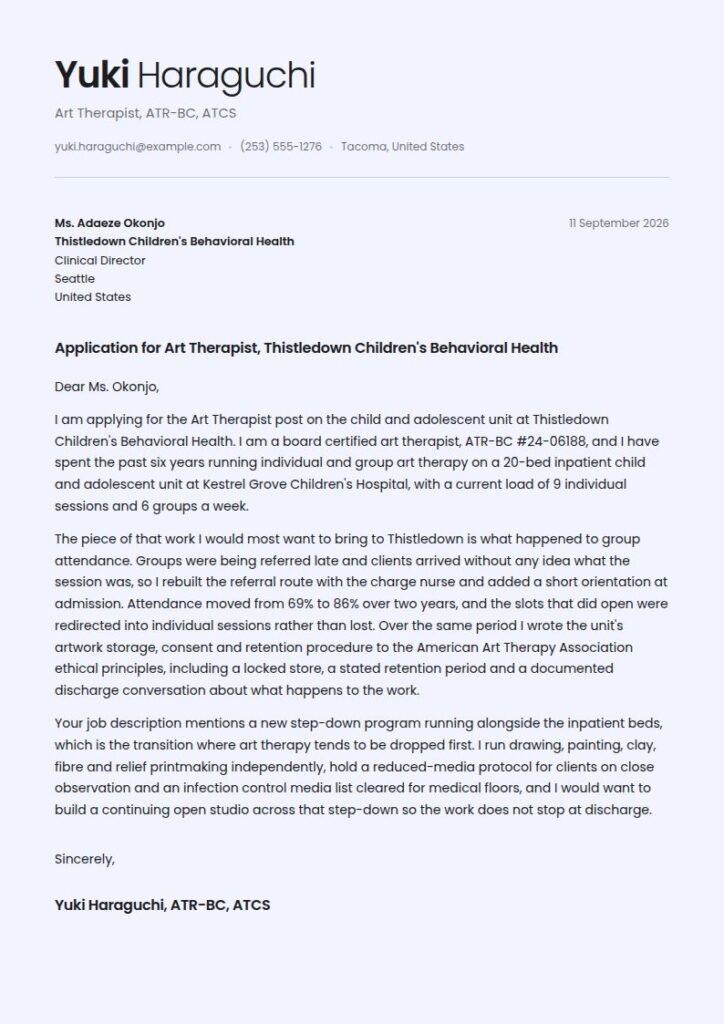
I am applying for the Art Therapist post on the child and adolescent unit at Thistledown Children's Behavioral Health. I am a board certified art therapist, ATR-BC #24-06188, and I have spent the past six years running individual and group art therapy on a 20-bed inpatient child and adolescent unit at Kestrel Grove Children's Hospital, with a current load of 9 individual sessions and 6 groups a week.
The piece of that work I would most want to bring to Thistledown is what happened to group attendance. Groups were being referred late and clients arrived without any idea what the session was, so I rebuilt the referral route with the charge nurse and added a short orientation at admission. Attendance moved from 69% to 86% over two years, and the slots that did open were redirected into individual sessions rather than lost. Over the same period I wrote the unit's artwork storage, consent and retention procedure to the American Art Therapy Association ethical principles, including a locked store, a stated retention period and a documented discharge conversation about what happens to the work.
Your job description mentions a new step-down program running alongside the inpatient beds, which is the transition where art therapy tends to be dropped first. I run drawing, painting, clay, fibre and relief printmaking independently, hold a reduced-media protocol for clients on close observation and an infection control media list cleared for medical floors, and I would want to build a continuing open studio across that step-down so the work does not stop at discharge.
I hold the ATCS supervision credential and currently supervise two provisional clinicians, so I can carry your students as well as a caseload. I am available from the start of November. Thank you for your time.
Sincerely, Yuki Haraguchi, ATR-BC, ATCS
Openings that work
| Instead of | Use |
|---|---|
| I have always believed in the healing power of art | I am a board certified art therapist, ATR-BC, applying for the post on your child and adolescent unit |
| I am writing to express my interest in your art therapist position | I have run individual and group art therapy on a 20-bed inpatient unit for six years |
| I am a creative and intuitive practitioner | I run drawing, painting, clay, fibre and relief printmaking independently |
| I would be a wonderful addition to your team | Your step-down program is where art therapy tends to be dropped first |
What counts as evidence in art therapy
Almost every service measures art therapy badly, so the candidate who brings any real number stands out immediately.
| Kind of evidence | What it looks like in a sentence |
|---|---|
| Attendance | Group attendance moved from 69% to 86% over two years after the referral route was rebuilt |
| Caseload | Carry 9 individual sessions and 6 groups a week on a 20-bed unit |
| Program | Built an open studio that ran 48 weeks a year and reached 130 patients |
| Supervision | Supervised 11 clinicians through the ATCB registration hours; all 11 registered on first application |
Two occupations tell you what the post is worth
There is no Bureau of Labor Statistics Occupational Outlook Handbook profile for art therapists, so there is no federal wage, employment count or growth rate for the occupation. Do not quote one.
The two published occupations that bracket the work are recreational therapists, median $61,960 a year as of May 2025, and marriage and family therapists, median $66,940 a year as of May 2025 (BLS, May 2025). Both sit above the median for all occupations of $50,980 as of May 2025 (BLS, May 2025).
Within recreational therapy, hospitals employ 42 percent of the occupation at a median of $63,780 while nursing and residential care facilities employ 20 percent at $51,690 (BLS, May 2025). That gap is the setting, not the skill.
What to change for the service you are writing to
For a hospital post, lead with the credential, name your infection control media list and your close-observation protocol, and mention documentation timeliness; those three make you safe to roster. For a school or community post, lead with the population and the group work, name the media that travel and the ones that need a sink, and say what you would do with a room that is not a studio. For a post that mentions supervision, say whether you hold ATCS.
Do not attach or describe client artwork, however anonymised; the ethical principles treat it as the client's property. Do not spend a paragraph on your own studio practice unless the post asks for it. Do not claim a credential level you are still accruing towards. Do not send a letter with no service name in it.
Length, format and sending it
One page, four paragraphs, 250 to 400 words. PDF unless the portal says otherwise, named for yourself and the post: yuki-haraguchi-art-therapist-cover-letter.pdf.
Address a person. Also, clinical leadership is usually public on a health system's own site, and "Dear Hiring Manager" on an otherwise precise letter reads as a letter sent to twelve services.
Use the same numbers as your resume so the two agree. Our art therapist resume example uses the figures here, and the free ATS checker will tell you whether the portal can read the file.
Key takeaways
- First, name your ATCB credential and its number in the first sentence.
- If you are accruing hours, give the numbers rather than staying vague.
- Then say which media you run independently and which need studio controls.
- Bring one measured outcome with a before, an after and a period.
- In addition, name the artwork storage and consent procedure you work to.
- Also, name one real thing about their service.
- Finally, address a named person and keep it to one page.
Build your art therapist resume in 15 minutes with our AI resume builder.
Art therapist cover letter questions, answered
How long should an art therapist cover letter be?
One page, four paragraphs, 250 to 400 words. Directors read these between clinics, and length does not read as effort.
Should I send a portfolio with the letter?
Only if the posting asks for one, and only of your own studio work. Client artwork never goes in a portfolio, an email or a personal site, at any level of anonymisation. The American Art Therapy Association's Ethical Principles for Art Therapists, revised December 2013, treat client artwork as protected information and the property of the client, and require written informed consent before it is reproduced or exhibited.
What do I write if I am still working towards registration?
Write the numbers. Under the Art Therapy Credentials Board's 2026 registration standards, a graduate of a CAAHEP-accredited program needs 1,000 hours of direct client contact and 100 hours of supervision, 50 of them with a board certified art therapist (ATCB, checked September 2026). A sentence such as "ATR-Provisional, 640 of the 1,000 client contact hours accrued and 74 supervision hours, 38 of them with an ATR-BC" tells a director precisely when you become independently rosterable.
How do I write to a service whose art therapy program I cannot find?
Read what is public for ten minutes: the service lines, the units, any new program announced in the past year, and the job description's wording about groups and settings. Then write one accurate sentence about what they are doing and connect it to a media or group decision you would make there. That sentence is the part that cannot be pasted into the next letter.
Should the letter mention my state license?
Yes, in the closing. Some states issue a dedicated art therapy license, some regulate art therapy under a related counseling license, and some do neither (American Art Therapy Association, checked September 2026). If you hold a counseling license as well as the ATCB credential, name it, because in many services that license is what makes your sessions billable.