Neonatal Nurse Resident, Level II Special Care Nursery Meena Radhakrishnan RN, BSN
Registered Nurse, Level II Special Care Nursery
[email protected] | (916) 555-1480 | Sacramento, United States
Profile
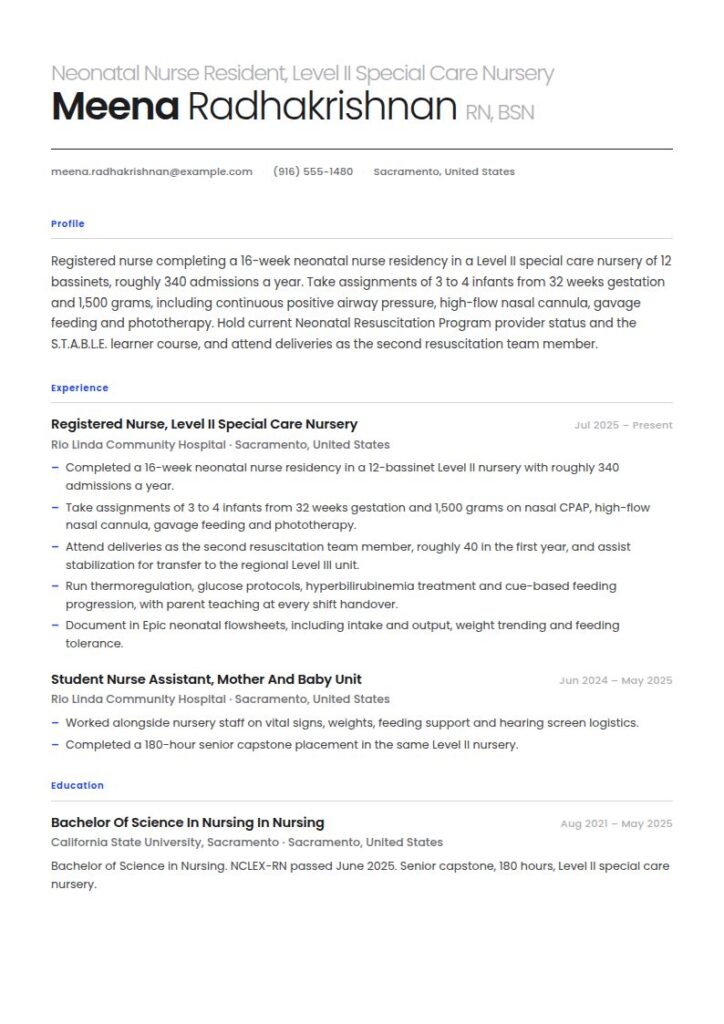
Registered nurse completing a 16-week neonatal nurse residency in a Level II special care nursery of 12 bassinets, roughly 340 admissions a year. Take assignments of 3 to 4 infants from 32 weeks gestation and 1,500 grams, including continuous positive airway pressure, high-flow nasal cannula, gavage feeding and phototherapy. Hold current Neonatal Resuscitation Program provider status and the S.T.A.B.L.E. learner course, and attend deliveries as the second resuscitation team member.
Work Experience
07/2025 - Present, Registered Nurse, Level II Special Care Nursery, Rio Linda Community Hospital, Sacramento, United States
- Completed a 16-week neonatal nurse residency in a 12-bassinet Level II nursery with roughly 340 admissions a year.
- Take assignments of 3 to 4 infants from 32 weeks gestation and 1,500 grams on nasal CPAP, high-flow nasal cannula, gavage feeding and phototherapy.
- Attend deliveries as the second resuscitation team member, roughly 40 in the first year, and assist stabilization for transfer to the regional Level III unit.
- Run thermoregulation, glucose protocols, hyperbilirubinemia treatment and cue-based feeding progression, with parent teaching at every shift handover.
- Document in Epic neonatal flowsheets, including intake and output, weight trending and feeding tolerance.
06/2024 - 05/2025, Student Nurse Assistant, Mother and Baby Unit, Rio Linda Community Hospital, Sacramento, United States
- Worked alongside nursery staff on vital signs, weights, feeding support and hearing screen logistics.
- Completed a 180-hour senior capstone placement in the same Level II nursery.
Education
08/2021 - 05/2025, Bachelor of Science in Nursing, Nursing, California State University, Sacramento, Sacramento, United States
Bachelor of Science in Nursing. NCLEX-RN passed June 2025. Senior capstone, 180 hours, Level II special care nursery.
Skills
Nasal CPAP and high-flow nasal cannula, 70
Neonatal Resuscitation Program algorithm, 75
Thermoregulation and glucose protocols, 80
Gavage and cue-based feeding, 80
Phototherapy and hyperbilirubinemia care, 80
Parent teaching and discharge preparation, 70
Epic neonatal flowsheets, 75
Languages
English, native
Tamil, native
Spanish, beginner
Certificates
05/2020, Registered Nurse, California Board of Registered Nursing, 884217
Current through 2027.
01/2026, Neonatal Resuscitation Program Provider, American Academy of Pediatrics
9th edition, current. Required of clinical nurses in Level II, III and IV units under the 2023 AAP standards.
02/2021, S.T.A.B.L.E. Program, Learner Course, The S.T.A.B.L.E. Program
Post-resuscitation and pre-transport stabilization: sugar, temperature, airway, blood pressure, lab work and emotional support.
02/2026, Basic Life Support Provider, American Heart Association
Summary
A NICU nurse resume names the AAP level of every unit you have worked in, the gestational age and birth weight floor you have taken, the ventilation modes and lines you manage, and the neonatal credentials behind them. This guide gives you three adaptable versions, the acuity block most applicants leave out, and current Bureau of Labor Statistics pay for hospital nurses.
NICU Nurse resume examples by experience level
In short, a NICU nurse resume is a one to two page document naming the level of every unit you have staffed, the smallest and youngest infants you have taken, the ventilation and line work you do, and the neonatal credentials behind it.
Neonatal nurse managers read these resumes for one judgment: if I put this nurse on nights next month, which assignment can she take? For example, a nurse who has run high-frequency oscillatory ventilation on a 24-week infant with an umbilical arterial line is a different hire from a nurse who has fed and monitored 34-week infants in a special care nursery. However, only the resume says which one you are.
Resume guide for a NICU nurse resume
Specifically, this guide and the corresponding NICU nurse resume example will cover:
- First, how to write a NICU nurse resume, section by section
- Secondly, unit level as the spine of the page, and what each level proves
- Thirdly, three adaptable summaries: new graduate, staff nurse and lead
- Fourthly, the gestational age floor, ventilation modes, lines and cooling
- Lastly, what the market looks like and what you can expect to earn
How to write a NICU nurse resume
Overall, it takes six blocks: contact header with credentials, summary, unit and acuity profile, experience with numbers, education and certification, and equipment. In general, use one page for your first five years, then two once you charge, transport or precept. Put the unit profile under the summary: level, bed count, annual admissions and assignment ratio are four lines that let a manager place you before reading anything else.
| Section | What it is answering | Where it goes |
|---|---|---|
| RN license and neonatal credentials | Is this verifiable, and is RNC-NIC current? | Header, with the license number |
| Unit level and bed count | What did this unit admit, and what could it not? | Under the summary |
| Acuity and equipment | Which assignment can I give this nurse? | Its own block, by category |
Give the gestational age and weight floor, not the word critical
"Cared for critically ill neonates" is the most common sentence on these resumes and it carries no information. Replace it with the floor you have actually taken: "Primary nurse for infants from 23 weeks and 4 days and 490 grams; typical assignment 1:1 to 1:2 on ventilated and fresh post-operative infants, 1:3 on grower feeders."
Then say what you do at that floor: the ventilation mode, the line, the drip. A manager reading that knows your assignment before the interview.
Run the file through the ATS resume checker first. Health systems parse nursing applications into a structured record before a manager sees them.
Choosing the best resume format for a NICU nurse resume
Reverse chronological. Hospital, city, unit level, bed count, dates, then bullets that each carry a number or a device. Then use two pages once you have a charge, transport or preceptor line worth its own bullets.
Above all, never use a functional or skills-first format. After all, neonatal managers read for continuity and escalation: which level, how long, and what you were trusted with by the end. Repeat the unit level in every employer line, even when two jobs were at the same level.
Include your contact information
| ✅ Right | ❌ Wrong |
|---|---|
| Meena Radhakrishnan, RN, BSN, RNC-NIC | Meena Radhakrishnan |
| Neonatal Intensive Care, Level IV, 72 beds | Compassionate neonatal nurse |
| CA RN #884217, NRP current, S.T.A.B.L.E. instructor | Licensed RN with NICU experience |
| (916) 555-1480, [email protected], Sacramento, CA | (916) 555-1480, [email protected] |
Put RNC-NIC next to your name if you hold it. In fact, it is a searched string in recruiting tools, and "neonatal certified" is not the same text. Add the state and license number, because license verification comes first.
Make use of a summary
In short, use four lines: credentials, unit level and bed count, the acuity floor, and one thing you own beyond your own assignment.
Registered nurse completing a 16-week neonatal nurse residency in a Level II special care nursery of 12 bassinets, roughly 340 admissions a year. Take assignments of 3 to 4 infants from 32 weeks gestation and 1,500 grams, including continuous positive airway pressure, high-flow nasal cannula, gavage feeding and phototherapy. Hold current Neonatal Resuscitation Program provider status and the S.T.A.B.L.E. learner course, and attend deliveries as the second resuscitation team member.
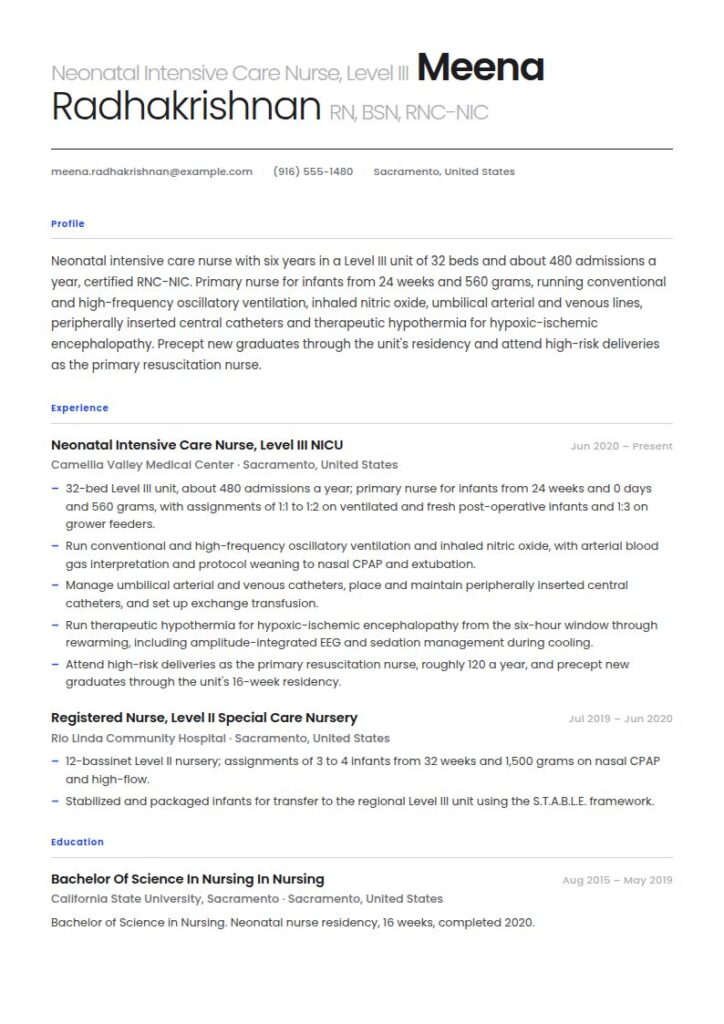
Neonatal intensive care nurse with six years in a Level III unit of 32 beds and about 480 admissions a year, certified RNC-NIC. Primary nurse for infants from 24 weeks and 560 grams, running conventional and high-frequency oscillatory ventilation, inhaled nitric oxide, umbilical arterial and venous lines, peripherally inserted central catheters and therapeutic hypothermia for hypoxic-ischemic encephalopathy. Precept new graduates through the unit's residency and attend high-risk deliveries as the primary resuscitation nurse.
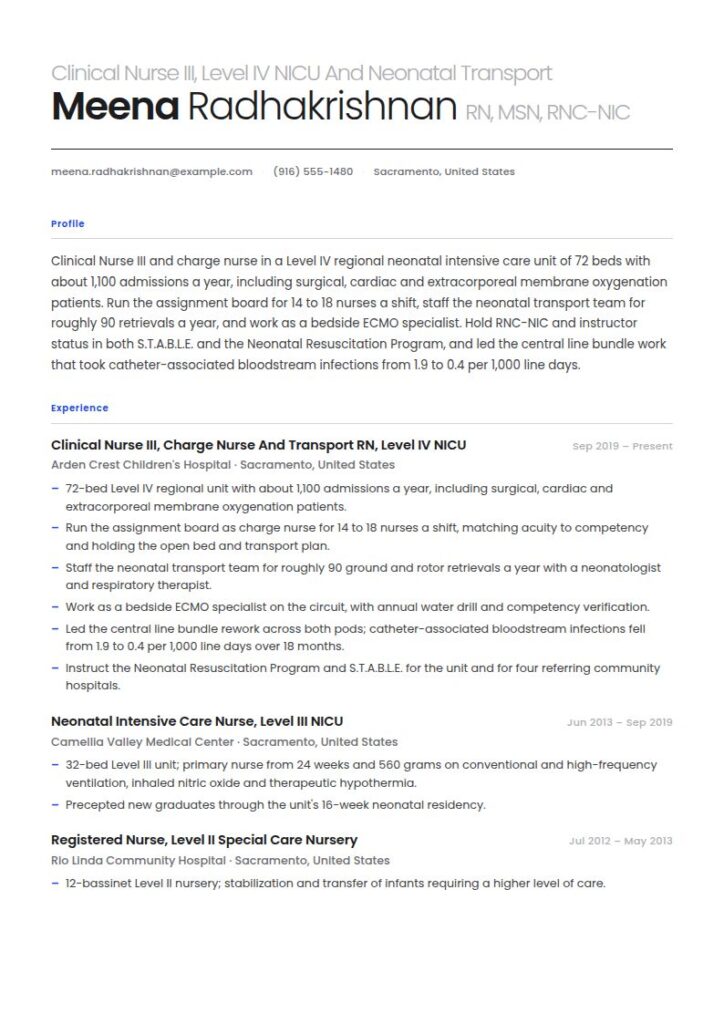
Clinical Nurse III and charge nurse in a Level IV regional neonatal intensive care unit of 72 beds with about 1,100 admissions a year, including surgical, cardiac and extracorporeal membrane oxygenation patients. Run the assignment board for 14 to 18 nurses a shift, staff the neonatal transport team for roughly 90 retrievals a year, and work as a bedside ECMO specialist. Hold RNC-NIC and instructor status in both S.T.A.B.L.E. and the Neonatal Resuscitation Program, and led the central line bundle work that took catheter-associated bloodstream infections from 1.9 to 0.4 per 1,000 line days.
Right vs wrong: the same NICU nurse summary, twice
| ✅ Right | ❌ Wrong |
|---|---|
| Six years in a Level III unit of 32 beds with about 480 admissions a year. | Experienced NICU nurse in a busy neonatal unit. |
| Primary nurse for infants from 24 weeks and 560 grams. | Cared for critically ill premature neonates. |
| Run conventional and high-frequency oscillatory ventilation, inhaled nitric oxide, UAC, UVC and PICC lines. | Skilled in advanced neonatal equipment. |
| Central line infections moved from 1.9 to 0.4 per 1,000 line days. | Committed to excellent patient outcomes. |
For instance, the right column can be turned into an assignment. The left column, however, cannot, and an assignment is what a manager is buying.
Outline your neonatal experience
Then list hospital, city, unit level, bed count, admissions, dates. Then bullets, each naming a device, a procedure or a number.
| Instead of | Use |
|---|---|
| Cared for critically ill neonates | Primary nurse for infants from 24 weeks and 560 grams, assignment 1:1 to 1:2 on ventilated and fresh post-operative infants |
| Managed ventilators | Run conventional and high-frequency oscillatory ventilation and inhaled nitric oxide, including weaning to nasal CPAP |
| Assisted with procedures | Assist umbilical line placement, place and maintain PICC lines, manage chest tubes |
| Participated in quality improvement | Led the central line bundle rework; catheter-associated bloodstream infections fell from 1.9 to 0.4 per 1,000 line days over 18 months |
Neonatal Intensive Care Nurse, Camellia Valley Medical Center, Sacramento, CA, Level III NICU, 32 beds, about 480 admissions a year, June 2020 to Present
Primary nurse for infants from 24 weeks and 560 grams; typical assignment 1:1 to 1:2 on ventilated and fresh post-operative infants, 1:3 on grower feeders.
Run conventional and high-frequency oscillatory ventilation, inhaled nitric oxide and nasal CPAP weaning, with arterial blood gas interpretation and ventilator adjustment under protocol.
Manage umbilical lines, place and maintain peripherally inserted central catheters, and run therapeutic hypothermia from the six-hour window through rewarming.
Attend high-risk deliveries as the primary resuscitation nurse, roughly 120 a year, and precept new graduates through the unit's 16-week residency.
The level of the unit you staffed and the acuity you can take
Indeed, this is the section that separates a NICU nurse resume from every other nursing resume, and unit level is the organizing idea. In other words, a manager who knows your level knows most of what you have seen.
The levels are defined nationally, so use them. The American Academy of Pediatrics sets four. Level I provides neonatal resuscitation at every delivery, postnatal care of stable term newborns, and stabilization of infants born 35 to 37 weeks who remain physiologically stable. Level II cares for moderately ill infants born at 32 weeks or later, or 1,500 grams or more, and can provide continuous positive airway pressure and mechanical ventilation for brief periods of less than 24 hours. At Level III, the unit cares for infants below 1,500 grams or below 32 weeks with critical illness, with ongoing assisted ventilation including conventional and high-frequency modes and inhaled nitric oxide. Level IV adds on-site surgical repair of serious congenital or acquired malformations, with pediatric medical and surgical specialists continuously available (AAP, Levels of Neonatal Care policy statement, Pediatrics, September 2012).
Equipment boundaries by NICU level
The 2023 standards make the equipment boundaries explicit, which is what makes them useful on a resume. A Level III unit must "have the ability to provide high-frequency ventilation, inhaled nitric oxide (iNO) delivery, and/or therapeutic hypothermia." A Level IV unit must additionally "have the capability to provide surgical repair of complex congenital or acquired conditions" and "have the ability to provide ECMO." A Level II unit cannot provide high-frequency ventilation, ECMO or complex surgery on site (Stark AR, Pursley DWM, Papile LA, et al., Standards for Levels of Neonatal Care: II, III, and IV, Pediatrics, 2023;151(6):e2023061957).
What each NICU level let you do
Write the level, then the things that level let you do:
- Gestational age and birth weight floor. The youngest and smallest infant you have been primary nurse for, with your assignment ratio at that acuity.
- Ventilation modes. Nasal CPAP and high-flow, conventional ventilation, high-frequency oscillatory or jet ventilation, inhaled nitric oxide, and whether you wean and extubate under protocol.
- Lines and access. Umbilical arterial and venous catheters, peripherally inserted central catheters, whether you place PICCs or only maintain them, and arterial sampling.
- Therapeutic hypothermia. Whether you have initiated cooling inside the window, run the servo-controlled blanket, managed sedation and seizure monitoring, and rewarmed.
- Surgical and cardiac. Fresh post-operative care, gastroschisis, necrotizing enterocolitis, congenital diaphragmatic hernia, ductal-dependent lesions on prostaglandin, and ECMO if you were a trained specialist.
- Delivery room and transport. Resuscitation attendance volume, your role on the team, and transport retrievals if you staff a rig or a flight.
Unit: Level III NICU, 32 beds, approximately 480 admissions a year; typical assignment 1:1 to 1:2 ventilated, 1:3 grower feeders
Gestational age and weight floor: primary nurse from 24 weeks and 0 days and 560 grams
Ventilation: nasal CPAP, high-flow nasal cannula, conventional ventilation, high-frequency oscillatory ventilation, inhaled nitric oxide, protocol weaning and extubation
Lines and access: umbilical arterial and venous catheters, PICC placement and maintenance, arterial sampling, exchange transfusion setup
Neuro: therapeutic hypothermia from the six-hour window through rewarming, amplitude-integrated EEG, seizure and sedation management
Diagnoses: respiratory distress syndrome, bronchopulmonary dysplasia, necrotizing enterocolitis, hypoxic-ischemic encephalopathy, pulmonary hypertension
Delivery room and transport: primary resuscitation nurse at roughly 120 high-risk deliveries a year; ground retrievals with a neonatologist
Build a snapshot of your key skills
In addition, use twelve to sixteen entries in four groups. Devices, modes and diagnoses, not adjectives.
Respiratory: Nasal CPAP and high-flow, Conventional ventilation, High-frequency oscillatory ventilation, Inhaled nitric oxide, Surfactant administration, Protocol weaning and extubation
Access and procedures: Umbilical arterial and venous lines, PICC placement and maintenance, Arterial sampling, Chest tube support
Neuro and thermal: Therapeutic hypothermia, Amplitude-integrated EEG, Thermoregulation for extremely low birth weight infants
Feeding, family and systems: Total parenteral nutrition, Gavage and cue-based feeding, Donor milk and fortification, Car seat tolerance screening, Family discharge teaching, Epic neonatal flowsheets
List your education, license and certifications
License first with the state and number, then the neonatal credentials, then the degree. Meanwhile, in neonatal hiring the credential set is read almost as carefully as the experience.
RNC-NIC is the one that moves a file. The National Certification Corporation requires an active, unencumbered RN license in the United States or Canada, "24 months of specialty experience as a U.S. or Canadian RN comprised of a minimum of 2000 hours," and employment in the specialty sometime in the last 24 months, and it is explicit that "both practice time and hours must be met. This is not an either/or criterion" (NCC, Neonatal Intensive Care Nursing, checked September 2026). Write it as RNC-NIC with the year and the issuing body.
NRP is not optional. The 2023 AAP standards require clinical nurses in Level II, III and IV units to be registered nurses with Neonatal Resuscitation Program certification and to take part in "annual simulation and skills verification, which includes low-volume, high-risk procedures" (Pediatrics, 2023;151(6):e2023061957). The program is run by the American Academy of Pediatrics with the American Heart Association, and the 9th edition launched in Fall 2025 alongside the current neonatal resuscitation guidelines (AAP, checked September 2026). Say which edition you completed and whether you instruct.
S.T.A.B.L.E. covers the handover that transport and community hospitals run on. Its six modules are sugar, temperature, airway, blood pressure, lab work and emotional support, and the program was "created to assist with the recall and retention of information and to standardize and organize care in the post-resuscitation/pre-transport stabilization period" (The S.T.A.B.L.E. Program, checked September 2026).
Registered Nurse, California Board of Registered Nursing, #884217, current through 2027
RNC-NIC, Neonatal Intensive Care Nursing, National Certification Corporation, #NCC-RNC-40218, 2023
Neonatal Resuscitation Program Provider, American Academy of Pediatrics, 9th edition, current; instructor since 2025
S.T.A.B.L.E. Program, learner course 2021, instructor 2024
Bachelor of Science in Nursing, California State University, Sacramento, CA. Neonatal nurse residency, 16 weeks, 2020.
Additional: Basic Life Support Provider, American Heart Association, current. Neonatal ECMO specialist, hospital program, 2024.
Choose the right layout and design
Finally, keep a single column, plain type at 11 or 12 point, clear headings, no photograph, no rating bars. Health system portals read the file into a structured record before a manager opens it, and two columns and graphics are where that breaks.
Spell out an abbreviation the first time and then use it. A recruiter may not know UAC, HFOV or aEEG, while the manager who reads it next searches for those strings.
Name the AAP level of every unit in the employer line. Give the bed count and annual admissions. State the gestational age and birth weight floor. List ventilation modes by name, and say whether you place PICC lines or only maintain them. Say whether you have initiated therapeutic hypothermia inside the window. Give resuscitation attendance and transport volume with a period.
Do not write "critically ill neonates" and stop. Do not claim a level of care your unit did not hold, since managers know the regional units. Do not list ECMO unless you were a trained specialist on the circuit. Do not describe an identifiable infant or family. Do not put a bereavement story in a resume.
NICU nurse job market and outlook
At present, the Bureau of Labor Statistics publishes no separate profile for NICU nurses. Instead, the published occupation is registered nurses, and neonatal intensive care sits inside its hospital line, the largest of the industry groups the Handbook reports.
| Measure | Value |
|---|---|
| Registered nurse jobs, 2025 | 3,465,400 |
| Projected change, 2025-35 | 6 percent, faster than average, +194,700 |
| Projected annual openings | About 180,800 |
| Typical entry-level education | Bachelor's degree |
| Median annual wage, registered nurses, May 2025 | $97,550, or $46.90 an hour |
| Median annual wage, hospitals, May 2025 | $100,220 |
Source: U.S. Bureau of Labor Statistics, Occupational Outlook Handbook, Registered Nurses, May 2025 wages and 2025-35 projections, published 27 August 2026.
Where registered nurses work:
| Setting | Share of employment | Median annual wage (May 2025) |
|---|---|---|
| Hospitals, state, local and private | 59 percent | $100,220 |
| Ambulatory healthcare services | 19 percent | $91,230 |
| Nursing and residential care facilities | 6 percent | $84,300 |
| Government, excluding state and local education and hospitals | 5 percent | $110,780 |
| Educational services, state, local and private | 3 percent | $78,620 |
Source: U.S. Bureau of Labor Statistics, Occupational Outlook Handbook, Registered Nurses, May 2025.
Nearly one in ten newborns now goes to a NICU
The neonatal intensive care admission rate in the United States rose from 8.7 percent of live births in 2016 to 9.8 percent in 2023, a 13 percent increase, so nearly 1 in 10 infants was admitted to a NICU in 2023. The rate rose in every group examined: from 49.1 percent to 51.6 percent among preterm infants, and from 5.1 percent to 5.9 percent among infants of normal or higher birth weight (Martin JA and Osterman MJK, Increases in Neonatal Intensive Care Admissions in the United States, 2016-2023, NCHS Data Brief No. 525, March 2025).
Two things follow for your resume. Volume is growing fastest at the less acute end, among term and normal-weight infants, which is why Level II and Level III units are hiring and why a nurse who can take feeder growers and short-course respiratory support has a market. But the hard assignments are still at the bottom of the weight range, so the page has to prove both: the floor you can take, and that you can run a four-patient grower assignment without losing the ventilated infant next door.
For scale, there were 3,628,934 births in the United States in 2024, with a preterm rate of 10.41 percent (NCHS, Births: Final Data for 2024, published 9 June 2026).
What salary you can expect as a NICU nurse
As a result, there is no published NICU nurse wage. The relevant figure is registered nurses in hospitals, where the median annual wage was $100,220 as of May 2025 against $97,550 for registered nurses overall, with the occupation's range running from below $68,940 for the lowest 10 percent to above $137,470 for the highest 10 percent (BLS Occupational Outlook Handbook, May 2025).
Even so, four things on the page move an individual offer. Unit level, because a Level IV regional referral unit with surgical, cardiac and ECMO patients pays differently from a Level II nursery. Certification, because many systems attach a differential to RNC-NIC. Shift and role, since nights, weekends, charge, transport and ECMO specialist are usually separate differentials rather than a higher base. Finally, the clinical ladder, which is where "Clinical Nurse III" comes from and which is awarded against a written portfolio.
That last point is the practical one. Ladder advancement and transport or ECMO selection are decided on documentation, so the resume and the portfolio should carry the same numbers: precepting counts, quality project results and certifications with dates. Write them down as they happen, because nobody reconstructs a line day count two years later.
Key takeaways for a NICU nurse resume
- First, name the AAP level of every unit in the employer line, with bed count and annual admissions.
- Also give the gestational age and birth weight floor you have been primary nurse for.
- List ventilation modes by name, including high-frequency and inhaled nitric oxide.
- Similarly, say which lines you place and which you only maintain.
- Say whether you have initiated therapeutic hypothermia inside the window.
- Lastly, put RNC-NIC next to your name, and name your NRP edition and instructor status.
- Give resuscitation attendance and transport volume with a period.
Build your NICU nurse resume in 15 minutes with our AI resume builder.
Related medical resume examples
- Nurse resume
- ICU nurse resume
- ER nurse resume
- Charge nurse resume
- New graduate nursing resume
- Travel nurse resume
- Respiratory therapist resume
- Lactation consultant resume
- Physician assistant resume
- Paramedic resume
- Sonographer resume
- Doctor resume
Pair it with a matching NICU nurse cover letter.
NICU nurse resume questions, answered
How long should a NICU nurse resume be?
One page for your first five years, two once you charge, transport, precept or hold a clinical ladder step. Depth belongs in the unit and acuity block.
Do I need RNC-NIC to get a NICU job?
Not to start, and you cannot hold it early either. The National Certification Corporation requires 24 months of specialty experience with a minimum of 2,000 hours and employment in the specialty within the last 24 months, and both conditions must be met (NCC, checked September 2026). Before that, the credentials that count are NRP provider status and the S.T.A.B.L.E. course. Once eligible, sit it: many systems pay a differential and some Level IV units expect it.
How do I get into a NICU as a new graduate?
Through a neonatal nurse residency, and the application is a different document from an experienced nurse's. Write the clinical rotation hours you spent in a nursery or NICU, the level of that unit, your capstone placement, NRP provider status, and any neonatal work as a student nurse assistant. Level II units hire new graduates more often than Level IV units do, and a Level II start is a normal route into a regional unit later.
What if my unit was Level II and I want a Level IV job?
Say the level honestly and then write everything at the top of your range. A Level II unit provides CPAP and short courses of mechanical ventilation for infants from 32 weeks or 1,500 grams (AAP, Levels of Neonatal Care, Pediatrics, September 2012), so your evidence is the sickest infants you stabilized before transfer, your S.T.A.B.L.E. work and your delivery room resuscitations. That is a credible Level III application, and naming the boundary beats blurring it.
How do I write about infants and families without breaching privacy?
Describe the work and the population, never the case. A weight band, a gestational age range and a diagnosis category are fine. A gestational age plus a date plus a rare diagnosis is potentially identifying, and a bereavement story does not belong on a resume.