Final-Semester Nursing Student Bethanie Sorrentino BSN Candidate
Patient Care Assistant, Inpatient Medical Unit
[email protected] | (401) 555-1354 | Providence, United States
Profile
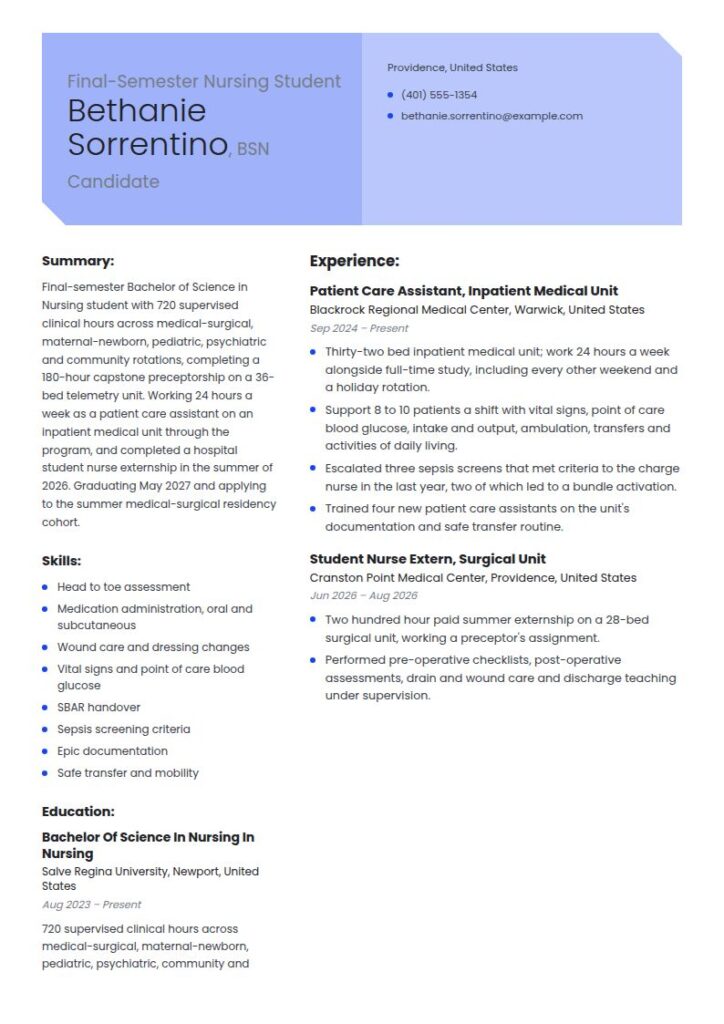
Final-semester Bachelor of Science in Nursing student with 720 supervised clinical hours across medical-surgical, maternal-newborn, pediatric, psychiatric and community rotations, completing a 180-hour capstone preceptorship on a 36-bed telemetry unit. Working 24 hours a week as a patient care assistant on an inpatient medical unit through the program, and completed a hospital student nurse externship in the summer of 2026. Graduating May 2027 and applying to the summer medical-surgical residency cohort.
Work Experience
09/2024 - Present, Patient Care Assistant, Inpatient Medical Unit, Blackrock Regional Medical Center, Warwick, United States
- Thirty-two bed inpatient medical unit; work 24 hours a week alongside full-time study, including every other weekend and a holiday rotation.
- Support 8 to 10 patients a shift with vital signs, point of care blood glucose, intake and output, ambulation, transfers and activities of daily living.
- Escalated three sepsis screens that met criteria to the charge nurse in the last year, two of which led to a bundle activation.
- Trained four new patient care assistants on the unit's documentation and safe transfer routine.
06/2026 - 08/2026, Student Nurse Extern, Surgical Unit, Cranston Point Medical Center, Providence, United States
- Two hundred hour paid summer externship on a 28-bed surgical unit, working a preceptor's assignment.
- Performed pre-operative checklists, post-operative assessments, drain and wound care and discharge teaching under supervision.
Education
08/2023 - Present, Bachelor of Science in Nursing, Nursing, Salve Regina University, Newport, United States
720 supervised clinical hours across medical-surgical, maternal-newborn, pediatric, psychiatric, community and telemetry rotations, including a 180-hour leadership capstone preceptorship on a 36-bed telemetry unit. Cumulative grade point average 3.71. NCLEX-RN authorization to test expected June 2027.
Skills
Head to toe assessment, 70
Medication administration, oral and subcutaneous, 65
Wound care and dressing changes, 65
Vital signs and point of care blood glucose, 85
SBAR handover, 70
Sepsis screening criteria, 70
Epic documentation, 75
Safe transfer and mobility, 85
Languages
English, native
Italian, intermediate
Certificates
01/2026, Basic Life Support for Healthcare Providers, American Heart Association
Current through 2028.
08/2026, Student Nurse Externship Completion, Cranston Point Medical Center Department of Nursing Education
200 hours on a surgical unit.
Summary
A new graduate nursing resume is a one page document built on clinical rotations written as experience, your NCLEX status with its date, and the nurse residency cohort you are applying to. This guide gives you three adaptable versions, the rotation table almost nobody writes properly, and current Bureau of Labor Statistics pay and outlook for registered nurses.
New Graduate Nursing resume examples by experience level
A new graduate nursing resume is a one page document built on your clinical rotations written as experience, your NCLEX status with its date, and the residency cohort you are asking to join.
Be clear about what this document is. A new graduate nursing resume is a residency application, not a job application. The reader is not deciding whether you can run a unit; they are deciding whether to spend a year of preceptor time on you, and whether you will still be there at the end of it.
Resume guide for a new graduate nursing resume
This guide and the corresponding new graduate nursing resume example will cover:
- How to write a new graduate nursing resume when you have no nursing job yet
- The clinical rotation table, written as experience with hours and populations
- Three adaptable versions: final-semester student, new graduate in residency, and second-year nurse
- How the residency cycle works and what it means for when you apply
- What Bureau of Labor Statistics data shows about pay and openings
How to write a new graduate nursing resume
Six blocks: contact header, summary, licensure and NCLEX status, clinical rotations, paid and unpaid healthcare work, and education with the capstone named. One page. Two is not a sign of thoroughness at this stage; it is a sign that the rotations were written twice.
The order is set by what a residency coordinator screens for first. Graduation date, license status and NCLEX date decide whether you are eligible for a cohort at all, so they sit at the top. The rotation table decides everything after that.
| Section | What it is answering | Where it goes |
|---|---|---|
| Graduation and NCLEX | Can this applicant start with the cohort, and are they licensed by then? | Header and the first block under the summary |
| Clinical rotations | What have they actually done, and on which units? | Its own table, in place of a work history |
| Capstone or preceptorship | Have they worked a full assignment alongside one nurse? | Named separately from the rotations |
| Healthcare work | Have they been paid to be in a hospital, and did they stay? | Reverse chronological, with hours per week |
| Education | Program, accreditation, expected or actual graduation date | Near the top, not the bottom |
Put the graduation date and the NCLEX date in the header
Residency cohorts start on fixed dates, and coordinators build them backwards from a licensing deadline. The two dates they need are your graduation date and either the date you passed NCLEX-RN or the date you are authorized to test.
Write them plainly: "BSN conferred 16 May 2026. NCLEX-RN passed 24 June 2026. Rhode Island RN license #RN-055182, issued 2 July 2026." Or, before you sit: "BSN expected 14 May 2027. NCLEX-RN authorization to test expected June 2027."
A file that makes the coordinator hunt for the graduation date gets set aside during a screen that may take ninety seconds per applicant, and cohort screening is done in one sitting.
Run the finished file through the ATS resume checker before you submit it. Health systems run residency applications through an applicant tracking system, and a rotation table is exactly what a decorative template turns into unreadable text.
Choosing the best resume format for a new graduate nursing resume
Reverse chronological, single column, one page. Use a hybrid only in the narrow sense that your clinical rotations sit in a structured block rather than in a chronological job list, and everything else stays chronological underneath them.
Avoid the functional format entirely, tempting as it is when you have no nursing job history. A coordinator wants the sequence: when you were in school, when you worked as a nurse tech, when the capstone happened and how recently. A skills-first page with no dates reads as an attempt to hide the one thing nobody is holding against you.
Include your contact information
| ✅ Right | ❌ Wrong |
|---|---|
| Bethanie Sorrentino | Bethanie Sorrentino |
| BSN, RN | Aspiring nurse ready to make a difference |
| RI RN license #RN-055182, NCLEX-RN passed June 2026 | Recent nursing graduate |
| (401) 555-1354, [email protected], Providence, RI | (401) 555-1354, [email protected] |
Put the license number on the page as soon as you have one, and the NCLEX date there before you do. Those two facts are what a residency coordinator confirms first.
Make use of a summary
Four lines: where you are in the program or in your first year, the total clinical hours behind you, the unit type you are applying to, and one thing you did that was not required of you.
Final-semester Bachelor of Science in Nursing student with 720 supervised clinical hours across medical-surgical, maternal-newborn, pediatric, psychiatric and community rotations, completing a 180-hour capstone preceptorship on a 36-bed telemetry unit. Working 24 hours a week as a patient care assistant on an inpatient medical unit through the program, and completed a hospital student nurse externship in the summer of 2026. Graduating May 2027 and applying to the summer medical-surgical residency cohort.
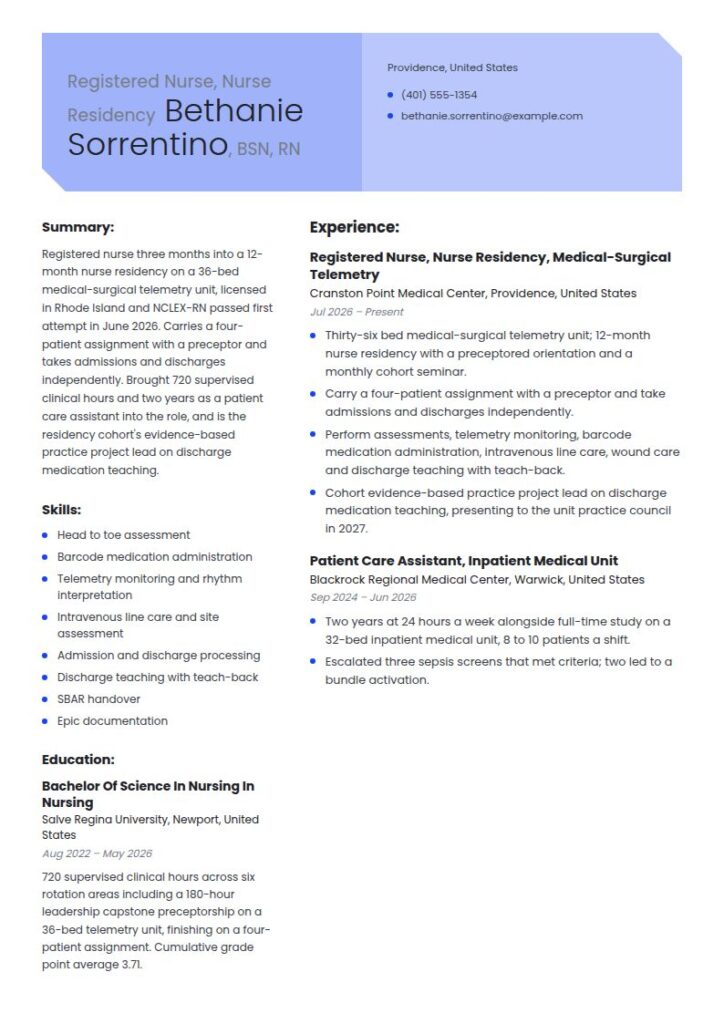
Registered nurse three months into a 12-month nurse residency on a 36-bed medical-surgical telemetry unit, licensed in Rhode Island and NCLEX-RN passed first attempt in June 2026. Carries a four-patient assignment with a preceptor and takes admissions and discharges independently. Brought 720 supervised clinical hours and two years as a patient care assistant into the role, and is the residency cohort's evidence-based practice project lead on discharge medication teaching.
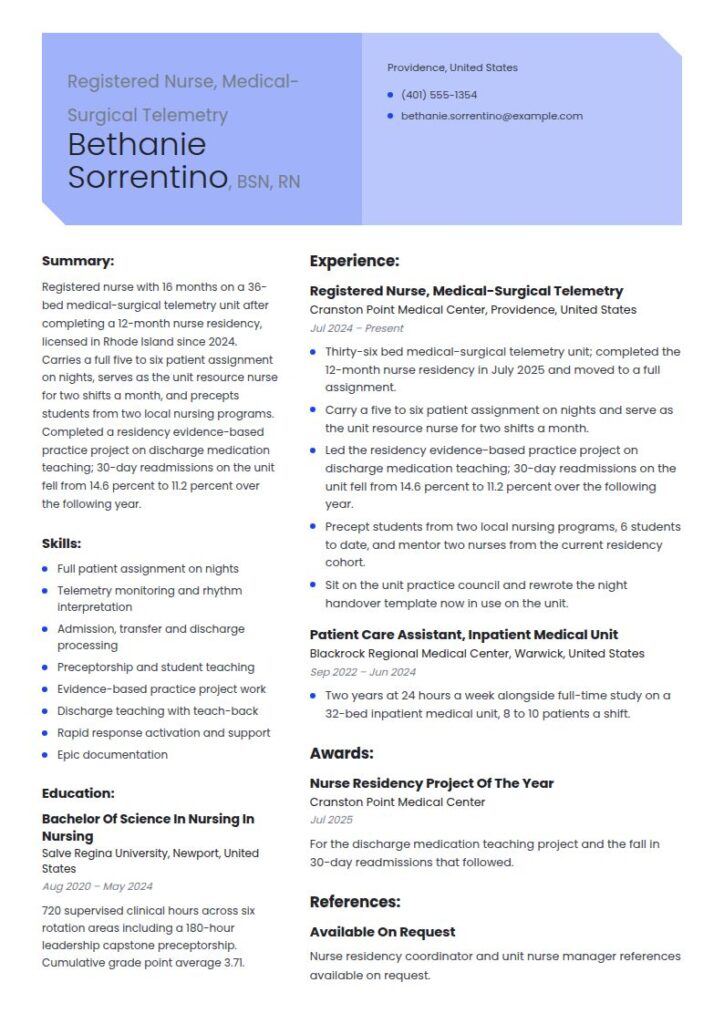
Registered nurse with 16 months on a 36-bed medical-surgical telemetry unit after completing a 12-month nurse residency, licensed in Rhode Island since 2024. Carries a full five to six patient assignment on nights, serves as the unit resource nurse for two shifts a month, and precepts students from two local nursing programs. Completed a residency evidence-based practice project on discharge medication teaching; 30-day readmissions on the unit fell from 14.6 percent to 11.2 percent over the following year.
Right vs wrong: the same new graduate nursing summary, twice
| ✅ Right | ❌ Wrong |
|---|---|
| Final-semester BSN student with 720 supervised clinical hours across five rotation areas. | Aspiring nurse with a strong desire to help others and make a difference. |
| Completing a 180-hour capstone preceptorship on a 36-bed telemetry unit. | Gained valuable hands-on experience during clinical rotations. |
| Working 24 hours a week as a patient care assistant through the program. | Hard-working team player who learns quickly in fast-paced environments. |
The left column is checkable. A residency coordinator can picture the unit, count the hours and work out what you have already been allowed to do. The right column could have been written by any of the four hundred other applicants in the cohort screen.
Outline your experience when your experience is clinical
You have more employment history than you think, and most new graduates bury it.
| Instead of | Use |
|---|---|
| Completed clinical rotations at various healthcare facilities | 720 supervised clinical hours across five rotation areas at three named sites, listed with hours and populations |
| Shadowed nurses and observed procedures | Performed admission assessments, medication administration and discharge teaching under preceptor supervision |
| Worked as a CNA | Patient care assistant, 24 hours a week for two years on a 32-bed inpatient medical unit, 8 to 10 patients a shift |
| Assisted patients with daily needs | Took vital signs, blood glucose and intake and output on 8 to 10 patients a shift, and escalated three sepsis screens that met criteria |
| Participated in a student externship | 200-hour paid student nurse externship on a surgical unit, working a nurse's assignment alongside one preceptor |
| Completed a capstone project | 180-hour capstone preceptorship on a 36-bed telemetry unit, progressing to a four-patient assignment by the final two weeks |
Patient Care Assistant, Inpatient Medical Unit, Blackrock Regional Medical Center, Warwick, RI, September 2024 to Present
Thirty-two bed inpatient medical unit. Work 24 hours a week alongside full-time study, including every other weekend and holiday rotation.
Support 8 to 10 patients a shift with vital signs, point of care blood glucose, intake and output, ambulation, transfers and activities of daily living.
Escalated three sepsis screens that met criteria to the charge nurse in the last year, two of which led to a bundle activation.
Student Nurse Extern, Surgical Unit, Cranston Point Medical Center, Providence, RI, June 2026 to August 2026
Two hundred hour paid summer externship, working a preceptor's assignment on a 28-bed surgical unit.
Performed pre-operative checklists, post-operative assessments, drain and wound care, and discharge teaching under supervision.
Write your clinical rotations as the experience section of a new graduate nursing resume
This is the block that decides the file, and almost every new graduate writes it as a single line: "completed clinical rotations at various facilities."
That line throws away the only evidence you have. Your rotations are the experience section. Write them as a table, and give five columns: the rotation, the site and unit, the hours, the patient population, and what you performed rather than watched.
| Rotation | Site and unit | Hours | Population and what I performed | |---|---|---|---| | Medical-surgical | Cranston Point Medical Center, 7 West | 135 | Adult inpatient medicine; full head to toe assessments, oral and subcutaneous medication administration, wound care, intake and output, documentation in Epic | | Maternal-newborn | Cranston Point Medical Center, Labor and Delivery and Postpartum | 90 | Antepartum, intrapartum and postpartum care; fetal monitoring observation, newborn assessment, feeding support | | Pediatrics | Cranston Point Medical Center, Pediatric Inpatient | 90 | Infant to adolescent; weight-based dosage calculation and administration with preceptor verification, growth and development assessment | | Psychiatric and mental health | Bristol Point Behavioral Health, Adult Inpatient | 90 | Adult acute psychiatric inpatients; therapeutic communication, suicide risk screening with a validated tool, group co-facilitation | | Community and public health | Providence school and clinic placements | 90 | School-age and adult community health; immunization clinic support, blood pressure screening, health teaching sessions | | Telemetry and progressive care | Blackrock Regional Medical Center, 4 North | 45 | Adult cardiac monitoring; rhythm interpretation, telemetry documentation, pre-procedure preparation | | Leadership capstone preceptorship | Cranston Point Medical Center, 6 East Telemetry, 36 beds | 180 | Progressed from two to four patients with one preceptor across 12 weeks; admissions, discharges, medication administration, handover, and rapid response attendance |
Total supervised clinical hours: 720
Two rules make that table work.
Split what you performed from what you observed. A coordinator assumes observation unless you say otherwise, and an applicant who distinguishes the two is the applicant whose claims get believed. Write "performed under preceptor supervision" where that is true, and "observed" where that is what it was. Nobody expects a student to have practiced independently, and pretending otherwise is the fastest way to lose the file.
Give hours, not weeks. Hours are the currency of nursing education and licensure, and they compare across programs. Total them at the bottom.
Then name the capstone separately, because it is not an ordinary rotation. It is the closest thing you have to a nursing job: one preceptor, one assignment, growing over weeks. Say how many patients you finished on.
Residency cohorts run on a calendar, and the calendar is the whole strategy
Nurse residency programs recruit in cohorts rather than continuously, usually tied to graduation seasons, with applications opening months before a start date and closing well before the class begins. Two national bodies accredit them, and their names belong on your page when they apply.
The Commission on Collegiate Nursing Education accredits Entry-to-Practice Nurse Residency Programs, and approved revised accreditation standards for those programs on 3 June 2026 (Commission on Collegiate Nursing Education, checked September 2026). The American Nurses Credentialing Center runs the Practice Transition Accreditation Program, which it describes as setting "the global standard for residency or fellowship programs that transition registered nurses (RNs) and advanced practice registered nurses (APRNs) into new practice settings," and which accredits RN residencies, RN fellowships and APRN fellowships (American Nurses Credentialing Center, checked September 2026).
Practically, that means three things for your resume. Apply to the cohort, not the hospital. State the cohort and unit you want by name, because coordinators sort by preference. And if the program you completed or are applying to is accredited, name the accreditor, because it tells a future employer what kind of transition year you had.
Build a snapshot of your key skills
Ten to fourteen entries in three groups: clinical skills you have performed, assessment and documentation, and systems. Keep it to things you have actually done in a clinical setting.
Clinical: head to toe assessment, oral, subcutaneous and intramuscular medication administration, intravenous line care and site assessment, wound care and dressing changes, urinary catheter care, specimen collection, blood glucose monitoring, safe transfer and mobility
Assessment and documentation: focused respiratory and cardiac assessment, pain assessment and reassessment, sepsis screening criteria, fall and pressure injury risk tools, intake and output, SBAR handover, discharge teaching with teach-back
Systems: Epic and Cerner documentation, barcode medication administration, telemetry monitoring, point of care testing devices
List your education, licensure and NCLEX status
Program first with its accreditation and the graduation date, then licensure and NCLEX, then certifications, then anything academic worth naming.
Bachelor of Science in Nursing, Salve Regina University, Newport, RI, conferred May 2026. Cumulative grade point average 3.71. Accredited nursing program. 720 supervised clinical hours including a 180-hour leadership capstone preceptorship.
NCLEX-RN passed first attempt, June 2026
Registered Nurse, Rhode Island Department of Health, license #RN-055182, issued July 2026
Basic Life Support for Healthcare Providers, American Heart Association, current through 2028
Student Nurses' Association chapter treasurer, 2025 to 2026. Dean's list, five semesters.
The NCLEX line is worth writing carefully. NCSBN reported a first-time pass rate of 86.71 percent among 192,916 candidates educated in United States member board jurisdictions for the period 1 January to 31 December 2025 (NCSBN NCLEX-RN 2025 year-end report). Passing on the first attempt is the common outcome rather than an exceptional one, so state it plainly with the date and move on; the date is what matters to a cohort start.
Choose the right layout and design
Single column, 11 or 12 point, plain headings, no photograph, one page. The rotation table is the only structure on the page that needs to hold together, so keep everything else simple enough that it does.
Put the graduation date and NCLEX date in the header. Write the rotations as a table with hours and populations. Separate what you performed from what you observed. Name the capstone unit and the patient load you finished on. List the nurse tech, patient care assistant or externship job with hours per week. Name the cohort and unit you are applying to. Keep it to one page.
Do not write "various clinical rotations" or "clinical experience in multiple settings". Do not list a skill you practiced only in a laboratory as though it were clinical. Do not claim device or drip competence you have not been signed off on; that belongs to nurses with critical care hours behind them, and claiming it early is what gets a new graduate file discarded. Do not name or describe an identifiable patient. Do not pad to two pages with coursework.
New graduate nursing job market and outlook
New graduates enter a large occupation with steady openings, where the bottleneck is not demand but the number of residency places a hospital can staff with preceptors.
The Bureau of Labor Statistics does not publish a separate occupation for new graduate nurses. You are entering the registered nurses occupation, and these are its current figures.
| Measure | Value |
|---|---|
| Registered nurse jobs, 2025 | 3,465,400 |
| Projected employment, 2035 | 3,660,100 |
| Projected change, 2025-35 | 6 percent, faster than average, +194,700 |
| Projected annual openings | About 180,800 |
| Typical entry-level education | Bachelor's degree |
| Median annual wage, May 2025 | $97,550 ($46.90 per hour) |
Source: U.S. Bureau of Labor Statistics, Occupational Outlook Handbook, Registered Nurses, May 2025 wages with 2025 to 2035 projections.
Nearly 193,000 new candidates a year, and 180,800 annual openings
NCSBN reported 192,916 first-time NCLEX-RN candidates educated in United States member board jurisdictions during 2025, with a first-time pass rate of 86.71 percent (NCSBN NCLEX-RN 2025 year-end report, reporting period 1 January to 31 December 2025).
BLS projects about 180,800 registered nurse openings each year from 2025 to 2035, most of them replacements, with employment growing 6 percent over the decade (BLS Occupational Outlook Handbook, Registered Nurses, 2025 to 2035 projections).
Those two numbers sit close together, which is the honest shape of the new graduate market: there is work, and there is also a full graduating class competing for the entry points into it every year. What is scarce is not the job but the structured first year. Residency places are limited by preceptor availability, not by vacancies, which is why applying to the cohort on time and writing rotations that show you can be precepted efficiently matters more at this stage than anything else on your page.
What salary you can expect as a new graduate nurse
The median annual wage for registered nurses was $97,550, or $46.90 an hour, as of May 2025, with the lowest 10 percent earning less than $68,940 and the highest 10 percent more than $137,470 (BLS Occupational Outlook Handbook, May 2025). A new graduate starts near the bottom of that distribution rather than at the median, because the median includes nurses with twenty years of steps behind them.
What a first offer actually consists of is usually fixed, and the parts of it that are not fixed are worth knowing:
- Base scale. Most hospitals place new graduates on a published step, so there is little to negotiate on the number itself. What you can ask about is credit for prior healthcare work, which some systems grant.
- Shift and weekend differentials. Nights and weekends carry premiums, and a new graduate willing to start on nights is frequently offered the place first.
- Degree differential. Some employers pay a differential for a bachelor's degree at hire.
- Residency commitment. Many residency places carry a service commitment, typically expressed in months, sometimes with repayment if you leave early. Read it before you sign, because it is the real term of the offer.
Key takeaways for a new graduate nursing resume
- Treat the page as a residency application, not a job application.
- Put graduation date and NCLEX date, passed or scheduled, in the header.
- Write the rotations as a table with site, unit, hours and population.
- Separate what you performed from what you observed.
- Name the capstone preceptorship separately, with the patient load you finished on.
- List the nurse tech, patient care assistant or externship job with hours per week.
- Name the cohort and unit you want, and keep the whole thing to one page.
Build your new graduate nursing resume in 15 minutes with our AI resume builder.
Related medical resume examples
- Nursing student resume
- Nurse resume
- CNA resume
- Nursing assistant resume
- Licensed practical nurse resume
- LVN resume
- Medical assistant resume
- ER nurse resume
- NICU nurse resume
- ICU nurse resume
- Travel nurse resume
- School nurse resume
Pair it with a matching new graduate nursing cover letter.
New graduate nursing resume questions, answered
How long should a new graduate nursing resume be?
One page. A residency coordinator screening several hundred applications for one cohort reads the header, the rotation table and the graduation date. A second page at this stage almost always contains coursework, which nobody reads, or the rotations written twice.
What do I put on a nursing resume with no experience?
The rotations, as a table, with site, unit, hours, population and what you performed rather than observed. Then the capstone preceptorship named separately with the patient load you finished on, then any paid healthcare job, then the externship. That is between 500 and 900 hours of supervised clinical practice for most programs, which is not nothing, and writing it as a single line is what makes it look like nothing.
Should I apply before I have passed NCLEX?
Usually yes, and most residency cycles expect it. Cohorts are built months ahead of a start date, and the application normally asks for your expected graduation date and your anticipated licensure date rather than a license number. Write the authorization to test date if you have it, then update the file the day you pass.
Does my grade point average belong on the page?
Include it if it is 3.5 or above, with the scale. Below that, leave it off and let the rotation table and the clinical hours carry the file. Some residency applications ask for a transcript separately, in which case the number is being read anyway and putting it on the resume changes nothing.
How do I choose between a large system residency and a smaller hospital?
Look at the structure rather than the name. How long the residency runs, whether it is accredited and by whom, how many weeks of preceptored orientation come before your own assignment, what the cohort size is, and what the service commitment is. The Commission on Collegiate Nursing Education accredits Entry-to-Practice Nurse Residency Programs and the American Nurses Credentialing Center accredits practice transition programs including RN residencies (CCNE and ANCC, checked September 2026), so an accreditation is a checkable answer to a question that is otherwise all atmosphere.