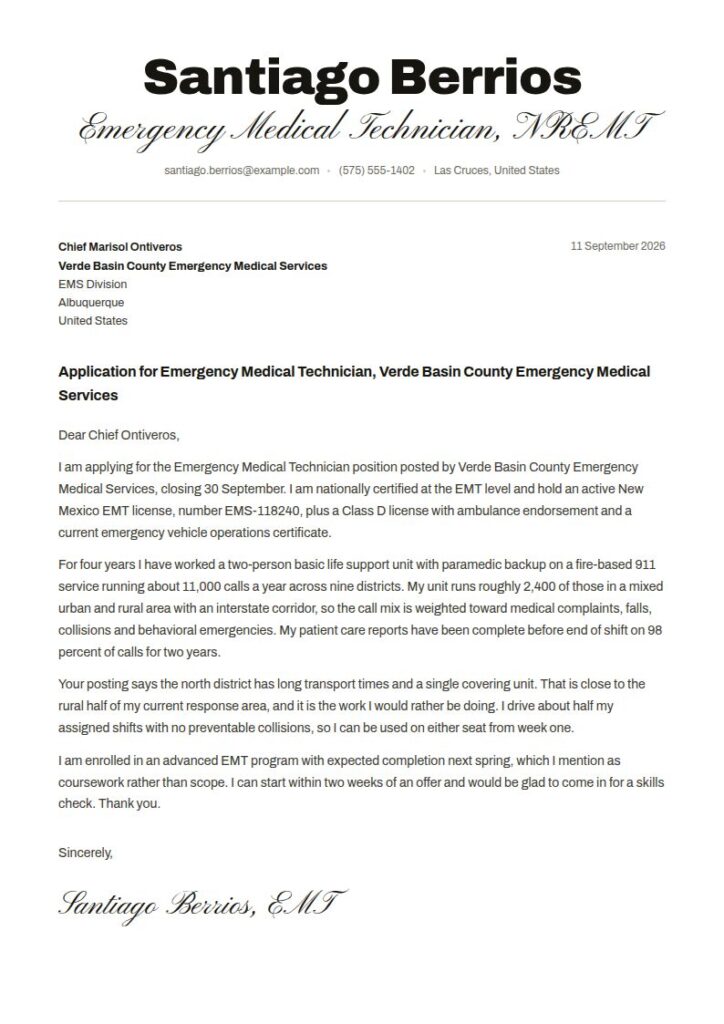
Santiago Berrios Emergency Medical Technician, NREMT Las Cruces, 88005, United States [email protected] · (575) 555-1402
11 September 2026
Chief Marisol Ontiveros EMS Division Verde Basin County Emergency Medical Services Albuquerque, United States
Application for Emergency Medical Technician, Verde Basin County Emergency Medical Services
Dear Chief Ontiveros,
I am applying for the Emergency Medical Technician position posted by Verde Basin County Emergency Medical Services, closing 30 September. I am nationally certified at the EMT level and hold an active New Mexico EMT license, number EMS-118240, plus a Class D license with ambulance endorsement and a current emergency vehicle operations certificate.
For four years I have worked a two-person basic life support unit with paramedic backup on a fire-based 911 service running about 11,000 calls a year across nine districts. My unit runs roughly 2,400 of those in a mixed urban and rural area with an interstate corridor, so the call mix is weighted toward medical complaints, falls, collisions and behavioral emergencies. My patient care reports have been complete before end of shift on 98 percent of calls for two years.
Your posting says the north district has long transport times and a single covering unit. That is close to the rural half of my current response area, and it is the work I would rather be doing. I drive about half my assigned shifts with no preventable collisions, so I can be used on either seat from week one.
I am enrolled in an advanced EMT program with expected completion next spring, which I mention as coursework rather than scope. I can start within two weeks of an offer and would be glad to come in for a skills check. Thank you.
Sincerely, Santiago Berrios, EMT
Summary
An EMT cover letter names the level you are certified at, the state license that lets you work, and the call record behind both. This guide gives you a full adaptable letter, the scope line that decides whether your file is eligible at all, and what changes between applying to a municipal service and applying to a private ambulance operator.
EMT cover letter examples by experience level
In short, an EMT cover letter is a one-page letter telling an EMS hiring officer what level you are certified at, whether you hold a license in their state, and what you have actually run.
It is short because the reader is fast. A division chief screening against a closing date wants eligibility first and evidence second, and a letter giving both in the opening is already ahead of the stack.
Guide to an EMT cover letter
Specifically, this guide and the corresponding EMT cover letter example will cover:
- How to structure the letter, paragraph by paragraph
- Why certification level and state license belong in the opening
- Writing the scope you hold, and why overstating it ends applications
- What counts as evidence on an EMT letter
- What changes between a public service and a private operator
How to write an EMT cover letter
| Paragraph | Its job | Length |
|---|---|---|
| Opening | The posting, your certification level, your state license | 2 sentences |
| Evidence | Service model, call volume, call mix, one documentation fact | 4 sentences |
| Fit | Something specific about their service, plus availability | 3 sentences |
| Close | Driving credentials, start date, thank you | 2 sentences |
Lead with level and license, in that order
The National Registry of Emergency Medical Technicians certifies at four levels: Emergency Medical Responder, EMT, Advanced EMT and Paramedic (NREMT, nremt.org, read 16 September 2026). A posting is written against exactly one of them.
Certification is not licensure. All states require EMTs and paramedics to be licensed in the state where they work, and requirements vary by state (BLS Occupational Outlook Handbook, EMTs and paramedics, May 2025). Your first sentence carries both: the level you are certified at, and whether your license in their state is active or in progress.
Moving states, say where the application stands. "Reciprocity application submitted 2 September, decision expected October" is usable. "Licensed and ready to work" when the license is pending unravels at the background check.
An EMT cover letter example you can adapt
Dear Chief Ontiveros,
I am applying for the Emergency Medical Technician position posted by Verde Basin County Emergency Medical Services, closing 30 September. I am nationally certified at the EMT level and hold an active New Mexico EMT license, number EMS-118240, plus a Class D license with ambulance endorsement and a current emergency vehicle operations certificate.
For four years I have worked a two-person basic life support unit with paramedic backup on a fire-based 911 service running about 11,000 calls a year across nine districts. My unit runs roughly 2,400 of those in a mixed urban and rural area with an interstate corridor, so the call mix is weighted toward medical complaints, falls, collisions and behavioral emergencies. My patient care reports have been complete before end of shift on 98 percent of calls for two years.
Your posting says the north district has long transport times and a single covering unit. That is close to the rural half of my current response area, and it is the work I would rather be doing. I drive about half my assigned shifts with no preventable collisions, so I can be used on either seat from week one.
I am enrolled in an advanced EMT program with expected completion next spring, which I mention as coursework rather than scope. I can start within two weeks of an offer and would be glad to come in for a skills check. Thank you.
Sincerely, Santiago Berrios, EMT
Openings that work
| Instead of | Use |
|---|---|
| I have always wanted to help people in their worst moments | I am applying for the EMT position posted by Verde Basin County EMS, closing 30 September |
| I am a certified EMT looking for a new opportunity | I am nationally certified at the EMT level with an active New Mexico license, EMS-118240 |
| I have experience responding to emergency calls | My unit runs about 2,400 calls a year on a fire-based 911 service, urban and rural |
| I am a hard worker with strong attention to detail | My patient care reports are complete before end of shift on 98 percent of calls |
The right column is verifiable, and EMS hiring runs on verification: the license register, the driving record, the background check and a call to your last supervisor. As a result, facts surviving all four create no work for the reader.
Write the scope you hold, and nothing above it
This line ends more EMT applications than any other, usually written without intent to mislead.
For example, assisting a paramedic with a skill is not performing it. Likewise, watching a procedure on a ride-along is not experience with it. Similarly, enrolling in an advanced EMT or paramedic program is not holding the certification. However, applicants write all three into letters as the same thing, and a field training officer finds the gap in week one.
Write it in two parts. The scope you hold, with level and certifying body. After that, name your current program as coursework, with an expected completion date. In particular, that second line is valuable to a service planning staffing a year out.
What counts as evidence on an EMT letter
| Kind of evidence | What it looks like in a sentence |
|---|---|
| Service model | Fire-based 911, two-person BLS unit with paramedic backup |
| Volume | About 2,400 calls a year on my unit, 11,000 across the service |
| Call mix | Medical complaints, falls, collisions and behavioral emergencies |
| Response area | Mixed urban and rural, with an interstate corridor |
| Documentation | Reports complete before end of shift on 98 percent of calls |
| Driving | Drive half of assigned shifts, no preventable collisions |
In fact, none of these describe a patient. Therefore, write categories and numbers, never cases. After all, a letter retelling one dramatic call says you discuss patients outside the record.
Applying to a public service versus a private one
For a municipal, county or fire-based service, follow the posting exactly: closing date, attachments, portal and any stated minimum. Public hiring is procedural and a missing document is a rejection, not a phone call. For a private ambulance operator, lead with transport volume, receiving facilities and your handoff practice, since interfacility work is most of that schedule. Give your shift availability plainly.
Do not write a scope above the one you hold. Do not describe a pending license as active. Do not leave the driving credential out; a crew is two people and one drives. Do not send one letter to both a 911 service and an interfacility operator. Do not name or describe an identifiable patient.
The market you are writing into
EMTs and paramedics held 284,100 jobs in 2025, split as 181,900 EMTs and 102,200 paramedics, with employment projected to grow 6 percent from 2025 to 2035, a change of 16,400 jobs, and about 18,200 openings projected each year over the decade (BLS Occupational Outlook Handbook, EMTs and paramedics, May 2025 with 2025 to 2035 projections). Ambulance services employ 46 percent of EMTs and local government 24 percent, at an EMT median of $44,470 in May 2025 against $60,600 for paramedics (BLS, May 2025).
Openings are frequent, so completeness beats polish: the application finished before the closing date beats the elegant one missing an attachment. And with a quarter of the market in local government, your letter must work inside a public process that will not chase you.
Length, format and sending it
Overall, aim for one page, four paragraphs, 250 to 350 words. Similarly, send a PDF unless the portal says otherwise, named for yourself and the post: santiago-berrios-emt-cover-letter.pdf. In addition, address a person: division chiefs and operations managers are usually named on the service's own site, and where the posting names a hiring contact, use that name exactly.
Moreover, attach every document the posting lists, in the format it asks for, and use the same facts as your resume in the same words. For instance, our EMT resume example uses the call record in this letter.
Key takeaways
- First, lead with certification level and state license status, in that order.
- Likewise, describe a pending license as pending, with the date the application went in.
- In addition, give service model, annual call volume and call mix in one paragraph.
- Finally, add one documentation fact; it is the most-checked habit in the occupation.
- Put the driving credential and driving record in the letter, not only the resume.
- Name a program in progress as coursework, never as scope.
- Follow a public posting exactly, because a missing attachment is a rejection.
Write your EMT cover letter in 10 minutes with our AI cover letter builder.
EMT cover letter questions, answered
Do EMS services actually read cover letters?
Many do, particularly smaller services and any service where the chief screens personally. Even where the portal is the real application, the letter is the only place you state license status, driving credential and availability in your own words, and those decide a first-round call.
How long should an EMT cover letter be?
One page, four paragraphs, 250 to 350 words. Hiring officers read these in batches against a closing date, and length does not read as effort.
What do I write with no field experience yet?
Write the certificate program as experience: clinical rotation hours, field internship shifts, and the patient contact count if you logged one. Then certification and license numbers, driving credentials and shift availability. A new EMT who is licensed, can drive and works nights is a straightforward hire, so make all three unmissable.
Should I mention that I am in a paramedic program?
Yes, as coursework with an expected completion date, never as scope. Services plan staffing a year ahead and an in-progress program is a reason to hire you. Written as though the certification exists, it ends the application at the license check.
How do I write about volunteer EMS time?
Label it as volunteer and give it the facts you would give paid work: service model, call volume, call types and response area. Volunteer time on a rural service with long transports often carries more independent decision-making than the same period in a dense urban system, if you write the numbers.