Gunnar Lindqvist Clinical Audiologist, AuD, CCC-A Rochester, 55904, United States [email protected] · (507) 555-1180
16 September 2026
Dr. Sigrid Thorvaldsen Hearing and Balance Service Granite Falls Hearing and Balance Institute Saint Paul, United States
Application for Clinical Audiologist, Hearing and Balance Service
Dear Dr. Thorvaldsen,
I am applying for the Clinical Audiologist post in your hearing and balance service. I hold the AuD, the Certificate of Clinical Competence in Audiology, a Minnesota license in good standing, and the American Board of Audiology Vestibular Audiology Specialty Certification, and I run the full diagnostic battery from comprehensive audiometric evaluation and immittance through otoacoustic emissions, diagnostic and threshold auditory brainstem response, videonystagmography, rotary chair and VEMP.
At my current hospital I complete roughly 260 vestibular evaluations and 180 cochlear implant programming sessions a year, with written interpretation to the referring physician inside two working days. The piece I would most want to bring with me is the implant follow-up work: by restructuring the appointment sequence after activation, we cut the interval from activation to a stable map from 14 weeks to 9, without adding clinic time. I also cover intraoperative neurophysiologic monitoring on a rota and run a half-day tinnitus management clinic each week.
Your posting mentions rebuilding the pediatric diagnostic pathway after newborn hearing screening referral. That is the work I would want. I test children from 6 months using visual reinforcement and conditioned play audiometry and infants under natural sleep with threshold auditory brainstem response, and at my current department that pathway moved from a 68 percent to a 91 percent diagnostic follow-up rate within the recommended timeline.
I precept fourth-year AuD externs and would be glad to continue. I can start with six weeks' notice. Thank you for your time.
Sincerely, Gunnar Lindqvist, AuD, CCC-A
Summary
An audiologist cover letter names the procedures you can run without supervision, the populations you are cleared to run them on, and the license and certification behind both. This guide gives you a full adaptable letter, what changes between a private practice, a hospital and a school district, and the openings that get a strong file read early.
Audiologist cover letter examples by experience level
An audiologist cover letter is a one-page letter that tells a clinic director which columns of their schedule you can cover, which patients you are cleared to see, and what credential makes both of those true.
Directors hire against a gap. A departing audiologist took the vestibular caseload with them, or the implant clinic has a six-week wait, or nobody left in the building can test a sleeping infant. A letter that names what you can run, and for whom, answers the only question they actually have.
Guide to an audiologist cover letter
This guide and the corresponding audiologist cover letter example will cover:
- How to structure the letter, paragraph by paragraph
- Why the procedure list belongs in the first paragraph
- What changes between a private practice, a hospital and a school district
- How to talk about over-the-counter hearing aids without sounding defensive
- The openings that get a strong file read early
How to write an audiologist cover letter
| Paragraph | Its job | Length |
|---|---|---|
| Opening | The post, your license and certification, and the procedures you run | 2 to 3 sentences |
| Evidence | One caseload with a volume, and something that improved | 4 to 5 sentences |
| Fit | Their service, their gap, and what you would take on | 3 to 4 sentences |
| Close | Populations cleared for, availability, thank you | 2 sentences |
Write the schedule into your first paragraph
A clinic director reading applications is holding a template week with holes in it: two vestibular mornings, an implant afternoon, a pediatric diagnostic clinic and a general diagnostic list.
Name what you can cover: "I run videonystagmography with caloric irrigation, rotary chair, and cervical and ocular VEMP, and I carry an implant programming caseload." That sentence answers the question they have.
Then add the population line, which almost nobody writes: "I test children from 6 months behaviorally and infants under natural sleep with threshold ABR." A director staffing a pediatric diagnostic clinic will read that twice.
An audiologist cover letter example you can adapt
Dear Dr. Thorvaldsen,
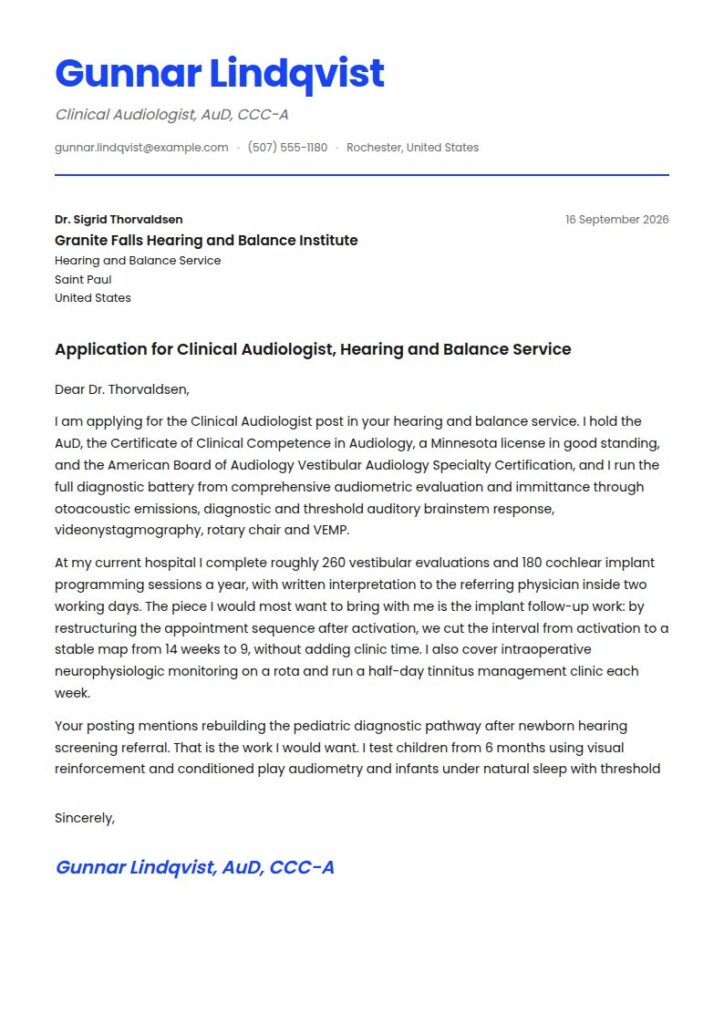
I am applying for the Clinical Audiologist post in your hearing and balance service. I hold the AuD, the Certificate of Clinical Competence in Audiology, a Minnesota license in good standing, and the American Board of Audiology Vestibular Audiology Specialty Certification, and I run the full diagnostic battery from comprehensive audiometric evaluation and immittance through otoacoustic emissions, diagnostic and threshold auditory brainstem response, videonystagmography, rotary chair and VEMP.
At my current hospital I complete roughly 260 vestibular evaluations and 180 cochlear implant programming sessions a year, with written interpretation to the referring physician inside two working days. The piece I would most want to bring with me is the implant follow-up work: by restructuring the appointment sequence after activation, we cut the interval from activation to a stable map from 14 weeks to 9, without adding clinic time. I also cover intraoperative neurophysiologic monitoring on a rota and run a half-day tinnitus management clinic each week.
Your posting mentions rebuilding the pediatric diagnostic pathway after newborn hearing screening referral. That is the work I would want. I test children from 6 months using visual reinforcement and conditioned play audiometry and infants under natural sleep with threshold auditory brainstem response, and at my current department that pathway moved from a 68 percent to a 91 percent diagnostic follow-up rate within the recommended timeline.
I precept fourth-year AuD externs and would be glad to continue. I can start with six weeks' notice. Thank you for your time.
Sincerely, Gunnar Lindqvist, AuD, CCC-A
Openings that work
| Instead of | Use |
|---|---|
| I am passionate about helping people hear better | I run VNG with caloric irrigation, rotary chair, and cervical and ocular VEMP |
| I am writing to express my interest in this position | I am applying for the Clinical Audiologist post in your hearing and balance service |
| I have experience with a wide range of audiological assessments | I complete roughly 260 vestibular evaluations and 180 implant programming sessions a year |
| I would be a valuable addition to your team | Your posting mentions rebuilding the pediatric diagnostic pathway, which is the work I would want |
What a private practice, a hospital and a school district each want
The same letter, weighted differently, because the schedule is different.
| Setting | What the letter should lead on |
|---|---|
| Private practice | Amplification volume, real-ear verification, manufacturer platforms, counseling, patient retention and return rates |
| Hospital or physician office | Electrophysiology, vestibular battery, implant programming, intraoperative monitoring, report turnaround to referring physicians |
| Educational services | Pediatric behavioral testing, classroom amplification and hearing assistive technology, individualized education program participation, teacher and family consultation |
The pay follows the setting too. Hospitals pay audiologists a median of $103,700 and educational services $98,110, against $92,620 in offices of physicians and $81,730 in offices of physical, occupational and speech therapists and audiologists (BLS Occupational Outlook Handbook, May 2025). Write for the setting you are applying to.
Talking about over-the-counter hearing aids
Applicants get nervous about this and should not. Say what is true.
What the OTC rule actually covers
FDA issued the final rule establishing a regulatory category for over-the-counter hearing aids on 17 August 2022, with devices available from 17 October 2022. The category is limited to "adults 18 years of age and older with perceived mild to moderate hearing loss", FDA advises that anyone under 18 "need to buy your hearing aids by prescription", and it states that "prescription hearing aids are only available through a licensed hearing health care professional who can program the device to your unique level of hearing loss" (U.S. Food and Drug Administration).
Meanwhile the occupation itself is small and growing: 14,200 audiologist jobs in 2025, projected to grow 11 percent through 2035, with about 600 openings a year nationally (BLS Occupational Outlook Handbook, 2025-35 projections).
So the letter should not defend amplification. It should point at everything the rule does not touch: pediatrics, electrophysiology, vestibular assessment, implants, intraoperative monitoring, and the diagnostic work that tells a patient whether an over-the-counter device is even appropriate.
What to claim, and what not to
Name the procedures you run without supervision and the age ranges you test. Give an annual volume for the caseload you would be hired to cover. State your license, its state and its standing, plus which credential comes from ASHA and which from the American Board of Audiology. Name one real thing about their service, taken from their own pages. Keep every figure identical to your resume.
Do not describe yourself as passionate about hearing health; it is the most common opening in the folder. Do not imply scope you do not hold, particularly intraoperative monitoring or infant electrophysiology, because it will be discovered in the first week. Do not list a discontinued credential as current. Do not write a generic letter in an occupation with about 600 openings a year, where the director almost certainly knows someone who knows you.
Length, format and sending it
One page, four paragraphs, 300 to 400 words. PDF, named for yourself and the post. Address a named person: the department director, the practice owner or the otolaryngologist leading the service, all of whom are usually published.
Use the same numbers as your resume so the two agree, and put the license number in both. Our audiologist resume example is written with the figures used here.
Key takeaways
- Name the procedures you can run independently in the first paragraph.
- Add the population line: age ranges and testing techniques, including infants if you test them.
- Give one annual volume for the caseload the post exists to cover.
- Weight the letter for a private practice, a hospital or a school district.
- Address over-the-counter hearing aids by pointing at what they do not cover.
- Separate your ASHA certification from your American Board of Audiology credentials.
- Address a named person and keep it to one page.
Write your audiologist cover letter in 10 minutes with our AI cover letter builder.
Audiologist cover letter questions, answered
How long should an audiologist cover letter be?
One page, four paragraphs, 300 to 400 words. The procedure and population lines are what earn the interview, and neither of them takes long to write.
Should I list every procedure I can run?
In the letter, list the ones the post exists to cover, plus the population range. Keep the complete battery on the resume. A letter that reads as an inventory stops being an argument.
What do I write as a new graduate?
Write the externship as a job: the setting, the rotations, the procedures you logged and the volumes. Then state what you run independently now and what you run under supervision, honestly. A director would rather hire someone who is clear about the boundary than discover it in week two.
How do I address a gap in clinical practice?
Directly and briefly, in one sentence, and then say what you have done to return to currency: supervised sessions completed, continuing education, equipment retraining. In a licensed clinical occupation the concern is currency rather than loyalty, so answer that concern rather than the one nobody has.
Do I need a specialty certification to be competitive?
No, but it helps where the post is specialized. The American Board of Audiology currently offers board certification in audiology, the Pediatric Audiology Specialty Certification and the Vestibular Audiology Specialty Certification, plus certificate programs in audiology preceptorship, tinnitus management and educational audiology. The Cochlear Implant Specialty Certification examination was discontinued in 2018, so list it with its year if you hold it.