Camille Arceneaux Baton Rouge, 70808, United States [email protected] · (225) 555-0733
11 September 2026
Dr. Simone Ferraro Clinical Director Northfold Eye Care New Orleans, United States
Application for Optometrist, Northfold Eye Care
Dear Dr. Ferraro,
I am applying for the optometrist position at Northfold Eye Care. I am licensed in Louisiana and Mississippi with therapeutic certification, and the scope I have practiced day to day is full primary care optometry: dilated fundus examination, glaucoma diagnosis and monitoring, dry eye management, corneal foreign body removal, punctal occlusion, and prescribing topical and oral therapeutic agents.
For the last nine years I have carried roughly 3,600 encounters a year at a community health center, 14 to 16 a day across two lanes, with about 30 percent of the schedule medical rather than refractive and about 22 percent diabetic eye examination. The work I would most want to bring is the diabetic retinopathy screening pathway I built with two primary care clinics on the same campus: annual screening volume went from 410 to 1,150 over three years, and the referral loop back to the primary care team was the part that made it hold.
Your practice posting describes an optometrist working alongside two surgeons with a co-management load. I have run optical coherence tomography, threshold visual fields, gonioscopy and fundus photography independently for nine years, so the equipment would not be a training period. I have completed the NBEO Injection Skills Examination and the Laser and Surgical Procedures Examination, though I have not performed either under my current licensure, and I would want to be clear about that from the start rather than later.
I hold both state licenses currently and could start within 45 days of an offer. Thank you for your time.
Sincerely, Camille Arceneaux, OD
Summary
An optometrist cover letter names your state license, the scope of practice you actually worked in, the setting and its volume, and the medical share of your schedule. This guide gives you a full adaptable letter, the rule that keeps every patient off the page, and what changes between a retail lane, a private practice and a hospital or community clinic.
Optometrist cover letter examples by experience level
An optometrist cover letter is a one-page letter that tells a practice what your license authorizes, what you actually performed, what setting you did it in, and how much of your schedule was medical rather than refractive.
Scope is why this letter has a job to do at all. What a doctor of optometry may do is set state by state, so a reader in another state cannot work out from your job titles what you have actually been doing. The letter is where you say it plainly.
Before anything else:
No patient in the letter, and no images with it
No name, no initials, no age, no diagnosis, no case, no retinal or anterior segment image attached to the application. Not a de-identified case either, because the reader cannot verify that and ocular imaging is identifiable data.
Optometry pulls hard in the other direction, because an image is how the profession demonstrates work to itself. A lecture, a case report and a job application have different consent requirements, and only two of the three can carry a picture.
Write volume, mix, scope and equipment instead. "Roughly 3,600 encounters a year, about 30 percent medical" tells a hiring practice more than any single case could, and it does not open your application with a records problem.
Guide to an optometrist cover letter
This guide and the corresponding optometrist cover letter example will cover:
- How to structure the letter, paragraph by paragraph
- Why your scope statement belongs in the first two sentences
- What counts as evidence when you cannot describe a case
- How the letter changes between retail, private practice and clinic roles
- The openings that get a strong file put in the wrong pile
How to write an optometrist cover letter
| Paragraph | Its job | Length |
|---|---|---|
| Opening | The post, your license states, and the scope you practiced | 2 to 3 sentences |
| Evidence | Setting, volume, medical share, and one thing you built | 4 to 5 sentences |
| Fit | Something specific about their practice, and what you would add | 3 to 4 sentences |
| Close | Credentialing readiness, availability, thank you | 2 sentences |
An optometrist cover letter example you can adapt
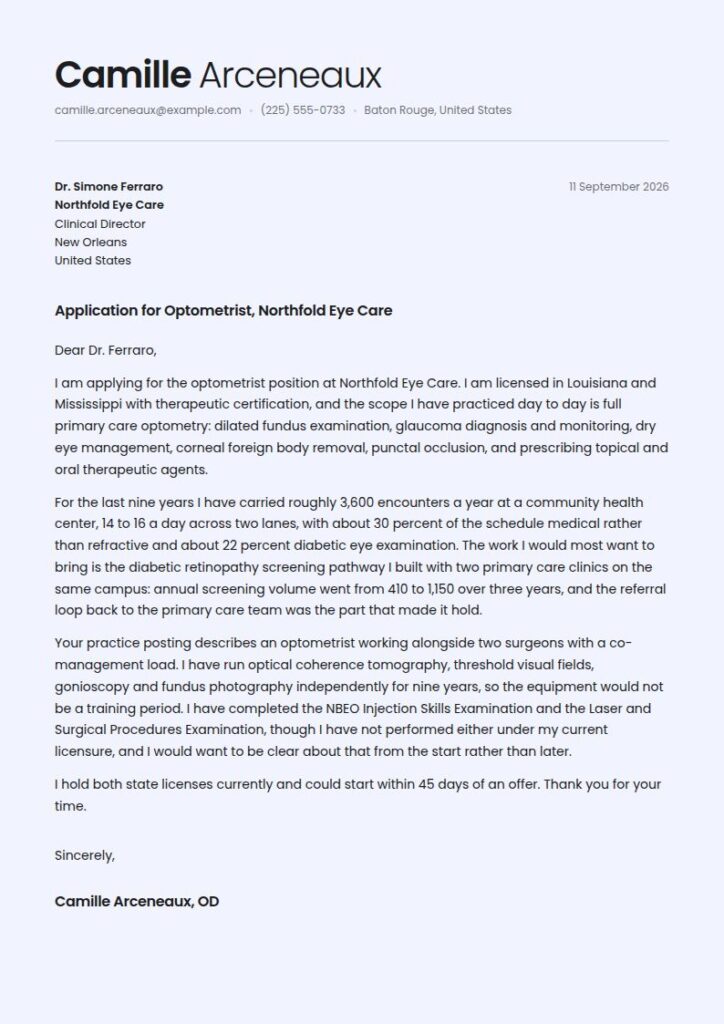
Dear Dr. Ferraro,
I am applying for the optometrist position at Northfold Eye Care. I am licensed in Louisiana and Mississippi with therapeutic certification, and the scope I have practiced day to day is full primary care optometry: dilated fundus examination, glaucoma diagnosis and monitoring, dry eye management, corneal foreign body removal, punctal occlusion, and prescribing topical and oral therapeutic agents.
For the last nine years I have carried roughly 3,600 encounters a year at a community health center, 14 to 16 a day across two lanes, with about 30 percent of the schedule medical rather than refractive and about 22 percent diabetic eye examination. The work I would most want to bring is the diabetic retinopathy screening pathway I built with two primary care clinics on the same campus: annual screening volume went from 410 to 1,150 over three years, and the referral loop back to the primary care team was the part that made it hold.
Your practice posting describes an optometrist working alongside two surgeons with a co-management load. I have run optical coherence tomography, threshold visual fields, gonioscopy and fundus photography independently for nine years, so the equipment would not be a training period. I have completed the NBEO Injection Skills Examination and the Laser and Surgical Procedures Examination, though I have not performed either under my current licensure, and I would want to be clear about that from the start rather than later.
I hold both state licenses currently and could start within 45 days of an offer. Thank you for your time.
Sincerely, Camille Arceneaux, OD
Openings that work
| Instead of | Use |
|---|---|
| I am a dedicated optometrist passionate about preserving vision | I am licensed in Louisiana and Mississippi with therapeutic certification, practicing full primary care optometry |
| I am writing to express my interest in your optometrist position | I am applying for the optometrist post; both state licenses are current and I could start within 45 days |
| I have experience in comprehensive eye care | Roughly 3,600 encounters a year, 30 percent medical, 22 percent diabetic eye examination |
| I am a great fit for your practice | Your posting describes an optometrist working alongside two surgeons with a co-management load |
Say what your scope actually was
Two claims, and they are not the same: what your license authorizes and what you performed routinely. Write both, and write the gap between them.
This matters because scope is state law. As of June 2026, Vermont became the seventeenth state to authorize doctors of optometry to perform ophthalmic laser procedures, the third state to expand scope that year after Kansas and Tennessee (American Optometric Association, 25 June 2026), and comparable differences exist for injections and minor lid procedures. A reader in a different state genuinely cannot infer your scope from your job title.
| Kind of evidence | What it looks like in a sentence |
|---|---|
| Scope practiced | Dilated fundus examination, glaucoma monitoring, foreign body removal, punctal occlusion, oral therapeutic agents |
| Volume | Roughly 3,600 encounters a year at 14 to 16 a day across two lanes |
| Medical share | About 30 percent of the schedule medical rather than refractive |
| Equipment | OCT, threshold visual fields, gonioscopy and fundus photography run independently |
| A pathway you built | Diabetic retinopathy screening from 410 to 1,150 a year over three years |
| The honest gap | NBEO ISE and LSPE completed, neither performed under current licensure |
That last row is worth the sentence it costs. A practice in a broader scope state reads it as somebody who can be credentialed quickly. A practice that finds it out after an offer reads it as something else entirely.
Retail, private practice and clinic letters are different letters
For an ophthalmology or hospital practice, lead with scope, medical share and equipment, then co-management volume. For a private optometric practice, lead with scope and volume, then add the service line you could build: specialty contact lens, dry eye, myopia management. For a retail role, lead with throughput, urgent same-day capacity and dispensing familiarity, and keep scope as a supporting line. For a community health or government clinic, lead with access, populations served, screening pathways and language capability.
Do not put a patient, a case or an ocular image in the letter or its attachments. Do not write "full scope" without saying what that means where you practiced. Do not imply you have performed a procedure you are only examined for. Do not send the retail letter to an ophthalmology practice. Do not open with a philosophy of eye care.
A small occupation, growing fast, with three very different settings
There were 45,100 optometrist jobs in 2025, projected to grow 10 percent through 2035 for an increase of 4,300, with about 2,000 openings a year (BLS Occupational Outlook Handbook, Optometrists, published 27 August 2026). That is much faster than average growth on a small base, which means individual letters get read carefully.
The settings split sharply: offices of optometrists 61 percent, offices of physicians 14 percent, retail trade 13 percent, self-employed 5 percent and outpatient care centers 4 percent (BLS, published 27 August 2026). The medians run in an order most applicants do not expect: outpatient care centers $207,030, retail trade $159,250, offices of physicians $145,630 and offices of optometrists $129,250 (BLS, May 2025).
The Handbook attributes the growth to an aging population, cataract and macular degeneration, rising myopia, device use and diabetic retinopathy. Four of those five are medical eye care, which is why the medical share of your schedule is the number worth putting in the second paragraph.
Length, format and sending it
One page, four paragraphs, 250 to 400 words. PDF unless the portal says otherwise, named for yourself and the post: camille-arceneaux-optometrist-cover-letter.pdf.
Address a person. Clinical leadership is on almost every practice site, and a generic salutation on an otherwise precise letter reads as a file sent to twelve practices.
Keep the figures identical to your resume, including the scope lines, because a mismatch between the two documents on what you are authorized to do is the worst kind of mismatch to have. Our optometrist resume example uses the numbers written here.
Key takeaways
- Never put a patient, a case or an ocular image in the letter or its attachments.
- Name every state license in the first paragraph, with therapeutic certification if you hold it.
- Write the scope you practiced, not only the scope your license allows.
- State the gap honestly where you are examined but not yet performing.
- Give encounters a year, encounters a day and the medical share as a percentage.
- Name the equipment you run independently, because it removes a training period.
- Change the emphasis for retail, private practice, ophthalmology and clinic roles.
Write your optometrist cover letter in 10 minutes with our AI cover letter builder.
Optometrist cover letter questions, answered
How long should an optometrist cover letter be?
One page, four paragraphs, 250 to 400 words. The scope sentence and the volume sentence are the two that have to be there; everything else is competing for the remaining space.
Do I really need to spell out my scope of practice?
Yes, especially when applying across a state line. Scope is state law, and as of June 2026 seventeen states authorize doctors of optometry to perform ophthalmic laser procedures (American Optometric Association, 25 June 2026), with comparable variation on injections and minor lid procedures. Without the sentence, the reader has to guess, and a guess is not going to be generous.
Can I include clinical images of interesting findings?
No. Ocular imaging is identifiable data and carries a consent trail that a job application cannot show. If a practice genuinely wants to see case work as part of a formal interview process, that is a separate conversation with its own documentation, and it is not an attachment to a first letter.
I have only worked in retail optical. How do I write to a medical practice?
Write the medical work you did do, because there usually is some: pathology detected and referred, glaucoma and diabetic monitoring, urgent same-day visits, foreign body removal, and the equipment you ran. Then give your volume, which retail settings produce in quantity. Retail trade is 13 percent of optometrist employment and offices of physicians 14 percent (BLS, published 27 August 2026), so the move happens often enough that a reader will recognize it.
What do I write as a new graduate?
Write your fourth-year rotations as jobs: the setting type for each, encounters, the medical share, the equipment you operated independently, and what you did under supervision rather than alone. Then license status with its date, the NBEO parts you have completed, and the area you want structured mentorship in. A new graduate who can state a volume, a scope and an equipment list is straightforward to schedule.