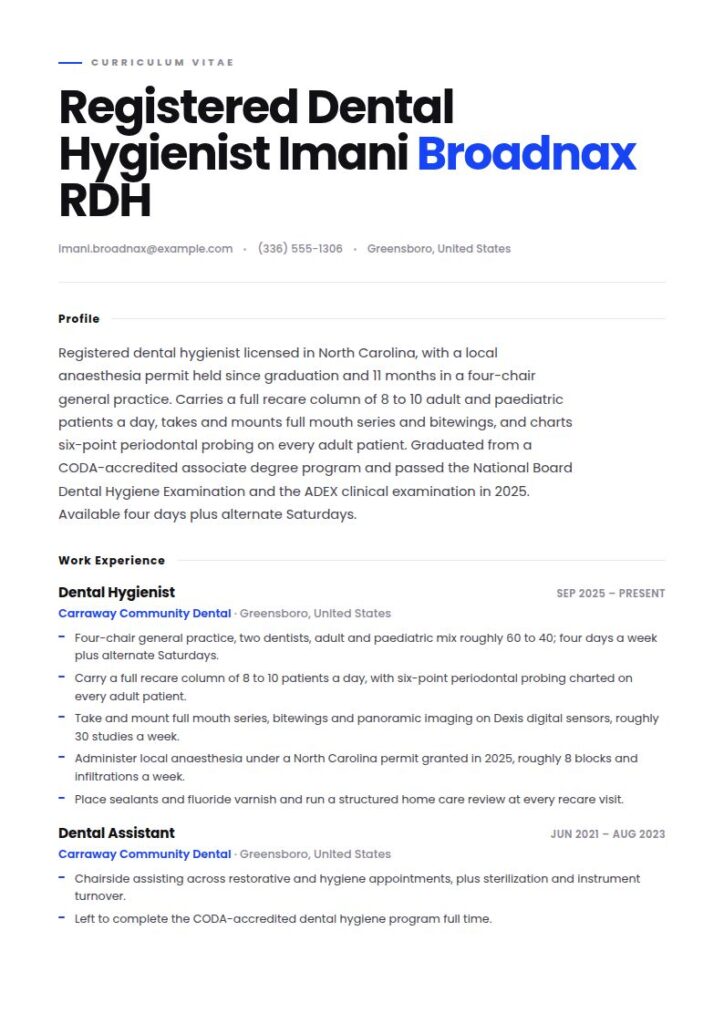
Registered Dental Hygienist Imani Broadnax RDH
Dental Hygienist
[email protected] | (336) 555-1306 | Greensboro, United States
Profile
Registered dental hygienist licensed in North Carolina, with a local anaesthesia permit held since graduation and 11 months in a four-chair general practice. Carries a full recare column of 8 to 10 adult and paediatric patients a day, takes and mounts full mouth series and bitewings, and charts six-point periodontal probing on every adult patient. Graduated from a CODA-accredited associate degree program and passed the National Board Dental Hygiene Examination and the ADEX clinical examination in 2025. Available four days plus alternate Saturdays.
Work Experience
09/2025 - Present, Dental Hygienist, Carraway Community Dental, Greensboro, United States
- Four-chair general practice, two dentists, adult and paediatric mix roughly 60 to 40; four days a week plus alternate Saturdays.
- Carry a full recare column of 8 to 10 patients a day, with six-point periodontal probing charted on every adult patient.
- Take and mount full mouth series, bitewings and panoramic imaging on Dexis digital sensors, roughly 30 studies a week.
- Administer local anaesthesia under a North Carolina permit granted in 2025, roughly 8 blocks and infiltrations a week.
- Place sealants and fluoride varnish and run a structured home care review at every recare visit.
06/2021 - 08/2023, Dental Assistant, Carraway Community Dental, Greensboro, United States
- Chairside assisting across restorative and hygiene appointments, plus sterilization and instrument turnover.
- Left to complete the CODA-accredited dental hygiene program full time.
Education
08/2023 - 05/2025, Associate of Applied Science, Dental Hygiene, Piedmont Ridge College of Dental Hygiene, Greensboro, United States
CODA-accredited program. Clinical requirement completed across 340 patient appointments including 32 periodontal maintenance cases and a community rotation in a school sealant clinic.
Skills
Adult and paediatric prophylaxis, 80
Six-point periodontal probing and charting, 80
Local anaesthesia administration, 70
Full mouth series and bitewing radiography, 80
Sealant placement and fluoride varnish, 85
Oral cancer screening and medical history review, 75
Dentrix and Dexis digital imaging, 75
Languages
English, native
Spanish, intermediate
Certificates
07/2025, Registered Dental Hygienist, North Carolina, North Carolina Board of Dental Examiners, DH-20194466
Local anaesthesia permit granted 2025. License current through 2027.
03/2025, National Board Dental Hygiene Examination, Joint Commission on National Dental Examinations
ADEX dental hygiene clinical examination passed May 2025.
06/2025, Basic Life Support for Healthcare Providers, American Heart Association
Current through 2027.
Summary
A dental hygienist resume is a one to two page document naming your state license, the add-on permits that widen what you may perform, your periodontal and recare numbers, and the schedule you keep. This guide gives you three adaptable versions, the permit block almost nobody writes, and current Bureau of Labor Statistics pay and outlook for the occupation.
Dental Hygienist resume examples by experience level
In short, a dental hygienist resume is a one to two page document that names your state license, the permits layered on top of it, the periodontal and recare numbers you produce, and the days you are available.
However, the license is the entry ticket and every applicant has one. What separates two files is the second block: the add-on permits that change what you may perform, what the practice may bill, and in some states whether you may treat a patient with no dentist on the premises. Almost nobody lists them properly.
Resume guide for a dental hygienist resume
In particular, this guide and the corresponding dental hygienist resume example will cover:
- How to write a dental hygienist resume, section by section
- The permits that widen a license, and how to list them by state with dates
- Three adaptable summaries: new graduate, practicing hygienist and lead or public health hygienist
- How to write periodontal production and recare numbers a practice owner recognizes
- What the job market looks like and what Bureau of Labor Statistics pay data shows
How to write a dental hygienist resume
Use six blocks: contact header, summary, licensure and permits, clinical experience, skills and systems, and finally education. One page for your first five years, two once you carry a periodontal program, mentor, or work across more than one practice.
In practice, the order follows how a practice owner or office manager reads. License and permits first because they are gates. Numbers second because they are the difference between two licensed applicants.
| Section | What it is answering | Where it goes |
|---|---|---|
| License and permits | What may this person legally perform, and where? | Directly under the summary, by state with dates |
| Schedule and availability | Which days can I fill, and can they carry a full column? | In the summary and in each job's scope line |
| Clinical experience | Recare volume, periodontal case acceptance, radiographs, adult and paediatric mix | Reverse chronological, with numbers |
| Systems | Which practice management software, which imaging, which caries detection | Short named list |
List permits by state with the date each was granted
Dental hygiene licensure is a state matter, and what a license permits is not the same in two states.
The American Dental Hygienists' Association reports that as of August 2025 all states permit dental hygienists to administer local anaesthesia, that 35 states allow hygienists to administer nitrous oxide and eight permit monitoring it, and that direct access, where a hygienist may assess a patient, initiate treatment, provide care without a dentist present and maintain an ongoing provider relationship, is permitted in a defined list of states (American Dental Hygienists' Association, checked September 2026).
So a hygienist's real scope is the license plus a stack of permits: local anaesthesia, nitrous oxide administration or monitoring, restorative or expanded function, and in some states a public health or collaborative practice authority. Each one is granted separately, dated separately, and checkable on a state board register.
Write them as a block, each with the state and the date. "Local anaesthesia permit, North Carolina, 2019" is verifiable. "Expanded duties" is not, and it is what almost every other applicant writes.
Run the finished file through the ATS resume checker before you send it. Dental service organizations screen applications through an applicant tracking system before an office manager opens one.
Choosing the best resume format for a dental hygienist resume
Reverse chronological, single column. One page for your first five years, two once you have run a periodontal program, held more than one permit, worked across practices or moved into public health.
Also, one format problem is specific to this occupation. BLS notes that many dental hygienists work part time, that dentists may hire hygienists for only a few days a week, and that some hygienists therefore work for more than one dentist (BLS Occupational Outlook Handbook, Dental Hygienists, last modified 27 August 2026). That produces resumes with three concurrent jobs, which look chaotic in a strict reverse chronological list.
Group them instead. Instead, use one heading per practice with the days worked, sorted by the most recent start date, and a line saying the arrangement was concurrent and by design. For example, a practice owner reading "Tuesdays and Thursdays, concurrent with the role below" sees a full-time hygienist. In contrast, a reader who has to work that out sees job-hopping.
Include your contact information
| ✅ Right | ❌ Wrong |
|---|---|
| Imani Broadnax | Imani Broadnax |
| Registered Dental Hygienist, RDH | Caring dental professional |
| NC license #DH-20194466, local anaesthesia and nitrous oxide permits | Licensed hygienist |
| (336) 555-1306, [email protected], Greensboro, NC | (336) 555-1306, [email protected] |
Also put the license number on the page. After all, state boards publish license verification lookups and an office manager will use one. As a result, the file that lets them confirm you in ten seconds moves first.
Make use of a summary
Keep it to four lines: license and permits, setting and patient mix, one production or clinical number, and finally your availability.
Registered dental hygienist licensed in North Carolina, with a local anaesthesia permit held since graduation and 11 months in a four-chair general practice. Carries a full recare column of 8 to 10 adult and paediatric patients a day, takes and mounts full mouth series and bitewings, and charts six-point periodontal probing on every adult patient. Graduated from a CODA-accredited associate degree program and passed the National Board Dental Hygiene Examination and the ADEX clinical examination in 2025. Available four days plus alternate Saturdays.
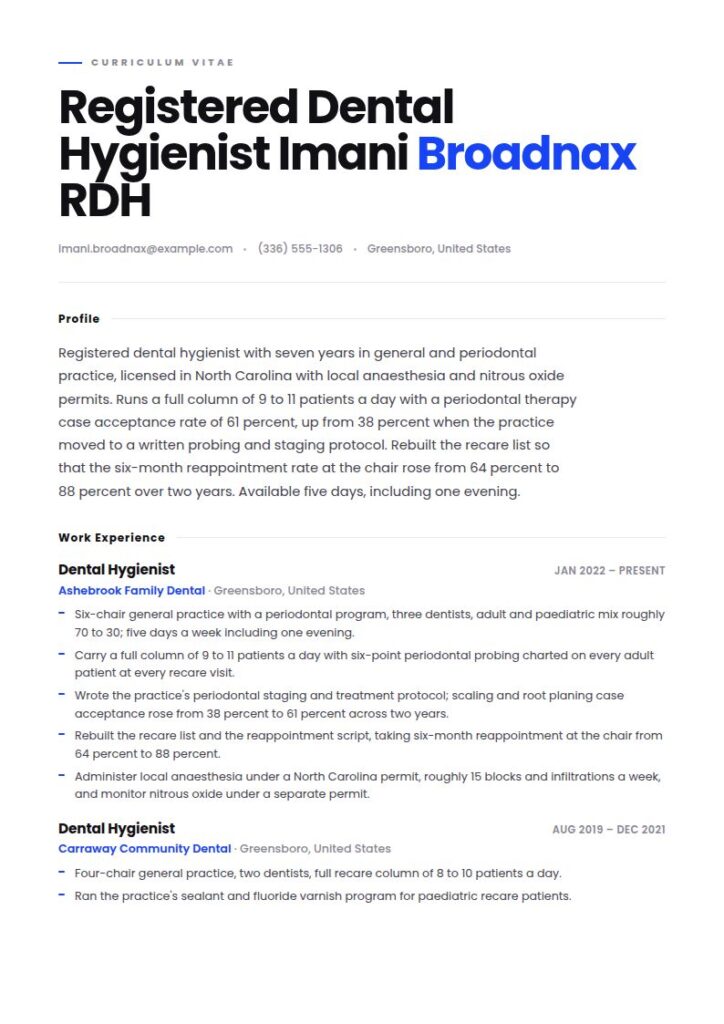
Registered dental hygienist with seven years in general and periodontal practice, licensed in North Carolina with local anaesthesia and nitrous oxide permits. Runs a full column of 9 to 11 patients a day with a periodontal therapy case acceptance rate of 61 percent, up from 38 percent when the practice moved to a written probing and staging protocol. Rebuilt the recare list so that the six-month reappointment rate at the chair rose from 64 percent to 88 percent over two years. Available five days, including one evening.
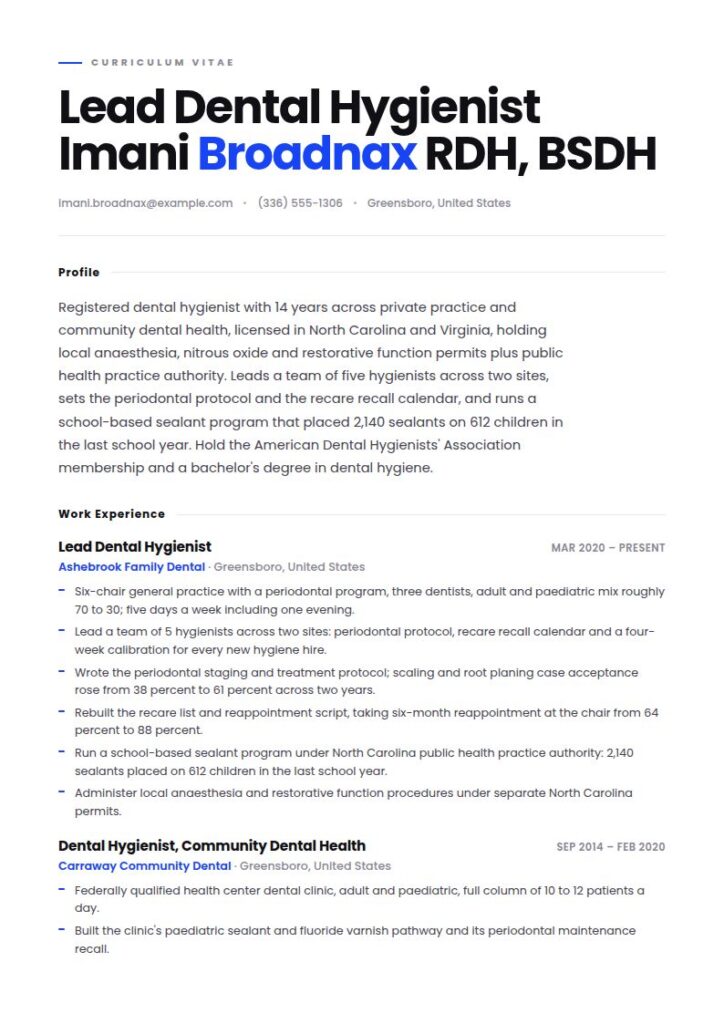
Registered dental hygienist with 14 years across private practice and community dental health, licensed in North Carolina and Virginia, holding local anaesthesia, nitrous oxide and restorative function permits plus public health practice authority. Leads a team of five hygienists across two sites, sets the periodontal protocol and the recare recall calendar, and runs a school-based sealant program that placed 2,140 sealants on 612 children in the last school year. Hold the American Dental Hygienists' Association membership and a bachelor's degree in dental hygiene.
Right vs wrong: the same dental hygienist summary, twice
| ✅ Right | ❌ Wrong |
|---|---|
| Registered dental hygienist licensed in North Carolina with local anaesthesia and nitrous oxide permits. | Compassionate dental hygienist committed to excellent patient care. |
| Full column of 9 to 11 patients a day; periodontal therapy case acceptance at 61 percent, up from 38 percent. | Experienced in periodontal therapy and patient education. |
| Six-month reappointment rate at the chair rose from 64 percent to 88 percent over two years. | Skilled at building strong relationships with patients. |
The left column, for example, is a column that fills and a number that changes. The right column, on the other hand, is every other file in the pile.
Outline your clinical experience
Practice, type, city, days worked, dates, then the scope line: chairs, providers, patient mix, daily column and whether the role was concurrent. Then three to five bullets with numbers.
| Instead of | Use |
|---|---|
| Performed dental cleanings for patients | Carried a full column of 9 to 11 adult and paediatric patients a day in a six-chair general practice |
| Provided periodontal treatment | Delivered scaling and root planing under a written staging protocol; case acceptance rose from 38 percent to 61 percent |
| Took dental X-rays | Took and mounted full mouth series, bitewings and panoramic imaging on Dexis digital sensors, roughly 40 studies a week |
| Educated patients on oral hygiene | Ran a five-minute structured home care review at every recare visit, tied to the probing chart the patient could see |
| Administered local anaesthesia | Administered local anaesthesia under a North Carolina permit held since 2019, roughly 15 blocks and infiltrations a week |
| Helped with scheduling and recall | Rebuilt the recare list; six-month reappointment at the chair rose from 64 percent to 88 percent over two years |
Lead Dental Hygienist, Ashebrook Family Dental, Greensboro, NC, March 2020 to Present
Six-chair general practice with a periodontal program, three dentists, adult and paediatric mix roughly 70 to 30. Five days a week including one evening.
Carry a full column of 9 to 11 patients a day, with six-point periodontal probing charted on every adult patient at every recare visit.
Wrote the practice's periodontal staging and treatment protocol; scaling and root planing case acceptance rose from 38 percent to 61 percent across two years.
Rebuilt the recare list and the reappointment script, taking six-month reappointment at the chair from 64 percent to 88 percent.
Administer local anaesthesia under a North Carolina permit, roughly 15 blocks and infiltrations a week, and monitor nitrous oxide under a separate permit.
Mentor two hygienists and every new hygiene hire through a four-week calibration on probing, charting and case presentation.
The license, and the permits that widen it
In fact, this is the section that decides which of two licensed hygienists gets the call, and it is the one almost nobody writes.
Start with how the license is earned, because a new graduate's page has to show each step cleared. Licensure requires a degree from an accredited dental hygiene program and passing written and clinical examinations, and continuing education is required to maintain it; many jobs also require cardiopulmonary resuscitation certification (BLS Occupational Outlook Handbook, Dental Hygienists, last modified 27 August 2026). Similarly, each of those has a named body behind it.
The program is accredited by the Commission on Dental Accreditation, which has held accreditation authority from the United States Department of Education since 1952, was established in its current form in 1975, and accredits more than 1,400 programs across predoctoral, advanced and allied dental education including dental hygiene (Commission on Dental Accreditation, checked September 2026).
The written examination is the National Board Dental Hygiene Examination, governed by the Joint Commission on National Dental Examinations, a nine-hour examination delivered at Pearson VUE test centers in the United States and Canada and accepted in all United States licensing jurisdictions (Joint Commission on National Dental Examinations, checked September 2026). The clinical examination is separate: the American Board of Dental Examiners administers the ADEX dental hygiene examination, and ADEX's own acceptance map showed Delaware and Nebraska as the only jurisdictions not accepting it as of 6 March 2026 (American Board of Dental Examiners, checked September 2026).
Dental hygiene permits that widen your scope
Then the permits, which are where the differences actually live.
Local anaesthesia. As of August 2025 all states permit dental hygienists to administer local anaesthesia, according to the American Dental Hygienists' Association (checked September 2026). Because the permit is now universal, what distinguishes you is the date you obtained it and the volume you administer, not whether you hold it.
Nitrous oxide. ADHA reports 35 states allow hygienists to administer nitrous oxide and eight permit monitoring it (ADHA, checked September 2026). This one is not universal, so hold the permit and say so.
Restorative or expanded function. Where a state grants it, this changes what the practice can schedule into your column and therefore what your day is worth. Name the permit exactly as the board names it.
Public health or collaborative practice authority. ADHA defines direct access as a hygienist being able to assess a patient, initiate treatment, provide care without a dentist present and maintain an ongoing provider and patient relationship (ADHA, checked September 2026). This authority is what makes school sealant programs, community clinics and long-term care rounds possible, and it is the single most differentiating line a hygienist can have.
Registered Dental Hygienist, North Carolina Board of Dental Examiners, license #DH-20194466, issued July 2019, current through 2027
Registered Dental Hygienist, Virginia, license #DH-VA-118742, issued 2023, current through 2027
Local anaesthesia permit, North Carolina, 2019; Virginia, 2023
Nitrous oxide administration permit, North Carolina, 2021
Restorative function permit, North Carolina, 2023
Public health practice authority, North Carolina, 2024, permitting assessment and preventive treatment in school and community settings without a dentist on site
National Board Dental Hygiene Examination, Joint Commission on National Dental Examinations, passed 2019. ADEX dental hygiene clinical examination, passed 2019.
Basic Life Support for Healthcare Providers, American Heart Association, current through 2027
Write the permits even where they are common, because the block itself is the signal: it tells an office manager you understand your own scope, and it saves them a call to the board.
Build a snapshot of your key skills
In practice, list ten to fourteen entries in four groups: clinical, periodontal, imaging, and systems. Named techniques and named products.
Clinical: adult and paediatric prophylaxis, six-point periodontal probing and charting, scaling and root planing, ultrasonic and hand instrumentation, local anaesthesia administration, nitrous oxide monitoring, sealant placement, fluoride varnish
Periodontal: staging and grading to current classification, maintenance interval setting, case presentation and treatment plan discussion, re-evaluation protocol
Imaging: full mouth series, bitewings, panoramic and vertical bitewings, digital sensor technique, radiographic interpretation for referral
Screening and prevention: oral cancer screening, caries risk assessment, blood pressure screening and medical history review, tobacco cessation conversation
Systems: Dentrix, Eaglesoft, Open Dental, Dexis digital imaging, CariVu and intraoral camera
List your education and certifications
Program, accreditation, examinations with their years, then degrees, then continuing education and CPR.
Bachelor of Science, Dental Hygiene, 2023
Associate of Applied Science, Dental Hygiene, CODA-accredited program, 2019. Clinical requirement completed across 380 patient appointments including 46 periodontal maintenance cases.
Continuing education: periodontal instrumentation and staging, 2026; nitrous oxide sedation monitoring, 2021; public health practice authority course, 2024
Basic Life Support for Healthcare Providers, American Heart Association, current through 2027
Member, American Dental Hygienists' Association, since 2019
Then name the accreditation on the program line. After all, it is the first thing a licensing check confirms and it costs you four characters.
Choose the right layout and design
Above all, use a single column, 11 or 12 point, clear headings, and no photograph. In particular, dental service organizations and larger group practices parse these into a structured record, and license and permit strings are exactly what breaks in a decorative template.
Put the license number and state in the header or the first block. List each permit separately with its state and date. Give the daily column size and the patient mix. Put a periodontal number on the page: case acceptance, maintenance interval compliance, or probing coverage. State your availability by days, including evenings and Saturdays. Group concurrent part-time roles and label them as concurrent.
Do not write "expanded duties" without naming the permit, because the board register names it precisely. Do not list a permit from a state you are not currently licensed in without saying so. Do not describe yourself as compassionate or caring; every file does. Do not name a patient or describe an identifiable case. Do not leave three part-time roles looking like three short jobs.
Dental hygienist job market and outlook
A well-paid occupation growing much faster than average, concentrated almost entirely in one industry.
| Measure | Value |
|---|---|
| Dental hygienist jobs, 2025 | 225,300 |
| Projected change, 2025-35 | 8 percent, much faster than average |
| Projected annual openings | About 15,000 |
| Typical entry-level education | Associate's degree |
| Median annual wage, May 2025 | $98,100 ($47.16 per hour) |
Source: U.S. Bureau of Labor Statistics, Occupational Outlook Handbook, Dental Hygienists, 2025-35 projections and May 2025 wage data, last modified 27 August 2026.
Ninety-four percent of the jobs are in one place, and many of them are part time
Offices of dentists employ 94 percent of dental hygienists, at a May 2025 median of $98,280. Offices of physicians employ 1 percent at $91,160 and government excluding education and hospitals 1 percent at $80,830 (BLS Occupational Outlook Handbook, last modified 27 August 2026).
BLS also notes that many dental hygienists work part time, that dentists may hire hygienists to work only a few days a week, and that some hygienists work for more than one dentist as a result (BLS, last modified 27 August 2026).
Those two facts together are the shape of the job search. You are almost certainly applying to a private dental practice, and the practice is almost certainly hiring days rather than a person. That is why availability belongs in the summary and why concurrent roles need grouping: an office manager filling Tuesdays and Thursdays is reading your resume for whether you can take Tuesdays and Thursdays, and everything else is secondary to that.
What salary you can expect as a dental hygienist
Overall, the median annual wage for dental hygienists was $98,100, or $47.16 an hour, as of May 2025. The lowest 10 percent earned less than $74,880 and the highest 10 percent more than $126,050 (BLS Occupational Outlook Handbook, last modified 27 August 2026). For comparison, the median annual wage for all occupations was $50,980 in May 2025.
Because 94 percent of hygienists work in offices of dentists at a $98,280 median (BLS, May 2025), the industry variation that moves pay in most occupations barely exists here. However, the variation is in the day rate and in what can be scheduled into your column, which is where a resume genuinely works:
- Permits. A restorative or expanded function permit changes what a practice can bill from your chair, and a nitrous oxide permit removes a dependency on the dentist for certain appointment types. Both are day-rate arguments made in advance.
- Periodontal production. A hygienist whose case acceptance moves produces measurably more per column, and it is the number practice owners track most closely.
- Days and flexibility. Evenings and Saturdays are hard to fill and are frequently paid at a premium.
- Public health authority. It opens a second category of employer: community clinics, school programs, long-term care and federally qualified health centers.
Key takeaways for a dental hygienist resume
- First, lead with the license, its number and its state, because it is a gate, not an achievement.
- Then list every permit separately with the state and the date it was granted.
- Also put the daily column size and the patient mix in the scope line of each job.
- Similarly, give one periodontal number that moved, with the period it moved over.
- State your availability by days, including evenings and Saturdays.
- In addition, group concurrent part-time roles and label them concurrent.
- Finally, name the practice management software and the imaging system by product.
Build your dental hygienist resume in 15 minutes with our AI resume builder.
Related medical resume examples
- Dentist resume
- Dental assistant resume
- Dental receptionist resume
- Endodontist resume
- Medical assistant resume
- Health educator resume
- Surgical tech resume
- Physical therapist assistant resume
- Occupational therapist resume
- Medical receptionist resume
- Healthcare resume
- Medical resume
Pair it with a matching dental hygienist cover letter.
Dental hygienist resume questions, answered
How long should a dental hygienist resume be?
One page for your first five years. Two once you hold multiple permits, work across practices, lead a hygiene team or run a periodontal or community program. If you are at two pages mainly because you have listed three concurrent part-time roles, group them instead and go back to one.
Which permits should I list, and how?
All of them, each on its own line with the state and the date granted. Local anaesthesia, nitrous oxide administration or monitoring, restorative or expanded function, and public health or collaborative practice authority are granted separately and appear separately on a board register. ADHA reports that as of August 2025 all states permit hygienists to administer local anaesthesia, with 35 allowing nitrous oxide administration and eight permitting monitoring (ADHA, checked September 2026), so date and volume are what distinguish you on the anaesthesia line.
What do I put on a dental hygienist resume as a new graduate?
Write clinic as a job: the number of patient appointments completed, the periodontal cases among them, the radiographic series taken, and any community rotation. Then the license with its number, each examination with its year, and your permits. The National Board Dental Hygiene Examination is a nine-hour examination accepted in all United States licensing jurisdictions (Joint Commission on National Dental Examinations, checked September 2026), so naming it with the year you passed is a precise credential claim.
How do I present working for two practices at once?
Group them by practice, give the days worked on each heading line, and add the word concurrent. BLS notes that many hygienists work part time and some work for more than one dentist (BLS, last modified 27 August 2026), so the arrangement is normal; what harms you is a reader mistaking it for four short jobs in three years.
What numbers can I use if the practice does not track production?
Use what a chart gives you: patients a day, six-point probing coverage, radiographic series a week, blocks and infiltrations a week, sealants placed, recare reappointment at the chair, or the interval compliance of your periodontal maintenance patients. A number you can source from your own day sheet is more credible than a production figure you cannot explain.