Endodontist Anjali Venkataraman DDS, MS
Associate Endodontist
[email protected] | (480) 555-1186 | Tempe, United States
Profile
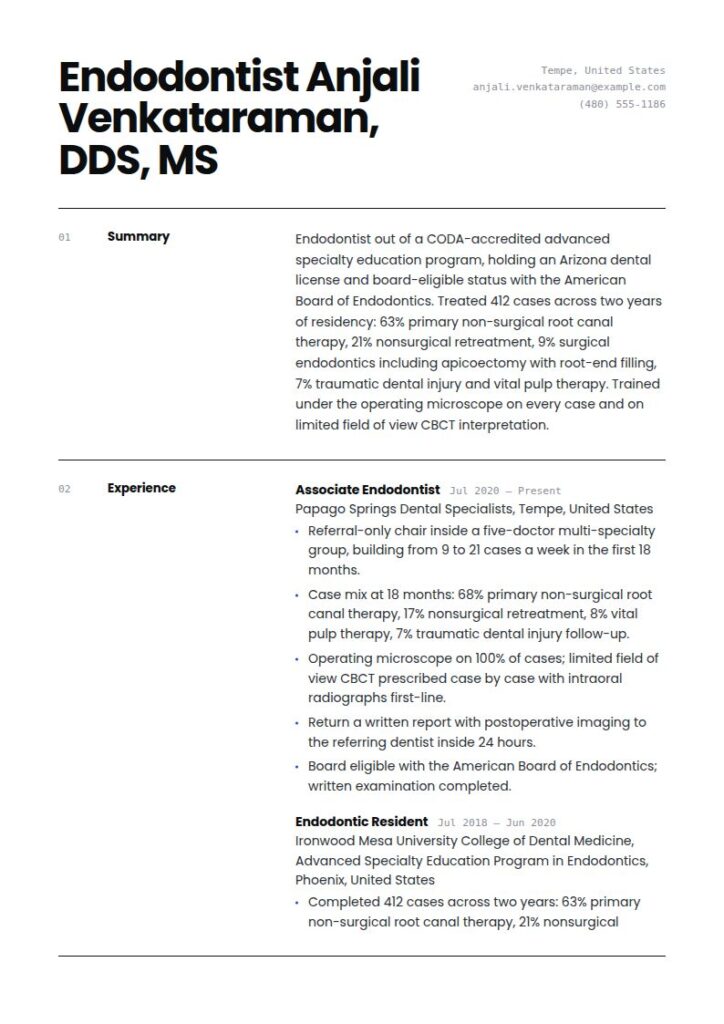
Endodontist out of a CODA-accredited advanced specialty education program, holding an Arizona dental license and board-eligible status with the American Board of Endodontics. Treated 412 cases across two years of residency: 63% primary non-surgical root canal therapy, 21% nonsurgical retreatment, 9% surgical endodontics including apicoectomy with root-end filling, 7% traumatic dental injury and vital pulp therapy. Trained under the operating microscope on every case and on limited field of view CBCT interpretation.
Work Experience
07/2020 - Present, Associate Endodontist, Papago Springs Dental Specialists, Tempe, United States
- Referral-only chair inside a five-doctor multi-specialty group, building from 9 to 21 cases a week in the first 18 months.
- Case mix at 18 months: 68% primary non-surgical root canal therapy, 17% nonsurgical retreatment, 8% vital pulp therapy, 7% traumatic dental injury follow-up.
- Operating microscope on 100% of cases; limited field of view CBCT prescribed case by case with intraoral radiographs first-line.
- Return a written report with postoperative imaging to the referring dentist inside 24 hours.
- Board eligible with the American Board of Endodontics; written examination completed.
07/2018 - 06/2020, Endodontic Resident, Ironwood Mesa University College of Dental Medicine, Advanced Specialty Education Program in Endodontics, Phoenix, United States
- Completed 412 cases across two years: 63% primary non-surgical root canal therapy, 21% nonsurgical retreatment, 9% surgical endodontics, 7% traumatic dental injury and vital pulp therapy.
- Worked under the operating microscope on every case, with rubber dam isolation and electronic apex location as standard.
- Prescribed and interpreted limited field of view CBCT against the AAE and AAOMR joint position statement.
- Covered the program emergency clinic one week in four, including avulsion, luxation and root fracture management.
07/2016 - 06/2018, Associate General Dentist, Copper Sky Dental Group, Mesa, United States
- Full-scope general practice averaging 11 patients a day, with roughly 4 endodontic cases a week on anterior and premolar teeth.
- Referred out molar endodontics and retreatment, which is what led to specialty training.
Education
07/2018 - 06/2020, Master of Science and Certificate in Endodontics, Endodontics, Ironwood Mesa University College of Dental Medicine, Phoenix, United States
Advanced Specialty Education Program in Endodontics, accredited by the Commission on Dental Accreditation. Twenty-four months of full-time study. Residency case log of 412 completed cases.
08/2012 - 05/2016, Doctor of Dental Surgery, Dentistry, Ironwood Mesa University College of Dental Medicine, Phoenix, United States
Skills
Non-surgical root canal therapy, molar and multi-canal, 80
Nonsurgical retreatment, 70
Operating microscope, 85
Limited field of view CBCT interpretation, 75
AAE pulpal and apical diagnostic terminology, 85
Traumatic dental injury management, 70
Vital pulp therapy and partial pulpotomy, 70
Rubber dam isolation and electronic apex location, 90
Languages
English, native
Tamil, native
Spanish, beginner
Certificates
06/2016, Arizona Dental License, Arizona State Board of Dental Examiners, AZ-D-14206
Active through 2028. Integrated National Board Dental Examination and state clinical assessment completed.
06/2020, Certificate in Endodontics, Ironwood Mesa University College of Dental Medicine
Twenty-four month CODA-accredited advanced specialty education program in endodontics.
02/2026, Basic Life Support for Healthcare Providers, American Heart Association
Summary
An endodontist resume is a one to two page document that names your case mix, your referral base, your board status with the American Board of Endodontics and the imaging you work with. This guide gives you three adaptable versions, the case-type vocabulary a practice owner reads for, and current Bureau of Labor Statistics pay and outlook for dental specialists.
Endodontist resume examples by experience level
An endodontist resume is a one to two page document that names your case mix, your referral base, your board status and the imaging and magnification you work under.
Endodontics is a referral specialty, and that one fact changes what the resume has to do. Patients do not arrive by themselves. They arrive because a general dentist looked at a tooth, decided it was beyond what they wanted to do in their own operatory, and sent it down the road. A practice hiring an associate is buying two things: the cases you can take without sending them back, and the dentists who will keep sending them. Most endodontist resumes describe neither. They describe a residency and a license, which every applicant has.
Resume guide for an endodontist resume
This guide and the corresponding endodontist resume example will cover:
- How to write an endodontist resume, section by section
- The case-type vocabulary that tells a practice owner what you can actually take
- Three adaptable summaries: new associate, practicing endodontist and partner
- How to write a referral record without naming a single patient
- What the job market looks like and what dental specialists earn
How to write an endodontist resume
Seven sections: contact header, summary, licensure and board status, case mix and referral record, clinical experience, education and residency, and skills. One page while you are in or just out of residency, two once you have a case log and a referral base worth describing.
The order matters. Licensure and board status sit above experience because they are gates, and the case mix block sits above the job history because a practice owner reads for scope before chronology.
| Section | What it is answering | Where it goes |
|---|---|---|
| License and board status | Can this person be credentialed here on day one? | Directly under the summary |
| Case mix | Which cases I now refer out could stay in this building? | Its own block, not buried in bullets |
| Referral record | Will dentists send work to this person, and have they? | Immediately after case mix |
| Clinical experience | Where, how long, and at what volume? | Reverse chronological, with numbers |
Write your cases the way the specialty classifies them
The American Association of Endodontists publishes an Endodontic Case Difficulty Assessment Form that sorts a case into low, moderate or high difficulty against criteria such as canal morphology, tooth position, apex diameter, radiographic appearance and trauma history; it was last updated on 1 September 2022 and recommends considering cone beam computed tomography for moderate and high difficulty cases.
That vocabulary already exists, so use it: a line reading "high difficulty molar retreatment, including separated instrument retrieval and perforation repair" maps onto a form the reader has seen.
Do the same with diagnosis. The AAE Consensus Conference recommended diagnostic terminology gives the pulpal terms (normal pulp, reversible pulpitis, symptomatic and asymptomatic irreversible pulpitis, pulp necrosis, previously treated, previously initiated therapy) and the apical terms (normal apical tissues, symptomatic and asymptomatic apical periodontitis, acute and chronic apical abscess, condensing osteitis). Using them correctly signals that you were trained properly.
Run the finished file through the ATS resume checker before you send it. Dental service organizations and hospital systems parse applications into a system before a human opens them.
Choosing the best resume format for an endodontist resume
Reverse chronological, with a case mix block interrupting it near the top. One page through residency and your first associateship, two once you have ownership, a faculty appointment, or a case log with enough range to be the argument.
Functional formats fail here for a reason: a practice owner reads for continuity of volume. How many cases a week, for how many years, in what setting. A format that hides the timeline hides the thing being bought.
Include your contact information
| ✅ Right | ❌ Wrong |
|---|---|
| Anjali Venkataraman, DDS, MS | Anjali Venkataraman |
| Endodontist, Diplomate of the American Board of Endodontics | Dedicated dental professional passionate about patient care |
| Arizona dental license #AZ-D-14206, active through 2028 | Licensed dentist |
| (480) 555-1186, [email protected] | (480) 555-1186, [email protected] |
Put the license number on the page. Credentialing will pull it anyway, and the file that lets an office manager start that process the same afternoon moves ahead of the one that does not. If you are board certified, write Diplomate of the American Board of Endodontics rather than "board certified": that is the title the board confers.
Make use of a summary
Four lines: credential, years and setting, case mix in one clause, and one number that is either volume or referral growth.
Endodontist out of a CODA-accredited advanced specialty education program, holding an Arizona dental license and board-eligible status with the American Board of Endodontics. Treated 412 cases across two years of residency: 63% primary non-surgical root canal therapy, 21% nonsurgical retreatment, 9% surgical endodontics including apicoectomy with root-end filling, 7% traumatic dental injury and vital pulp therapy. Trained under the operating microscope on every case and on limited field of view CBCT interpretation.
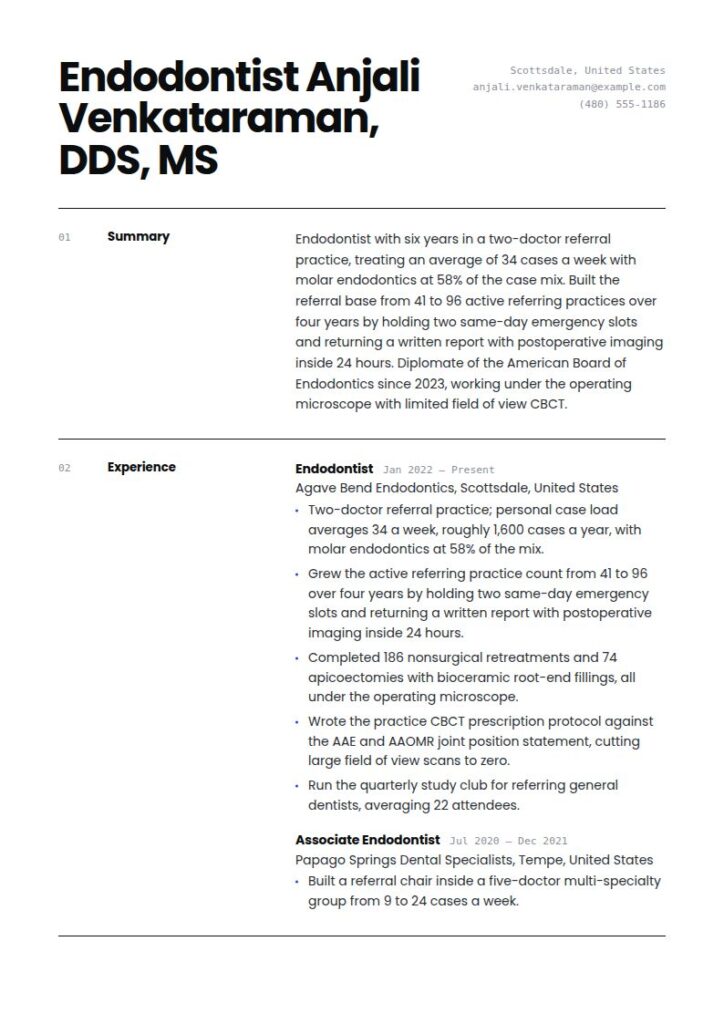
Endodontist with six years in a two-doctor referral practice, treating an average of 34 cases a week with molar endodontics at 58% of the case mix. Built the referral base from 41 to 96 active referring practices over four years by holding two same-day emergency slots and returning a written report with postoperative imaging inside 24 hours. Diplomate of the American Board of Endodontics since 2023, working under the operating microscope with limited field of view CBCT.
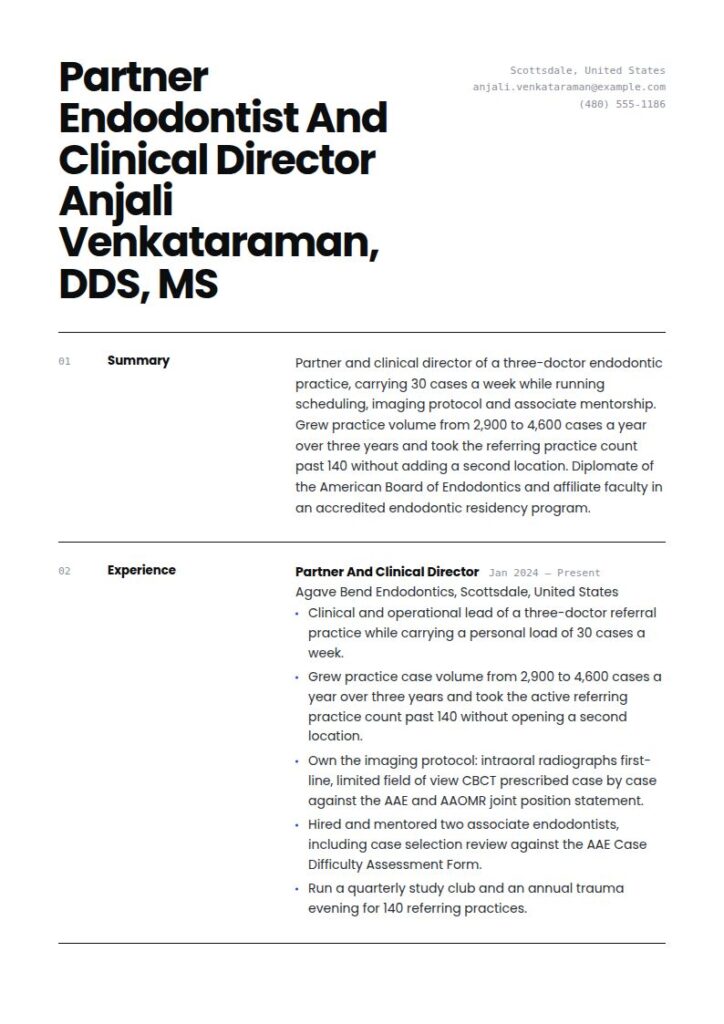
Partner and clinical director of a three-doctor endodontic practice, carrying 30 cases a week while running scheduling, imaging protocol and associate mentorship. Grew practice volume from 2,900 to 4,600 cases a year over three years and took the referring practice count past 140 without adding a second location. Diplomate of the American Board of Endodontics and affiliate faculty in an accredited endodontic residency program.
Right vs wrong: the same endodontist summary, twice
| ✅ Right | ❌ Wrong |
|---|---|
| Endodontist with six years in a two-doctor referral practice, averaging 34 cases a week. | Passionate endodontist committed to the highest standard of patient care. |
| Molar endodontics is 58% of the case mix; retreatment and surgery are a further 26%. | Experienced in a wide variety of endodontic procedures. |
| Grew the active referring practice count from 41 to 96 over four years. | Excellent communication skills with referring doctors. |
The right column can be modeled: a practice owner can multiply 34 cases a week by a fee schedule and decide whether a second chair pays for itself. The left column cannot.
Outline your clinical experience
Practice or institution, city, role, dates, and the setting in one clause: solo referral practice, multi-specialty group, dental service organization, hospital-based, or academic clinic. Then three to five bullets, each with a number.
| Instead of | Use |
|---|---|
| Performed root canal treatment on a wide range of teeth | Averaged 34 cases a week, 58% molar, across a six-year associateship |
| Skilled in endodontic surgery | Performed 74 apicoectomies with root-end preparation and bioceramic root-end filling under the microscope |
| Good relationships with referring dentists | Took the active referring practice count from 41 to 96 in four years |
Endodontist, Agave Bend Endodontics, Scottsdale, AZ, January 2022 to Present
Two-doctor referral practice. Personal case load averages 34 a week, roughly 1,600 cases a year, molar endodontics at 58% of the mix.
Grew the active referring practice count from 41 to 96 over four years by holding two same-day emergency slots and returning a written report with postoperative imaging inside 24 hours.
Completed 186 nonsurgical retreatments and 74 apicoectomies with bioceramic root-end fillings, all under the operating microscope.
Wrote the practice CBCT prescription protocol against the AAE and AAOMR joint position statement, cutting large field of view scans to zero.
Run the quarterly study club for referring general dentists, averaging 22 attendees.
Write your case mix and your referral base
This is the block almost nobody includes, and the one a practice owner actually reads. Two things decide whether they call: what you can take, and who sends it.
Case mix first, in the specialty's own categories rather than in adjectives. Primary non-surgical root canal therapy, split by tooth type, because an anterior and a mandibular second molar are not the same purchase. Nonsurgical retreatment. Surgical endodontics, named as apicoectomy with root-end preparation and filling. Traumatic dental injury management. Vital pulp therapy. Cracked tooth diagnosis. If you do regenerative procedures or apexification on immature teeth, say so.
The Commission on Dental Accreditation's standards for advanced endodontics programs require in-depth instruction in "non-surgical and surgical endodontic treatment and retreatment" (Standard 4-8(b)), "vital pulp management" and "endodontic management of traumatic dental injuries" (4-9), "radiography and other diagnostic imaging technologies, including use of Limited Field of View (LFOV) Cone Beam Computed Tomography (CBCT)" (4-8(e)) and "use of magnification technologies" (4-8(k)). Those four clauses are a ready-made outline for the block.
Referral base second. You can describe it completely without naming a patient or a referring doctor: the number of active referring practices, how that number moved and over what period, the share of volume from your largest referrers, your emergency access policy, and your report turnaround.
Case mix, most recent 12 months, 1,612 cases: primary non-surgical root canal therapy 61% (molar 58% of that total, premolar 24%, anterior 18%); nonsurgical retreatment 14%; surgical endodontics, apicoectomy with root-end preparation and bioceramic filling, 6%; traumatic dental injury management including avulsion, luxation and root fracture follow-up 5%; vital pulp therapy and partial pulpotomy 8%; cracked tooth diagnosis and consultation without treatment 6%.
Referral record: 96 active referring practices, up from 41 in 2022, with no single practice above 6% of volume. Two same-day emergency slots held daily; 91% of referred emergencies seen inside 24 hours. Written report with postoperative imaging returned to the referring dentist within 24 hours on 98% of cases.
Imaging and magnification: operating microscope on 100% of cases. Limited field of view CBCT prescribed case by case against the AAE and AAOMR joint position statement, with intraoral radiographs first-line.
Name the imaging standard, not just the machine
The joint position statement of the American Association of Endodontists and the American Academy of Oral and Maxillofacial Radiology on the use of cone beam computed tomography in endodontics, published as a 2015 update in the Journal of Endodontics, volume 41, issue 9, pages 1393 to 1396, is the document a well-run practice prescribes against.
Its first recommendation is that intraoral radiographs are the imaging modality of choice for evaluating the endodontic patient, and it states that for most endodontic applications limited field of view CBCT is preferred to medium or large field of view because the dose is lower. Its numbered recommendations set out where limited field of view CBCT is indicated: contradictory or non-specific signs and symptoms, suspected extra canals, calcified canals, suspected vertical root fracture, nonhealing of previous treatment, retreatment complications, and presurgical planning.
"Limited field of view CBCT prescribed case by case against the AAE and AAOMR joint position statement" reads as risk management. "CBCT experience" is a sentence about a machine.
Build a snapshot of your key skills
Four blocks: clinical procedures, diagnosis and imaging, materials and technology, and practice.
Clinical: Non-surgical root canal therapy, molar and multi-canal; Nonsurgical retreatment and separated instrument retrieval; Apicoectomy with root-end preparation and filling; Perforation repair; Vital pulp therapy and partial pulpotomy; Apexification and regenerative procedures; Management of avulsion, luxation and root fracture
Diagnosis and imaging: AAE pulpal and apical diagnostic terminology; Cracked tooth and vertical root fracture assessment; Limited field of view CBCT interpretation and prescription; AAE Case Difficulty Assessment
Materials and technology: Operating microscope; Rotary and reciprocating nickel-titanium instrumentation; Ultrasonic tips; Bioceramic sealers and root-end filling materials; Electronic apex location; Rubber dam isolation
Practice: Referral relationship management; Study club presentation; Report turnaround; Associate mentorship; Infection control and sterilization protocol
List your education, residency and board status
License and number first, then board status, then the residency with its program name and length, then the dental degree, then continuing education.
Arizona dental license #AZ-D-14206, Arizona State Board of Dental Examiners, active through 2028
Diplomate of the American Board of Endodontics, 2023. Written examination, case history examination and oral examination all completed.
Certificate in Endodontics and Master of Science, Advanced Specialty Education Program in Endodontics, Ironwood Mesa University College of Dental Medicine, Phoenix, AZ, 2020. Twenty-four month CODA-accredited program.
Doctor of Dental Surgery, Ironwood Mesa University College of Dental Medicine, Phoenix, AZ, 2016
Continuing education: AAE Annual Meeting 2023 to 2026; microsurgical endodontics 2024; regenerative endodontics 2025.
Three facts are worth stating plainly, because applicants leave them implicit.
Endodontics is one of twelve dental specialties recognized by the National Commission on Recognition of Dental Specialties and Certifying Boards, an ADA-affiliated commission, which adopted its recognition in April 2021 and defines the specialty as "the dental specialty which is concerned with the morphology, biology, physiology, pathology and regeneration of the human dental pulp and periradicular tissues."
CODA Standard 4-1 requires that "an advanced dental education program in endodontics must encompass a minimum duration of 24 months of full-time study", and Standard 4-6 that 40 to 60 percent of total clock hours in a 24-month program go to clinical care. Write the program length on the page.
Board certification is a three-stage process, not a single exam. The American Board of Endodontics runs a written examination covering "anatomy, biochemistry, pathology, immunology, microbiology, pharmacology, radiology, statistics, clinical endodontics and related disciplines", a case history examination in which the candidate submits cases from their own practice "diverse and complex enough to demonstrate exceptional knowledge, skills, and expertise in the full scope of the field of endodontics", and an oral examination. Whoever completes all three is a Diplomate. If you are partway through, say which stages you have passed and when you sit the next one.
On licensure, the American Dental Association sets out three requirements: a DDS or DMD from a CODA-accredited program, a passing result on the Integrated National Board Dental Examination, which "all U.S. licensing jurisdictions require applicants to pass", and a clinical assessment, required "in most U.S. licensing jurisdictions". None of that separates two endodontists, but your license number and its expiry date do.
Choose the right layout and design
Single column, plain type at 11 or 12 point, clear headings, no photograph and no clinical images. Practice groups and hospital systems parse these into a structured record before anyone reads them, and two-column layouts, text boxes and graphics are where parsing fails.
Put the license number and its expiry in the header. Give a percentage case mix over a stated period, not a list of adjectives. Name the residency program and say it was CODA accredited and 24 months. State your board status precisely, including which stages you have passed. Count your referring practices and say how that number moved. Say what magnification and imaging you work under.
Do not describe a patient, a tooth or a case in any way that could identify a person. Do not write "board certified" if you are board eligible; the distinction is checkable. Do not list continuing education without years. Do not claim case types you have done twice. Do not send a two-column template into a credentialing portal. Do not attach radiographs to a resume.
Endodontist job market and outlook
A very small, very high-paying corner of a mid-sized occupation. The Bureau of Labor Statistics publishes no separate wage or employment line for endodontists: in its Occupational Outlook Handbook they are counted inside "dentists, all other specialists", with the specialties that have no line of their own.
| Measure | Value |
|---|---|
| Dentist jobs, all types, 2025 | 161,400 |
| Of which dentists, all other specialists (includes endodontists) | 5,800 |
| Of which dentists, general | 141,900 |
| Projected change, 2025-35, all dentists | 6% (faster than average), +9,000 |
| Projected annual openings, all dentists | About 4,800 |
| Typical entry-level education | Doctoral or professional degree |
| Median annual wage, dentists, all other specialists, May 2025 | $224,990 |
Source: U.S. Bureau of Labor Statistics, Occupational Outlook Handbook, dentists, May 2025 wage data and 2025 to 2035 projections, last modified 27 August 2026.
Read the first two rows together. There are 5,800 jobs in the whole "all other specialists" category and endodontists are only part of it, so the employers who can hire you in a metropolitan area are few enough to count, and most are referral practices with one to four doctors. You are often writing to an owner who has never posted a vacancy. BLS notes on the same page that "all dental specialties require dentists to complete additional training before practicing that specialty", usually "a 2- to 4-year residency in an accredited program".
The specialty premium is real, and it is about $54,000
In May 2025 the median annual wage for dentists, all other specialists, the category that contains endodontists, was $224,990. For dentists, general, it was $170,950, and for dentists as a whole $176,110, or $84.67 an hour (U.S. Bureau of Labor Statistics, Occupational Outlook Handbook, May 2025). The spread across all dentists is wide: the lowest 10 percent earned less than $89,100 and the highest 10 percent more than $337,210.
Two things follow. The gap between the general and the specialist line is roughly $54,000 at the median, so any ambiguity about whether you are read as a specialist is expensive: put the certificate, the program and the board status where they are seen in four seconds. And because the published figure is a category rather than an endodontist figure, do not quote it in a negotiation as though it were one.
Where the jobs sit: offices of dentists hold 78 percent of dentist employment at a median of $173,760, 12 percent are self-employed, and outpatient care centers (2 percent, $195,330) and government (2 percent, $219,750) make up most of the rest (BLS, May 2025).
What salary you can expect as an endodontist
BLS publishes no endodontist wage. The nearest published figure is the median for dentists, all other specialists, $224,990 a year in May 2025, and that category covers several specialties rather than yours alone. For comparison, the May 2025 medians for the specialties BLS does break out were $352,220 for oral and maxillofacial surgeons, $311,180 for prosthodontists and $289,140 for orthodontists (BLS, May 2025).
What moves your own number is production, and production is case mix times volume times fee schedule, minus the cases you refer back out. That is what the case mix block describes, which is why it earns the space: a candidate showing 1,600 cases a year at 58% molar is making an argument about revenue, and "extensive experience in endodontics" is not.
Two other levers belong on the page. Board certification is used by practices and by academic appointments as a credentialing asset, and faculty affiliation with an accredited residency program tends to bring referrals from that program's graduates.
Key takeaways for an endodontist resume
- Lead with the license number and the board status; both are gates rather than achievements.
- Give a percentage case mix over a stated period, in the specialty's own categories, split by tooth type. Molar volume is what a practice is buying.
- Count your referring practices, say how that number moved, and over how long.
- Name your emergency access and report turnaround, the two things referring dentists judge.
- State the residency program, that it was CODA accredited, and that it was 24 months.
- Say what magnification and imaging you work under, and against which published standard.
- Never describe a case in a way that could identify a patient.
Build your endodontist resume in 15 minutes with our AI resume builder.
Related medical resume examples
- Dentist resume
- Dental hygienist resume
- Dental assistant resume
- Dental receptionist resume
- Optometrist resume
- Doctor resume
- Physician resume
- Surgical tech resume
- Medical receptionist resume
- Medical office manager resume
- Healthcare project manager resume
- Pharmacist resume
Pair it with a matching endodontist cover letter.
Endodontist resume questions, answered
How long should an endodontist resume be?
One page through residency and your first associateship, two once you have a case log, a referral record, ownership or a faculty appointment. Curriculum vitae length suits an academic application, but a private referral practice reads for scope and volume and will not reach page four.
Should I put my case numbers on the resume?
Yes, as aggregate counts and percentages over a stated period. Aggregate case data describes your practice, not a patient, and it is the most useful thing on the page. Never include a case description, a radiograph or any detail that could identify an individual.
How do I write about referrals without naming referring dentists?
Count them instead. The number of active referring practices, how that number moved over a named period, the share of volume from your largest referrers, your emergency access policy and your report turnaround describe the referral base completely without naming anyone.
Is board certification worth listing if I am still working through it?
Yes, stated precisely. The American Board of Endodontics process has three stages: a written examination, a case history examination built from your own cases, and an oral examination. Say which you have completed and when you sit the next one. A candidate who has passed the written examination and has a case history portfolio in preparation is further along than "board eligible" suggests on its own.
What does an endodontist resume need that a general dentist resume does not?
A case mix in specialty categories rather than a procedure list, a referral record, and a statement of the imaging and magnification standard you work to. A general dentist resume is read for chair time and production across a broad scope; an endodontist resume is read for depth in a narrow one and for the referral stream that feeds it.