Lucian Petrescu Senior Chemist, Method Validation and Transfer Wilmington, 19806, United States [email protected] · (302) 555-1372
11 September 2026
Ms. Ingrid Sollberg Quality Control Laboratory Kestrel Bio Manufacturing Wilmington, United States
Application for Senior Analytical Chemist, Kestrel Bio Manufacturing
Dear Ms. Sollberg,
I am applying for the Senior Analytical Chemist post at Kestrel Bio Manufacturing. I run reversed-phase HPLC and UPLC assay, related substances and dissolution on Agilent 1260 and 1290 Infinity II systems through Empower 3, plus headspace GC for residual solvents and ICP-MS elemental impurities to USP General Chapters 232 and 233, all under cGMP. I have validated four release methods to ICH Q2 criteria and hold an ACS-certified bachelor's degree and a master's in analytical chemistry.
For four years I have owned the analytical method lifecycle at a site running nine commercial products: development, validation, transfer, periodic review and retirement. The piece I would most want to bring to Kestrel is the transfer work. I moved 12 methods to two contract laboratories using comparative testing protocols with acceptance criteria agreed before any sample was run, and none failed or needed a repeat study. What made the difference was not the statistics; it was writing the receiving laboratory's sample preparation step out in full, because that is where every failed transfer I had seen had actually failed.
Your posting describes a second site coming online next year and a plan to move stability testing in house. That is the work I would want. I have also led 14 out-of-specification investigations to closure at a mean cycle time of 21 days against a 30-day limit, and supported two regulatory inspections with no laboratory observations.
I hold a Certified Quality Auditor credential from the American Society for Quality and ISO/IEC 17025 internal auditor training, and can give four weeks' notice. Thank you for your time.
Sincerely, Lucian Petrescu, M.S.
Summary
A chemist cover letter names the analytical methods you run without supervision, the instruments and data system behind them, the regulatory regime the work sat inside, and one measured result. This guide gives you a full adaptable letter, what changes when you move between industries, and the openings that get a technical file read to the end.
Chemist cover letter examples by experience level
A chemist cover letter is a one page letter telling a laboratory manager which of their instruments you could sit down at next month, under whose rules you have worked, and what you changed the last time you owned a method.
The person reading it is a working scientist with a queue behind them. They are not evaluating your enthusiasm for chemistry; they are estimating how many weeks of supervision you would cost.
Guide to a chemist cover letter
This guide and the corresponding chemist cover letter example will cover:
- How to structure the letter, paragraph by paragraph
- Why the platform and the regime belong in the first three sentences
- What counts as evidence when your work is confidential
- What changes when you move between industries or regimes
- The openings that get a technical file read to the end
How to write a chemist cover letter
| Paragraph | Its job | Length |
|---|---|---|
| Opening | The post, your specialism, the platforms and the regime | 2 to 3 sentences |
| Evidence | One method or investigation, one number, one period | 4 to 5 sentences |
| Fit | Something specific about their laboratory, and what you would take on | 3 to 4 sentences |
| Close | Degree, certification, availability, thank you | 2 sentences |
Put the platform and the regime in the first three sentences
A laboratory manager screens for two things before assessing you as a scientist: can you run our instruments, and have you worked under our rules.
So the opening is not "I am writing to express my strong interest in the Analytical Chemist position." It is: "I am applying for the Analytical Chemist post in your quality control laboratory. I run reversed-phase HPLC and UPLC assay, related substances and dissolution on Agilent 1260 and 1290 systems through Empower 3, under cGMP, and I have validated four release methods to ICH Q2 criteria."
Two sentences, and the screen is answered. Everything after it is argument rather than eligibility.
Which laboratory are you writing to
One letter cannot serve four industries. Chemical manufacturing employs 33 percent of chemists, scientific research and development services 16 percent and testing laboratories 11 percent (BLS Occupational Outlook Handbook, chemists, May 2025), and each reads a file differently.
| Laboratory | What the letter should lead with |
|---|---|
| cGMP quality control | Platforms, compendial and validated methods, out-of-specification handling, inspection history |
| Analytical development | Method development, forced degradation, stability-indicating design |
| Contract testing, ISO/IEC 17025 | Accredited methods by number, turnaround, quality control series, measurement uncertainty |
| Environmental and EPA work | Method numbers, holding times, matrix spikes, chain of custody |
| Research and development | The problem you worked on, what you made work, publications and patents |
Read the posting twice and write to the row it sits in.
A chemist cover letter example you can adapt
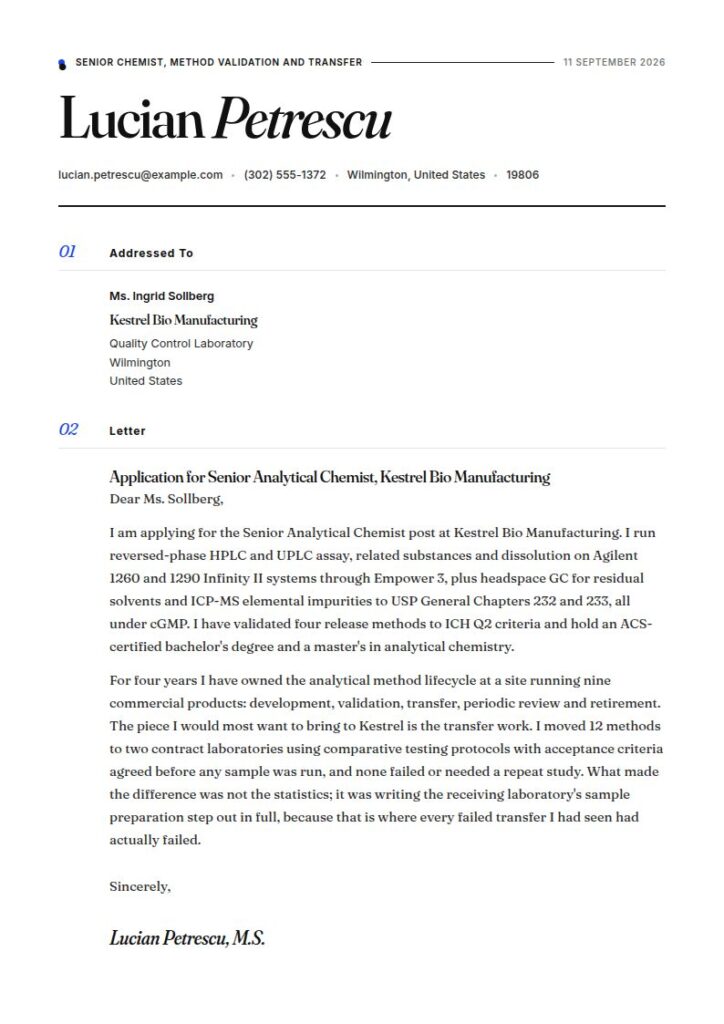
Dear Ms. Sollberg,
I am applying for the Senior Analytical Chemist post at Kestrel Bio Manufacturing. I run reversed-phase HPLC and UPLC assay, related substances and dissolution on Agilent 1260 and 1290 Infinity II systems through Empower 3, plus headspace GC for residual solvents and ICP-MS elemental impurities to USP General Chapters 232 and 233, all under cGMP. I have validated four release methods to ICH Q2 criteria and hold an ACS-certified bachelor's degree and a master's in analytical chemistry.
For four years I have owned the analytical method lifecycle at a site running nine commercial products: development, validation, transfer, periodic review and retirement. The piece I would most want to bring to Kestrel is the transfer work. I moved 12 methods to two contract laboratories using comparative testing protocols with acceptance criteria agreed before any sample was run, and none failed or needed a repeat study. What made the difference was not the statistics; it was writing the receiving laboratory's sample preparation step out in full, because that is where every failed transfer I had seen had actually failed.
Your posting describes a second site coming online next year and a plan to move stability testing in house. That is the work I would want. I have also led 14 out-of-specification investigations to closure at a mean cycle time of 21 days against a 30-day limit, and supported two regulatory inspections with no laboratory observations.
I hold a Certified Quality Auditor credential from the American Society for Quality and ISO/IEC 17025 internal auditor training, and can give four weeks' notice. Thank you for your time.
Sincerely, Lucian Petrescu, M.S.
Openings that work
| Instead of | Use |
|---|---|
| I am a highly motivated chemist with a passion for science | I run assay, related substances and dissolution on Agilent 1260 and 1290 through Empower 3, under cGMP |
| I have extensive experience with analytical instrumentation | I have validated four release methods to ICH Q2 criteria and authored the validation reports |
| I am detail-oriented and committed to quality | I closed 14 out-of-specification investigations at a mean cycle time of 21 days against a 30-day limit |
| I would be a valuable addition to your team | Your posting describes moving stability testing in house next year |
What counts as evidence for a chemist
Most laboratory work is confidential, which is why so many chemistry letters retreat into abstraction. You do not need the product name to make a claim checkable, only the quantity, the standard and the period.
| Kind of evidence | What it looks like in a sentence |
|---|---|
| Throughput | 140 release samples a month plus a 340-position stability program |
| Method work | Four release methods validated to ICH Q2 criteria, protocols and reports authored |
| Transfer | 12 methods transferred to two contract laboratories, none failed |
| Investigation | 14 out-of-specification investigations closed at a mean cycle time of 21 days against a 30-day limit |
| Turnaround | Semivolatiles queue cut from 11 days to 7 with acceptance criteria unchanged |
| Inspection | Two regulatory inspections supported with no laboratory observations |
Eighty-five thousand chemists, and the industry sets the pay
There were 84,900 chemist jobs in 2025, with chemist employment projected to grow 6 percent from 2025 to 2035 and about 6,500 openings a year across chemists and materials scientists combined (BLS Occupational Outlook Handbook, 2025 to 2035 projections).
The chemist median annual wage was $91,240 in May 2025, with the lowest 10 percent under $58,460 and the highest 10 percent above $160,830 (BLS, May 2025). Industry explains most of that spread: $137,720 in the federal government against $66,140 in testing laboratories (BLS, May 2025).
Around 6,500 openings a year is a small market. It rewards a letter written to one laboratory rather than one sent to thirty, and the letter is the only place you get to argue that your methods transfer across an industry line.
Moving between industries or regimes
Name the regime you have worked under and the one the post runs under, and say what carries across. Method verification, calibration, quality control series, traceability and documentation practice transfer between EPA, ISO/IEC 17025 and cGMP work; only the vocabulary changes. Name the instruments you would need no training on.
Do not put product names, batch numbers, customer names or anything under a confidentiality agreement in a letter you email to strangers. Do not claim method development when you have run somebody else's method. Do not describe yourself as detail-oriented; every letter in the folder does. Do not send a research letter to a quality control post with only the address changed.
Length, format and sending it
One page, four paragraphs, 250 to 400 words. PDF unless the portal says otherwise, named for yourself and the post: lucian-petrescu-analytical-chemist-cover-letter.pdf. Address the laboratory manager or group lead by name where the posting or the company site gives one; technical teams are small and usually listed.
Keep every figure identical to your resume. Our chemist resume example uses the same platforms, methods and numbers as this letter.
Key takeaways
- Name the platforms and the regime in the first three sentences.
- Write the instrument by manufacturer, model and detector, with its data system.
- Pick one method, transfer or investigation as the evidence paragraph, with a number and a period.
- Use throughput, cycle time and acceptance criteria instead of confidential product detail.
- Say what carries across when you move between industries, and what you would learn.
- Name one real thing about their laboratory, taken from their own pages.
- Address a named person and keep it to one page.
Write your chemist cover letter in 10 minutes with our AI cover letter builder.
Chemist cover letter questions, answered
How long should a chemist cover letter be?
One page, four paragraphs, 250 to 400 words. A laboratory manager reads these between sample batches, and the first three sentences decide whether the rest is read.
How do I write about confidential work?
Write the quantity, the standard and the period, and leave out the product. "Four release methods validated to ICH Q2 criteria" and "roughly 140 release samples a month plus a 340-position stability program" are checkable and disclose nothing.
Should I list every instrument in the letter?
No. The letter names the three or four platforms the posting asks for; the resume carries the full stack. A letter listing eleven instruments reads as one that has not read the posting.
What do I write with no industry experience yet?
Write your research as work: the group, the problem, the techniques, the instruments by model, the number of samples, and what you produced. Add teaching laboratory work, which is genuine instrument time. If your bachelor's degree is ACS-certified, say so: the 2023 ACS guidelines require 350 laboratory hours beyond general chemistry alongside five foundation and four in-depth courses (American Chemical Society Committee on Professional Training, 2023 guidelines).
Should I mention salary expectations?
No. Mention what sets the number instead: the platforms you run unsupervised, the regime you have worked under, whether you have validated and transferred methods, and your inspection record. The wage spread across industries is wide enough to be worth arguing on capability rather than on a figure.