Undergraduate Research Assistant, Psychology Tomás Iglesias
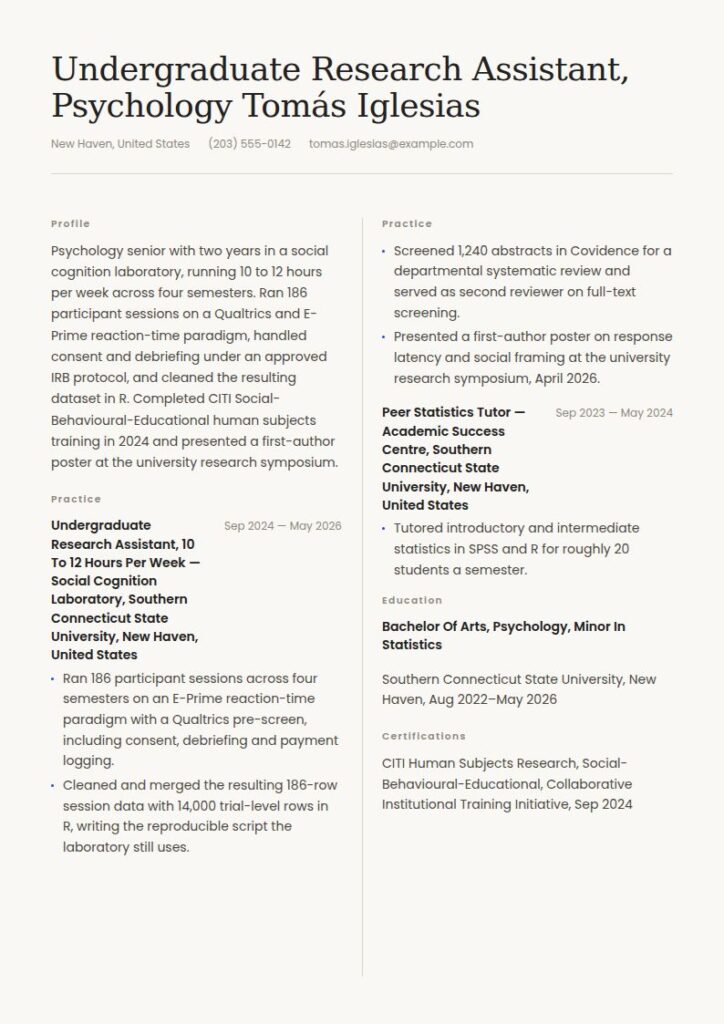
Undergraduate Research Assistant, 10 to 12 hours per week
[email protected] | (203) 555-0142 | New Haven, United States
Profile
Psychology senior with two years in a social cognition laboratory, running 10 to 12 hours per week across four semesters. Ran 186 participant sessions on a Qualtrics and E-Prime reaction-time paradigm, handled consent and debriefing under an approved IRB protocol, and cleaned the resulting dataset in R. Completed CITI Social-Behavioural-Educational human subjects training in 2024 and presented a first-author poster at the university research symposium.
Work Experience
09/2024 - 05/2026, Undergraduate Research Assistant, 10 to 12 hours per week, Social Cognition Laboratory, Southern Connecticut State University, New Haven, United States
- Ran 186 participant sessions across four semesters on an E-Prime reaction-time paradigm with a Qualtrics pre-screen, including consent, debriefing and payment logging.
- Cleaned and merged the resulting 186-row session data with 14,000 trial-level rows in R, writing the reproducible script the laboratory still uses.
- Screened 1,240 abstracts in Covidence for a departmental systematic review and served as second reviewer on full-text screening.
- Presented a first-author poster on response latency and social framing at the university research symposium, April 2026.
09/2023 - 05/2024, Peer Statistics Tutor, Academic Success Centre, Southern Connecticut State University, New Haven, United States
- Tutored introductory and intermediate statistics in SPSS and R for roughly 20 students a semester.
Education
08/2022 - 05/2026, Bachelor of Arts, Psychology, minor in Statistics, Southern Connecticut State University, New Haven, United States
Departmental honours thesis on response latency and social framing. Coursework in research methods, regression, and experimental design.
Skills
Participant recruitment and informed consent, 75
E-Prime and Qualtrics session running, 80
Data cleaning in R and tidyverse, 70
SPSS, 70
Systematic review screening in Covidence, 65
Laboratory notebook and source documentation, 70
Languages
English, native
Spanish, native
Certificates
09/2024, CITI Human Subjects Research, Social-Behavioural-Educational, Collaborative Institutional Training Initiative
Foundations course. Refresher due 2027.
Summary
A research assistant resume is a one to two page methods document naming the techniques you can run unsupervised, the instruments and software you know, the size of the datasets you have handled, and your human subjects training. This guide gives you three adaptable versions, the methods block most applicants leave out, and current Bureau of Labor Statistics pay and outlook.
Research Assistant resume examples by experience level
A research assistant resume is a one to two page document that tells a principal investigator which techniques you can run without supervision, on what instruments, at what volume, and whether you are already cleared to touch human data.
Most research assistant resumes are duty lists: assisted with experiments, collected data, helped with literature reviews. A principal investigator learns nothing from that. They have a protocol, a grant with a timeline attached, and one question a duty list cannot answer: if I hand this person the assay on Monday, do I have to stand next to them?
Resume guide for a research assistant resume
This guide and the corresponding research assistant resume example will cover:
- How to write a research assistant resume, section by section
- Why a methods block belongs on the page, and what goes in it
- Three adaptable summaries: undergraduate, professional and senior
- What CITI training and IRB experience are worth on paper
- What the job market looks like and what you can expect to earn
How to write a research assistant resume
Six sections: contact header, summary, research experience, methods and instrumentation, education, and training and certifications. One page while you are an undergraduate or in your first post-baccalaureate year, two once you have publications, a protocol you wrote, or people you have trained. The order matters because the reader is triaging: method first, context second, person third.
| Section | What it is answering | Where it goes |
|---|---|---|
| Methods and instrumentation | Can this person run my protocol on Monday? | Its own block, high on page one |
| Research experience | In what setting, on whose money, at what volume? | Reverse chronological, with sample sizes |
| Human subjects training | Can I add them to the protocol without a delay? | Certifications, with the completion date |
| Outputs | Did any of it finish? | Posters, abstracts, authorship, datasets, code |
The job title covers two different jobs, so say which one you are applying from
"Research assistant" covers an undergraduate working eight hours a week for course credit and a salaried professional running a multi-site protocol. Federal wage data treats the professional version as its own occupation: social science research assistants held 38,400 jobs in 2025 with a median annual wage of $61,990 (BLS Occupational Outlook Handbook, May 2025 wage data).
Write the version you are in. An undergraduate who says "10 hours per week, two semesters, 40 participant sessions run" is more credible than one who implies a full-time post. Hours per week and duration belong on the page for any part-time research role; leaving them off reads as hiding them.
Run the finished file through the free Rezoom ATS resume checker before you submit. University and hospital portals parse applications into a structured record before a human opens them.
Choosing the best resume format for a research assistant resume
Reverse chronological, with the methods block breaking the chronology once near the top. One page for undergraduate and first post-baccalaureate applications, two once you have authorship, a written protocol, or staff you have trained.
An academic curriculum vitae is a different document, and sending one to a staff research post is a common mistake. A CV is exhaustive; a resume is selective and answers a scheduling question. Keep the CV for faculty and fellowship applications.
Include your contact information
| ✅ Right | ❌ Wrong |
|---|---|
| Tomás Iglesias | Tomás Iglesias |
| Research Assistant II, Clinical and Behavioural Research | Hardworking science graduate seeking research opportunities |
| CITI Human Subjects Research, Biomedical, current to 2027 | CITI certified |
| (203) 555-0142, [email protected], New Haven, CT | (203) 555-0142, [email protected] |
Put the human subjects training and its currency in the first block. A candidate whose CITI is current can be added to a protocol the week they start; one who has to retake it adds weeks to the first study they touch.
Make use of a summary
Four lines: your research setting, the methods you own, one volume figure, and one output.
Psychology senior with two years in a social cognition laboratory, running 10 to 12 hours per week across four semesters. Ran 186 participant sessions on a Qualtrics and E-Prime reaction-time paradigm, handled consent and debriefing under an approved IRB protocol, and cleaned the resulting dataset in R. Completed CITI Social-Behavioural-Educational human subjects training in 2024 and presented a first-author poster at the university research symposium.
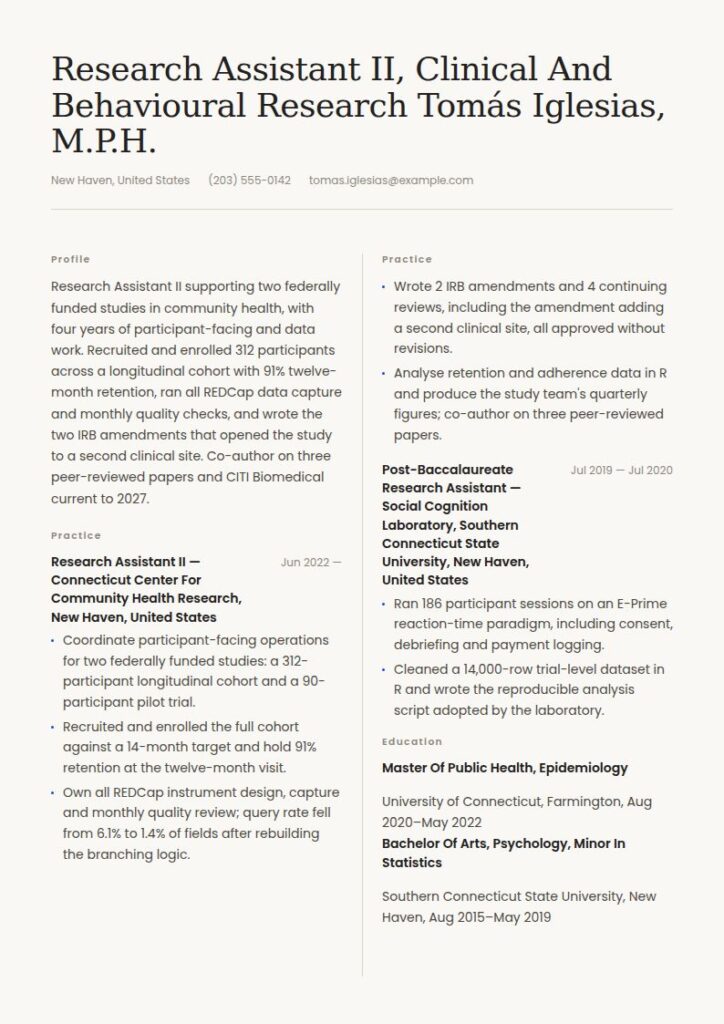
Research Assistant II supporting two federally funded studies in community health, with four years of participant-facing and data work. Recruited and enrolled 312 participants across a longitudinal cohort with 91% twelve-month retention, ran all REDCap data capture and monthly quality checks, and wrote the two IRB amendments that opened the study to a second clinical site. Co-author on three peer-reviewed papers and CITI Biomedical current to 2027.
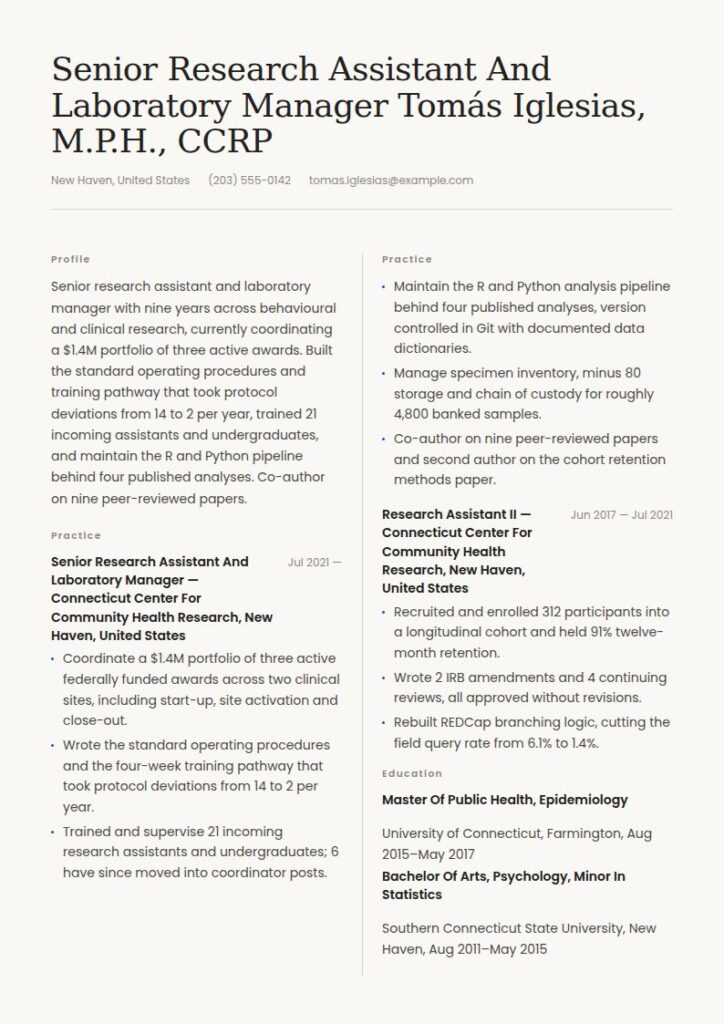
Senior research assistant and laboratory manager with nine years across behavioural and clinical research, currently coordinating a $1.4M portfolio of three active awards. Built the standard operating procedures and training pathway that took protocol deviations from 14 to 2 per year, trained 21 incoming assistants and undergraduates, and maintain the R and Python pipeline behind four published analyses. Co-author on nine peer-reviewed papers.
Right vs wrong: the same research assistant summary, twice
| ✅ Right | ❌ Wrong |
|---|---|
| Research Assistant II supporting two federally funded studies in community health. | Detail-oriented research professional with a passion for scientific discovery. |
| Recruited and enrolled 312 participants with 91% twelve-month retention. | Responsible for participant recruitment and retention activities. |
| Wrote the two IRB amendments that opened the study to a second clinical site. | Assisted with regulatory documentation as needed. |
The right column tells a principal investigator what happens if they hire you. The left column could be written by anyone who has ever been near a laboratory.
Outline your research experience
Institution, laboratory or centre, city, title, dates, and hours per week if the post was part time. Then three to five bullets, each naming a method or a deliverable and carrying a number: participants, samples, runs, records, sites, or dollars.
| Instead of | Use |
|---|---|
| Assisted with data collection | Ran 186 participant sessions on an E-Prime reaction-time paradigm, with consent and debriefing |
| Performed laboratory experiments | Ran 340 ELISA plates and 60 Western blots to protocol, with a 3% repeat rate |
| Helped with data analysis | Cleaned and analysed a 14,000-row longitudinal dataset in R, writing the reproducible script the laboratory still uses |
| Assisted with literature review | Screened 1,240 abstracts in Covidence, second reviewer on full-text screening |
| Worked with study participants | Maintained 91% twelve-month retention across a 312-participant longitudinal cohort |
Research Assistant II, Connecticut Center for Community Health Research, New Haven, CT, June 2022 to Present
Coordinate participant-facing operations for two federally funded studies: a 312-participant longitudinal cohort and a 90-participant pilot trial.
Recruited and enrolled the full cohort against a 14-month target and hold 91% retention at the twelve-month visit.
Own all REDCap instrument design, capture and monthly quality review; query rate fell from 6.1% to 1.4% of fields after rebuilding the branching logic.
Wrote 2 IRB amendments and 4 continuing reviews, including the amendment adding a second clinical site, all approved without revisions.
Analyse retention and adherence data in R and produce the study team's quarterly figures; co-author on three peer-reviewed papers.
Build a methods block: techniques, instruments, software and volumes
This is the section that separates a research assistant resume from a duty list, and almost nobody includes it. It is four lines, each answering a different question.
Methods run independently: recruitment and informed consent, structured interviewing, ELISA, Western blot, RNA extraction, qPCR, venepuncture and specimen processing
Methods run under supervision: flow cytometry, immunohistochemistry, confocal imaging
Instruments and platforms: REDCap, Qualtrics, E-Prime, BD FACSCanto II, Bio-Rad CFX96, minus 80 specimen management
Software and analysis: R (tidyverse, lme4), Python (pandas), SPSS, Stata, NVivo, Covidence, EndNote, Git
Two lines, not one, for the methods. "Run independently" and "run under supervision" are different claims, and a principal investigator will find out which is true in week two. Splitting them honestly is more persuasive than one long list.
Then attach volume. "ELISA" is a word; "340 ELISA plates with a 3% repeat rate" is a person who has run it often enough to have a repeat rate.
Name the research context too, because the same title means four different jobs. Bench laboratory work, clinical research coordination, social and behavioural research, and market or policy research share almost no methods, and a screener filling a clinical coordinator post will discard a strong bench resume in four seconds if the first block does not say which one you are.
Build a snapshot of your key skills
Twelve to sixteen entries in four groups: operations, data, compliance, communication.
Operations: Protocol execution, Participant recruitment and retention, Informed consent, Structured interviewing, Specimen collection and processing, Site activation
Data: REDCap instrument design, Data cleaning and quality control, R and tidyverse, Python and pandas, Inferential statistics, Reproducible analysis in Git
Compliance: IRB submissions and amendments, Adverse event reporting, HIPAA and data privacy, Good Clinical Practice, Protocol deviation logging
Scientific communication: Literature searching, Systematic review screening, Poster and abstract preparation, Laboratory notebook standards
List your education and certifications
Degree first with the institution and the year, then your research training, then human subjects certification with its completion date and expiry.
Master of Public Health, Epidemiology, University of Connecticut, Farmington, CT, 2022. Thesis on retention in longitudinal community cohorts.
Bachelor of Arts, Psychology, minor in Statistics, Southern Connecticut State University, New Haven, CT, 2019. Departmental honours thesis and first-author poster.
Certifications: CITI Human Subjects Research, Biomedical, Collaborative Institutional Training Initiative, 2024, refresher due 2027. CITI Good Clinical Practice, 2024. Certified Clinical Research Professional (CCRP), Society of Clinical Research Associates, 2023. Bloodborne pathogens and laboratory safety, annual.
Human subjects training is a gate, and it has a named federal source
Human subjects research in the United States is governed by 45 CFR 46, the Common Rule, administered by the HHS Office for Human Research Protections. NIH requires that "investigators and all key personnel who will be involved in the design or conduct of NIH-funded human subjects research must fulfill the protection of human subjects education requirement" (NIH Guide notice NOT-OD-00-039).
Most institutions satisfy that through the Collaborative Institutional Training Initiative, whose Human Subjects Research series splits into a Biomedical track and a Social-Behavioural-Educational track, each with foundations, comprehensive and refresher courses (CITI Program, 2026).
Name the track, not just the acronym. "CITI Social-Behavioural-Educational, 2024, refresher due 2027" tells a coordinator you can join a protocol immediately. "CITI certified" does not, and the wrong track means a delay.
Choose the right layout and design
Single column, plain type at 11 or 12 point, clear headings, no photograph, no skill rating bars. Two columns, text boxes and graphics are where applicant system parsing breaks.
Put a methods block on page one, split into what you run independently and what you run supervised. Attach a number to every method: plates, runs, participants, rows, sites. State hours per week and duration for any part-time or credit-bearing role. List human subjects training with the track and the date. Include outputs, posters and preprints included, and say what your contribution was.
Do not send an academic CV to a staff research post. Do not write "assisted with" when you can write what you actually ran. Do not claim a technique you have watched rather than performed. Do not list a laboratory without saying what was studied there. Do not name or describe an individual study participant, ever.
Research assistant job market and outlook
A small, growing occupation concentrated in universities, hospitals and research institutes, where the funding cycle sets the hiring cycle.
| Measure | Value |
|---|---|
| Social science research assistant jobs, 2025 | 38,400 |
| Projected change, 2025-35 | 5% (faster than average) |
| Typical entry-level education | Bachelor's degree |
| Median annual wage, May 2025 | $61,990 |
Source: U.S. Bureau of Labor Statistics, Occupational Outlook Handbook, May 2025 wage data and 2025-35 projections.
Laboratory-side research assistant work sits under a different occupation. Biological technicians, who "assist biological and medical scientists with tasks such as laboratory setup, data collection, and observation", held 74,400 jobs in 2025 with a median annual wage of $57,510, projected to grow 7% through 2035 with about 9,400 openings a year (BLS Occupational Outlook Handbook, May 2025 wage data and 2025-35 projections).
Your job is funded by a line in a grant, so read the funding first
University research and development spending reached $117.7 billion in fiscal year 2024, up $8.9 billion or 8.1% on the previous year, with the federal government funding 55% of it (National Center for Science and Engineering Statistics, NSF, February 2026).
That explains most of what is strange about research assistant hiring. Posts appear when an award starts and close when it ends, and because more than half the money is federal, federal budget cycles move this market more than any labour trend.
So name the funder where you can: "NIH R01-funded cohort study" reads differently from "a research project", and it signals you have worked inside federal reporting requirements. And do not apologise for a fixed-term post. A two-year appointment that ended when the award ended is normal here; an unexplained gap is not.
Where these jobs sit, using the biological technician breakdown:
| Setting | Share of employment |
|---|---|
| Scientific research and development services | 33% |
| Government | 14% |
| Colleges, universities and professional schools, state | 12% |
| Healthcare and social assistance | 12% |
| Colleges, universities and professional schools, private | 10% |
Source: U.S. Bureau of Labor Statistics, Occupational Outlook Handbook, biological technicians, May 2025.
What salary you can expect as a research assistant
The median annual wage for social science research assistants was $61,990 as of May 2025, and $57,510 for biological technicians, whose lowest 10 percent earned less than $40,330 and highest 10 percent more than $84,940 (BLS Occupational Outlook Handbook, May 2025 wage data).
Most institutions run these roles on a banded scale, usually Research Assistant I, II and III, with movement between bands decided by documented scope rather than negotiation. That is where the resume earns money, because the things that move a candidate up a band are the things applicants leave off: methods run without supervision, regulatory documents authored, staff trained, and authorship.
A graduate degree matters less here than the specific method. A master's with no wet-lab technique will lose a bench post to a bachelor's with 300 documented assays. Where a master's pays is the move from assistant to coordinator or analyst, the usual route out of the title.
Key takeaways for a research assistant resume
- Write a methods document, not a duties document.
- Put a methods block on page one, split into independent and supervised.
- Attach a volume figure to every method: plates, runs, participants, rows.
- Name the research context, since bench, clinical, social and market research barely overlap.
- List human subjects training with the track, the date and the refresher date.
- Name the funder and the study design where you are allowed to.
- Include outputs, and state what your contribution was.
Build your research assistant resume in 15 minutes.
Related education resume examples
- Academic resume
- College professor resume
- Adjunct professor resume
- Academic librarian resume
- Instructional designer resume
- Teacher resume
- High school teacher resume
- Math teacher resume
- Tutor resume
- Academic tutor resume
- Masters resume
- Middle school teacher resume
Pair it with a matching research assistant cover letter.
Research assistant resume questions, answered
How long should a research assistant resume be?
One page as an undergraduate or in your first post-baccalaureate year. Two once you have authorship, a protocol or amendment you wrote, or assistants you have trained. Send a resume, not a curriculum vitae, unless the post is faculty or a named fellowship.
Should I include a publication if I am the fourth author?
Yes, with your position in the author list and one clause saying what you did. "Fourth author; ran all specimen processing and the retention analysis" is credible. A bare citation invites the reader to assume the smallest possible contribution. Posters, abstracts and preprints count if you label them accurately.
What do I put on a research assistant resume with no research experience?
Write coursework that involved real method as method: laboratory techniques from your practical units with the number of runs, a statistics course with its software and dataset, an independent study with its research question. Add human subjects training, which many institutions let you complete before hiring.
Does CITI training belong on the resume?
Yes, with the track and the date. NIH requires protection of human subjects education for all key personnel on funded human subjects research (NIH Guide notice NOT-OD-00-039), and CITI is how most institutions meet it. Write "CITI Human Subjects Research, Biomedical, 2024, refresher due 2027", because the track decides which protocols you can join.
Is a research assistant role a career or a stepping stone?
Both, and the resume should say which. The title covers undergraduate hourly work and a professional grade with a banded pay scale, where social science research assistants earned a median of $61,990 in May 2025 (BLS Occupational Outlook Handbook). If you intend to stay, write scope. If you are heading to graduate school, write method and output.