Mathematics Teacher, Grades 5 to 12 Viktor Halvorsen
Student Teacher, Mathematics, Grades 8 to 11
[email protected] | (218) 555-0187 | Duluth, United States
Profile
Newly licensed mathematics teacher holding a Minnesota Tier 3 Licence in Mathematics 5-12, with a full year of student teaching across Algebra I, Geometry and Grade 8 Pre-Algebra. Carried three preps and 134 students, with the failure rate in my Algebra I sections falling from 24% to 13% between the first and second semesters. Trained in standards-based grading and available to coach Math League.
Work Experience
08/2025 - 05/2026, Student Teacher, Mathematics, Grades 8 to 11, Eastbrook High School, Duluth Public Schools, Duluth, United States
- Taught three preps across Algebra I, Geometry and Grade 8 Pre-Algebra, 134 students across five sections a day.
- Algebra I failure rate in my sections fell from 24% to 13% between the first and second semesters, 96 students.
- Rebuilt the Algebra I unit 4 sequence around a weekly retest and reteach cycle after a 38% common assessment mastery result.
- Ran a Tuesday and Thursday retest block for 31 students; 24 moved to proficient on the second attempt.
09/2023 - 05/2025, Mathematics Tutor, Undergraduate Learning Centre, University of Wisconsin-Madison, Madison, United States
- Tutored college algebra, precalculus and first-semester calculus in drop-in and standing weekly sessions.
- Carried a standing caseload of 14 students a semester alongside 6 drop-in hours a week.
Education
08/2022 - 05/2026, Bachelor of Science, Mathematics, with Secondary Teacher Licensure, University of Wisconsin-Madison, Madison, United States
Minnesota Tier 3 Licence, Mathematics 5-12, #MN-5518024, issued June 2026 by the Professional Educator Licensing and Standards Board. Coursework through real analysis, abstract algebra and mathematical statistics.
Skills
Algebra I instruction and intervention, 75
Standards-based grading, 70
Retest and reteach cycles, 75
Item analysis, 60
Desmos and Desmos Classroom, 85
TI-84 and Delta Math, 80
Languages
English, native
Norwegian, intermediate
Certificates
06/2026, Minnesota Tier 3 Licence, Mathematics 5-12, Minnesota Professional Educator Licensing and Standards Board, MN-5518024
Grades 5 to 12 mathematics. Renewable.
01/2026, CPR and First Aid, American Red Cross
Summary
A math teacher resume is a one to two page document that names your licence, your grade band and the exact rungs of the mathematics course ladder you can be scheduled to teach, from pre-algebra to AP Calculus BC. This guide gives you three adaptable versions, the ladder block most applicants leave out, and current Bureau of Labor Statistics pay and outlook.
Math Teacher resume examples by experience level
A math teacher resume is a one to two page document that names your licence, your grade band and the exact rungs of the mathematics course ladder you can be scheduled to teach.
Mathematics is unusual among school subjects because it is a strict sequence. A history department can move a teacher between World History and Government without much friction. A mathematics department cannot move a teacher from Algebra I to AP Calculus BC on a Friday afternoon. Every teacher sits at a point on the ladder, and a chair building next year's schedule is not asking whether you are good. They are asking how high you go and how low you will go.
Resume guide for a math teacher resume
This guide and the corresponding math teacher resume example will cover:
- How to write a math teacher resume, section by section
- The course ladder block, and why it decides your schedule
- Three adaptable summaries: new, experienced and department lead
- How to show results when your course has no state exam
- What the market looks like and what you can expect to earn
How to write a math teacher resume
Six sections: contact header, summary, licence and grade band, teaching experience, course ladder, education and skills. Mathematics teaching spans Grade 6 through Grade 12 and into dual credit, and the most useful thing your header can do is say where in that span you are licensed.
| Section | What it is answering | Where it goes |
|---|---|---|
| Licence and grade band | Can I schedule this person for Grade 7 and for Grade 12? | Directly under the summary |
| Course ladder | How high up the sequence can they teach, and how low will they go? | Its own block |
| Teaching experience | What changed for students in their sections? | Reverse chronological, with numbers |
| Education | Graduate hours in mathematics, and any content beyond calculus | Include the hours as a number |
Say how low you will go, not only how high
Every applicant for a mathematics post writes the top of their ladder. Far fewer write the bottom, and the bottom is where the sections are.
Algebra I is the largest course in most secondary mathematics departments and the one with the highest failure rate, which is why it generates the most sections and the most turnover. A candidate who teaches AP Calculus BC and will take two sections of Algebra I solves two problems at once. A candidate who can only teach the top of the ladder is a scheduling constraint, and chairs know it before the interview.
Run the finished file through the free Rezoom ATS resume checker before you submit. Large districts parse applications into a structured record before a human opens them.
Choosing the best resume format for a math teacher resume
Reverse chronological. One page for your first five years, two once you have carried advanced courses, written curriculum or led a department.
Functional and skills-based formats fail here for a specific reason. A chair reads a mathematics resume for progression: which courses, in which order, over how many years. A format that hides the sequence hides the thing being assessed, because moving up the ladder is how mathematics teachers develop.
Include your contact information
| ✅ Right | ❌ Wrong |
|---|---|
| Viktor Halvorsen | Viktor Halvorsen |
| Mathematics Teacher, Grades 6 to 12 | Passionate math educator who makes numbers fun |
| Minnesota Tier 4 Licence, Mathematics 5-12, #MN-5518024 | Licensed teacher |
| (218) 555-0187, [email protected], Duluth, MN | (218) 555-0187, [email protected] |
Put the licence number and grade band on the page. Mathematics licences are banded differently by state, and "Mathematics 5-12" answers a question that "certified math teacher" leaves open.
Make use of a summary
Four lines: grade band, years, the span of the ladder you carry, and one outcome with a number attached.
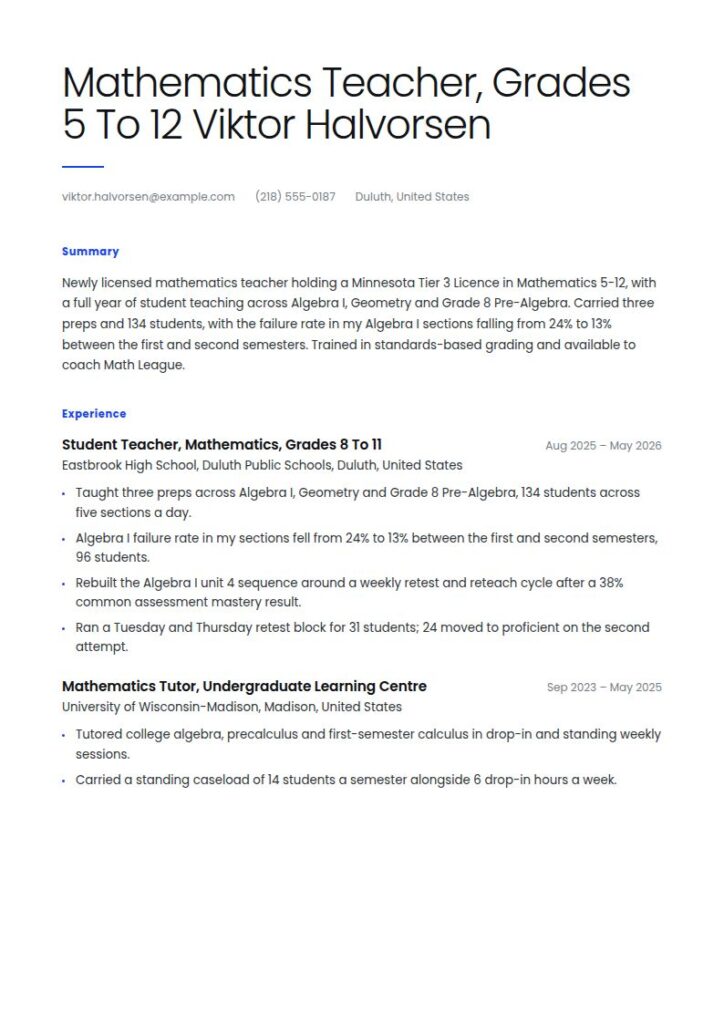
Newly licensed mathematics teacher holding a Minnesota Tier 3 Licence in Mathematics 5-12, with a full year of student teaching across Algebra I, Geometry and Grade 8 Pre-Algebra. Carried three preps and 134 students, with the failure rate in my Algebra I sections falling from 24% to 13% between the first and second semesters. Trained in standards-based grading and available to coach Math League.
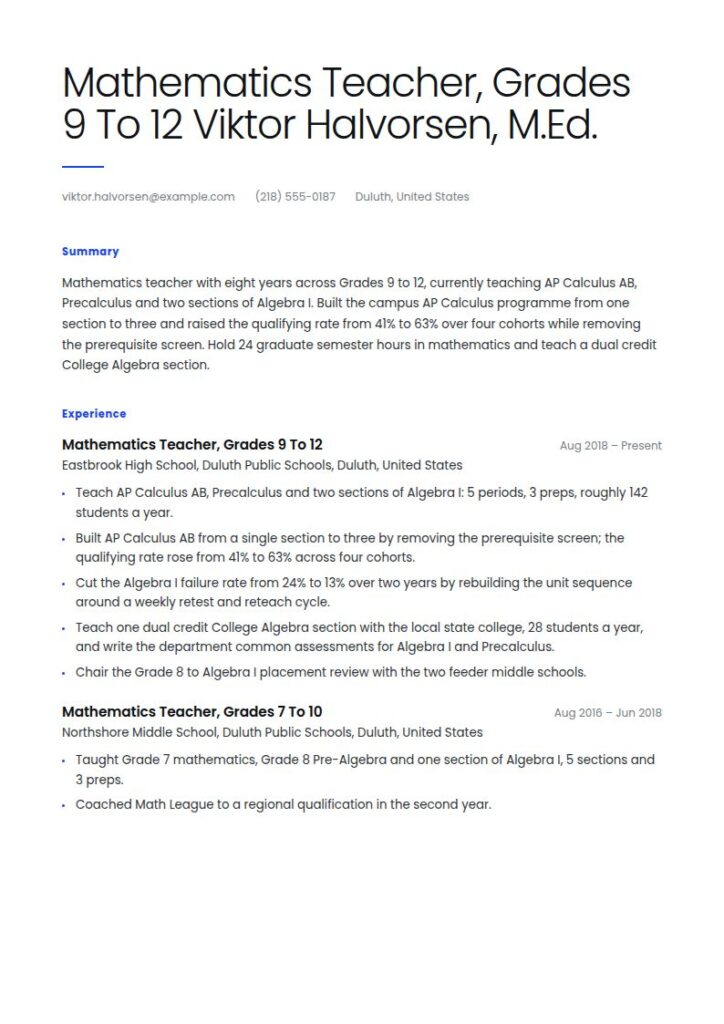
Mathematics teacher with eight years across Grades 9 to 12, currently teaching AP Calculus AB, Precalculus and two sections of Algebra I. Built the campus AP Calculus programme from one section to three and raised the qualifying rate from 41% to 63% over four cohorts while removing the prerequisite screen. Hold 24 graduate semester hours in mathematics and teach a dual credit College Algebra section.
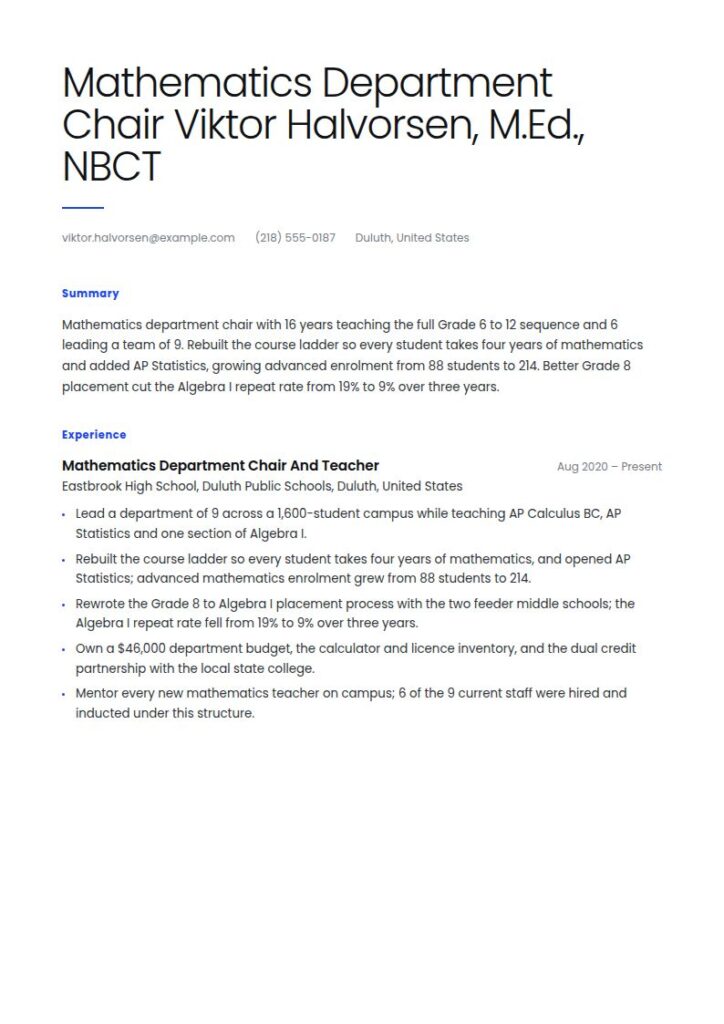
Mathematics department chair with 16 years teaching the full Grade 6 to 12 sequence and 6 leading a team of 9. Rebuilt the course ladder so every student takes four years of mathematics and added AP Statistics, growing advanced enrolment from 88 students to 214. Better Grade 8 placement cut the Algebra I repeat rate from 19% to 9% over three years.
Right vs wrong: the same math teacher summary, twice
| ✅ Right | ❌ Wrong |
|---|---|
| Mathematics teacher with eight years across Grades 9 to 12, currently teaching AP Calculus AB, Precalculus and two sections of Algebra I. | Experienced educator with a strong background in mathematics instruction. |
| Built the campus AP Calculus programme from one section to three. | Helped grow advanced course offerings at my school. |
| Raised the qualifying rate from 41% to 63% over four cohorts while removing the prerequisite screen. | Dedicated to helping every student achieve their potential in math. |
The left column is a schedule. The right column is a sentiment, and a chair with an unfilled Precalculus section cannot use one.
Outline your teaching experience
School, district, city, grade levels, courses and dates, then three to five bullets, each naming a course or cohort and carrying a number.
| Instead of | Use |
|---|---|
| Taught mathematics to high school students | Taught 5 sections across Algebra I, Precalculus and AP Calculus AB, 142 students and three preps |
| Improved student achievement in math | Cut the Algebra I failure rate from 24% to 13% across two semesters, 96 students |
| Helped grow the AP programme | Took AP Calculus from 1 section to 3 and the qualifying rate from 41% to 63% over four cohorts |
| Tutored students after school | Ran a Tuesday and Thursday retest block for 31 students; 24 moved to proficient on the second attempt |
Mathematics Teacher, Grades 9 to 12, Eastbrook High School, Duluth Public Schools, Duluth, MN, August 2018 to Present
Teach AP Calculus AB, Precalculus and two sections of Algebra I, 5 periods and 3 preps, roughly 142 students a year.
Built AP Calculus AB from a single section to three by removing the prerequisite screen; the qualifying rate rose from 41% to 63% across four cohorts.
Cut the Algebra I failure rate from 24% to 13% over two years by rebuilding the unit sequence around a weekly retest and reteach cycle.
Teach one dual credit College Algebra section with the local state college, 28 students a year, and write the department's common assessments for Algebra I and Precalculus.
Name where you sit on the course ladder
This is the block that decides your schedule, and almost nobody writes it. Mathematics is a sequence, so a chair reads your file as a range rather than a list. Give them the range in three lines, with a year or an enrolment beside anything advanced. Each rung tells them something different.
| Rung | What it signals |
|---|---|
| Grade 6 to 8 mathematics, Pre-Algebra | The middle band and the Grade 8 to Algebra I handoff, where most placement errors are made |
| Algebra I | The largest and highest-failure course in most departments, and the source of the most sections |
| Geometry | Proof and spatial reasoning, a different skill from the algebra strand |
| Algebra II | The gate to every advanced course, and a common bottleneck |
| Precalculus and AP Precalculus | You can be scheduled into the pathway that feeds calculus |
| AP Statistics | A separate branch, often unstaffed, and a strong differentiator |
| AP Calculus AB, then BC | Content depth, and the top of the ladder in most schools |
| Dual credit College Algebra or Calculus | Graduate hours in mathematics, which most accreditors set at 18 |
Taught: AP Calculus AB, Precalculus, Algebra II, Algebra I, Dual Credit College Algebra
Licensed to teach, not yet taught: Grades 6 to 8 mathematics, Pre-Algebra, Geometry, AP Statistics
Willing to pick up: two sections of Algebra I, Math League coaching, summer bridge for incoming Algebra I students
Those three lines answer three questions: what you have run, what you can be scheduled for tomorrow, and what you will absorb beyond the obvious. The third line is where ties break.
Where mathematics enrolment actually sits
In May 2025, 285,891 students took AP Calculus AB with 64.2% scoring 3 or higher, 266,791 took AP Statistics with 60.3% scoring 3 or higher, and 160,436 took AP Calculus BC with 78.6% scoring 3 or higher. AP Precalculus, the newest course in the sequence, drew 253,596 students with 80.8% scoring 3 or higher (College Board, AP score distributions, May 2025).
AP Statistics is now close in size to AP Calculus AB and is taught by far fewer teachers, because it sits on a separate branch of the ladder rather than at the top of the calculus strand. If you can teach it, it belongs on the first line of your file.
The National Council of Teachers of Mathematics argued in Catalyzing Change in High School Mathematics (NCTM, 2018) that schools should offer continuous four-year pathways, with every student studying mathematics each year and two to three years in a common shared pathway, and should discontinue tracking students into dead-end course pathways. A chair who has read that report wants teachers who carry both ends of the ladder, not specialists in the top.
Build a snapshot of your key skills
Ten to fourteen entries in groups. Keep them testable: a chair will ask about any of them.
Instruction: Standards-based grading, Retest and reteach cycles, Problem-based task design, Vertical alignment Grade 6 to 12, Scaffolding for students below grade level
Assessment and data: Item analysis, Common assessment writing, Placement decision review, AP score analysis
Systems and tools: Desmos and Desmos Classroom, GeoGebra, TI-84 and TI-Nspire, Delta Math, AP Classroom, Infinite Campus
Advanced content: AP Calculus AB and BC curriculum, AP Statistics curriculum, Dual credit College Algebra
List your education, licence and endorsements
Licence first with its tier, band, number and expiry, then degrees with graduate mathematics hours stated as a number, then certifications.
Minnesota Tier 4 Licence, Mathematics 5-12, #MN-5518024, valid through 2030. Issued by the Minnesota Professional Educator Licensing and Standards Board.
Master of Education, Mathematics Education, University of Minnesota Duluth, Duluth, MN, 2020. 24 graduate semester hours in mathematics, including real analysis and mathematical statistics.
Bachelor of Science, Mathematics, University of Wisconsin-Madison, Madison, WI, 2014
Certifications: AP Calculus AB Summer Institute, College Board (2019, renewed 2024). AP Statistics Summer Institute, College Board (2023). Desmos Certified Educator (2022).
The graduate hours line matters here because it is what lets a school schedule you for dual credit. Most regional accreditors ask for a master's in the discipline or a master's plus 18 graduate semester hours in it, and few applicants say whether they clear it.
Choose the right layout and design
Single column, plain type at 11 or 12 point, clear headings, no photograph. District applicant systems parse these into a structured record before a person sees them, and columns, text boxes and graphics break that.
Give the licence tier, band and number in the header. Write a three-line ladder block: taught, licensed, willing. Put a year and an enrolment beside every advanced course. State your graduate mathematics hours as a number. Give one number per bullet, tied to a course. Name the competition, club or summer bridge you would take on.
Do not write "taught various math classes" when the named ladder is the point. Do not list only the top of the ladder; it reads as a scheduling constraint. Do not claim software you have opened once, because a chair will ask. Do not omit Algebra I from a file that includes AP Calculus, if you have taught it.
Math teacher job market and outlook
Mathematics sits inside two flat occupations with heavy replacement demand, and a persistent shortage that makes the flat headline misleading.
| Measure | High school teachers | Middle school teachers |
|---|---|---|
| Jobs, 2025 | 1,087,500 | 630,100 |
| Projected change, 2025-35 | 0%, -2,500 | 0%, -2,600 |
| Projected annual openings | ~63,500 | ~38,800 |
| Typical entry-level education | Bachelor's degree | Bachelor's degree |
| Median annual wage, May 2025 | $72,040 | $64,370 |
Source: U.S. Bureau of Labor Statistics, Occupational Outlook Handbook, 2025-35 projections and May 2025 wage data.
Flat occupation, forty-state shortage
For the 2024 to 2025 school year, mathematics was reported in shortage by 40 states, behind only special education at 45 and science at 41 (Learning Policy Institute, July 2025).
The results explain the demand. On the 2024 NAEP, Grade 8 mathematics was flat against 2022 after the historic eight-point drop recorded that year, with a little more than a quarter of Grade 8 students at or above NAEP Proficient and nearly 40 percent below NAEP Basic (National Assessment Governing Board, 29 January 2025). Grade 12 mathematics fell 3 points against 2019, with 22 percent at or above NAEP Proficient and 45 percent below NAEP Basic, the highest share ever recorded (National Assessment Governing Board, 9 September 2025).
That is the argument for evidence over enthusiasm. Districts are hiring against measured decline, so a file that shows a number moving in one named course does something no philosophy statement can.
Where the jobs sit:
| Setting | Share of high school teacher employment | Median annual wage (May 2025) |
|---|---|---|
| Elementary and secondary schools, local (public) | 81% | $74,190 |
| Elementary and secondary schools, private | 17% | $61,810 |
Source: U.S. Bureau of Labor Statistics, Occupational Outlook Handbook, May 2025.
What salary you can expect as a math teacher
The median annual wage was $72,040 for high school teachers and $64,370 for middle school teachers as of May 2025; among high school teachers the lowest 10 percent earned less than $48,780 and the highest 10 percent more than $107,600 (BLS Occupational Outlook Handbook, May 2025).
District salary schedules do not pay mathematics more than English at the same step. Almost everything that moves a mathematics teacher above the schedule is a differential or stipend awarded against documentation: a shortage-subject differential where one exists, an AP or dual credit stipend, a department chair stipend, a National Board stipend, and competition sponsorships.
That is why the ladder block has a cash value. It is the evidence a district uses to decide which stipends you qualify for on the day the contract is written, rather than a year later.
Key takeaways for a math teacher resume
- Lead with the licence tier, band and number; the band is a gate.
- Write the course ladder in three lines: taught, licensed, willing to pick up.
- Name the bottom of your ladder as clearly as the top, because that is where the sections are.
- Put a year and an enrolment beside every advanced course.
- State your graduate semester hours in mathematics; that is the dual credit bar.
- Give one number per bullet, tied to a named course and a period of time.
- Name the competition or club you would take on, and keep the file single column so district portals can parse it.
Build your math teacher resume in 15 minutes.
Related education resume examples
- Teacher resume
- High school teacher resume
- Middle school teacher resume
- Elementary school teacher resume
- Student teacher resume
- Substitute teacher resume
- Special education teacher resume
- English teacher resume
- ESL teacher resume
- Academic tutor resume
- Tutor resume
- Principal resume
Pair it with a matching math teacher cover letter.
Math teacher resume questions, answered
Should I list every math course I have taught?
Yes, by name, in its own block, and separate what you have taught from what your licence covers. "Various math courses" tells a chair nothing, and the gap between taught and licensed is often the most useful line on the page: it says what they could try you on next year.
What if I have only taught the lower end of the ladder?
Write it clearly and add the rung above as a licensed-not-yet-taught line. Departments promote up the ladder from inside far more often than they hire into the top of it, so a candidate strong in Algebra I and ready for Algebra II is a normal and welcome hire.
How do I show results in a course with no state exam?
Use what your department already tracks: failure and pass rates by section, common assessment mastery, retest recovery, AP qualifying rates and enrolment, repeat rates in the next course, and Grade 8 placement accuracy. Give the before, the after and the period.
Does AP Statistics count as much as AP Calculus?
For scheduling, often more. In May 2025, 266,791 students took AP Statistics against 285,891 for AP Calculus AB (College Board, May 2025), and it sits on a separate branch of the ladder that fewer teachers can cover. A department that wants to open a section and has nobody to teach it will notice that line immediately.
Do I need graduate hours in mathematics to teach dual credit?
Usually yes. Most regional accreditors require a master's in the discipline, or a master's plus 18 graduate semester hours in it, for the instructor of record in a dual credit course. Count your graduate mathematics hours and state the number, because a chair who can schedule you for dual credit is scheduling a course the district funds differently.