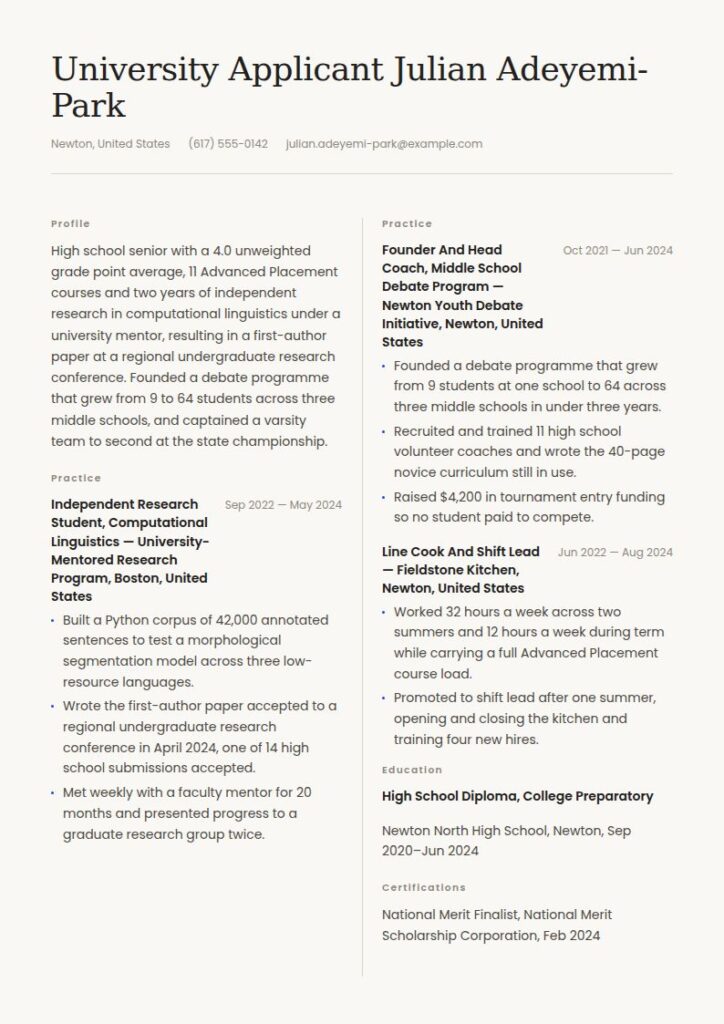
University Applicant Julian Adeyemi-Park
Independent Research Student, Computational Linguistics
[email protected] | (617) 555-0142 | Newton, United States
Profile
High school senior with a 4.0 unweighted grade point average, 11 Advanced Placement courses and two years of independent research in computational linguistics under a university mentor, resulting in a first-author paper at a regional undergraduate research conference. Founded a debate programme that grew from 9 to 64 students across three middle schools, and captained a varsity team to second at the state championship.
Work Experience
09/2022 - 05/2024, Independent Research Student, Computational Linguistics, University-Mentored Research Program, Boston, United States
- Built a Python corpus of 42,000 annotated sentences to test a morphological segmentation model across three low-resource languages.
- Wrote the first-author paper accepted to a regional undergraduate research conference in April 2024, one of 14 high school submissions accepted.
- Met weekly with a faculty mentor for 20 months and presented progress to a graduate research group twice.
10/2021 - 06/2024, Founder and Head Coach, Middle School Debate Program, Newton Youth Debate Initiative, Newton, United States
- Founded a debate programme that grew from 9 students at one school to 64 across three middle schools in under three years.
- Recruited and trained 11 high school volunteer coaches and wrote the 40-page novice curriculum still in use.
- Raised $4,200 in tournament entry funding so no student paid to compete.
06/2022 - 08/2024, Line Cook and Shift Lead, Fieldstone Kitchen, Newton, United States
- Worked 32 hours a week across two summers and 12 hours a week during term while carrying a full Advanced Placement course load.
- Promoted to shift lead after one summer, opening and closing the kitchen and training four new hires.
Education
09/2020 - 06/2024, High School Diploma, College Preparatory, Newton North High School, Newton, United States
4.00 unweighted grade point average. 11 Advanced Placement courses. National Merit Finalist. Relevant coursework: AP Calculus BC, AP Computer Science A, AP Statistics, AP Macroeconomics.
Skills
Python (pandas, NumPy), 75
Research design and literature review, 70
Academic writing, 80
Public speaking and competitive debate, 90
Curriculum writing and coaching, 80
LaTeX, 65
Languages
English, native
Korean, fluent
Spanish, intermediate
Certificates
02/2024, National Merit Finalist, National Merit Scholarship Corporation
Summary
A Harvard resume means the one-page academic and pre-professional format that selective university applications and on-campus recruiting expect: education first, quantified bullets, no pronouns, no graphics. This guide gives you three adaptable versions, the difference between an activities list and a resume, and the published careers-office rules the format is drawn from.
Harvard resume examples by experience level
A Harvard resume is not a document any one university issues. It is the shorthand people use for a particular format: a one-page, reverse chronological, education-first resume with quantified bullets, no personal pronouns, no graphics and no photograph.
That format is what highly selective university applications and on-campus recruiting both expect, and it is published openly. Harvard's careers office puts its resume guides and templates on a public website, as do most of its peers, and the rules are specific enough to follow. This guide cites that published guidance as one example among several. It is not affiliated with, endorsed by or connected to any university, and it contains no inside knowledge of any admissions office.
What it does contain is the standard itself, and the three points in a young career where you have to produce it.
Resume guide for a Harvard resume
This guide and the corresponding Harvard resume example will cover:
- How to write a one-page academic resume, section by section
- What the published careers-office rules actually say about format
- Three adaptable summaries: applicant, undergraduate and graduating senior
- Why the Common App activities list is a different document with different limits
- What the market looks like and what the qualification is worth
How to write a Harvard resume
Five sections: contact header, education, experience, activities and leadership, and skills and interests. One page, single column, reverse chronological inside every section.
Education sits first, which is the choice that marks this style out. In a professional resume education goes at the bottom; in an academic and early-career resume it goes at the top, because it is the strongest fact you have and the reader is sorting on it.
| Section | What goes in it | Why it sits there |
|---|---|---|
| Education | Institution, degree, field, dates, honours, coursework | The screen; keep it first until you have several years of work |
| Experience | Roles, research, internships, paid work, with quantified bullets | The evidence |
| Activities and leadership | Offices held, teams, publications, competitions | Where initiative shows |
| Skills and interests | Languages, technical tools, certifications, interests | The last line, and it does get read |
The published format rules are specific, so follow them exactly
Harvard's Mignone Center for Career Success publishes its resume guides openly. Its guidance for master's candidates states that "for most master's degree candidates, it is typical and often preferred to have a one-page resume", that font size "should be between 10 and 12 point and kept consistent throughout the document", that margins "should be equal all the way around the page and should be at least three quarters of an inch in size", and to "stick to a common, easy to read font, and avoid text boxes, color, and shading" (Harvard FAS Mignone Center for Career Success, resume and cover letter guide, 2025).
Its college resume guidance adds the content rules: be "specific rather than general", "active rather than passive" and "fact-based (quantify and qualify)", and do not "use personal pronouns (such as I or We)" or "start each line with a date". It also advises against a picture, age, gender or references (Harvard FAS Mignone Center for Career Success, guide to creating a strong resume).
Peer careers offices publish near-identical rules. The consistency is the point: this is a convention, not a preference, and a file that breaks it reads as written by someone outside it.
Run yours through the free Rezoom ATS resume checker before you send it, because recruiting portals parse before a human opens anything.
Choosing the best resume format for a Harvard resume
Reverse chronological, one page, single column, no columns and no sidebars.
One page is the hard constraint, and it is the part people fight. It is not a limit on what you have done; it is a test of whether you can rank it. A second page in an early-career resume signals that nothing has been cut, which is the opposite of the judgment being screened for. The exception is a research CV, a different document with different rules: publications, presentations, teaching and funding, as long as it needs to be.
Include your contact information
| ✅ Right | ❌ Wrong |
|---|---|
| Julian Adeyemi-Park | Julian Adeyemi-Park |
| Newton, MA | 214 Chestnut Hill Avenue, Apt 3, Newton, MA 02459 |
| (617) 555-0142, [email protected] | (617) 555-0142, [email protected] |
| linkedin.com/in/julianadeyemipark | Instagram, personal photograph, date of birth |
Four lines, no more. Use your full legal name as it appears on your transcript; a mismatch between the resume and the academic record creates a verification problem nobody will chase for you.
Make use of a summary
A summary is optional here and is often left off high school and undergraduate resumes, where education and activities carry the page. Where you include one, keep it to three lines: who you are academically, what you have done, and what you are applying for.
High school senior with a 4.0 unweighted grade point average, 11 Advanced Placement courses and two years of independent research in computational linguistics under a university mentor, resulting in a first-author paper at a regional undergraduate research conference. Founded a debate programme that grew from 9 to 64 students across three middle schools, and captained a varsity team to second at the state championship.
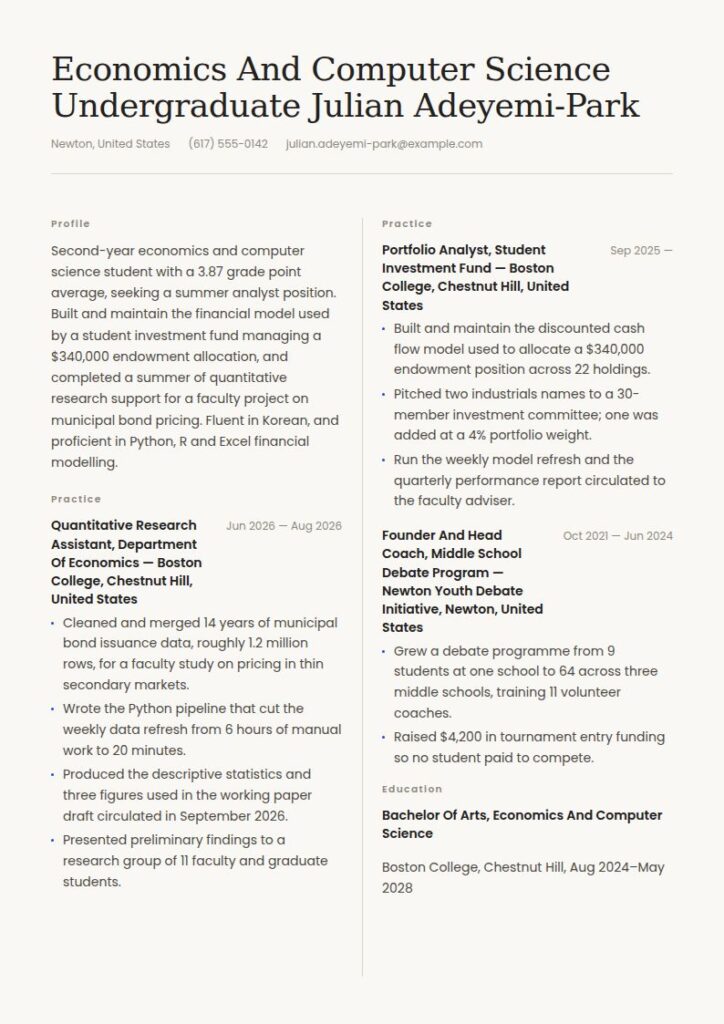
Second-year economics and computer science student with a 3.87 grade point average, seeking a summer analyst position. Built and maintain the financial model used by a student investment fund managing a $340,000 endowment allocation, and completed a summer of quantitative research support for a faculty project on municipal bond pricing. Fluent in Korean, and proficient in Python, R and Excel financial modelling.
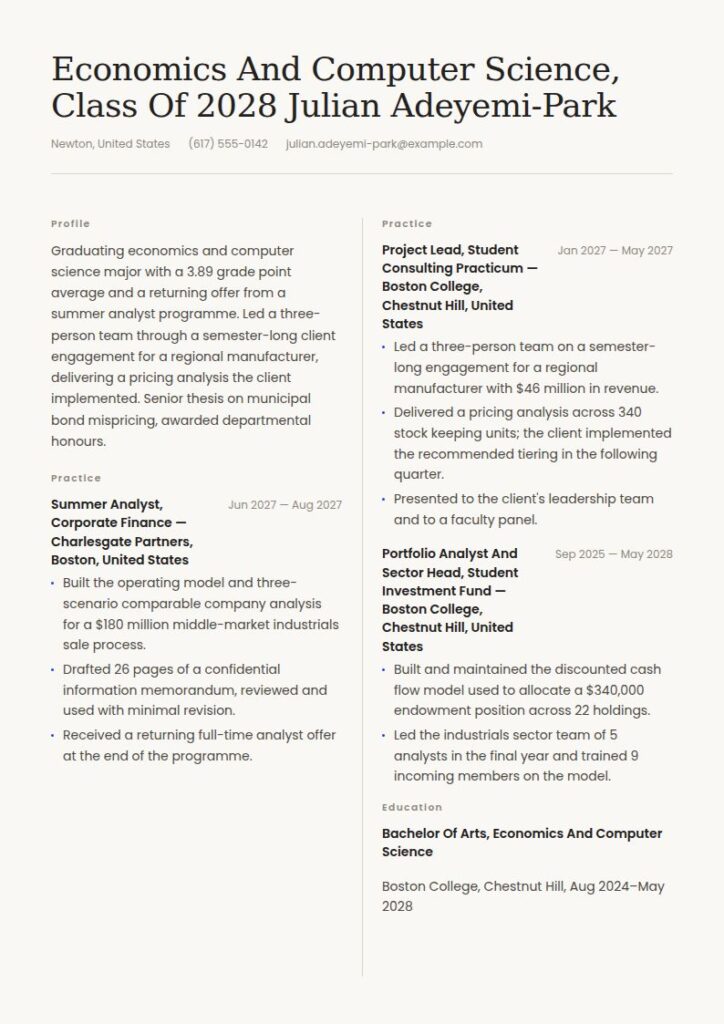
Graduating economics and computer science major with a 3.89 grade point average and a returning offer from a summer analyst programme. Led a three-person team through a semester-long client engagement for a regional manufacturer, delivering a pricing analysis the client implemented. Senior thesis on municipal bond mispricing, awarded departmental honours.
Right vs wrong: the same Harvard resume summary, twice
| ✅ Right | ❌ Wrong |
|---|---|
| Second-year economics and computer science student with a 3.87 grade point average. | Highly motivated student with a strong academic background. |
| Built and maintain the financial model used by a fund managing a $340,000 endowment allocation. | Active member of the student investment club. |
| Completed a summer of quantitative research support on municipal bond pricing. | Gained valuable experience in finance and research. |
The right column is checkable. In a process where everyone in the pile has good grades, checkable is the only thing that separates files.
Outline your experience
Organisation, role, city, dates. Then two to four bullets, each starting with a past-tense verb and carrying a number, a scale or an outcome. The formula the published guides describe is verb, task, quantified result. Nothing should be passive, and nothing should begin with a date.
| Instead of | Use |
|---|---|
| Responsible for helping run the student investment fund | Built and maintained the discounted cash flow model used to allocate a $340,000 endowment position |
| Worked on a research project with a professor | Cleaned and merged 14 years of municipal bond issuance data, 1.2 million rows, for a faculty pricing study |
| Was captain of the debate team | Captained a 24-person debate team to a second-place state finish, and coached 9 novice members through their first season |
| Had a summer job at a restaurant | Worked 32 hours a week through two summers while carrying a full course load, funding roughly 40% of term costs |
That last row is worth keeping. A paid job during term is evidence, not a gap in a prestige narrative, and admissions readers and recruiters both read it as one.
Quantitative Research Assistant, Department of Economics, Boston College, Chestnut Hill, MA, June 2026 to August 2026
Cleaned and merged 14 years of municipal bond issuance data, roughly 1.2 million rows, for a faculty study on pricing in thin secondary markets.
Wrote the Python pipeline that reduced the weekly data refresh from 6 hours of manual work to 20 minutes.
Produced the descriptive statistics and three figures used in the working paper draft circulated in September 2026.
Presented preliminary findings to a research group of 11 faculty and graduate students.
The activities list, the admissions resume and the recruiting resume
These are three different documents, and most applicants treat them as one.
The Common App activities section is a form with hard limits. You can list up to ten activities, with 100 characters for the organisation name, 50 for the position or leadership description and 150 for the details, honours won and accomplishments (Common App, first-year activities guidance, 25 June 2025). Those limits change the writing: at 150 characters you choose between one number and one verb rather than composing a sentence. Cut articles, cut "responsible for", lead with the scale.
The admissions resume, where a university accepts one as an additional document, reaches what the form clipped: one page, education first, with room for the research project and its output, the programme you built and its growth, the job you held and its hours.
The recruiting resume arrives about eighteen months later and is different again, because the reader is. Careers offices publish the timelines openly and they are earlier than students expect: for investment banking, applications open in the winter and spring of second year for an internship that runs after third year, with interviews rolling through spring and summer (Dartmouth Center for Career Design, banking recruiting guidance). By then the admissions-era activities have to be recast as work: scale, money handled, models built, people managed.
| Document | Hard limit | What the reader wants |
|---|---|---|
| Common App activities | 10 entries, 150 characters each | Scale, duration, position, one number |
| Admissions resume | One page | Depth on the three things that matter, in full sentences |
| Recruiting resume | One page | Quantified outcomes, technical skills, relevant coursework, GPA |
Rank ruthlessly and keep it to one page. Put education first until you have several years of work behind you. Start every bullet with a past-tense verb and put a number in it. List your grade point average while it is strong, with its scale. Name the tools, languages and methods you can actually use. Keep one line of genuine interests at the bottom, because it is where interviews start.
Do not use personal pronouns, per the published guidance. Do not use text boxes, colour, shading, columns or a photograph. Do not begin a line with a date. Do not list more than four or five courses. Do not claim a language as fluent that you cannot interview in. Do not call yourself driven, motivated or hardworking; the whole pile says that.
Build a snapshot of your key skills
Six to ten entries on one or two lines, split into technical and languages. List only what survives a follow-up question.
Technical: Python (pandas, NumPy), R, SQL, Excel financial modelling and discounted cash flow, Stata, LaTeX
Languages: English (native), Korean (fluent), Spanish (intermediate, B1 certified)
Interests: Competitive debate coaching, long-distance running, municipal finance history
List your education and honours
Institution, degree, field, expected or awarded date, grade point average with its scale, honours, and a short coursework line.
Boston College, Chestnut Hill, MA. Bachelor of Arts, Economics and Computer Science, expected May 2028. Grade point average 3.87 of 4.00. Dean's List, all semesters.
Relevant coursework: Econometrics, Corporate Finance, Data Structures, Machine Learning, Financial Accounting
Newton North High School, Newton, MA. Graduated June 2024, 4.0 unweighted. National Merit Finalist. 11 Advanced Placement courses.
Drop the school entry once you are past second year, unless it carries a nationally recognised award.
Choose the right layout and design
One page, single column, a common serif or sans-serif face at 10 to 12 point, margins of at least three quarters of an inch on all four sides, no text boxes, no colour, no shading and no photograph, following the published guidance cited above.
Export as PDF, named for yourself and the post. A two-column template with an icon set is exactly the file this convention is defined against, and recruiting portals parse it badly as well.
The market a Harvard resume competes in
The volume is the reason the format is strict.
| Measure | Value |
|---|---|
| Distinct first-year applicants, 2025-26 season | 1,527,328 |
| Applications submitted through Common App | 10,786,782 |
| Average applications per applicant | 7.06 |
| Change in applications on the prior season | +6% |
| Activities a student may list | 10 |
Source: Common App, end-of-season report, 2025-26 first-year application trends, published 20 August 2026.
The conversion point has moved earlier than most students think
Among employers surveyed for the 2026 Internship and Co-op Survey, the intern-to-full-time conversion rate reached 63.1%, the highest in five years, and 88.3% of offers made to interns were accepted, up from 82.8% the year before (National Association of Colleges and Employers, published 3 April 2026, based on 2024-25 interns).
Read that alongside the recruiting calendar. If roughly two thirds of interns convert to full-time offers, and the internship is sourced in the winter of second year, the resume that decides a graduate job is written before third year begins.
That is the case for taking this format seriously early. The version that matters most is usually the one you write with the least experience, under the tightest page limit, for the earliest deadline.
What salary you can expect
There is no single wage here, because this page covers a qualification level rather than an occupation. The federal data on what the credential is worth is the honest substitute.
| Educational attainment | Median usual weekly earnings, 2025 | Unemployment rate, 2025 |
|---|---|---|
| Doctoral degree | $2,307 | 1.8% |
| Professional degree | $2,294 | 1.9% |
| Master's degree | $1,876 | 2.6% |
| Bachelor's degree | $1,578 | 2.8% |
| Associate degree | $1,135 | 3.0% |
| High school diploma | $966 | 4.3% |
| All workers | $1,268 | 3.4% |
Source: U.S. Bureau of Labor Statistics, Employment Projections, earnings and unemployment by educational attainment, 2025 annual data for full-time wage and salary workers aged 25 and over. BLS notes that 2025 annual estimates are 11-month averages excluding October and are not strictly comparable with other years.
A bachelor's degree carries a median of $1,578 a week against $966 for a high school diploma, a gap of about 63%, with roughly a third lower unemployment. What the resume does inside that is narrower: it decides which internship you get, and the internship is what converts.
Key takeaways for a Harvard resume
- One page, single column, education first, reverse chronological inside every section.
- No pronouns, no photograph, no colour, no text boxes, per the published careers-office rules.
- Start every bullet with a past-tense verb and put a number in it.
- Treat the activities list and the resume as two documents with different limits.
- Write to the character count when the form imposes one; cut articles, keep numbers.
- Include the paid job; hours worked during term reads as evidence, not as a gap.
- Write the recruiting version early, because the internship window opens in second year.
Build your resume in 15 minutes.
Related education resume examples
- College admissions resume
- College student resume
- High school student resume
- Student resume
- Internship resume
- Scholarship resume
- Graduate school resume
- Master's resume
- PhD resume
- College graduate resume
- Research assistant resume
- Academic resume
Pair it with a matching Harvard cover letter.
Harvard resume questions, answered
Is there an official Harvard resume template?
Harvard's careers office publishes resume templates and guides on a public website, and other selective universities publish their own. No university issues an official resume to applicants, and no template gets anyone admitted. What the published guides give you is a checkable set of formatting rules: one page, 10 to 12 point type, margins of at least three quarters of an inch, no text boxes, colour or shading, no personal pronouns.
Should I put my GPA on the resume?
Yes, while it is strong, with the scale attached: "3.87 of 4.00". Finance, consulting and technology recruiting commonly asks for it, and leaving it off a file that otherwise looks competitive invites the assumption you are hiding it. Drop it once you have several years of work behind you.
How do I write a resume with no work experience?
Write what you have as work. Research, a club you built, a team you captained, a tutoring programme, a paid job, a family responsibility that took real hours. Each gets an organisation, a role, dates and two to four bullets with numbers: how many people, how many hours, how much money, how much it grew.
Does a resume matter for university admissions if the application already has an activities list?
The activities list is compulsory and capped; the resume, where accepted as an additional document, is optional and is not. The Common App allows ten activities at 150 characters each for details, enough for scale and duration and little else. Check each university's policy first, because some ask you not to attach one.
How early should I start on the recruiting version?
Earlier than feels reasonable. Careers offices publish banking timelines showing applications opening in the winter and spring of second year for internships that run after third year, and with an intern-to-full-time conversion rate of 63.1% in the most recent survey (NACE, April 2026), that internship is usually the graduate job. A usable one-page resume by the start of second year is the target.