Julian Adeyemi-Park Economics and Computer Science Undergraduate Newton, 02459, United States [email protected] · (617) 555-0142
11 September 2026
Ms. Adaeze Okonkwo Campus Recruiting, Corporate Finance Charlesgate Partners Boston, United States
Application for Summer Analyst, Corporate Finance, Charlesgate Partners
Dear Ms. Okonkwo,
I am applying for the Summer Analyst position in corporate finance at Charlesgate Partners, which I saw through the Boston College recruiting calendar. I am a second-year economics and computer science student with a 3.87 grade point average, and I build and maintain the valuation model for a student fund that allocates a $340,000 endowment position.
The work I would most want to bring is from a faculty research project on municipal bond pricing last summer. The group had four research assistants spending most of a day each week refreshing an issuance dataset by hand, and the refresh was identical every time. I proposed automating it, wrote a Python pipeline over two weeks, and reduced the weekly refresh from about six hours of manual work to twenty minutes. That freed the team to extend the sample from 6 years to 14, roughly 1.2 million rows, which is the sample the working paper now uses. It also taught me that most of the value in a junior role is noticing which repeated task should stop being manual.
Charlesgate interests me specifically because of the middle-market industrials focus. My fund work has been almost entirely industrials, I led the pitch that added a components manufacturer at a 4% weight, and I would rather learn valuation in a sector where the operating detail actually moves the number than in one where it does not. I also read your published note on pricing in thin secondary markets, which overlaps directly with the research I worked on.
I am available for the full ten-week programme from June and can interview at any point this autumn. Thank you for considering my application.
Sincerely, Julian Adeyemi-Park
Summary
A Harvard cover letter means the one-page academic and pre-professional letter that selective programmes and on-campus recruiting expect: a named addressee, one specific reason for this employer, one piece of quantified evidence, and no restatement of the resume. This guide gives you a full adaptable letter and the published careers-office rules behind the format.
Harvard cover letter examples by experience level
A Harvard cover letter is not a document any university issues. It is shorthand for a convention: a one-page, four-paragraph letter addressed to a named person, built on one specific reason for this employer and one piece of quantified evidence, in the same plain type as the resume it accompanies.
Harvard's careers office publishes its cover letter guidance openly, as do its peers, and this guide cites that guidance as one example among several. It is not affiliated with, endorsed by or connected to any university, and contains no inside knowledge of any admissions or recruiting process.
Guide to a Harvard cover letter
This guide and the corresponding Harvard cover letter example will cover:
- How to structure the letter, paragraph by paragraph
- Why the letter must not repeat the resume
- What a specific reason for one employer sounds like
- How the letter changes across research, consulting and finance
- Length, format and how to send it
How to write a Harvard cover letter
| Paragraph | Its job | Length |
|---|---|---|
| Opening | The exact post, where you saw it, and one line on who you are | 2 to 3 sentences |
| Evidence | One project, one number, one outcome, told properly | 4 to 6 sentences |
| Fit | Why this employer specifically, from something real you found | 3 to 4 sentences |
| Close | Availability and thank you | 2 sentences |
The letter is for the thing the resume cannot hold
A resume bullet is one line and a number. A letter paragraph is the story that line compresses: what the situation was, what you decided, what you did, what changed.
So pick one bullet and unpack it. "Wrote the Python pipeline that cut the weekly data refresh from 6 hours to 20 minutes" becomes a paragraph about noticing that four research assistants spent most of a day on an identical weekly task, proposing the automation without being asked, and what the group did with the time it got back.
The published guidance is consistent on tone: be specific rather than general, active rather than passive, and fact-based, quantifying and qualifying wherever possible (Harvard FAS Mignone Center for Career Success). The same rules govern resume and letter; the letter just has room for sentences.
A Harvard cover letter example you can adapt
Dear Ms. Okonkwo,
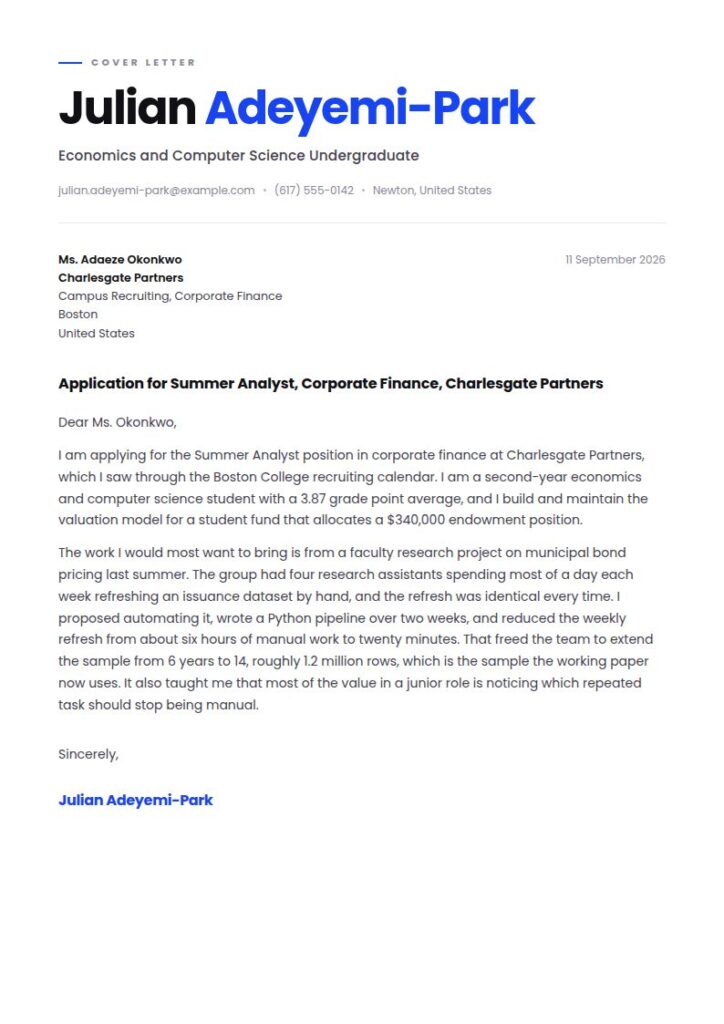
I am applying for the Summer Analyst position in corporate finance at Charlesgate Partners, which I saw through the Boston College recruiting calendar. I am a second-year economics and computer science student with a 3.87 grade point average, and I build and maintain the valuation model for a student fund that allocates a $340,000 endowment position.
The work I would most want to bring is from a faculty research project on municipal bond pricing last summer. The group had four research assistants spending most of a day each week refreshing an issuance dataset by hand, and the refresh was identical every time. I proposed automating it, wrote a Python pipeline over two weeks, and reduced the weekly refresh from about six hours of manual work to twenty minutes. That freed the team to extend the sample from 6 years to 14, roughly 1.2 million rows, which is the sample the working paper now uses. It also taught me that most of the value in a junior role is noticing which repeated task should stop being manual.
Charlesgate interests me specifically because of the middle-market industrials focus. My fund work has been almost entirely industrials, I led the pitch that added a components manufacturer at a 4% weight, and I would rather learn valuation in a sector where the operating detail actually moves the number than in one where it does not. I also read your published note on pricing in thin secondary markets, which overlaps directly with the research I worked on.
I am available for the full ten-week programme from June and can interview at any point this autumn. Thank you for considering my application.
Sincerely, Julian Adeyemi-Park
Openings that work
| Instead of | Use |
|---|---|
| I am writing to express my strong interest in your internship programme | I am applying for the Summer Analyst position in corporate finance, which I saw through the Boston College recruiting calendar |
| I am a highly motivated student with a passion for finance | I am a second-year economics and computer science student who builds the valuation model for a $340,000 student fund |
| Your firm's excellent reputation attracted me | Charlesgate interests me specifically because of the middle-market industrials focus |
| I believe I would be a valuable asset to your team | I would rather learn valuation in a sector where the operating detail moves the number |
What the letter must not do
Address a named person, found on the firm's site, the recruiting calendar or the programme page. Name the exact post and where you saw it. Unpack exactly one resume bullet into a real paragraph. Give one specific, checkable reason for this employer. Keep the same typeface, size and margins as your resume. Send a PDF named for yourself and the post.
Do not restate the resume in prose; the reader has it open. Do not open with your childhood interest in the field. Do not praise the employer's prestige or excellence, which reads as a letter that could go anywhere. Do not exceed one page or four paragraphs. Do not use colour, a sidebar or an icon; the convention is plain type on white.
Volume is why the specific line survives and the generic one does not
In the 2025-26 season, 1,527,328 distinct first-year applicants submitted 10,786,782 applications through the Common App, an average of 7.06 each and 6% more applications than the season before (Common App, end-of-season report, published 20 August 2026).
Recruiting runs on the same arithmetic a few years later, and it runs early: the intern-to-full-time conversion rate reached 63.1% among employers surveyed for the 2026 Internship and Co-op Survey, the highest in five years, with 88.3% of intern offers accepted (National Association of Colleges and Employers, published 3 April 2026).
The reader is doing two things at once: reducing a very large pile fast, and identifying someone they will still want twelve months later. A paragraph of admiration helps with neither. One checkable sentence about why this employer, and one about what you did, helps with both.
How the letter changes by destination
| Application | What paragraph two carries | What paragraph three names |
|---|---|---|
| Research or lab position | The method, the dataset, the output, the supervisor | The paper, question or technique you want to work on |
| Consulting | A team you led, a client, a recommendation implemented | A practice area or a published case you read |
| Finance | A model you built, a pitch you made, money under analysis | A sector, deal type or published note |
| Graduate school or fellowship | The thesis question and why it is open | Two named faculty and what each works on |
| Teaching or tutoring role | Number of students, duration, measured change | The programme's own curriculum or population |
The pattern holds: paragraph two is evidence with a number, and paragraph three is the sentence you could not have written about anyone else.
Length, format and sending it
One page, four paragraphs, 250 to 400 words. Same font, size and margins as the resume, following the published guidance to keep type between 10 and 12 point, margins at least three quarters of an inch, and to avoid text boxes, colour and shading (Harvard FAS Mignone Center for Career Success, 2025).
Address a person. Recruiting coordinators, programme directors and lab principal investigators are almost always named publicly. "Dear Hiring Committee" tells the reader the letter went to thirty firms.
Use the same numbers as your resume and check the pair together. Our Harvard resume example uses the figures above, and the free Rezoom ATS resume checker will tell you whether the file parses.
Key takeaways
- One page, four paragraphs, addressed to a named person.
- Name the exact post and where you found it in the first sentence.
- Unpack one resume bullet into a paragraph; do not summarise the resume.
- Put a number in the second paragraph and a checkable fact in the third.
- Give one reason for this employer that could not apply to a competitor.
- Match the resume's typeface, size and margins exactly.
- Start earlier than feels reasonable, because the recruiting window opens in second year.
Write your cover letter in 10 minutes.
Harvard cover letter questions, answered
Do selective universities want a cover letter with an application?
Almost never. Admissions runs on essays, and an unrequested letter usually goes unread. The cover letter becomes essential a year or two later, for research positions, internships, fellowships and on-campus recruiting. Check each programme's instructions and send only what is asked for.
How long should a Harvard cover letter be?
One page, four paragraphs, 250 to 400 words. The convention is strict for the same reason the one-page resume is: the reader is sorting a large pile, and length is not effort.
What do I write when I have no relevant experience?
Write the transferable thing properly rather than apologising. A summer of paid work at 32 hours a week while carrying a full course load shows reliability under load; a tutoring programme you built shows initiative and scale. Give the numbers, then say in one sentence what it taught you that applies here. Never open with what you lack.
Should I mention my grade point average in the letter?
Once, in the first paragraph, if it is strong and the process asks for it. Finance, consulting and many technology programmes screen on it explicitly. Do not repeat it later; the letter exists for what a transcript cannot show.
Is it acceptable to reuse the letter across applications?
Reuse the structure and the evidence paragraph. Rewrite the first and third every time, because those name the post and the employer and are the two a reader checks. A letter with the wrong firm name in it is the most common self-inflicted rejection in on-campus recruiting.