Instructional Designer Adrian Kovačević M.Ed.
Instructional Designer, Learning and Organizational Development
[email protected] | (612) 555-0142 | Minneapolis, United States
Profile
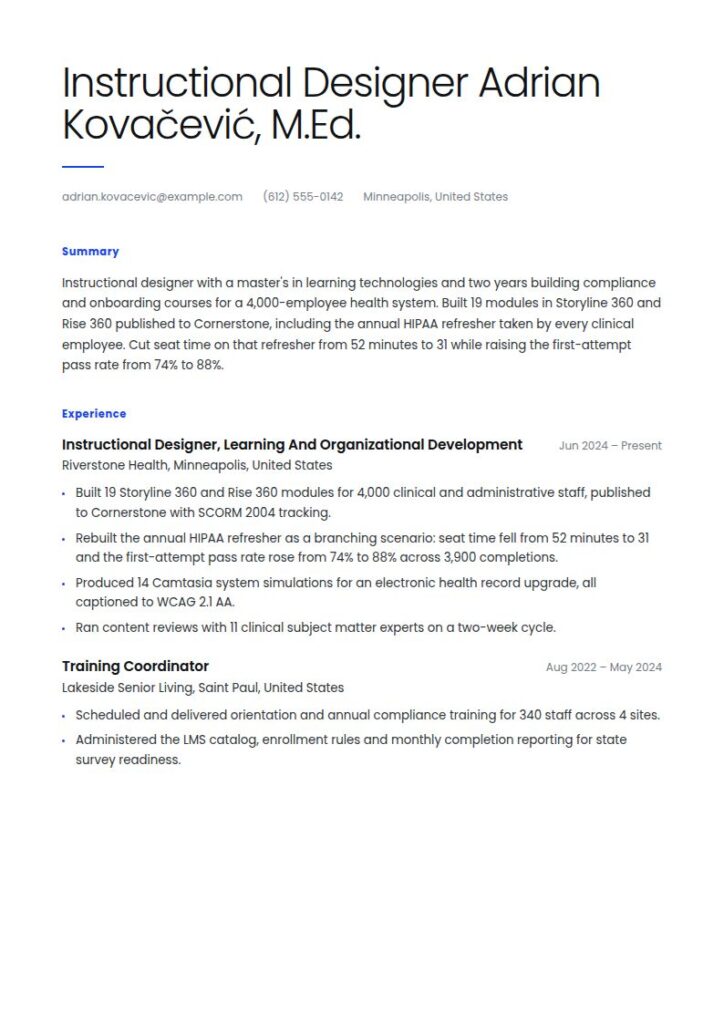
Instructional designer with a master's in learning technologies and two years building compliance and onboarding courses for a 4,000-employee health system. Built 19 modules in Storyline 360 and Rise 360 published to Cornerstone, including the annual HIPAA refresher taken by every clinical employee. Cut seat time on that refresher from 52 minutes to 31 while raising the first-attempt pass rate from 74% to 88%.
Work Experience
06/2024 - Present, Instructional Designer, Learning and Organizational Development, Riverstone Health, Minneapolis, United States
- Built 19 Storyline 360 and Rise 360 modules for 4,000 clinical and administrative staff, published to Cornerstone with SCORM 2004 tracking.
- Rebuilt the annual HIPAA refresher as a branching scenario: seat time fell from 52 minutes to 31 and the first-attempt pass rate rose from 74% to 88% across 3,900 completions.
- Produced 14 Camtasia system simulations for an electronic health record upgrade, all captioned to WCAG 2.1 AA.
- Ran content reviews with 11 clinical subject matter experts on a two-week cycle.
08/2022 - 05/2024, Training Coordinator, Lakeside Senior Living, Saint Paul, United States
- Scheduled and delivered orientation and annual compliance training for 340 staff across 4 sites.
- Administered the LMS catalog, enrollment rules and monthly completion reporting for state survey readiness.
Education
09/2022 - 05/2024, Master of Education, Learning Technologies, University of Minnesota, Minneapolis, United States
Capstone: a branching compliance scenario evaluated against first-attempt assessment performance.
09/2016 - 05/2020, Bachelor of Arts, Communication Studies, University of Wisconsin-Eau Claire, Eau Claire, United States
Skills
Articulate Storyline 360, 75
Articulate Rise 360, 85
Camtasia, 80
Cornerstone LMS administration, 70
SCORM 1.2 and 2004 publishing, 70
Storyboarding and objective writing, 75
WCAG 2.1 AA captioning and alt text, 70
Subject matter expert interviewing, 70
Languages
English, native
Croatian, native
Spanish, beginner
Certificates
04/2025, Associate Professional in Talent Development (APTD), ATD Certification Institute
Credential of the Association for Talent Development.
10/2025, Certified Professional in Accessibility Core Competencies (CPACC), International Association of Accessibility Professionals
Summary
An instructional designer resume is a one to two page document that carries a live portfolio link, names the authoring tools and platforms you build in, and reports what each course changed for the people who took it. This guide gives you three adaptable versions, what a portfolio page has to contain, and current Bureau of Labor Statistics pay and outlook.
Instructional Designer resume examples by experience level
An instructional designer resume is a one to two page document that names the authoring tools you build in, the platforms you publish to, and what measurably changed for the people who took your courses. It also carries a working portfolio link, and that link does at least half the work.
This is the one role in the education category that mostly does not happen in a school. Instructional designers sit in corporate learning and development, hospital systems, software companies, government agencies and university online programs.
Resume guide for an instructional designer resume
This guide and the instructional designer resume example below will cover:
- How to write the resume, section by section
- What a portfolio link has to contain before it helps you
- Three adaptable summaries: new, practising and lead
- Which learning models to name, and which claims are contested
- What the job market looks like and what you can expect to earn
How to write an instructional designer resume
Six blocks: contact header with the portfolio URL, summary, tools and platforms, experience, selected projects, education and certifications. One page under five years, two once you have run programs rather than courses.
| Section | What it is answering | Where it goes |
|---|---|---|
| Portfolio link | Can I see what this person builds? | In the header, next to the email |
| Tools and platforms | Can they build in what we already own? | Its own block, high on page one |
| Experience | What changed because the training existed? | Reverse chronological, with numbers |
| Selected projects | What is the hardest thing they shipped? | Two or three entries, scope and outcome |
A hiring manager checks two things in the first fifteen seconds: is there a portfolio, and does the tool list match the stack the organization already owns.
Put the portfolio URL in the header, not at the bottom
Instructional design is one of the few fields where a resume without a link reads as incomplete. The header should run name, title, city, email, phone, portfolio URL, because the link is used as a contact detail. Write it in full as a real hyperlink. A shortened link, a general profile or a password-protected portfolio all cost you the click.
Run the finished file through the free Rezoom ATS resume checker before you submit. Large employers and university systems parse applications into a structured record before a human opens them.
Choosing the best resume format for an instructional designer resume
Reverse chronological, with a selected projects block underneath. One page for the first five years, two once you have owned a curriculum or led a team.
A purely functional format fails here even though the work is project-based, because the hiring question is whether you have shipped inside a real organization with real constraints: a subject matter expert who will not answer email, a legal review, a launch date tied to a go-live. A timeline shows that. For a career changer, move the projects block above experience.
Include your contact information
| ✅ Right | ❌ Wrong |
|---|---|
| Adrian Kovačević | Adrian Kovačević |
| Instructional Designer, Healthcare and Compliance | Passionate learning professional and lifelong learner |
| adriankovacevic.example.com | Portfolio available upon request |
| (612) 555-0142, [email protected], Minneapolis, MN | (612) 555-0142, [email protected] |
"Portfolio available upon request" reads as "there is no portfolio". Fix that before you send the resume.
Make use of a summary
Four lines: what you design, for whom, in what tools, and one outcome with a number attached.
Instructional designer with a master's in learning technologies and two years building compliance and onboarding courses for a 4,000-employee health system. Built 19 modules in Storyline 360 and Rise 360 published to Cornerstone, including the annual HIPAA refresher taken by every clinical employee. Cut seat time on that refresher from 52 minutes to 31 while raising the first-attempt pass rate from 74% to 88%.
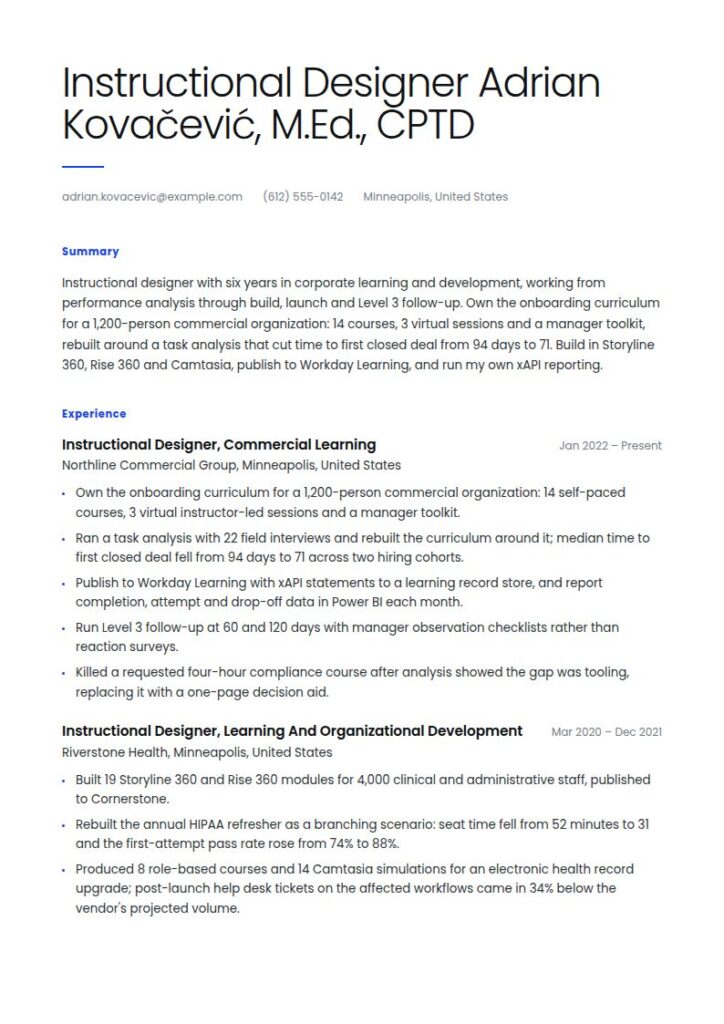
Instructional designer with six years in corporate learning and development, working from performance analysis through build, launch and Level 3 follow-up. Own the onboarding curriculum for a 1,200-person commercial organization: 14 courses, 3 virtual sessions and a manager toolkit, rebuilt around a task analysis that cut time to first closed deal from 94 days to 71. Build in Storyline 360, Rise 360 and Camtasia, publish to Workday Learning, and run my own xAPI reporting.
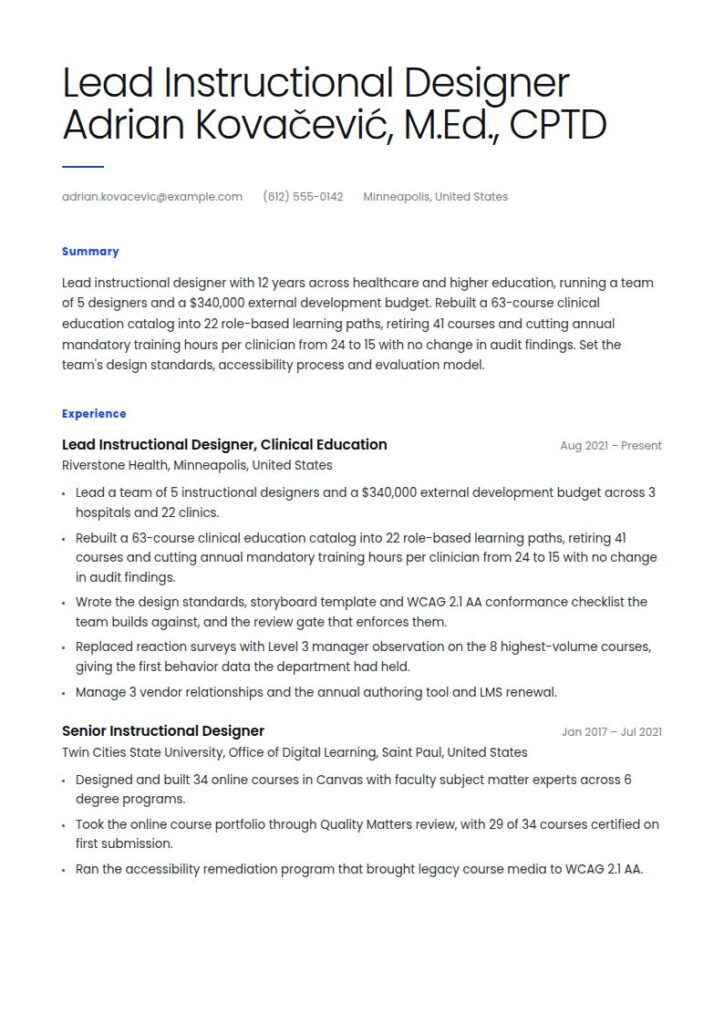
Lead instructional designer with 12 years across healthcare and higher education, running a team of 5 designers and a $340,000 external development budget. Rebuilt a 63-course clinical education catalog into 22 role-based learning paths, retiring 41 courses and cutting annual mandatory training hours per clinician from 24 to 15 with no change in audit findings. Set the team's design standards, accessibility process and evaluation model.
Right vs wrong: the same instructional designer summary, twice
| ✅ Right | ❌ Wrong |
|---|---|
| Instructional designer with six years in corporate learning and development. | Creative learning professional passionate about engaging content. |
| Own the onboarding curriculum: 14 courses, 3 virtual sessions and a manager toolkit. | Experienced in designing a wide variety of training materials. |
| Task analysis cut time to first closed deal from 94 days to 71. | Committed to delivering high-impact learning solutions. |
| Build in Storyline 360, Rise 360 and Camtasia; publish to Workday Learning. | Proficient in industry-standard authoring tools. |
The right column can be matched against a job posting line by line. The left column cannot.
Outline your instructional design experience
Employer, title, dates, and the size of the audience. Then three to five bullets, each naming an artifact or an audience and carrying a number: seat time, completion, assessment scores, time to productivity, help desk tickets.
| Instead of | Use |
|---|---|
| Designed and developed eLearning courses | Built 19 Storyline 360 and Rise 360 modules for 4,000 clinical and administrative staff |
| Worked with subject matter experts | Ran content reviews with 11 clinical subject matter experts on a two-week cycle |
| Improved training outcomes | First-attempt pass rate rose from 74% to 88% after the rebuild |
| Created engaging content | Cut average seat time on the annual refresher from 52 minutes to 31 |
Instructional Designer, Learning and Organizational Development, Riverstone Health, Minneapolis, MN, March 2022 to Present
Design compliance, onboarding and clinical systems training for 4,000 employees across 3 hospitals and 22 clinics.
Rebuilt the annual HIPAA refresher as a branching scenario in Storyline 360: seat time fell from 52 minutes to 31 and the first-attempt pass rate rose from 74% to 88% across 3,900 completions.
Ran the learning workstream for an electronic health record upgrade: 8 role-based Rise 360 courses, 14 Camtasia simulations and a 40-page quick reference set, with post-launch help desk tickets 34% below the vendor's projected volume.
Replaced a requested four-hour course with a one-page decision aid after analysis showed the gap was tooling, not knowledge, saving roughly 2,600 staff hours a year.
Administer 320 active courses in Cornerstone: versioning, enrollment rules and quarterly compliance reporting.
Your portfolio link is the other half of the instructional designer resume
No other role in this category is hired on a link. This one is, and a portfolio showing only finished screens loses to one showing reasoning. Hiring managers here screen work samples ahead of credentials, favoring a small number of deeply documented projects over a large gallery (Devlin Peck, ID Hiring Manager Report and career guide, updated August 2026).
Three projects is enough. Each gets a page answering five questions:
| The question | What goes on the page |
|---|---|
| What was the problem? | The performance gap, who had it, how you knew |
| Who was the audience? | Role, headcount, constraints, prior knowledge |
| What did you decide, and what did you give up? | Seat time against depth, build cost against reuse |
| What did you build it in? | Tool, output format, platform, accessibility standard |
| What happened? | The measure you moved, before and after, over what period |
The third row separates candidates. Anyone can show a finished course. A page that says "we cut the scenario from six branches to three because the subject matter expert could not review six inside the legal window, and here is what that cost" gets you a conversation.
Put one line next to the link on the resume: "3 case studies including a branching HIPAA scenario and an EHR go-live curriculum." That tells the reader whether the click is worth it.
If the work belongs to an employer, do not put it online. Rebuild it with invented content, label it a portfolio redesign, and document the reasoning.
Name the models, but be accurate about what is settled and what is not
ADDIE is a process description, not a theory, and "uses ADDIE" tells a reader almost nothing. Write which phase you own instead. SAM and other iterative approaches are a choice with a cost: they suit unstable content, and they make fixed-bid contracts harder to write. Bloom's revised taxonomy is uncontroversial for writing objectives at a stated level of cognitive demand; use it for that and nothing more, since the original strict hierarchy claim is not well supported.
Kirkpatrick's four levels are the common evaluation vocabulary. The contested part is the assumption that the levels form a causal chain, so that good reaction scores predict behavior change. They do not, which is why Level 1 sheets are weak evidence alone.
Leave one claim off entirely: designing to visual, auditory or kinesthetic learning styles. A systematic review of 37 studies covering 15,405 educators in 18 countries found 89.1% believe in matching instruction to learning styles, while concluding there is no empirical evidence that matching improves learning (Frontiers in Education, December 2020).
Build a snapshot of your key skills
Twelve to sixteen entries in four groups: analysis and design, authoring and media, platforms and data, accessibility. Split them, because the reader checks the tool group against a purchase order.
Analysis and design: Performance and needs analysis, Task analysis, Assessment blueprinting, Scenario and branching design, Objective writing with Bloom's revised taxonomy, Storyboarding
Authoring and media: Articulate Storyline 360, Articulate Rise 360, Adobe Captivate, Camtasia, Vyond, Figma
Platforms and data: Cornerstone, Workday Learning, Canvas, Moodle, SCORM 1.2 and 2004, xAPI and learning record stores, Power BI
Accessibility: WCAG 2.1 AA conformance, Section 508, Captioning and transcripts, Keyboard-only navigation testing, Alternative text for interactive objects
Accessibility deserves its own line. Public institutions and government contractors procure against it, and anyone who has remediated a course knows how much slower retrofitting is.
List your education and certifications
Degree first, then certifications with the awarding body and the year. Instructional coordinators are one of the few education occupations where a master's is the typical entry-level education (BLS Occupational Outlook Handbook, 2025-35), so it belongs high on the page.
Master of Education, Learning Technologies, University of Minnesota, Minneapolis, MN, 2021
Bachelor of Arts, Communication Studies, University of Wisconsin-Eau Claire, Eau Claire, WI, 2017
Certifications: Certified Professional in Talent Development (CPTD), ATD Certification Institute, 2025. Certified Professional in Accessibility Core Competencies (CPACC), International Association of Accessibility Professionals, 2024.
There is no license for this occupation. The ATD Certification Institute credentials are the closest thing to a common professional marker, and accessibility certification increasingly appears in public sector and higher education postings. They are tiebreakers, not gates.
Choose the right layout and design
Single column, plain type at 11 or 12 point, clear headings, no photograph, live hyperlinks that survive a PDF export. Test the export: a portfolio link that does not click is the most common self-inflicted wound here. Resist making the resume a design showcase. Applicant systems parse multi-column layouts badly, and the portfolio is where visual judgment belongs.
Put the full portfolio URL in the header. Name the exact tools and platforms. Give one number per experience bullet, tied to an audience or an artifact. Say which phase you personally own. List the accessibility standard you build to. Name the evaluation level you actually reached.
Do not write "portfolio available upon request". Do not publish an employer's proprietary course. Do not claim a tool you have only watched a tutorial on, since a build exercise is common at second interview. Do not describe designing to learning styles. Do not use a two-column template for a corporate applicant system.
Instructional designer job market and outlook
A mid-sized occupation with slow growth, heavy replacement demand and a wide employer mix.
| Measure | Value |
|---|---|
| Instructional coordinator jobs, 2025 | 248,700 |
| Projected change, 2025-35 | 2% (slower than average), +4,100 |
| Projected annual openings | ~23,100 |
| Typical entry-level education | Master's degree |
| Work experience typically required | 5 years or more |
| Median annual wage, May 2025 | $77,440 |
Source: U.S. Bureau of Labor Statistics, Occupational Outlook Handbook, instructional coordinators, 2025-35 projections and May 2025 wage data.
Where the jobs sit:
| Setting | Share of employment | Median annual wage (May 2025) |
|---|---|---|
| Elementary and secondary schools, local | 35% | $82,130 |
| Colleges, universities and professional schools, state | 11% | $61,810 |
| Colleges, universities and professional schools, private | 8% | $73,070 |
| Educational support services, private | 8% | $72,610 |
| Government, excluding state and local education and hospitals | 6% | $89,920 |
Source: U.S. Bureau of Labor Statistics, Occupational Outlook Handbook, May 2025.
That table causes most of the confusion about this job. The largest employer group is school districts, where the title is usually curriculum coordinator or instructional coach. Corporate instructional designers sit in industries that do not read as education, so they never appear as one block.
Corporate learning budgets fell while learning hours rose
Direct learning expenditure per employee was $846 in 2025, a decrease of $408 from 2024, while average learning hours used per employee rose from 13.7 to 16.7 over the same period (ATD, 2026 State of the Industry report, published 11 May 2026).
Spending down and hours up is a specific instruction to candidates. Organizations are buying less external development and delivering more internally, so the skills that gained value are the ones that cut cost per hour delivered: building fast in Rise, converting instructor-led material to self-paced, curating rather than commissioning.
What salary you can expect as an instructional designer
The median annual wage for instructional coordinators was $77,440 as of May 2025, with the lowest 10 percent under $47,980 and the highest 10 percent over $121,670 (BLS, May 2025).
That spread is wider than in the schedule-driven teaching occupations, and it is mostly sector. Government work outside education pays a median of $89,920 and local school districts $82,130, while state colleges and universities sit at $61,810, a gap of roughly $28,000 inside one occupation (BLS, May 2025).
Three things move an offer inside a band: evidence that you can build without external vendors; data literacy, meaning you produce the reporting rather than request it; and a documented case where analysis prevented a build.
Key takeaways for an instructional designer resume
- Put a working portfolio URL in the header, and check that it clicks in the PDF.
- Give three documented case studies, each showing a tradeoff you made.
- Name the exact tools and platform, not "industry-standard tools".
- Attach a number to every bullet: seat time, pass rate, tickets, time to productivity.
- Say which phase you own, rather than naming ADDIE and stopping.
- State what is measured and skip what is contested.
- Never publish an employer's content; rebuild and label it.
Build your instructional designer resume in 15 minutes.
Related education resume examples
- Teacher resume
- High school teacher resume
- Middle school teacher resume
- Elementary school teacher resume
- Special education teacher resume
- Teacher assistant resume
- Substitute teacher resume
- ESL teacher resume
- Tutor resume
- School counselor resume
- Principal resume
- Early childhood educator resume
Pair it with a matching instructional designer cover letter.
Instructional designer resume questions, answered
How long should an instructional designer resume be?
One page for the first five years, two once you have owned a curriculum, managed a budget or led designers. The portfolio absorbs detail that would otherwise push a resume to three pages.
Do I really need a portfolio to get hired?
In practice, yes. Work samples are screened ahead of credentials here, and current hiring guidance favors a small number of deeply documented projects over a large gallery (Devlin Peck, ID Hiring Manager Report and career guide, updated August 2026). Three case studies with the reasoning written out beat a longer list of finished screens.
What if all my work is confidential?
Build portfolio pieces from scratch with invented content and label them as such: a rebuilt compliance module, a short branching scenario, a job aid with its analysis. Never publish an employer's material, and never name a real internal system, person or incident.
How do I move from teaching into instructional design?
Move the projects block above experience and translate what you already do: curriculum you wrote, assessments you blueprinted, professional development you designed. Then close the tool gap, because the second-interview screen is usually a build task.
Should I list ADDIE, SAM, Bloom and Kirkpatrick?
List them sparingly and say something about each one you name. Bloom's revised taxonomy is fine for writing objectives at a stated level of demand. Kirkpatrick is the common evaluation vocabulary, though the assumption that the levels form a causal chain is not supported. Leave learning styles off the page.