Adrian Kovačević Instructional Designer, M.Ed. Minneapolis, 55408, United States [email protected] · (612) 555-0142
11 September 2026
Ms. Dana Whitfield Director of Learning and Development Cobalt Ridge Medical Systems Minneapolis, United States
Application for Instructional Designer, Cobalt Ridge Medical Systems
Dear Ms. Whitfield,
I am applying for the Instructional Designer post at Cobalt Ridge Medical Systems. I build in Storyline 360, Rise 360 and Camtasia, publish to Workday Learning and Cornerstone with xAPI tracking, and run my own reporting in Power BI. My portfolio, with three documented case studies, is at adriankovacevic.example.com.
The project I would most want to tell you about is an annual HIPAA refresher. It was a 52-minute click-through that 3,900 people took once a year and nobody remembered. I rebuilt it as a branching scenario with the assessment written first: seat time fell to 31 minutes, the first-attempt pass rate rose from 74% to 88%, and the total staff time the organization spent on that one course dropped by about 1,300 hours. The portfolio page for it includes what I gave up, which was two of the six branches I wanted, because the compliance officer could only review four inside the legal window.
Your posting says the team is consolidating a course catalog ahead of a platform migration. That is close to the work I did last year, taking 63 clinical courses down to 22 role-based paths, and the hardest part was not the building. It was agreeing with the owners of 41 courses that their course should stop existing. I would be glad to take that part on.
I am available at four weeks' notice and happy to complete a build exercise if that is part of your process. Thank you for your time.
Sincerely, Adrian Kovačević, M.Ed.
Summary
An instructional designer cover letter names the portfolio link, the authoring tools and platform you already build in, and one course where you moved a number that the business cares about. This guide gives you a full adaptable letter, the openings that work, and what to say when all your work is confidential.
Instructional Designer cover letter examples by experience level
An instructional designer cover letter is a one-page letter that tells a hiring manager what you build in, what you have shipped, and what changed because you shipped it. It also points at your portfolio, where the letter's claims get checked.
The reader is usually a learning and development manager with a backlog, a tool stack they have already paid for, and a budget that got smaller. A letter that speaks to those three things stands out on its own.
Guide to an instructional designer cover letter
This guide and the instructional designer cover letter example below will cover:
- How to structure the letter, paragraph by paragraph
- Why the tool stack belongs in the first paragraph
- What a measured result looks like in learning work
- What to write when everything you have built is confidential
How to write an instructional designer cover letter
| Paragraph | Its job | Length |
|---|---|---|
| Opening | The role, your portfolio link, and the tools you build in | 2 to 3 sentences |
| Evidence | One course, one audience, one number, one period | 4 to 5 sentences |
| Fit | Something specific about their function, and what you would take on | 3 to 4 sentences |
| Close | Availability and thank you | 2 sentences |
Put the stack in the first paragraph, in their words
Learning teams buy tools and then hire against them. A team on Articulate 360 and Workday Learning is not looking for someone who needs three months and a licence to become useful, and a team on Captivate and Cornerstone thinks the same of Storyline specialists.
Read the posting and mirror the exact names. "I build in Storyline 360 and Rise 360 and publish to Workday Learning with xAPI tracking" answers a question the reader actually has. "Proficient with industry-standard authoring tools" answers nothing. Then add the link, written out in full, so the reader can open it while still reading.
An instructional designer cover letter example you can adapt
Dear Ms. Whitfield,
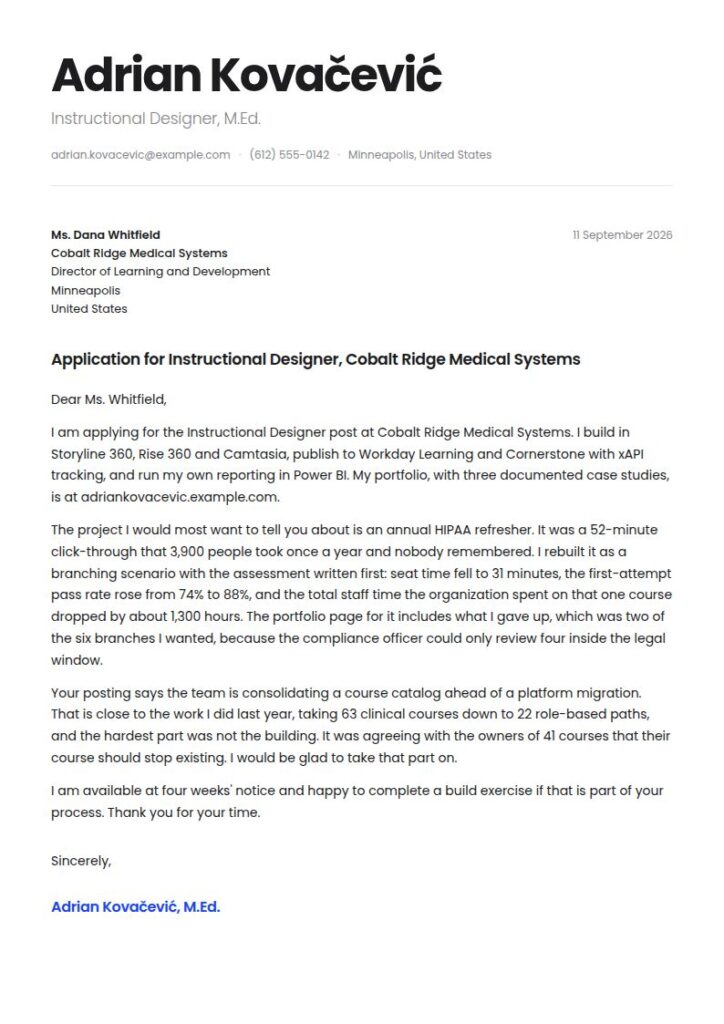
I am applying for the Instructional Designer post at Cobalt Ridge Medical Systems. I build in Storyline 360, Rise 360 and Camtasia, publish to Workday Learning and Cornerstone with xAPI tracking, and run my own reporting in Power BI. My portfolio, with three documented case studies, is at adriankovacevic.example.com.
The project I would most want to tell you about is an annual HIPAA refresher. It was a 52-minute click-through that 3,900 people took once a year and nobody remembered. I rebuilt it as a branching scenario with the assessment written first: seat time fell to 31 minutes, the first-attempt pass rate rose from 74% to 88%, and the total staff time the organization spent on that one course dropped by about 1,300 hours. The portfolio page for it includes what I gave up, which was two of the six branches I wanted, because the compliance officer could only review four inside the legal window.
Your posting says the team is consolidating a course catalog ahead of a platform migration. That is close to the work I did last year, taking 63 clinical courses down to 22 role-based paths, and the hardest part was not the building. It was agreeing with the owners of 41 courses that their course should stop existing. I would be glad to take that part on.
I am available at four weeks' notice and happy to complete a build exercise if that is part of your process. Thank you for your time.
Sincerely, Adrian Kovačević, M.Ed.
Openings that work
| Instead of | Use |
|---|---|
| I am passionate about creating engaging learning experiences | I build in Storyline 360 and Rise 360 and publish to Workday Learning with xAPI tracking |
| I am writing to express my interest in this position | My portfolio, with three documented case studies, is at the link below |
| I have a proven track record of delivering impactful training | A branching rebuild took the annual refresher from 52 minutes to 31 and first-attempt passing from 74% to 88% |
| I would be a great addition to your learning team | Your posting says you are consolidating a catalog ahead of a migration, which is what I spent last year doing |
What counts as evidence in learning work
Most instructional designers are never given a clean outcome measure, so report what the organization already counts.
| Kind of evidence | What it looks like in a sentence |
|---|---|
| Time | Cut seat time on the annual refresher from 52 minutes to 31 across 3,900 completions |
| Assessment | First-attempt pass rate rose from 74% to 88% after the rebuild |
| Business metric | Median time to first closed deal fell from 94 days to 71 across two hiring cohorts |
| Support load | Post-launch help desk tickets came in 34% below the vendor's projected volume |
| Scope removed | Took a 63-course catalog to 22 role-based paths and retired 41 courses |
| Work prevented | Replaced a requested four-hour course with a one-page job aid after analysis |
The last row is worth more than it looks. A designer who can show that analysis stopped a build is showing judgment, which finished screens cannot demonstrate.
Budgets fell while learning hours rose
Direct learning expenditure per employee was $846 in 2025, a decrease of $408 from 2024, while average learning hours used per employee rose from 13.7 to 16.7 over the same period (ATD, 2026 State of the Industry report, published 11 May 2026).
The occupation is steady rather than booming: 248,700 instructional coordinator jobs in 2025, projected to grow 2 percent through 2035, with about 23,100 openings a year (BLS Occupational Outlook Handbook, 2025-35 projections).
Teams are delivering more hours on less money, so they hire people who build internally, work fast in Rise, convert instructor-led material to self-paced, and can prove a course was worth its build time. A letter that says "I produce the reporting myself" answers a real budget problem.
When everything you have built is confidential
This is the most common reason people say they cannot apply, and it is solvable.
Do not publish an employer's course. Build two or three pieces from scratch with invented content and label them plainly as portfolio work: a short branching scenario, a compliance module redesign, a job aid with its analysis. Nobody in this field mistakes that for a lack of real experience, because everyone has an employer who owns the files.
In the letter, describe the real work at the level of problem and result, without naming the system, the department, the incident or anyone involved. "A 52-minute annual refresher taken by 3,900 staff" is credible and carries no confidential detail.
Name the exact tools and platform from the posting. Put the portfolio URL in the first paragraph, written out in full. Give one course, one number and one time frame. Say what you gave up and why, because tradeoffs read as experience. Offer to do the build exercise. Name one real thing about their learning function.
Do not send a letter with no link in it. Do not attach a confidential course as a work sample. Do not describe designing for visual, auditory or kinesthetic learning styles, since there is no empirical evidence that matching instruction to them improves learning (Frontiers in Education, December 2020). Do not open with a paragraph about your love of learning.
Length, format and sending it
One page, four paragraphs, 250 to 400 words. PDF unless the portal says otherwise, named for yourself and the post: adrian-kovacevic-instructional-designer-cover-letter.pdf.
Check that the portfolio link is still live after the PDF export. A letter whose only link is dead text has removed its own best feature.
Address a person. A named greeting on a letter that also names their tool stack reads as someone who did ten minutes of work. Keep the figures identical to your resume so the two agree. Our instructional designer resume example uses the same numbers as the letter above.
Key takeaways
- Name the tools and platform in the first paragraph, using the posting's own words.
- Put the portfolio URL in full, high in the letter, and check it survives the PDF.
- Give one course, one audience, one number and one period of time.
- Say what you gave up and why; tradeoffs distinguish experience from output.
- Report whatever the organization already counts, including work you prevented.
- Describe confidential work by problem and result, never by system or person.
- Offer to do the build exercise, because most processes include one.
Write your instructional designer cover letter in 10 minutes.
Instructional designer cover letter questions, answered
How long should an instructional designer cover letter be?
One page, four paragraphs, 250 to 400 words. The portfolio carries the detail, so the letter only has to make someone click.
Do I need a cover letter if I already have a portfolio?
Yes, and they do different jobs. The portfolio shows what you built and how you reasoned. The letter says why this employer's specific problem is one you have solved before.
What do I write with no instructional design job history yet?
Write the portfolio pieces as the evidence and translate adjacent work honestly: training you delivered, curriculum you wrote, documentation you built. Then name the tools you can build in today and offer to do the exercise.
Should I mention models like ADDIE or Kirkpatrick?
Only if you say something specific with them. "I write the assessment before the storyboard" or "we ran Level 3 manager observation at 60 days" is a claim about your practice. A list of model names is filler, and the assumption that Kirkpatrick's levels form a causal chain, so that reaction scores predict behavior change, is not supported.
How do I write to a company whose learning function I know nothing about?
Read the posting closely, then look at their careers site, public training offers and any conference talks their team has given. Name the tool stack, the audience size and one thing they said they are trying to do. One accurate sentence about their situation beats a paragraph of admiration.