High School Science Teacher Priya Raghavan
Student Teacher, Science, Grades 10 to 12
[email protected] | (512) 555-0173 | Austin, United States
Profile
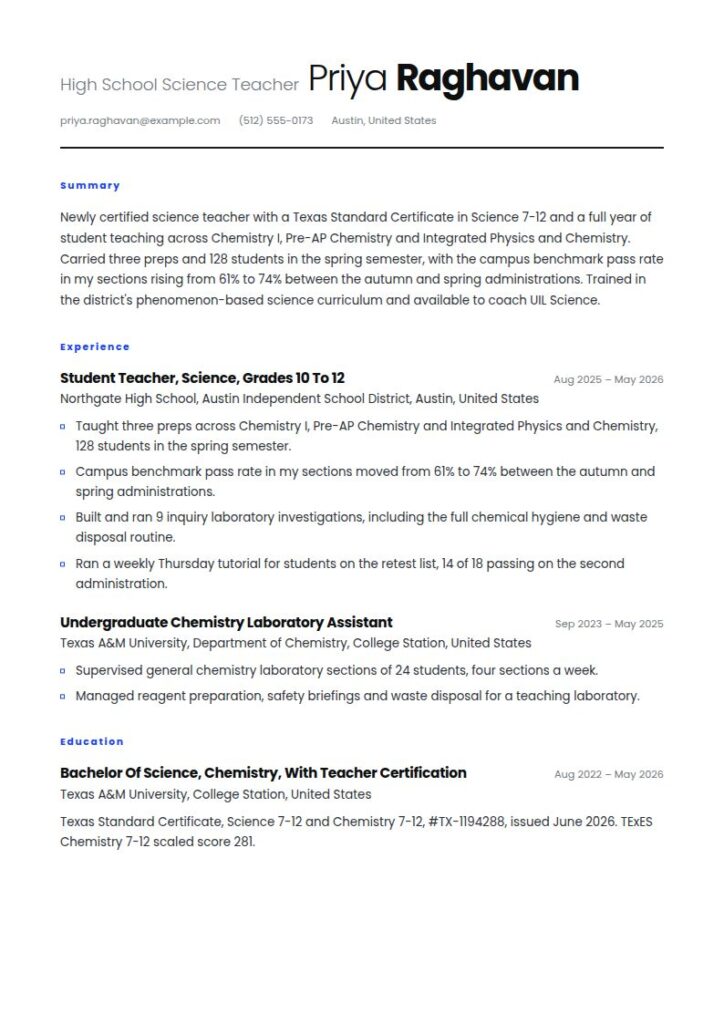
Newly certified science teacher with a Texas Standard Certificate in Science 7-12 and a full year of student teaching across Chemistry I, Pre-AP Chemistry and Integrated Physics and Chemistry. Carried three preps and 128 students in the spring semester, with the campus benchmark pass rate in my sections rising from 61% to 74% between the autumn and spring administrations. Trained in the district's phenomenon-based science curriculum and available to coach UIL Science.
Work Experience
08/2025 - 05/2026, Student Teacher, Science, Grades 10 to 12, Northgate High School, Austin Independent School District, Austin, United States
- Taught three preps across Chemistry I, Pre-AP Chemistry and Integrated Physics and Chemistry, 128 students in the spring semester.
- Campus benchmark pass rate in my sections moved from 61% to 74% between the autumn and spring administrations.
- Built and ran 9 inquiry laboratory investigations, including the full chemical hygiene and waste disposal routine.
- Ran a weekly Thursday tutorial for students on the retest list, 14 of 18 passing on the second administration.
09/2023 - 05/2025, Undergraduate Chemistry Laboratory Assistant, Texas A&M University, Department of Chemistry, College Station, United States
- Supervised general chemistry laboratory sections of 24 students, four sections a week.
- Managed reagent preparation, safety briefings and waste disposal for a teaching laboratory.
Education
08/2022 - 05/2026, Bachelor of Science, Chemistry, with Teacher Certification, Texas A&M University, College Station, United States
Texas Standard Certificate, Science 7-12 and Chemistry 7-12, #TX-1194288, issued June 2026. TExES Chemistry 7-12 scaled score 281.
Skills
Inquiry-based laboratory design, 70
Chemical hygiene and laboratory safety, 85
Differentiation for mixed-readiness sections, 65
Benchmark and common assessment design, 60
Vernier probeware and Logger Pro, 75
Canvas and Google Workspace for Education, 85
Languages
English, native
Tamil, native
Spanish, beginner
Certificates
06/2026, Texas Standard Certificate, Science 7-12, Texas Education Agency, TX-1194288
Chemistry 7-12 endorsement. Valid through 2031.
01/2026, CPR and First Aid, American Red Cross
Summary
A high school teacher resume is a one to two page document naming your state licence, your subject endorsements and the specific courses you are certified to teach. This guide gives you three adaptable versions, the course list that most applicants leave out, and current Bureau of Labor Statistics pay and outlook for the occupation.
High School Teacher resume examples by experience level
A high school teacher resume is a one to two page document that names your state licence, your subject endorsements, and the exact courses a principal could put you in front of in August.
That last part is where most applicants lose the job. A principal is not hiring a teacher in the abstract. They are holding a master schedule with holes in it: two sections of Chemistry, one of Physics, one of Anatomy, and a period of something nobody wants. The resume that fills three of those holes wins over the resume that fills one, even when the second candidate is the stronger teacher.
Resume guide for a high school teacher resume
This guide and the corresponding high school teacher resume example will cover:
- How to write a high school teacher resume, section by section
- Why a course list belongs on the page and where to put it
- Three adaptable summaries: new, experienced and department lead
- What AP, dual credit and IB eligibility are worth, and how to prove them
- What the job market looks like and what you can expect to earn
How to write a high school teacher resume
Six sections: contact header, summary, licensure and endorsements, teaching experience, courses taught, education, and skills. One page early in a career, two once you have a decade and a leadership line.
The order is deliberate. Licensure comes before experience because it is a gate, not an achievement. An unlicensed applicant for a licensed post is a no, however good the rest reads.
| Section | What it is answering | Where it goes |
|---|---|---|
| Licence and endorsements | Can this person legally teach the sections I need filled? | Directly under the summary |
| Courses taught | Which holes in my master schedule does this close? | Its own block, not buried in bullets |
| Teaching experience | What changed for students in their rooms? | Reverse chronological, with numbers |
| Education | Does this person clear the dual credit bar? | Include graduate credit hours in the subject |
Count your graduate hours in the subject and put the number on the page
Dual enrolment has become one of the largest growth areas in American secondary education: roughly 2.8 million high school students took college courses for credit in 2023 to 2024, and dual enrolment students now make up about one in five community college enrolments nationally (Community College Research Center, July 2026).
The instructor requirement for most regional accreditors is a master's degree in the discipline, or a master's plus 18 graduate semester hours in the discipline. Very few applicants state whether they clear it.
If you have 18 or more graduate hours in your subject, write it: "Master of Science, Chemistry, 30 graduate hours in chemistry, meets SACSCOC dual credit instructor requirements." A principal who can schedule you for a dual credit section is scheduling a course the district gets paid differently for.
Run the finished file through the free Rezoom ATS resume checker before you submit. Large districts parse applications into a system before a human opens them.
Choosing the best resume format for a high school teacher resume
Reverse chronological. One page for your first five years, two pages once you have led a department, written curriculum, or run AP sections with results worth citing.
Functional and skills-based formats fail here. A principal reads a teaching resume for continuity: which school, which grades, which courses, how long. A format that hides the timeline reads as a timeline worth hiding.
Include your contact information
| ✅ Right | ❌ Wrong |
|---|---|
| Priya Raghavan | Priya Raghavan |
| High School Chemistry & Physics Teacher | Dedicated educator passionate about student success |
| Texas Standard Certificate, Science 7-12, #TX-1194288 | Certified teacher |
| (512) 555-0173, [email protected], Austin, TX | (512) 555-0173, [email protected] |
Put the certificate number on the page. Human resources verifies it anyway, and the file that lets them do it in ten seconds moves faster than the one that does not.
Make use of a summary
Four lines: subject and grade band, years, the courses you carry, and one outcome with a number attached.
Newly certified science teacher with a Texas Standard Certificate in Science 7-12 and a full year of student teaching across Chemistry I, Pre-AP Chemistry and Integrated Physics and Chemistry. Carried three preps and 128 students in the spring semester, with the campus benchmark pass rate in my sections rising from 61% to 74% between the autumn and spring administrations. Trained in the district's phenomenon-based science curriculum and available to coach UIL Science.
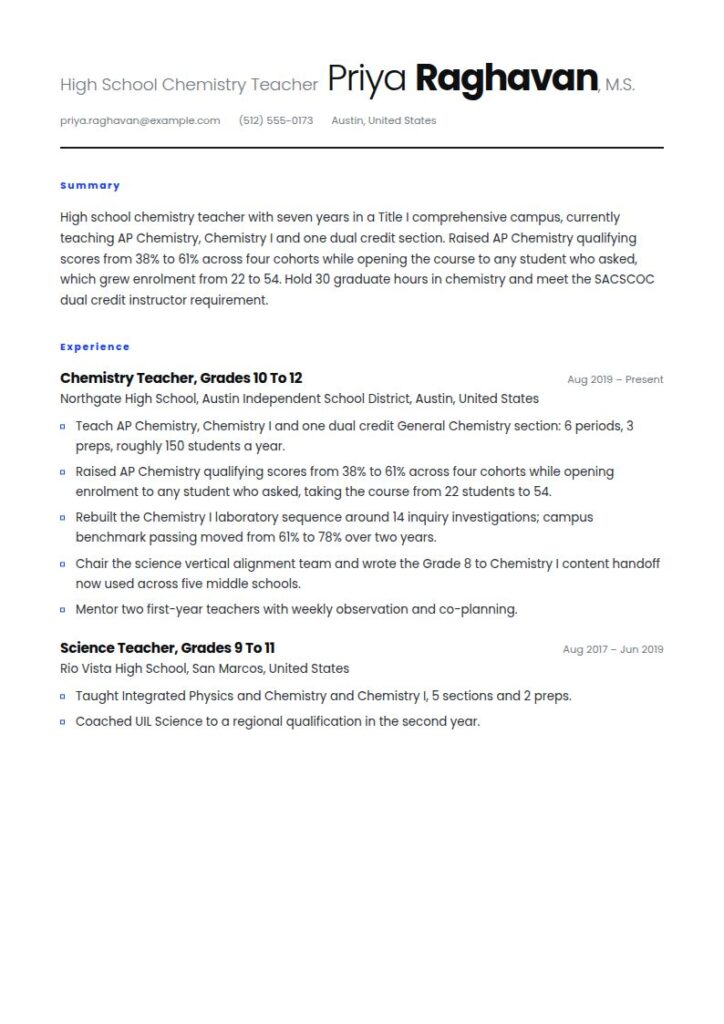
High school chemistry teacher with seven years in a Title I comprehensive campus, currently teaching AP Chemistry, Chemistry I and one dual credit section. Raised AP Chemistry qualifying scores from 38% to 61% across four cohorts while opening the course to any student who asked, which grew enrolment from 22 to 54. Hold 30 graduate hours in chemistry and meet the SACSCOC dual credit instructor requirement.
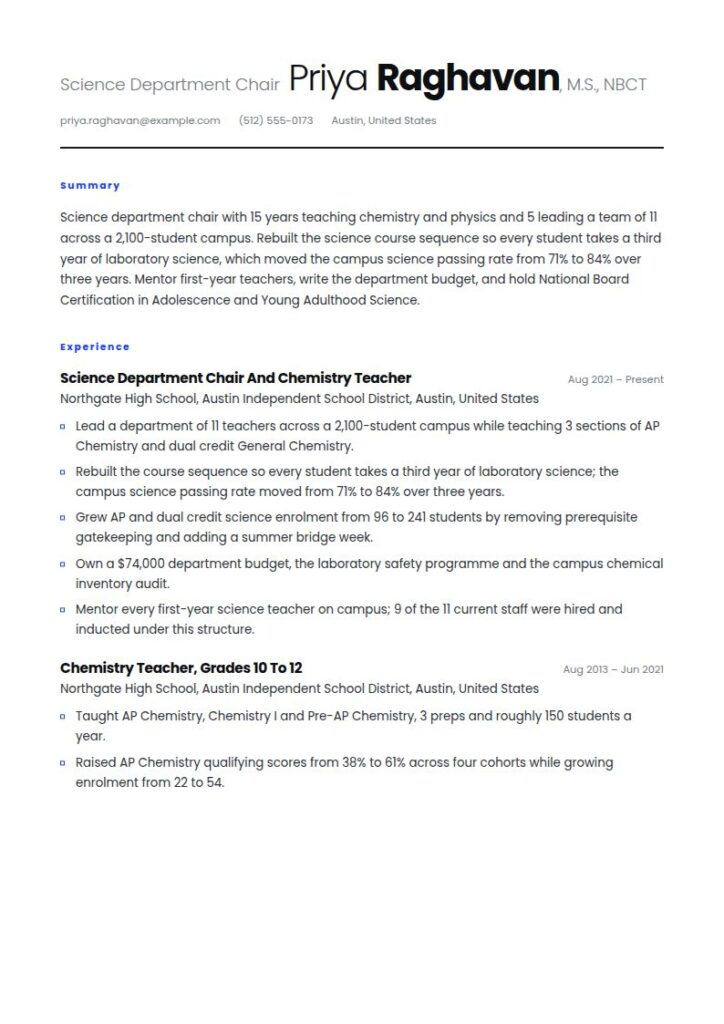
Science department chair with 15 years teaching chemistry and physics and 5 leading a team of 11 across a 2,100-student campus. Rebuilt the science course sequence so every student takes a third year of laboratory science, which moved the campus science STAAR passing rate from 71% to 84% over three years. Mentor first-year teachers, write the department budget, and hold National Board Certification in Adolescence and Young Adulthood Science.
Right vs wrong: the same high school teacher summary, twice
| ✅ Right | ❌ Wrong |
|---|---|
| High school chemistry teacher with seven years in a Title I comprehensive campus. | Passionate educator with a love of science and a heart for students. |
| Currently teaching AP Chemistry, Chemistry I and one dual credit section. | Experienced in teaching a variety of science courses at the high school level. |
| Raised AP qualifying scores from 38% to 61% across four cohorts while growing enrolment from 22 to 54. | Committed to helping every student reach their full potential. |
The right column can be scheduled. The left column cannot, and a principal reading forty files at the end of a school year is scheduling.
Outline your teaching experience
School, district, city, grade levels, courses, and dates. Then three to five bullets. Each bullet names a course or a cohort and carries a number.
| Instead of | Use |
|---|---|
| Taught chemistry to high school students | Taught 5 sections of Chemistry I and 1 of AP Chemistry, 147 students across three preps |
| Improved student test scores | Moved the campus chemistry benchmark pass rate from 61% to 78% over two years |
| Used technology in the classroom | Rebuilt the laboratory sequence around 14 inquiry investigations with Vernier probeware and district-supplied data logging |
| Served on school committees | Chaired the campus science vertical alignment team, writing the Grade 8 to Chemistry I handoff adopted district-wide |
| Helped struggling students | Ran a Thursday tutorial for 20 students on the retest list; 17 passed on the second administration |
Chemistry Teacher, Grades 10 to 12, Northgate High School, Austin Independent School District, Austin, TX, August 2019 to Present
Teach AP Chemistry, Chemistry I and one dual credit General Chemistry section, 6 periods and 3 preps, roughly 150 students a year.
Raised AP Chemistry qualifying scores from 38% to 61% across four cohorts while opening enrolment to any student who asked, which took the course from 22 students to 54.
Rebuilt the Chemistry I laboratory sequence around 14 inquiry investigations; campus benchmark passing moved from 61% to 78% over two years.
Chair the science vertical alignment team and wrote the Grade 8 to Chemistry I content handoff now used across five middle schools.
Mentor two first-year teachers, including weekly observation and co-planning.
Name every course you are certified and willing to teach
This is the block almost nobody includes, and it is the one that closes schedules.
Courses taught: AP Chemistry, Chemistry I, Pre-AP Chemistry, Integrated Physics and Chemistry, Dual Credit General Chemistry I and II
Certified to teach, not yet taught: Physics I, Environmental Systems, Anatomy and Physiology
Willing to pick up: UIL Science coaching, Science Olympiad, after-school tutorial
Three separate lines, because they answer three different questions. What you have run, what you could legally be scheduled for tomorrow, and what you would take on beyond the timetable. The third line is often what decides a tie between two equally qualified applicants.
Build a snapshot of your key skills
Ten to fourteen entries in three groups: instruction, assessment and data, and the systems the district runs.
Instruction: Inquiry-based laboratory design, AP Chemistry curriculum, Dual credit instruction, Differentiation for mixed-readiness sections, Literacy strategies in science
Assessment and data: Item analysis, Benchmark and common assessment design, Data-driven intervention planning, AP score analysis, STAAR End-of-Course preparation
Systems and tools: Skyward, Canvas, Vernier probeware and Logger Pro, AP Classroom, Google Workspace for Education
Laboratory: Chemical hygiene plan and safety data sheet management, Waste disposal compliance, Laboratory inventory
List your education, licence and endorsements
Licence first with its number and expiry, then endorsements, then degrees with graduate hours in the subject, then certifications.
Texas Standard Certificate, Science 7-12 and Chemistry 7-12, #TX-1194288, valid through 2029
Master of Science, Chemistry, The University of Texas at Austin, Austin, TX, 2018. 30 graduate semester hours in chemistry, meeting the SACSCOC dual credit instructor requirement.
Bachelor of Science, Chemistry, Texas A&M University, College Station, TX, 2014
Certifications: National Board Certification, Adolescence and Young Adulthood Science (2024). AP Chemistry Summer Institute, College Board (2021, renewed 2025). CPR and first aid, American Red Cross (2026).
Choose the right layout and design
Single column, plain type at 11 or 12 point, clear section headings, no photograph. District applicant systems parse these into a structured record before a human sees them, and two columns, text boxes and graphics are where that parsing breaks.
Put the licence number and expiry in the header or the first block. List every course you have taught as a named course, not as "various science classes". Separate what you have taught from what you are certified to teach. State your graduate hours in the subject if you have 18 or more. Give one number per experience bullet. Name the extracurricular you would take on.
Do not lead with a philosophy of education statement; the interview is where that belongs. Do not write "various subjects" or "multiple grade levels" when the specific list is what gets you scheduled. Do not list an expired certification without saying it is expired. Do not use a two-column template for a district portal. Do not pad to two pages before you have earned it.
High school teacher job market and outlook
A very large occupation with no growth and heavy replacement demand, which is a hiring market shaped entirely by subject.
| Measure | Value |
|---|---|
| High school teacher jobs, 2025 | 1,087,500 |
| Projected change, 2025-35 | 0% (little or no change), -2,500 |
| Projected annual openings | ~63,500 |
| Typical entry-level education | Bachelor's degree |
| Median annual wage, May 2025 | $72,040 |
Source: U.S. Bureau of Labor Statistics, Occupational Outlook Handbook, 2025-35 projections and May 2025 wage data.
The shortage is not in teaching, it is in three subjects
Analysing federal Teacher Shortage Area data for the 2024 to 2025 school year, the Learning Policy Institute found special education reported in shortage by 45 states, science by 41 and mathematics by 40, with 48 states reporting a shortage in at least one of the three (Learning Policy Institute, July 2026).
The same analysis counted roughly 425,000 positions nationally that were either vacant or filled by someone without full certification, about one in eight teaching positions.
That is why the course list matters more than the cover letter. If your endorsement sits in one of those three areas, the resume's job is to make that visible in the first four seconds. If it does not, the resume's job is to show breadth: the second and third subject you can legally cover.
Where the jobs sit:
| Setting | Share of employment | Median annual wage (May 2025) |
|---|---|---|
| Elementary and secondary schools, local (public) | 81% | $74,190 |
| Elementary and secondary schools, private | 17% | $61,810 |
Source: U.S. Bureau of Labor Statistics, May 2025.
What salary you can expect as a high school teacher
The median annual wage for high school teachers was $72,040 as of May 2025. The lowest 10 percent earned less than $48,780 and the highest 10 percent more than $107,600 (BLS, May 2025).
Almost all of that spread is district salary schedule, not negotiation. Public schools pay a median of $74,190 against $61,810 in private schools, a gap of roughly 20 percent, though private schools often ask for less paperwork and fewer state assessments in return.
Where a resume can move money is in the stipends and differentials layered on the schedule: a shortage-subject stipend, a National Board stipend, an AP or dual credit stipend, a department chair stipend, and coaching or activity sponsorships. Those are awarded against documentation. Listing the certification, the graduate hours and the activity you would sponsor is what makes you eligible on the day the contract is written rather than a year later.
Key takeaways for a high school teacher resume
- Lead with the licence and the endorsements; they are the gate, not an achievement.
- Give a named course list, split into taught, certified, and willing to take on.
- Put a number in every experience bullet, tied to a course or a cohort.
- State your graduate hours in the subject if you have 18 or more; that is the dual credit bar.
- Name the extracurricular you would sponsor, because it breaks ties.
- Show continuity: same campus, same district, and what you built there.
- Keep it single column and parseable, since district portals read it before a person does.
Build your high school teacher resume in 15 minutes.
Related education resume examples
- Teacher resume
- Middle school teacher resume
- Elementary school teacher resume
- Substitute teacher resume
- Special education teacher resume
- Math teacher resume
- English teacher resume
- ESL teacher resume
- School counselor resume
- Principal resume
- Tutor resume
- Kindergarten teacher resume
Pair it with a matching high school teacher cover letter.
High school teacher resume questions, answered
How long should a high school teacher resume be?
One page for your first five years. Two pages once you have led a department, written curriculum, taught AP or dual credit with results worth citing, or accumulated a course list long enough to be the point. Never three.
Should I list every course I have taught?
Yes, by name, in its own block. "Various science courses" is invisible to a principal filling specific sections. Separate the courses you have taught from the ones your certificate covers but you have not yet run, because both are useful and they are not the same claim.
What do I put on a high school teacher resume with no experience?
Student teaching, written as a job: the campus, the grade levels, the courses, the number of preps, the student count, and any measured change in your sections. Then your certification with its number, your subject-area test scores if they were strong, and the extracurricular you would sponsor. A first-year candidate who can be scheduled for three courses and will coach something is a good hire.
Does National Board Certification belong on the resume?
Yes, with the certificate area and the year. About 146,700 educators have ever achieved it nationally (National Board for Professional Teaching Standards, January 2026), so it genuinely separates a file, and many districts attach a salary stipend to it.
How do I show results without standardised test scores?
Use whatever your campus actually tracks: benchmark or common assessment pass rates, AP qualifying rates and enrolment, course completion and failure rates, retest recovery numbers, attendance in your sections, or the growth of a programme you built. Give the before, the after and the period. A number with a time frame reads as evidence; a number on its own reads as decoration.