School Counselor, PreK-12 Danielle Whitcombe M.Ed.
School Counseling Intern, Grades 6 to 8
[email protected] | (480) 555-0119 | Mesa, United States
Profile
Newly certified school counselor holding an Arizona School Counselor Certificate, PreK-12, with a 600-hour practicum and internship across an elementary and a middle school campus. Carried a supervised caseload of 180 students, delivered 42 classroom lessons across grades 6 to 8, and ran two small groups on organization and peer conflict with pre and post data. Trained in the ASCA National Model and a district suicide risk screening protocol.
Work Experience
08/2019 - 05/2020, School Counseling Intern, Grades 6 to 8, Palo Verde Middle School, Mesa Public Schools, Mesa, United States
- Carried a supervised caseload of 180 students under a certified site supervisor, 600 total practicum and internship hours.
- Delivered 42 classroom lessons across grades 6 to 8 on study skills, digital citizenship and postsecondary awareness.
- Ran two eight-week small groups on organization and peer conflict, both with pre and post measures showing group-level gains.
- Supported the campus multi-tiered support team with attendance and grade data pulled from Infinite Campus.
01/2019 - 05/2019, School Counseling Practicum Student, Grades K to 5, Mesquite Elementary School, Mesa Public Schools, Mesa, United States
- Delivered 18 classroom lessons on emotional regulation and friendship skills across grades 2 to 5.
- Observed and co-facilitated a social skills group and shadowed 14 family conferences.
Education
08/2018 - 05/2020, Master of Education, School Counseling, Northern Arizona University, Flagstaff, United States
CACREP-accredited program. 700 practicum and internship hours across elementary and secondary placements. Coursework in the ASCA National Model, group counseling, and assessment.
08/2012 - 05/2016, Bachelor of Arts, Psychology, Arizona State University, Tempe, United States
Skills
Classroom lesson delivery, 75
Small group facilitation, 70
Solution-focused brief counseling, 70
ASCA National Model, 70
Risk screening and safety planning, 65
Infinite Campus and data pulls, 75
Languages
English, native
Spanish, intermediate
Certificates
06/2020, Arizona School Counselor Certificate, PreK-12, Arizona Department of Education, AZ-SC-448120
Valid through 2026.
03/2020, Youth Mental Health First Aid, National Council for Mental Wellbeing
Summary
A school counselor resume is a one to two page document naming your state license, your caseload size, and what changed for students across academic, career and social-emotional work. This guide gives you three adaptable versions, the caseload block most applicants leave out, and current Bureau of Labor Statistics pay and outlook for the occupation.
School Counselor resume examples by experience level
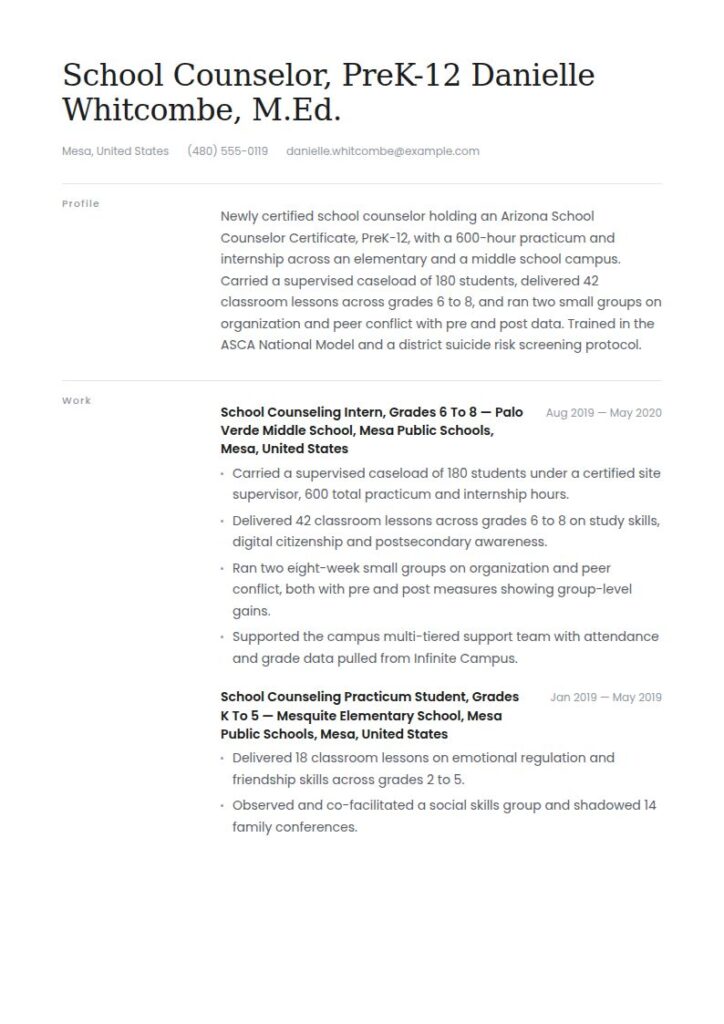
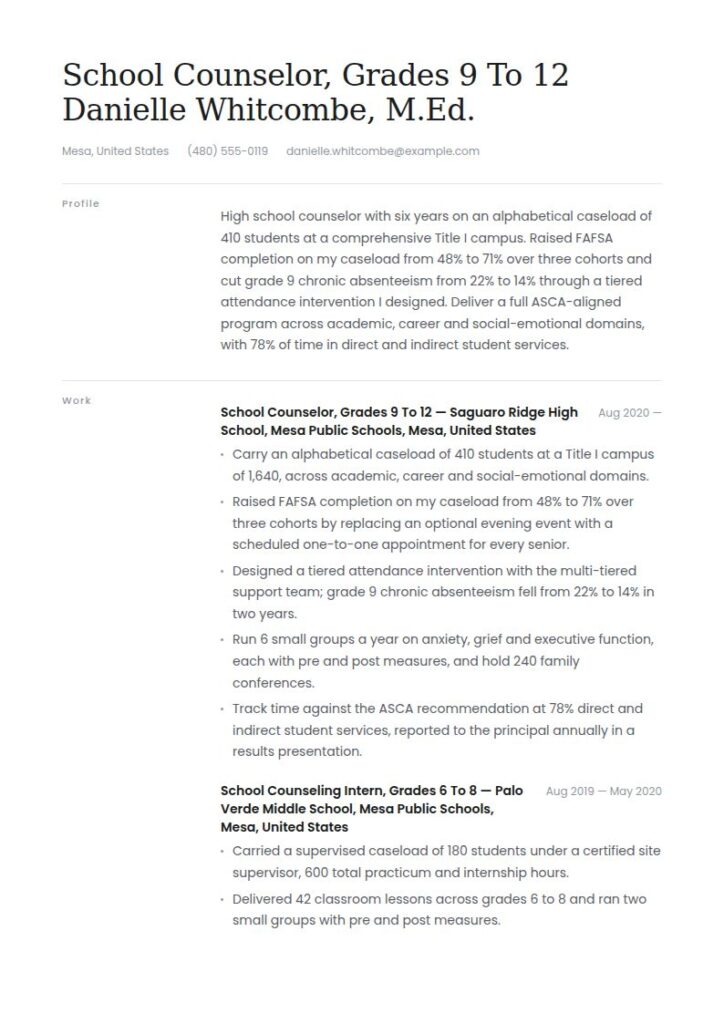
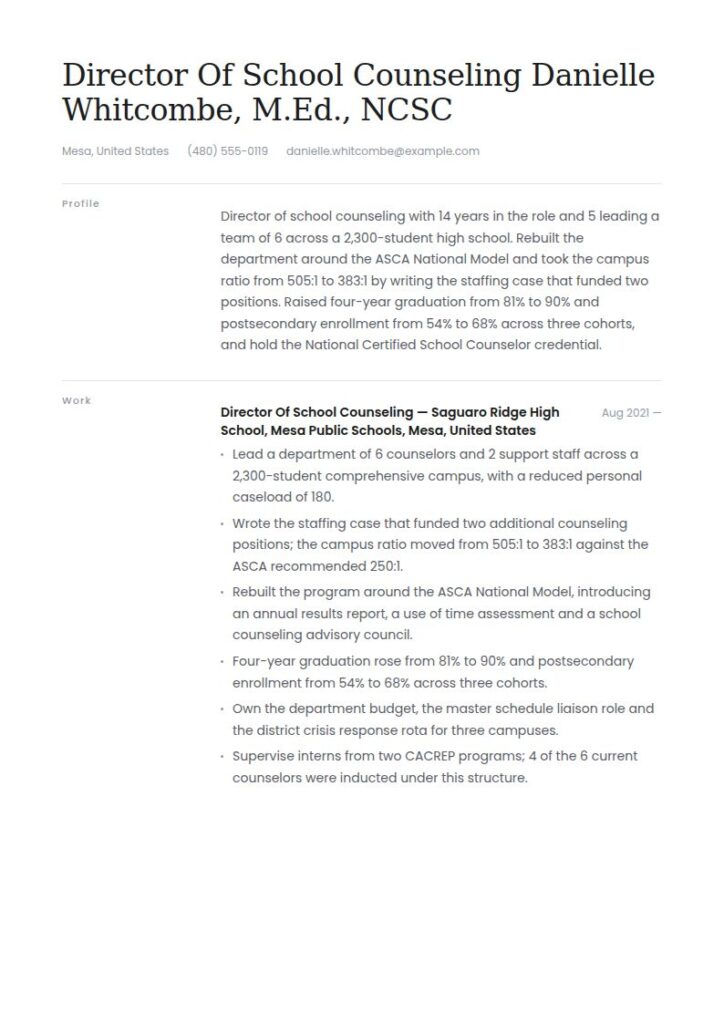
A school counselor resume is a one to two page document naming your state license, the size of the caseload you carried, and what measurably changed for those students.
The caseload number is the defining fact of this job and most resumes leave it off. The American School Counselor Association has recommended a 250:1 student-to-school-counselor ratio since 1965, and the national average for 2024 to 2025 was 372:1 (ASCA, February 2026). A principal reading your file knows their own ratio, and is working out whether you have done this job at their scale.
Resume guide for a school counselor resume
This guide and the corresponding school counselor resume example will cover:
- How to write a school counselor resume, section by section
- Why your caseload number belongs in the first four lines
- Three adaptable summaries: new, practicing and lead counselor
- How to show all three counseling domains separately
- What the job market looks like and what you can expect to earn
How to write a school counselor resume
Six sections: contact header, summary, license and certifications, counseling experience, caseload and program, education. One page for your first three years, two once you have run a comprehensive program or led a department. The license is a legal gate, not an achievement, and belongs above your experience: a candidate without the state credential for that grade band is a no however strong the rest reads.
| Section | What it is answering | Where it goes |
|---|---|---|
| State license | Can this person legally hold the post? | Directly under the summary |
| Caseload and ratio | Have they done this job at my scale? | First block, with the number |
| Counseling experience | What changed for students? | Reverse chronological, with data |
| Program work | Can they run a program, not just react? | ASCA National Model language and results |
Write the caseload before you write anything else
Start by writing one line: the number of students on your caseload, the grade band, and the school size. Everything else is built on it.
"Sole counselor for 410 students, grades 6 to 8, in a Title I middle school" tells a principal more than a paragraph of philosophy. It says you have worked above the recommended ratio, alone, in the grade band where ratios are worst.
ASCA's 2024 to 2025 data put the national average at 372:1 against a recommended 250:1, with only four states meeting it: Vermont at 172:1, New Hampshire at 186:1, Hawaii at 243:1 and Colorado at 247:1 (ASCA, February 2026). A high ratio is not a weakness to hide; it is the scale you have proved you can work at.
Run the finished file through the free Rezoom ATS resume checker first. District portals parse applications into a structured record before a human opens them.
Choosing the best resume format for a school counselor resume
Reverse chronological. One page for your first three years, two once you have built a program, led a team, or carried multi-year results.
Functional formats fail here. A hiring administrator reads a counseling resume for continuity: which schools, which grade bands, which caseloads, how long. A format that hides the timeline reads as a timeline worth hiding, and in a role built on trust with families that is expensive.
Include your contact information
| ✅ Right | ❌ Wrong |
|---|---|
| Danielle Whitcombe, M.Ed. | Danielle Whitcombe |
| School Counselor, PreK-12, Grades 9 to 12 | Caring professional committed to student wellbeing |
| Arizona School Counselor Certificate, PreK-12, #AZ-SC-448120 | State certified counselor |
| (480) 555-0119, [email protected], Mesa, AZ | (480) 555-0119, [email protected] |
Put the certificate number and grade band on the page. Human resources verifies it anyway, and the file that lets them do it in ten seconds moves faster.
Make use of a summary
Four lines: grade band and license, caseload, one postsecondary number, one program you built.
Newly certified school counselor holding an Arizona School Counselor Certificate, PreK-12, with a 600-hour practicum and internship across an elementary and a middle school campus. Carried a supervised caseload of 180 students, delivered 42 classroom lessons across grades 6 to 8, and ran two small groups on organization and peer conflict with pre and post data. Trained in the ASCA National Model and a district suicide risk screening protocol.
High school counselor with six years on an alphabetical caseload of 410 students at a comprehensive Title I campus. Raised FAFSA completion on my caseload from 48% to 71% over three cohorts and cut grade 9 chronic absenteeism from 22% to 14% through a tiered attendance intervention I designed. Deliver a full ASCA-aligned program across academic, career and social-emotional domains, with 78% of time in direct and indirect student services.
Director of school counseling with 14 years in the role and 5 leading a team of 6 across a 2,300-student high school. Rebuilt the department around the ASCA National Model and took the campus ratio from 505:1 to 383:1 by writing the staffing case that funded two positions. Raised four-year graduation from 81% to 90% and postsecondary enrollment from 54% to 68% across three cohorts, and hold the National Certified School Counselor credential.
Right vs wrong: the same school counselor summary, twice
| ✅ Right | ❌ Wrong |
|---|---|
| High school counselor with six years on an alphabetical caseload of 410 students. | Compassionate school counselor dedicated to helping every student succeed. |
| Raised FAFSA completion on my caseload from 48% to 71% over three cohorts. | Experienced in college and career readiness advising. |
| Cut grade 9 chronic absenteeism from 22% to 14% with a tiered attendance intervention. | Skilled at supporting students facing a variety of challenges. |
The right column can be compared to the reader's own numbers. The left column could be written by anyone.
Outline your counseling experience
School, district, city, grade band, caseload size, dates. Then three to five bullets, each naming a domain, a group of students and a number.
| Instead of | Use |
|---|---|
| Provided counseling services to students | Carried an alphabetical caseload of 410 students, grades 9 to 12, at a Title I campus |
| Helped students with college applications | Raised FAFSA completion on my caseload from 48% to 71% across three cohorts |
| Supported students with attendance issues | Designed a tiered attendance intervention; grade 9 chronic absence fell from 22% to 14% |
| Ran small groups | Ran 6 small groups a year on anxiety, grief and executive function, with pre and post measures |
| Worked with teachers and families | Held 240 family conferences a year and chaired the multi-tiered support team |
School Counselor, Grades 9 to 12, Saguaro Ridge High School, Mesa Public Schools, Mesa, AZ, August 2020 to Present
Carry an alphabetical caseload of 410 students at a Title I campus of 1,640, across academic, career and social-emotional domains.
Raised FAFSA completion on my caseload from 48% to 71% over three cohorts by replacing an optional evening event with a scheduled one-to-one appointment for every senior.
Designed a tiered attendance intervention with the multi-tiered support team; grade 9 chronic absenteeism fell from 22% to 14% in two years.
Run 6 small groups a year on anxiety, grief and executive function, each with pre and post measures, and hold 240 family conferences.
Track time against the ASCA recommendation at 78% direct and indirect student services, reported to the principal annually in a results presentation.
Put your caseload number on the page, and the ratio behind it
This is the block almost nobody includes, and the one that lets a principal compare you to their own school.
Caseload: 410 students, grades 9 to 12, alphabetical split, Title I campus of 1,640. Campus ratio 410:1 against the ASCA recommended 250:1.
Direct services: individual planning conferences with all 410 students annually, 6 small groups a year, 28 classroom lessons in grades 9 and 10.
Indirect services: 240 family conferences, multi-tiered support team chair, 44 provider referrals with documented handoff.
Time use: 78% direct and indirect student services against the ASCA recommendation of 80%, tracked in a use of time assessment and reported to the principal annually.
Four lines, answering four questions: your scale, what students received directly, what you did on their behalf, and whether you can prove where the time went.
That last line separates a program from a reaction. ASCA recommends counselors spend 80% of their time in direct and indirect student services, with the remaining 20% on program planning, and names scheduling, data entry and test coordination as inappropriate duties (ASCA, 2026). Almost every counselor is pulled into some of that; the one who has measured it can change it.
Build a snapshot of your key skills
Twelve to sixteen entries in four groups: the three counseling domains, plus the program work holding them together.
Academic: Individual planning conferences, Credit recovery and graduation checks, Course placement advocacy, Multi-tiered systems of support, Attendance intervention
Career and postsecondary: FAFSA completion, College application management, Career interest inventories, Dual enrollment and CTE pathway advising, Military and apprenticeship pathways
Social-emotional: Solution-focused brief counseling, Small group facilitation, Risk screening and safety planning, Crisis response, Restorative conflict mediation
Program and systems: ASCA National Model, Use of time assessment, Annual results reports, Data disaggregation, Naviance or SCOIR, PowerSchool or Infinite Campus
List your education, license and certifications
License first with its number, grade band and expiry, then the master's degree, then national certification and training.
Arizona School Counselor Certificate, PreK-12, #AZ-SC-448120, valid through 2029
Master of Education, School Counseling, Northern Arizona University, Flagstaff, AZ, 2020. CACREP-accredited program, 700 practicum and internship hours across elementary and secondary placements.
Bachelor of Arts, Psychology, Arizona State University, Tempe, AZ, 2016
Certifications: National Certified School Counselor, National Board for Certified Counselors (2024). ASCA National Model training (2022). Applied Suicide Intervention Skills Training (2025). Youth Mental Health First Aid (2024).
A master’s degree is the entry bar, and the national credential sits above it
School and career counselors typically need a master's degree in school counseling or a related field (BLS Occupational Outlook Handbook, 2026), and every state adds its own license or certificate on top, usually tied to a grade band.
The National Certified School Counselor credential sits above it. The National Board for Certified Counselors requires candidates to hold the National Certified Counselor credential in good standing, plus at least 3,000 hours of documented, supervised postgraduate counseling work experience over a minimum of 24 months (NBCC, NCSC Certification Eligibility Policy, 2026).
Write the license with its grade band, because the band decides which posts you can hold. "School Counselor, PreK-12" and "School Counselor, 7-12" are different files to a district filling an elementary post.
Choose the right layout and design
Single column, plain type at 11 or 12 point, clear headings, no photograph. District applicant systems parse these into a structured record, and two columns, text boxes and graphics break that.
Put your caseload number, grade band and campus size in the first block. Name the license with its number, grade band and expiry. Split your work into academic, career and social-emotional so the reader sees all three. Give a before, an after and a period for every result. Say what share of your time was direct and indirect service. Name the platforms the district runs.
Never name, initial or describe an individual student, and never include a case detail specific enough to identify one. Do not write "provided counseling services", which is the job title restated. Do not claim clinical language you are not licensed for. Do not list an expired certificate without saying so. Do not use a two-column template for a district portal.
School counselor job market and outlook
A large occupation with steady growth, a master's degree entry bar, and hiring that turns on district budgets.
| Measure | Value |
|---|---|
| School and career counselor and advisor jobs, 2025 | 389,500 |
| Projected change, 2025-35 | 3% (about as fast as average) |
| Projected annual openings | ~27,800 |
| Typical entry-level education | Master's degree |
| Median annual wage, May 2025 | $64,330 |
Source: U.S. Bureau of Labor Statistics, Occupational Outlook Handbook, May 2025 wage data and 2025-35 projections.
The ratio is moving, slowly, and in some states quickly
The national student-to-school-counselor ratio was 372:1 in 2024 to 2025 against the ASCA recommended 250:1, a recommendation standing since 1965 (ASCA, February 2026).
The average hides a split by grade band. ASCA found the high school ratio met the recommended level for the first time, while elementary and middle school ratios remained far higher. Arizona was the most improved state, moving from 645:1 to 570:1 in one year, with the District of Columbia improving 11% and New Mexico 8%. Kansas, Rhode Island and North Carolina moved the other way.
Two things follow. In elementary or middle school your caseload is probably larger than a high school reader expects, so stating it is to your advantage. And if your district cut its ratio, say whether you were part of the case that funded it. Writing the staffing proposal that added a counseling position is a leadership result very few candidates can claim.
Where the jobs sit:
| Setting | Share of employment | Median annual wage (May 2025) |
|---|---|---|
| Elementary and secondary schools, local (public) | 38% | $77,800 |
| Junior colleges, colleges and universities, state and local | 25% | $58,870 |
| Junior colleges, colleges and universities, private | 15% | $58,720 |
| Elementary and secondary schools, private | 7% | $62,190 |
| Other educational services, private | 5% | $57,480 |
Source: U.S. Bureau of Labor Statistics, Occupational Outlook Handbook, May 2025.
What salary you can expect as a school counselor
The median annual wage for school and career counselors and advisors was $64,330 as of May 2025. The lowest 10 percent earned less than $45,020 and the highest 10 percent more than $104,770 (BLS Occupational Outlook Handbook, May 2025 wage data).
The setting matters more than the negotiation. Public elementary and secondary schools pay a median of $77,800 against $58,870 in state and local colleges, because K-12 counselors usually sit on the district teacher salary schedule, with a master's column and a step for each year of service.
Where a resume moves money is the placement on that schedule and the stipends layered on it: credit for prior years of service, the master's plus 30 column, a national certification stipend, a lead counselor differential, summer registration contracts. All are awarded against documentation, so listing the credential, the hours and the leadership role makes you eligible on the day the contract is written rather than a year later.
Key takeaways for a school counselor resume
- Put the caseload number, grade band and campus size in the first block.
- Lead with the license, its grade band and its number; it is the gate.
- Show all three domains: academic, career and social-emotional.
- Give a before, an after and a period for every result.
- Use ASCA National Model language: define, manage, deliver, assess.
- Say what share of your time was direct and indirect service.
- Never name or describe an individual student, anywhere.
Build your school counselor resume in 15 minutes.
Related education resume examples
- Teacher resume
- High school teacher resume
- Middle school teacher resume
- Elementary school teacher resume
- Special education teacher resume
- Principal resume
- Assistant principal resume
- College admissions resume
- Teacher assistant resume
- Substitute teacher resume
- Paraprofessional resume
- Tutor resume
Pair it with a matching school counselor cover letter.
School counselor resume questions, answered
How long should a school counselor resume be?
One page for your first three years. Two once you have run a comprehensive program, led a department, or accumulated multi-year results worth citing. Never three, and never a curriculum vitae unless the post is in higher education.
Should I put my caseload number on the resume?
Yes, in the first block, with the grade band and campus size. It is the most useful number you have, because the reader can compare it to their own. ASCA recommends 250:1 and the national average was 372:1 in 2024 to 2025 (ASCA, February 2026), so a high caseload is evidence of scale, not an admission.
What do I put on a school counselor resume with no experience?
Write your practicum and internship as a job: the campuses, the grade bands, the supervised caseload, the total hours, the classroom lessons you delivered, and the small groups you ran with their pre and post data. Then the certificate with its number and grade band, and any crisis or risk training. A new counselor with 600 documented hours and two groups with data is a credible hire.
How do I write about counseling results without breaking confidentiality?
Report at the group level only. "31 risk screenings completed under the district protocol with documented handoff" is safe and informative. Anything describing one student, even without a name, can identify that student to someone who was there. Aggregate numbers, program outcomes and process descriptions are the whole safe vocabulary here.
Does the ASCA National Model belong on the resume?
Yes, and use its vocabulary rather than just naming it. The model is organized around four components, define, manage, deliver and assess (ASCA National Model, fifth edition), and a resume showing evidence in each reads as a program rather than a reaction. An annual results report, a use of time assessment and an advisory council are the artifacts to name.