Epidemiologist Hana Yoshida MPH
Epidemiologist, Communicable Disease Surveillance
[email protected] | (847) 555-0173 | Evanston, United States
Profile
Epidemiologist with an MPH in Epidemiology from the University of Illinois Chicago, working in communicable disease surveillance for a county health department covering 1.9 million residents. Run the weekly respiratory reporting pipeline across 34 reporting sites and cut the median time from laboratory report to case investigation from 72 hours to 31. Master's thesis analyzed six years of school-based outbreak data across 240 schools, and is now the basis of the department's seasonal reporting template.
Work Experience
08/2024 - Present, Epidemiologist, Communicable Disease Surveillance, County Department of Public Health, Chicago, United States
- Run the weekly respiratory surveillance pipeline across 34 reporting sites for a jurisdiction of 1.9 million residents.
- Cut the median time from laboratory report to case investigation from 72 hours to 31 by rebuilding the intake workflow and automating triage in R.
- Author the weekly surveillance brief circulated to 240 schools and 61 long-term care facilities.
- Trained 6 investigators on the new workflow and wrote the standard operating procedure now used by the unit.
01/2024 - 05/2024, Graduate Practicum, Communicable Disease Unit, County Department of Public Health, Chicago, United States
- 400-hour supervised practicum: mapped and rebuilt the case investigation workflow that became the basis of the current intake process.
- Cleaned and linked six years of school outbreak records across 240 schools for the department's archive.
07/2016 - 08/2022, Senior Research Analyst, Midwest Consumer Insights, Chicago, United States
- Designed and fielded quantitative studies for 14 client accounts, with samples from 600 to 9,000 respondents.
- Managed a team of three analysts and the quarterly reporting cycle for the largest account.
Education
08/2022 - 05/2024, MPH, Epidemiology, University of Illinois Chicago, Chicago, United States
Concentration in infectious disease surveillance. Thesis: analyzed six years of outbreak data across 240 schools using spatial cluster detection; the method became the department's seasonal reporting template. 400-hour supervised practicum.
09/2012 - 06/2016, BA, Psychology, Northwestern University, Evanston, United States
Minor in Statistics.
Skills
Outbreak investigation, 80
Surveillance system design, 80
R and tidyverse, 90
SQL, 80
Study design and sampling, 85
Writing for non-specialist audiences, 85
Languages
English, native
Japanese, fluent
Certificates
02/2025, Certified in Public Health (CPH), National Board of Public Health Examiners
Valid to 2030, maintained through continuing education credits.
Summary
A master's degree resume is written around a qualification rather than a job, and the decision it has to get right is how much room the degree takes. This guide gives you three adaptable versions, the placement rules, how to write a thesis or capstone as evidence of work, and current Bureau of Labor Statistics earnings and unemployment figures by educational attainment.
Master’s resume examples by experience level
A master's degree resume is a one to two page document written around a qualification rather than an occupation, and the decision it has to get right is how much room the degree takes up.
That decision is not a matter of taste. In some fields the master's is a hard entry requirement, and it belongs above the experience section because without it you are not eligible. In others it is a preference, and it belongs in an ordinary education block near the bottom. In a third set of situations it is a risk, and the resume has to answer a question the reader has not asked out loud: why does someone with this degree want this job?
Resume guide for a master's degree resume
This guide and the corresponding master's resume examples will cover:
- Where the degree goes on the page, and the rule that decides it
- Three adaptable summaries: new graduate, career changer, and senior practitioner
- How to write a thesis or capstone as evidence of work rather than as a title
- When a master's reads as overqualification, and what to do about it
- The fields where a master's is a hard entry requirement
- What Bureau of Labor Statistics data says a master's is worth in earnings and unemployment
How to write a master's degree resume
Six sections: contact header, summary, experience, a skills snapshot, education, and licensure or certification where the field has one. One page if you finished the degree in the last two or three years, two once the experience outweighs it.
The ordering is the whole game. Three placements, and the posting tells you which one you are in.
| The posting says | Where the degree goes | Why |
|---|---|---|
| Master's degree required | Directly under the header, before experience | It is a gate; the reader is checking eligibility first |
| Master's degree preferred | Standard education block, with the specialism named | It is a differentiator, not a filter |
| Bachelor's degree required, no mention of graduate study | Standard education block, one line, no thesis title | Extra weight invites the overqualification question |
| Licensure that a master's is a prerequisite for | With the license, at the top | The license is what the reader is checking, and the degree sits under it |
Name the specialism, not just the degree
"MS, Analytics" tells a reader almost nothing. "MPH, Epidemiology, with a concentration in infectious disease surveillance" tells them which vacancies you are eligible for.
Graduate programs are narrow by design, and the narrowness is the value. A master's in public health with a health policy concentration and a master's in public health with a biostatistics concentration are different qualifications that happen to share three letters, and a hiring manager in either field can tell them apart instantly.
Write the degree, the field, the institution, the year, and the concentration or track. Then, if the field cares, one line for the thesis or capstone written as work rather than as a title.
Run the finished file through the free Rezoom ATS resume checker before you submit. Applicant tracking systems parse education into structured fields, and an abbreviation-only entry such as "MPH, UIC, 2024" often lands in the wrong one.
Choosing the best resume format for a master's degree resume
Reverse chronological in almost every case, including when the degree interrupted a career. Two or three years of full-time graduate study is not a gap; it is a dated, verifiable, full-time commitment, and writing it in the timeline closes the question before it opens.
A combination format earns its place in one situation: a career changer whose in-field experience is the degree, a practicum and one or two projects, sitting on top of several years in an unrelated industry. Put a short block of relevant capability first, then the ordinary reverse chronological history underneath it, with the dates intact.
Do not use a functional format. It hides exactly the dates that make a graduate degree read as a decision rather than a disappearance.
Include your contact information
| ✅ Right | ❌ Wrong |
|---|---|
| Hana Yoshida, MPH | Hana Yoshida, Master of Public Health Graduate |
| Epidemiologist, Communicable Disease Surveillance | Highly motivated MPH seeking opportunities |
| (847) 555-0173, [email protected], Evanston, IL | [email protected] |
| linkedin.com/in/example | Full mailing address, date of birth, photograph |
Put the post-nominal after your name only where the field uses them: MPH, MSW, MPA, MEd, MBA and MS in clinical fields all travel. In most commercial roles they read as overreach, and the degree does its work in the education section instead.
Use a personal email address. University accounts are switched off some months after graduation, and a search started in May can still be live in October.
Make use of a summary
Four lines: what you are, the degree and its specialism where it matters, the scale of what you have handled, and one outcome with a number on it.
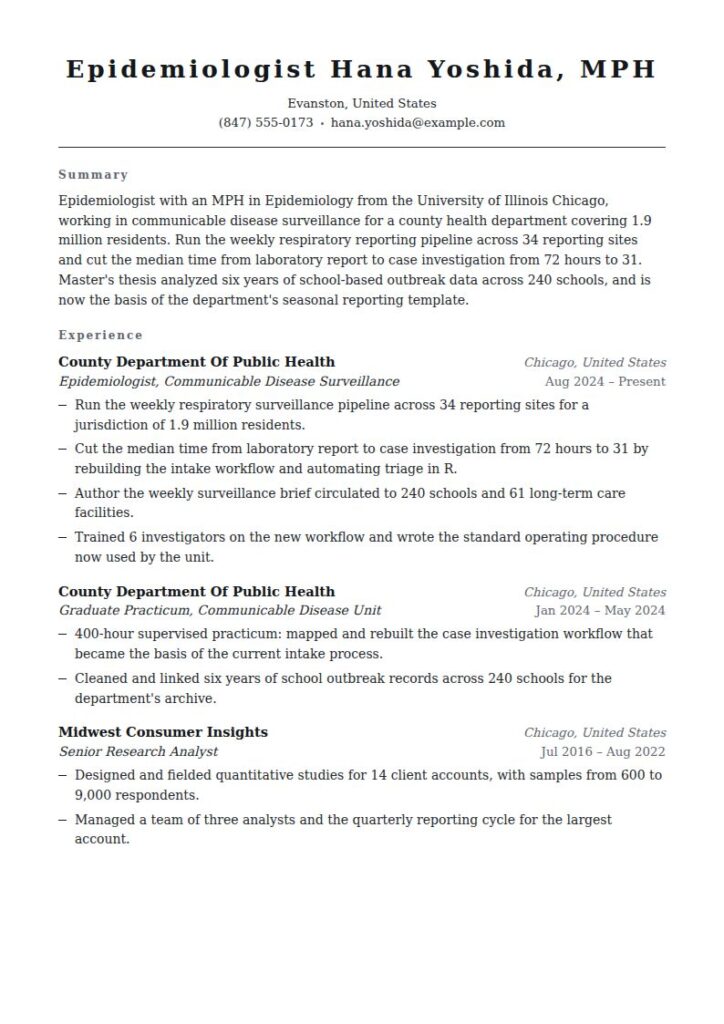
Epidemiologist with an MPH in Epidemiology from the University of Illinois Chicago, working in communicable disease surveillance for a county health department covering 1.9 million residents. Run the weekly respiratory reporting pipeline across 34 reporting sites and cut the median time from laboratory report to case investigation from 72 hours to 31. Master's thesis analyzed six years of school-based outbreak data across 240 schools, and is now the basis of the department's seasonal reporting template.
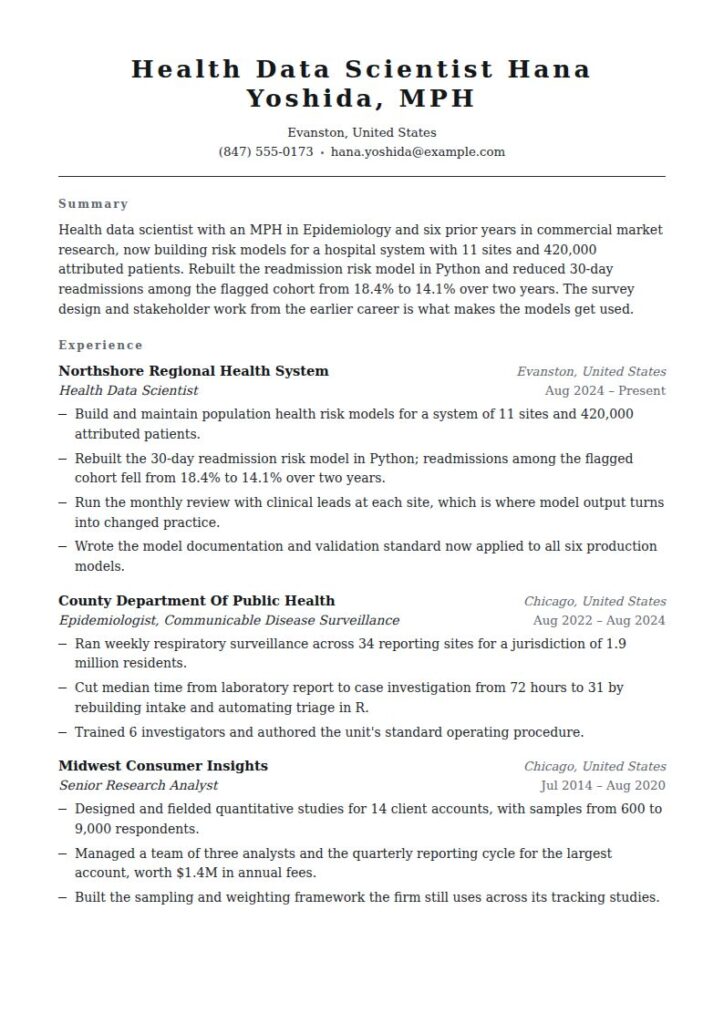
Health data scientist with an MPH in Epidemiology and six prior years in commercial market research, now building risk models for a hospital system with 11 sites and 420,000 attributed patients. Rebuilt the readmission risk model in Python and reduced 30-day readmissions among the flagged cohort from 18.4% to 14.1% over two years. The survey design and stakeholder work from the earlier career is what makes the models get used.
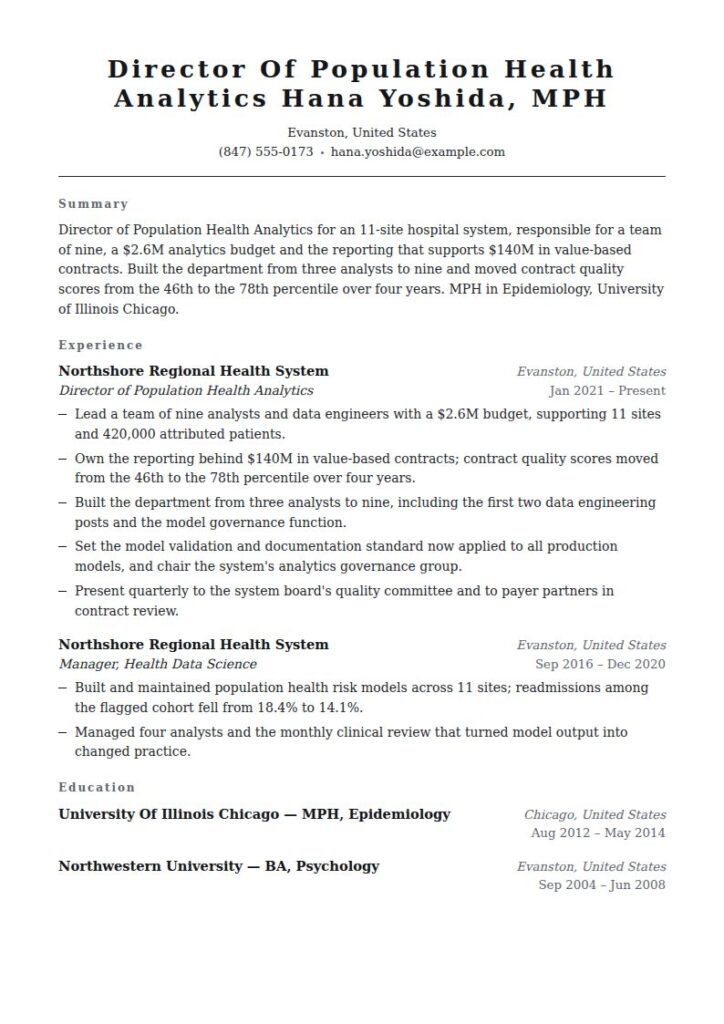
Director of Population Health Analytics for an 11-site hospital system, responsible for a team of nine, a $2.6M analytics budget and the reporting that supports $140M in value-based contracts. Built the department from three analysts to nine and moved contract quality scores from the 46th to the 78th percentile over four years. MPH in Epidemiology, University of Illinois Chicago.
Notice where the degree sits in each. It opens the first, qualifies the second, and closes the third. That is the arc, and it is the only thing about a master's resume that changes predictably with time.
Right vs wrong: the same master's summary, twice
| ✅ Right | ❌ Wrong |
|---|---|
| MPH in Epidemiology, University of Illinois Chicago, 2024. | Recent graduate with an advanced degree from a top program. |
| Thesis analyzed six years of outbreak data across 240 schools. | Completed a rigorous thesis in my field of study. |
| Cut median time from laboratory report to case investigation from 72 hours to 31. | Gained hands-on experience in public health surveillance. |
The right column is a set of claims somebody could check. The left column is a graduate hoping the degree will speak for itself, which it does not.
Outline your experience
Title, organization, city, dates, then three to five bullets. Graduate study counts here when it was funded or full-time work: a research assistantship, a teaching assistantship, a practicum, a residency or a funded project all belong in the experience section, not hidden inside the education block.
| Instead of | Use |
|---|---|
| Completed a master's thesis in epidemiology | Analyzed six years of outbreak data across 240 schools; the method is now the department's seasonal reporting template |
| Graduate research assistant | Managed data collection and cleaning for a 3-year, $480,000 study across 12 clinical sites |
| Gained experience with data analysis | Built the weekly respiratory surveillance pipeline in R across 34 reporting sites |
| Practicum placement at a health department | 400-hour practicum: rebuilt the case investigation workflow, cutting median turnaround from 72 to 31 hours |
| Strong communication skills | Present weekly surveillance findings to a 22-member interagency group and write the public dashboard copy |
Epidemiologist, Communicable Disease Surveillance, Cook County Department of Public Health, Chicago, IL, August 2024 to Present
Run the weekly respiratory surveillance pipeline across 34 reporting sites for a jurisdiction of 1.9 million residents.
Cut the median time from laboratory report to case investigation from 72 hours to 31 by rebuilding the intake workflow and automating triage in R.
Author the weekly surveillance brief circulated to 240 schools and 61 long-term care facilities, and present findings to a 22-member interagency group.
Trained 6 investigators on the new workflow and wrote the standard operating procedure now used by the whole unit.
Serve on the department's data governance group, covering release review and record linkage practice.
Where the degree goes, and how much room it gets
This is the section that makes a master's resume different from every other resume, and it is the one most people get wrong in the same direction: they give the degree too much space for too long.
A useful way to think about it is a budget. The degree gets a share of the page, and the share shrinks every year you work.
| Where you are | Share of page | What stays |
|---|---|---|
| Finishing, or within a year | Top third | Degree, concentration, thesis as one work-shaped line, practicum, assistantship, tools |
| One to three years in | Education block, four to six lines | Degree, concentration, one thesis line if the field cares, relevant coursework gone |
| Three to seven years in | Education block, two lines | Degree, field, institution, year |
| Seven years or more | One line | Degree, field, institution; the year becomes optional |
Two things people keep too long. Relevant coursework goes as soon as you have any in-field employment; listing it after that is an admission that nothing has happened since. A grade point average goes at the same point, because graduate grading is compressed enough to carry almost no information. One thing people drop too early: if the degree is the licensure prerequisite in your field, it stays at the top permanently, because the reader is checking eligibility every time.
How to write a thesis or capstone as evidence
A thesis title is not evidence. It is a label on a filing cabinet, and a hiring manager outside your subfield cannot open it.
Rewrite it as work. Four facts do it: what you analyzed or built, how much of it there was, what method you used, and what came of it. That is one or two lines, and it converts two years of study into something a reader can compare with a job.
| Instead of | Use |
|---|---|
| Thesis: "Spatial Determinants of Respiratory Outbreak Clustering in Urban School Settings" | Analyzed six years of outbreak data across 240 schools using spatial cluster detection; the method became the department's seasonal reporting template |
| Capstone project in supply chain optimization | Rebuilt a regional distributor's replenishment model across 14 sites, cutting stockouts by 22% in the pilot quarter |
| Master's research on teacher retention | Surveyed 1,100 teachers across 3 districts on retention; the findings informed the district's 2025 mentoring redesign |
Three rules. Say what it produced, even if that was a method, a dataset or a recommendation that was adopted. Give the scale, because scale is the part a reader can compare. Drop the title unless the field reads titles, which in practice means academia and a few research employers; the academic resume guide covers that case. If the thesis genuinely produced nothing usable, say less about it rather than dressing it up.
When a master's helps, and when it reads as overqualification
Overqualification is rarely about the degree itself. It is about an unanswered question: the reader cannot work out why you want this job, and is guessing you will leave when something better appears.
Match the seniority of the language to the seniority of the post. Put the degree in the education block when the posting asks for a bachelor's. Give a reason for the application in the cover letter, in one sentence, without apology: a sector change, a location, a return to hands-on work. Keep the same numbers in both documents. Name the tools and systems the job actually uses, because that is what settles whether you would be bored.
Do not remove the degree from the resume; a gap you cannot explain is worse than a question you can answer. Do not open the summary with the degree when applying below its level. Do not list a thesis title, a conference paper or a publication list on an application for an operational role. Do not write "seeking a role where I can apply my advanced degree", which states the problem rather than solving it. Do not inflate a prior job title to match the degree; it is checked.
The reverse case is worth naming too. Where the posting says "master's required", the degree is not a risk and hiding it is fatal. Applications in those fields are screened for eligibility before anything else, and a resume that buries the qualifying credential on page two is failing at the only stage it needed to pass.
Using a master's to change careers
A master's is the most common legitimate route into a field you have no history in, and the resume for that move has a specific job: it has to stop the reader from filing you under your old industry.
Three moves do most of the work. Lead with the new field: the header title, the summary and the top experience entry should all name the field you are entering, because a summary opening with six years in market research reads as a market researcher who studied something. Put the in-field experience above the out-of-field experience, using a labeled split such as "Relevant experience" and "Earlier experience", and keep every date. Then translate rather than discard: survey design is survey design in either industry, managing a client is managing a stakeholder, and six years of doing that is six years a new graduate does not have.
The one thing not to do is hide the old career. It accounts for the years, and the years are going to be counted.
The fields where a master's is a hard entry requirement
In most of the labor market a master's is a preference. In a specific and identifiable set of occupations it is the entry credential, usually because a state license depends on it, and no amount of experience substitutes.
The Bureau of Labor Statistics assigns every occupation a typical entry-level education. These are the master's-entry occupations with the largest employment or the fastest growth, and if you are in one the degree belongs at the top of the page permanently.
| Occupation | Median annual wage, May 2025 | Jobs, 2025 | Projected change, 2025-35 |
|---|---|---|---|
| Physician assistants | $135,880 | 168,900 | +21% |
| Nurse anesthetists, nurse midwives and nurse practitioners | $134,920 | 399,000 | +36% |
| Elementary, middle and high school principals | $105,870 | 343,800 | 0% |
| Mathematicians and statisticians | $105,720 | 33,500 | +10% |
| Postsecondary education administrators | $104,590 | 231,800 | +2% |
| Occupational therapists | $100,330 | 169,600 | +15% |
| Speech-language pathologists | $97,870 | 193,400 | +17% |
| Urban and regional planners | $89,320 | 45,800 | +4% |
| Instructional coordinators | $77,440 | 248,700 | +2% |
| Librarians and library media specialists | $68,270 | 142,300 | +3% |
| School and career counselors and advisors | $64,330 | 389,500 | +3% |
Source: U.S. Bureau of Labor Statistics, Occupational Outlook Handbook, May 2025 wage data and 2025-35 projections, published 27 August 2026.
Two patterns run through that list. The clinical occupations at the top combine a master's with a state license and national certification, and they are growing fast. The education occupations further down are flat or near flat in employment but still hire heavily through replacement, which the education sector resume guide covers.
If your target occupation is on that list, write the degree, the license and the certification as one block at the top, each with its issuing authority and expiry. If it is not, the degree is a line in the education section and the experience carries the page.
Build a snapshot of your key skills
Ten to fourteen entries in three groups: method, tools, and the transferable delivery skills that make a graduate employable rather than merely qualified.
Method: Outbreak investigation, Surveillance system design, Regression and survival analysis, Study design and sampling, Record linkage, Data governance and release review
Tools: R and tidyverse, Python and pandas, SQL, SAS, Tableau, REDCap, ArcGIS
Delivery: Writing for non-specialist audiences, Interagency briefing, Standard operating procedure authoring, Training and onboarding analysts, Project scheduling
The third group is the one most master's graduates leave off, and it is the one that decides between two candidates whose method lists are identical. A graduate degree is several years of independent project delivery against a deadline with minimal supervision, and writing it as that is honest, not inflated.
List your education and certifications
Degree, field, institution, city, year, then the concentration. Then licensure and certification, each with the authority that issued it.
MPH, Epidemiology, University of Illinois Chicago, Chicago, IL, 2024. Concentration in infectious disease surveillance. Thesis: analyzed six years of outbreak data across 240 schools using spatial cluster detection; the method became the department's seasonal reporting template.
BA, Psychology, Northwestern University, Evanston, IL, 2016. Minor in Statistics.
Certification in Public Health, National Board of Public Health Examiners, 2025, valid to 2030.
Graduate practicum: 400 hours, Cook County Department of Public Health, spring 2024.
Choose the right layout and design
Single column, 11 or 12 point body type, clear headings, no photograph. Keep the education entry in full words at least once: "Master of Public Health (MPH), Epidemiology" parses reliably where "MPH" alone sometimes does not, and the abbreviation can follow in the same line.
Never abbreviate the institution on first use, and give the city. Graduate programs are accredited campus by campus, and a reader checking accreditation needs to know which one you mean.
What a master's degree is worth in earnings and unemployment
The return on a master's is measurable, consistent across the data, and smaller than the marketing around graduate admissions implies. These are the national figures.
| Educational attainment | Median usual weekly earnings, 2025 | Unemployment rate, 2025 |
|---|---|---|
| Doctoral degree | $2,307 | 1.8% |
| Professional degree | $2,294 | 1.9% |
| Master's degree | $1,876 | 2.6% |
| Bachelor's degree | $1,578 | 2.8% |
| Associate's degree | $1,135 | 3.0% |
| Some college, no degree | $1,062 | 3.8% |
| High school diploma, no college | $966 | 4.3% |
| Less than a high school diploma | $770 | 6.1% |
| All workers | $1,268 | 3.4% |
Source: U.S. Bureau of Labor Statistics, Education pays, 2025 annual averages for workers aged 25 and over, published 27 August 2026.
The master’s premium is 19% over a bachelor’s, and the unemployment gap is small
Workers with a master's degree had median usual weekly earnings of $1,876 in 2025, against $1,578 for those with a bachelor's degree: a premium of about 19%, or roughly $15,500 a year before tax. Their unemployment rate was 2.6% against 2.8% (BLS, Education pays, 2025 annual averages, published 27 August 2026).
The employment picture is better than the earnings gap suggests. The Bureau of Labor Statistics projects that occupations where a master's is the typical entry-level education will grow 11.0% between 2025 and 2035, from 3,941,300 jobs to 4,376,700, against 3.5% growth for total employment over the same decade. The median annual wage across those occupations was $83,210 in 2025 (BLS Employment Projections, education and training assignments by occupation, published 8 September 2026).
Two things follow for the resume. The premium is real but modest on average, which means the degree by itself is not an argument, and a resume that leans on it will lose to one that shows work. Where the master's is the entry requirement for a licensed occupation, the calculation is different, because there the alternative is not a lower salary but no eligibility at all.
Master's level careers on Rezoom
This page is the qualification hub. Each link goes to a full resume guide for an occupation where a master's is either the entry requirement or the standard route upward.
Schools and school leadership
- Principal resume
- Assistant principal resume
- School counselor resume
- Instructional designer resume
- Special education teacher resume
- Teacher resume
- Education sector resume
Higher education and research
- College professor resume
- Adjunct professor resume
- Academic resume
- Academic librarian resume
- Librarian resume
- Research assistant resume
- College admissions resume
- Harvard application resume
Health and clinical practice
- Nurse practitioner resume
- Physician assistant resume
- Occupational therapist resume
- Speech-language pathologist resume
- Psychologist resume
- Psychotherapist resume
- Marriage and family therapist resume
- BCBA resume
- Epidemiologist resume
- Health care administration resume
Social work and counseling
- Social worker resume
- Medical social worker resume
- Healthcare social worker resume
- Counselor resume
Business, policy and data
- MBA candidate resume
- Data scientist resume
- Business analyst resume
- Consultant resume
- City manager resume
- Government sector resume
- Federal resume
Student and transition guides
- Graduate school resume
- PhD resume
- College graduate resume
- Career change resume
Key takeaways for a master's degree resume
- Let the posting decide the placement: required means top of page, preferred means education block.
- Name the concentration or track, not just the three letters.
- Rewrite the thesis or capstone as work: what, how much, what method, what came of it.
- Shrink the degree's share of the page every year; coursework and grade point average go first.
- Where the degree is a licensure prerequisite, it stays at the top permanently.
- For a career change, lead with the new field and translate the old one into its vocabulary.
- Answer the overqualification question in the cover letter, in one sentence, without apologizing.
Build your master's resume in 15 minutes.
Related education resume examples
- Academic resume
- Education sector resume
- College professor resume
- Adjunct professor resume
- Research assistant resume
- Academic librarian resume
- Librarian resume
- Instructional designer resume
- School counselor resume
- Principal resume
- Assistant principal resume
- College admissions resume
Pair it with a matching master's cover letter.
Master's resume questions, answered
Where should a master's degree go on a resume?
It depends on one word in the posting. If the posting says a master's is required, put it directly under the header, before experience, because eligibility is screened first. If it says preferred, it belongs in the ordinary education block with the concentration named. If the posting asks only for a bachelor's, keep it to a single line in the education section, because extra weight invites the overqualification question.
Should I put my thesis on my resume?
Only rewritten as work, and only where it earns the space. Give what you analyzed or built, how much of it there was, the method, and what came of it, in one or two lines. The title alone tells a reader outside your subfield nothing. Academic applications are the exception, and the [academic resume guide](/resume/academic/) covers them.
Does a master's degree actually increase earnings?
On average, modestly. Median usual weekly earnings in 2025 were $1,876 for workers with a master's against $1,578 for a bachelor's, a premium of about 19%, with unemployment at 2.6% against 2.8% (BLS, Education pays, 2025 annual averages). The stronger case is occupational rather than average: occupations where a master's is the typical entry credential are projected to grow 11.0% from 2025 to 2035 against 3.5% for total employment (BLS Employment Projections, 8 September 2026).
How do I avoid looking overqualified?
Answer the question the reader is silently asking. Match the language to the level of the post, keep the degree in the education block, name the tools the job actually uses, and give one plain sentence in the cover letter for why you want this role: a sector change, a location, a return to hands-on work. Removing the degree is the one move that makes it worse, because an unexplained two-year gap is harder to forgive than an explained qualification.
Which jobs require a master's degree to enter?
The Bureau of Labor Statistics lists a master's as the typical entry-level education for physician assistants, nurse practitioners, nurse anesthetists and nurse midwives, occupational therapists, speech-language pathologists, school and career counselors, librarians, instructional coordinators, school principals, postsecondary education administrators, urban and regional planners, and statisticians, among others. As of May 2025 their medians ran from $64,330 for school and career counselors to $135,880 for physician assistants (BLS Occupational Outlook Handbook, May 2025).
Can a master's degree be used to change careers?
Yes, and it is the most common legitimate route into a field with no prior history in it. Lead the resume with the new field in the header, the summary and the top experience entry; put practicum, assistantship and project work above the earlier career; and translate the old job into the new field's vocabulary rather than deleting it. Keep every date, because the years will be counted either way.