Teacher Assistant Theodore Mbeki
Teacher Assistant, Grade 3
[email protected] | (919) 555-0142 | Raleigh, United States
Profile
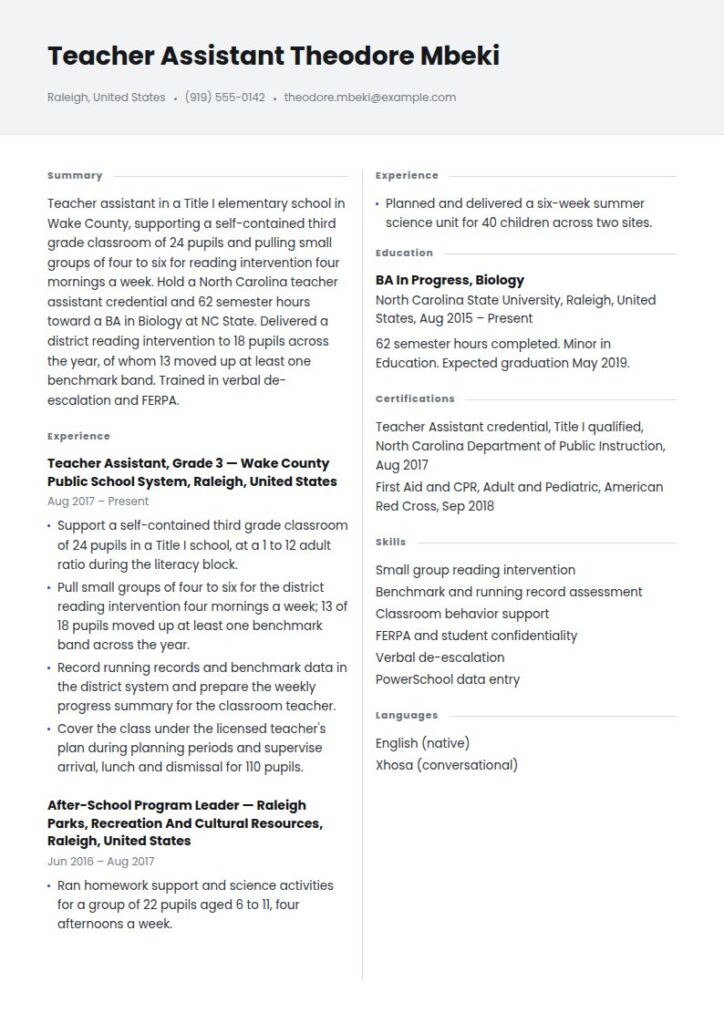
Teacher assistant in a Title I elementary school in Wake County, supporting a self-contained third grade classroom of 24 pupils and pulling small groups of four to six for reading intervention four mornings a week. Hold a North Carolina teacher assistant credential and 62 semester hours toward a BA in Biology at NC State. Delivered a district reading intervention to 18 pupils across the year, of whom 13 moved up at least one benchmark band. Trained in verbal de-escalation and FERPA.
Work Experience
08/2017 - Present, Teacher Assistant, Grade 3, Wake County Public School System, Raleigh, United States
- Support a self-contained third grade classroom of 24 pupils in a Title I school, at a 1 to 12 adult ratio during the literacy block.
- Pull small groups of four to six for the district reading intervention four mornings a week; 13 of 18 pupils moved up at least one benchmark band across the year.
- Record running records and benchmark data in the district system and prepare the weekly progress summary for the classroom teacher.
- Cover the class under the licensed teacher's plan during planning periods and supervise arrival, lunch and dismissal for 110 pupils.
06/2016 - 08/2017, After-School Program Leader, Raleigh Parks, Recreation and Cultural Resources, Raleigh, United States
- Ran homework support and science activities for a group of 22 pupils aged 6 to 11, four afternoons a week.
- Planned and delivered a six-week summer science unit for 40 children across two sites.
Education
08/2015 - Present, BA in progress, Biology, North Carolina State University, Raleigh, United States
62 semester hours completed. Minor in Education. Expected graduation May 2019.
Skills
Small group reading intervention, 80
Benchmark and running record assessment, 75
Classroom behavior support, 75
FERPA and student confidentiality, 85
Verbal de-escalation, 75
PowerSchool data entry, 70
Languages
English, native
Xhosa, conversational
Certificates
08/2017, Teacher Assistant credential, Title I qualified, North Carolina Department of Public Instruction
Met the Title I paraprofessional requirement through 48 completed semester hours.
09/2018, First Aid and CPR, Adult and Pediatric, American Red Cross
Renewed on a two-year cycle.
Summary
An education resume is a one to two page document that states your license and grade band, the size of the load or caseload you carry, and what changed for the students you taught. This guide gives you three adaptable versions, the hiring calendar that decides when you should apply, and a linked index of every education career on Rezoom with current Bureau of Labor Statistics pay.
Education resume examples by experience level
An education resume is a one to two page document that answers three questions before it argues anything else: what you are licensed to do, which ages you do it with, and how many students you carry while you do it.
Everything else on the page is evidence. The sector runs from a preschool room of eighteen four-year-olds to a district office managing a curriculum for thirty thousand, and the roles inside it are licensed differently, hired on different calendars, and read by different people. This page is the entry point for all of them.
Resume guide for an education resume
This guide and the corresponding education resume examples will cover:
- The three facts every education resume must state in the first four lines
- How to write each section, with the numbers that belong in it
- Three adaptable summaries: teacher assistant, classroom teacher, and district coordinator
- How the school hiring year actually runs, and when to have the file ready
- How large the education sector is and what its main occupations pay
- A linked index of every education career on Rezoom
How to write an education resume
Six sections: contact header, summary, experience, a skills snapshot, education, and licensure and certification. One page for support roles and early-career teachers, two once you are leading a grade level, a department or a district function.
The ordering changes with the role, but the top of the page does not. A principal reading eighty applications for one vacancy is sorting them by whether the person can legally stand in the room on the first day of school.
| Section | What it is answering | Where it goes |
|---|---|---|
| Header and summary | What license, which grades, which subjects, how many students? | Top, four lines, no philosophy |
| Experience | What did you teach or support, at what scale, and what changed? | Reverse chronological, with numbers |
| Licensure | Can this person be assigned to the vacancy we have? | High on page one, with the state and expiry |
| Education | Degree, field, institution, year, and the program route | After licensure unless you are a new graduate |
State the license, the grade band and the load in the first four lines
Three facts decide whether an education application is read: the license you hold, the grade band or setting you hold it for, and the number of students you are responsible for.
Write them plainly. "North Carolina Professional Educator's License, Science 6 to 9, valid to June 2029" is a fact a principal can act on. "Certified educator with classroom experience" is a sentence that makes them open the next file.
Load is the one people leave off. A high school teacher with five sections of thirty is doing different work from a teacher with three sections of twelve, and a special education teacher with a caseload of nine is doing different work from one with a caseload of twenty-eight. Put the number on the page.
Run the finished file through the free Rezoom ATS resume checker before you submit. Districts run applications through applicant tracking systems that parse your file into a structured record, and multi-column templates are where licensure fields get lost.
Choosing the best resume format for an education resume
Reverse chronological, in almost every case. School hiring is seasonal and contract-based, so a career in this sector produces a timeline full of one-year appointments, long-term substitute placements, summer programs and maternity covers. That looks normal to a principal and suspicious in a functional format that hides the dates.
Write the gaps rather than burying them. A year of substitute teaching is a year of work; give it dates, the number of schools and the grade bands you covered. A career changer coming in through a residency or an alternative licensure route should date the route itself and say which state issued the license at the end of it.
The one exception is a career changer with no classroom experience at all, where a combination format puts a short relevant skills block above an unrelated employment history. Even then, keep the dates visible.
Include your contact information
| ✅ Right | ❌ Wrong |
|---|---|
| Theodore Mbeki | Mr. Theodore Mbeki, B.A., M.Ed. |
| Science Teacher, NC License 6 to 9 | Passionate lifelong learner and educator |
| (919) 555-0142, [email protected], Raleigh, NC | [email protected] |
| Licensure: NC Professional Educator's License 1084772, valid to 2029 | Full street address, date of birth, photograph |
Use a personal email address you will keep. District addresses are switched off the day a contract ends, and a spring application can still be live in August.
Put the license number and expiry in the header or immediately below it. Human resources staff verify it against the state system before a principal ever sees the file, and giving them the number saves a step in a process that is already slow.
Make use of a summary
Four lines: the role and license, the grade band and setting, the size of what you carry, and one outcome with a number on it.
Teacher assistant in a Title I elementary school in Wake County, supporting a self-contained third grade classroom of 24 pupils and pulling small groups of four to six for reading intervention four mornings a week. Hold a North Carolina teacher assistant credential and 62 semester hours toward a BA in Biology at NC State. Delivered a district reading intervention to 18 pupils across the year, of whom 13 moved up at least one benchmark band. Trained in verbal de-escalation and FERPA.
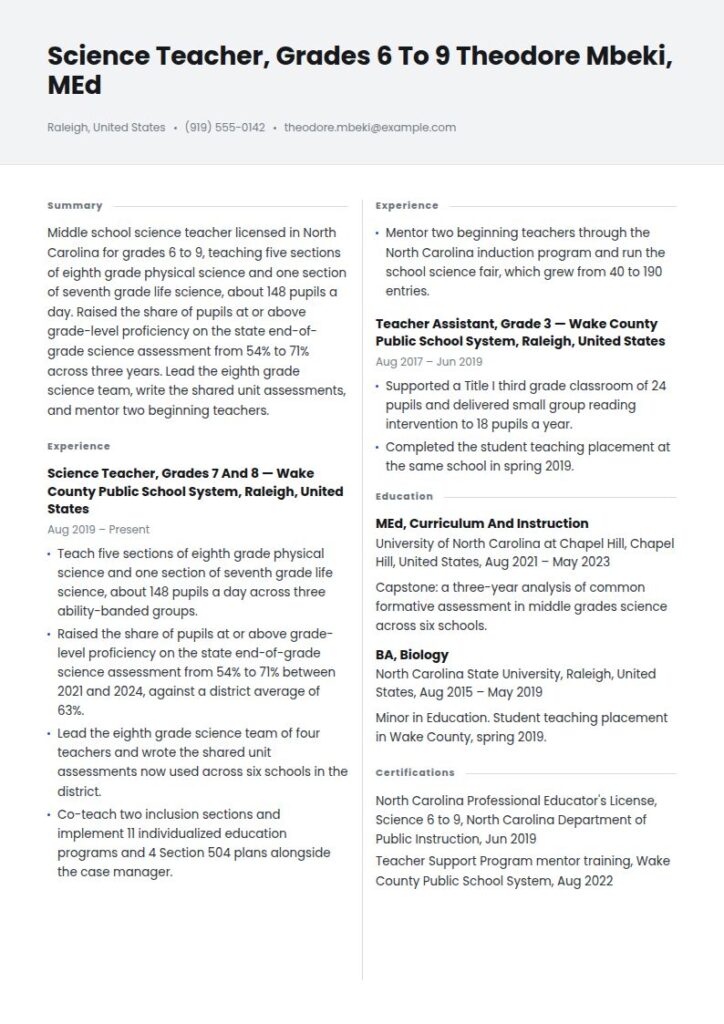
Middle school science teacher licensed in North Carolina for grades 6 to 9, teaching five sections of eighth grade physical science and one section of seventh grade life science, about 148 pupils a day. Raised the share of pupils at or above grade-level proficiency on the state end-of-grade science assessment from 54% to 71% across three years. Lead the eighth grade science team, write the shared unit assessments, and mentor two beginning teachers.
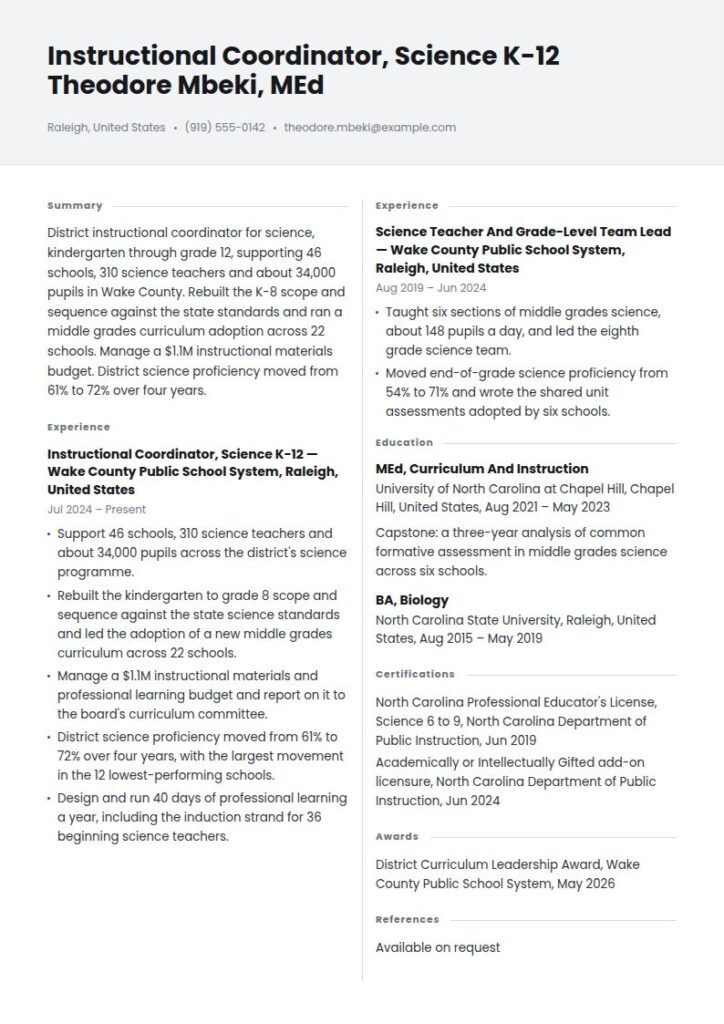
District instructional coordinator for science, kindergarten through grade 12, supporting 46 schools, 310 science teachers and about 34,000 pupils in Wake County. Rebuilt the K-8 scope and sequence against the state standards and ran a middle grades curriculum adoption across 22 schools. Manage a $1.1M instructional materials budget. District science proficiency moved from 61% to 72% over four years.
Right vs wrong: the same education summary, twice
| ✅ Right | ❌ Wrong |
|---|---|
| Licensed in North Carolina for grades 6 to 9 science, valid to June 2029. | Certified educator with a strong passion for student success. |
| Five sections of eighth grade physical science, about 148 pupils a day. | Responsible for teaching multiple science classes. |
| Proficiency moved from 54% to 71% across three years. | Consistently improved student outcomes and engagement. |
The right column can be verified in under a minute by a principal with a state licensure lookup and a school report card open. The left column is the same career written so nobody has to take your word for it.
Outline your experience
Title, school or district, city, dates, then three to five bullets per role. Every bullet carries a number: students taught, sections covered, caseload size, percentage point movement, staff trained, or budget managed.
| Instead of | Use |
|---|---|
| Taught science to middle school students | Taught 5 sections of 8th grade physical science and 1 of 7th grade life science, 148 pupils a day |
| Improved student achievement | Moved end-of-grade science proficiency from 54% to 71% over three years, against a district average of 63% |
| Supported students with special needs | Co-taught 2 inclusion sections and implemented 11 IEPs and 4 504 plans alongside the case manager |
| Worked with parents | Held 96 documented family conferences a year and ran a Saturday science morning attended by 140 families |
| Helped with curriculum | Wrote the 8th grade shared unit assessments now used across 6 schools in the district |
| Mentored new teachers | Mentored 2 beginning teachers through the state induction program; both returned for a second year |
Science Teacher, Grades 7 and 8, Wake County Public School System, Raleigh, NC, August 2019 to Present
Teach five sections of eighth grade physical science and one section of seventh grade life science, about 148 pupils a day across three ability-banded groups.
Raised the share of pupils at or above grade-level proficiency on the state end-of-grade science assessment from 54% to 71% between 2021 and 2024.
Lead the eighth grade science team of four teachers, writing the shared unit assessments now used across six schools in the district.
Co-teach two inclusion sections and implement 11 individualized education programs alongside the case manager.
Mentor two beginning teachers through the North Carolina induction program and run the school's science fair, which grew from 40 to 190 entries.
What the load or caseload number actually tells a hiring principal
This is the section most education resumes are missing, and it is the one that separates two candidates whose bullets otherwise read the same.
Every role in this sector has a volume metric that describes the job honestly, and every hiring manager in the sector reads it instantly. Name yours.
| Role | The number that describes the job |
|---|---|
| Classroom teacher | Sections, pupils per section, pupils per day, and how many distinct preparations |
| Special education teacher | Caseload size, service model, and how many IEPs you write and hold each year |
| Teacher assistant or paraprofessional | Adult to pupil ratio, whether one-to-one or classroom-wide, and hours of instructional contact |
| Preschool or early years | Group size and ratio against the state's licensing requirement for that age |
| School counselor | Caseload of students, against the 250 to 1 ratio the American School Counselor Association recommends |
| Substitute teacher | Days worked, schools covered, grade bands, and any long-term placements with their length |
| Principal or assistant principal | Enrollment, staff headcount, budget, and the share of pupils on free or reduced lunch |
| Instructional coordinator | Schools supported, teachers supported, and materials budget |
| Tutor | Students per week, hours per week, and the subject and level range |
Three distinct preparations is a heavier week than five sections of one course, and a reader from inside education knows that. Six preparations across two grade bands with two inclusion sections is a specific, difficult job, and writing it that way is not complaining; it is the evidence that you have already done what the vacancy asks.
How the school hiring year runs, and when to apply
School hiring is not continuous. It runs on a calendar set by resignation deadlines, budget approval and enrollment counts, and applying at the wrong point in that cycle is the commonest avoidable mistake in the sector.
| Window | What is happening | What to do |
|---|---|---|
| January to March | Districts post for known retirements and internal transfers; job fairs open | Have the file finished and the license current before the first fair |
| March to May | The main posting season, after state resignation deadlines pass and budgets clear | Apply broadly; this is where most contracts are signed |
| June to July | The second wave, as late resignations and enrollment shifts create vacancies | Keep applying; hard-to-staff subjects move here |
| August | Emergency hiring in the two weeks before students return | Be reachable; this is where a substitute or interim becomes a contract |
| September to December | Mid-year vacancies, long-term substitute placements and leave covers | Take the long-term placement; it is the standard route into a contract |
Two practical consequences. First, a resume finished in April is worth more than a better one finished in July, because the vacancy list is longest in spring. Second, if you are applying in August, put your phone number where it cannot be missed and answer it, because at that point principals are filling a room that has children arriving in nine days.
Higher education runs a different calendar again, with faculty searches opening in the autumn for the following academic year; the academic resume guide covers that side.
Build a snapshot of your key skills
Ten to fourteen entries in three groups: instruction, systems and compliance, and the platforms your district actually uses.
Instruction: Standards-aligned unit planning, Differentiated instruction, Inquiry and laboratory instruction, Formative assessment design, Small group intervention, Co-teaching models
Compliance and systems: IEP and 504 implementation, FERPA, Multi-tiered systems of support, Positive behavioral interventions and supports, Data-driven instruction cycles
Platforms: PowerSchool, Canvas, Google Workspace for Education, NWEA MAP, Gimkit and formative assessment tools
Name the actual student information system and learning platform. A district running PowerSchool and Canvas reads those two words as evidence you will not need three weeks of training, and it costs you one line to say them.
List your education and certifications
License first if you hold one, because it is the gating item. Then the degree, then endorsements, then everything else.
North Carolina Professional Educator's License, Science 6 to 9, license number 1084772, valid to June 2029. North Carolina Department of Public Instruction.
MEd, Curriculum and Instruction, University of North Carolina at Chapel Hill, 2023
BA, Biology, North Carolina State University, Raleigh, NC, 2019. Minor in Education.
Endorsements and training: Academically or Intellectually Gifted add-on licensure, 2024. Teacher Support Program mentor training, 2022. First aid and CPR, renewed 2025.
If you are licensed in more than one state, or hold reciprocity, say so on one line. Districts near state lines hire across them constantly and will not guess.
Choose the right layout and design
Single column, 11 or 12 point body type, clear section headings, no photograph, no personal details beyond city and contact. District applicant tracking systems parse the file before a human sees it, and a two-column layout with icons is where that parsing fails.
Put the license, state, grade band and expiry in the first four lines. Give every role its load or caseload number. Use percentage point movement rather than adjectives for outcomes. Name the student information system and learning platform your district runs. Date substitute and long-term placement work properly, with schools and grade bands. Keep a personal email address that outlives the contract.
Do not open with a teaching philosophy; that is a separate document and districts ask for it when they want it. Do not describe students or families in a way that could identify a child. Do not list every professional development session you have ever attended. Do not hide contract gaps behind a functional format. Do not send the same file to a preschool room and a district office; the two readers want opposite things.
The size and shape of the education sector
Education is one of the largest employment sectors in the country, and its headline growth number is close to zero while its hiring volume is enormous. Both of those things are true at once, and understanding why is what makes a job search in this sector make sense.
| Measure | Value |
|---|---|
| Educational instruction and library occupations, projected annual openings, 2025-35 | 871,900 |
| Median annual wage, educational instruction and library occupations, May 2025 | $60,570 |
| Private educational services employment, 2025 | 4,048,800 |
| Projected change, private educational services, 2025-35 | +2.5% |
| State and local government employment, 2025 | 20,605,500 |
| Projected change, state and local government, 2025-35 | +0.9% |
| Teachers in US public and private elementary and secondary schools, 2020-21 | about 4.2 million |
Sources: U.S. Bureau of Labor Statistics, Occupational Outlook Handbook, educational instruction and library occupations, May 2025 wages and 2025-35 projections, published 27 August 2026; BLS Employment Projections, employment by major industry sector, published 8 September 2026; National Center for Education Statistics, Fast Facts, teacher characteristics, 2020-21.
Flat growth and 871,900 openings a year are not a contradiction
The Bureau of Labor Statistics projects that employment in educational instruction and library occupations will grow more slowly than the average for all occupations between 2025 and 2035, and projects about 871,900 openings a year over that decade (BLS Occupational Outlook Handbook, 2025-35 projections, 27 August 2026).
Almost all of those openings come from replacement rather than growth. Kindergarten and elementary school teaching is projected to change by 0% and to lose 6,100 posts over the decade, and still to produce about 99,400 openings a year. High school teaching is projected at 0% with about 63,500 annual openings, and teacher assistants at 0% with about 176,200 (BLS Occupational Outlook Handbook, May 2025 data and 2025-35 projections).
The planning consequence is that the sector hires constantly but posts almost nothing new. Vacancies are somebody's retirement, transfer or resignation, which is exactly why they cluster in the spring window and why the person whose file is already finished gets the interview.
What the main education occupations pay
There is no single education wage. The sector is a stack of occupations with different entry bars, and the spread from a preschool room to a district office is wider than in most industries.
| Occupation | Median annual wage, May 2025 | Typical entry education |
|---|---|---|
| Elementary, middle and high school principals | $105,870 | Master's degree |
| Postsecondary education administrators | $104,590 | Master's degree |
| Postsecondary teachers | $85,330 | Varies by institution |
| Instructional coordinators | $77,440 | Master's degree |
| High school teachers | $72,040 | Bachelor's degree |
| Librarians and library media specialists | $68,270 | Master's degree |
| Special education teachers | $67,170 | Bachelor's degree |
| Career and technical education teachers | $65,150 | Bachelor's degree |
| Middle school teachers | $64,370 | Bachelor's degree |
| School and career counselors and advisors | $64,330 | Master's degree |
| Kindergarten and elementary school teachers | $63,820 | Bachelor's degree |
| Adult basic, secondary and ESL teachers | $61,540 | Bachelor's degree |
| Tutors | $43,350 | Some college, no degree |
| Preschool teachers | $38,140 | Associate's degree |
| Teacher assistants | $36,780 | Some college, no degree |
Source: U.S. Bureau of Labor Statistics, Occupational Outlook Handbook, May 2025 wage data, published 27 August 2026.
Two patterns are worth reading off that table. The first is that a master's degree is the typical entry credential for every occupation above $64,000 in the list except classroom teaching, which is why the master's degree resume guide matters to anyone planning a move upward. The second is that employer type moves the number: high school teachers had a median of $74,190 in local public schools and $61,810 in private schools as of May 2025 (BLS Occupational Outlook Handbook).
Every education career on Rezoom
This is the entry point for the whole education category. Each link goes to a full resume guide with three adaptable examples, a differentiating section for that role, and current pay data.
Teaching by grade band and subject
- Teacher resume
- Preschool teacher resume
- Early childhood educator resume
- Kindergarten teacher resume
- Elementary school teacher resume
- Middle school teacher resume
- High school teacher resume
- Math teacher resume
- English teacher resume
- Art teacher resume
- ESL teacher resume
- Special education teacher resume
Support and paraprofessional roles
- Teacher assistant resume
- Teacher aide resume
- Paraprofessional resume
- Substitute teacher resume
- Tutor resume
- Academic tutor resume
- Camp counselor resume
School leadership
Specialists and school services
Higher education
- College professor resume
- Adjunct professor resume
- Research assistant resume
- Resident assistant resume
- College admissions resume
- Academic resume
Entry routes and qualifications
Key takeaways for an education resume
- Put the license, state, grade band and expiry date in the first four lines.
- Give every role its load or caseload number; it is the fact your reader is looking for.
- Write outcomes as percentage point movement over a stated period, not as adjectives.
- Name the student information system and learning platform your district runs.
- Date substitute and long-term placement work properly; it is employment, not a gap.
- Finish the file before the spring posting window, because that is when vacancies peak.
- Keep a personal email address that still works four months after a contract ends.
Build your education resume in 15 minutes.
Related education resume examples
- Teacher resume
- Elementary school teacher resume
- High school teacher resume
- Special education teacher resume
- Teacher assistant resume
- Paraprofessional resume
- Substitute teacher resume
- School counselor resume
- Principal resume
- Instructional designer resume
- Academic resume
- Master's degree resume
Pair it with a matching education cover letter.
Education resume questions, answered
What should an education resume put first?
The license. State, grade band, subject area and expiry date, in the header or immediately under it. Human resources verifies licensure against the state system before a principal opens the file, and a resume that makes them hunt for it is a resume that waits. After the license comes the load: sections, pupils per day, or caseload size.
How long should an education resume be?
One page for a teacher assistant, paraprofessional, substitute or newly licensed teacher. Two pages once you are leading a grade level, a department, a school or a district function. Higher education administrative posts sometimes run to two, and faculty searches want a CV instead, which the [academic resume guide](/resume/academic/) explains.
When is the best time to apply for a teaching job?
March to May is the main window, after state resignation deadlines pass and district budgets clear. January to March is when job fairs open and early postings appear. There is a second wave in June and July, and emergency hiring in August. Mid-year vacancies from September onward are usually filled first by long-term substitutes, which is the standard route into a contract.
Do I need a master's degree to move up in education?
For most roles above the classroom, yes. The Bureau of Labor Statistics lists a master's as the typical entry-level education for principals, postsecondary education administrators, instructional coordinators, school counselors and librarians, all of which had May 2025 medians above $64,000 (BLS Occupational Outlook Handbook, May 2025). Classroom teaching is the main exception, entering at bachelor's level.
How do I write an education resume if I am changing careers into teaching?
Date the licensure route itself as if it were a job, because it is: the residency, the alternative certification program or the post-baccalaureate sequence, with the state that issued the license at the end of it. Then translate the previous career into instructional terms: training delivered, groups managed, materials written, outcomes measured. Keep the dates visible rather than switching to a functional format.
What pays best in the education sector?
School leadership and district administration. Elementary, middle and high school principals had a median of $105,870 and postsecondary education administrators $104,590 as of May 2025, against $60,570 for educational instruction and library occupations as a whole (BLS Occupational Outlook Handbook, May 2025). Employer type also moves the figure: high school teachers had a median of $74,190 in local public schools and $61,810 in private schools.