Research and Instruction Librarian Meera Balakrishnan MSLS
Research and Instruction Librarian, Sciences
[email protected] | (919) 555-0163 | Chapel Hill, United States
Profile
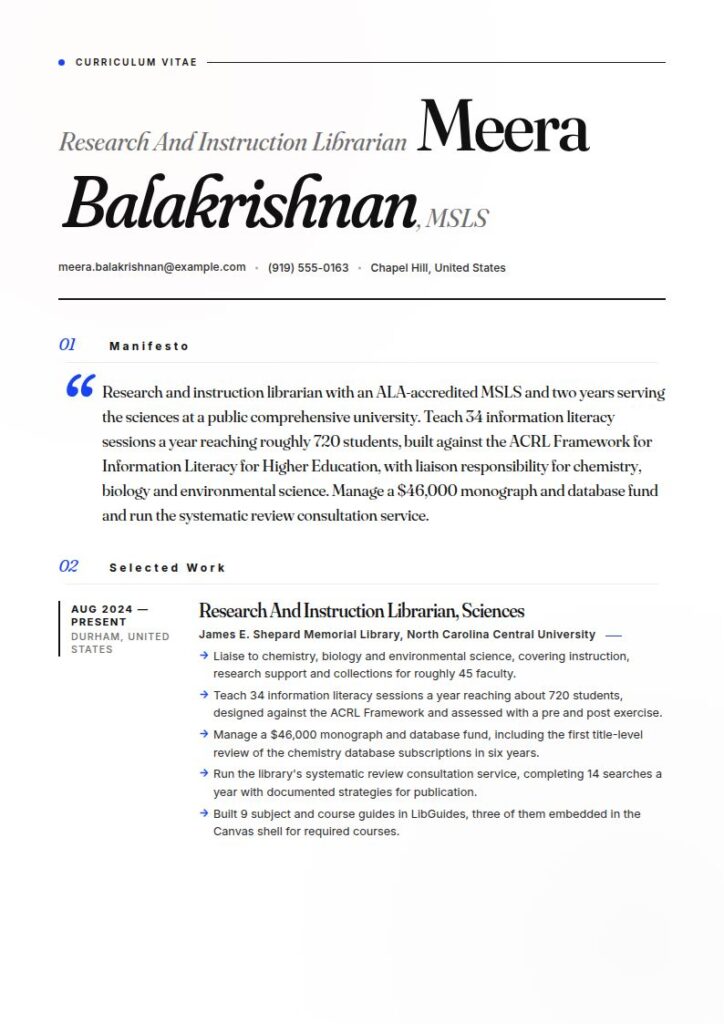
Research and instruction librarian with an ALA-accredited MSLS and two years serving the sciences at a public comprehensive university. Teach 34 information literacy sessions a year reaching roughly 720 students, built against the ACRL Framework for Information Literacy for Higher Education, with liaison responsibility for chemistry, biology and environmental science. Manage a $46,000 monograph and database fund and run the systematic review consultation service.
Work Experience
08/2024 - Present, Research and Instruction Librarian, Sciences, James E. Shepard Memorial Library, North Carolina Central University, Durham, United States
- Liaise to chemistry, biology and environmental science, covering instruction, research support and collections for roughly 45 faculty.
- Teach 34 information literacy sessions a year reaching about 720 students, designed against the ACRL Framework and assessed with a pre and post exercise.
- Manage a $46,000 monograph and database fund, including the first title-level review of the chemistry database subscriptions in six years.
- Run the library's systematic review consultation service, completing 14 searches a year with documented strategies for publication.
- Built 9 subject and course guides in LibGuides, three of them embedded in the Canvas shell for required courses.
01/2023 - 05/2024, Graduate Research Assistant, Research Data Services, University Libraries, University of North Carolina at Chapel Hill, Chapel Hill, United States
- Supported data management plan consultations for grant applicants across three science departments.
- Prepared and deposited 180 datasets to the institutional repository, writing the metadata and access statements for each.
Education
08/2022 - 05/2024, Master of Science in Library Science, Library Science, School of Information and Library Science, University of North Carolina at Chapel Hill, Chapel Hill, United States
ALA-accredited programme. Concentration in academic librarianship and research data management. Practicum in science liaison work, 140 hours.
08/2018 - 05/2022, Bachelor of Science, Chemistry, North Carolina State University, Raleigh, United States
Skills
ACRL Framework session design, 75
Chemistry and biology literature, 85
Systematic review searching, 75
Research data management, 75
Collection fund management, 65
LibGuides and Canvas integration, 85
Web of Science, SciFinder and Scopus, 85
Languages
English, native
Tamil, native
French, beginner
Certificates
06/2024, Research Data Management Librarian Academy, Research Data Management Librarian Academy
Summary
An academic librarian resume names the ALA-accredited master's degree that gates the profession, the departments you liaise to, the instruction sessions you teach and the funds you manage. This guide gives you three adaptable versions, the reason some posts need a CV instead, and current Bureau of Labor Statistics pay and outlook.
Academic Librarian resume examples by experience level
An academic librarian resume is a one to three page document naming your ALA-accredited master's degree, the departments you liaise to, the instruction you teach and the collections you manage.
The degree comes first because it is a gate. Nearly every professional post in a college or university library requires a master's from a programme accredited by the American Library Association's Committee on Accreditation, and committees screen for it before reading anything else. The rest of the file answers the question that decides the post: which departments do you serve, and what do you do for them.
Resume guide for an academic librarian resume
This guide and the corresponding academic librarian resume example will cover:
- How to write an academic librarian resume, section by section
- Why your liaison portfolio and instruction load come first
- Three adaptable summaries: early career, subject liaison and department head
- When the post wants a CV rather than a resume
- What the job market looks like and what you can expect to earn
How to write an academic librarian resume
Six sections: contact header, summary, education with the accreditation named, liaison and instruction portfolio, professional experience, and service or scholarship. One to two pages, longer where the post carries faculty status.
Education sits high here, which is unusual. The accredited degree is the screening criterion, and a committee confirms it first.
| Section | What it is answering | Where it goes |
|---|---|---|
| Accredited degree | Does this person clear the hard requirement? | Under the summary |
| Liaison portfolio | Which departments would they serve here? | Its own block |
| Instruction load | How many sessions, how many students, against what framework? | With liaison, with numbers |
| Functional specialism | Scholarly communication, repository, licensing, assessment? | Named explicitly |
| Service and scholarship | Do they meet the continuing appointment bar? | Its own section for a faculty post |
Write the accreditation, not just the degree
"Master of Science in Library Science" is the degree. "Master of Science in Library Science, School of Information and Library Science, University of North Carolina at Chapel Hill, ALA-accredited" is the qualification.
The American Library Association accredits master's programmes against its Committee on Accreditation standards, and accredited programmes award degrees under several names: MLS, MLIS, MA, MS and Master of Librarianship all appear. Because the title varies, the accreditation is the part carrying meaning.
Write it out once in the education block. It costs three words and removes the only question that can disqualify you on sight.
Run the finished file through the free Rezoom ATS resume checker first. University applicant systems parse these into a structured record before a committee opens them.
Choosing the best resume format for an academic librarian resume
Reverse chronological. One to two pages for a staff appointment, and a full curriculum vitae where the post carries faculty status.
That distinction matters more here than in any other education role. Many academic libraries appoint librarians as faculty, with rank, promotion and sometimes tenure. The ACRL, AAUP and AAC&U Joint Statement on Faculty Status of College and University Librarians, endorsed in 1972 and revised in 2012, holds that where librarians function essentially as part of the faculty, that identity should be recognised with corresponding entitlement to rank, promotion, tenure and research funds.
That means two documents. A staff post wants a two-page resume. A faculty post wants a CV listing publications, presentations, grants and committee service in full. In the posting, "tenure track", "continuing appointment", "rank of Assistant Librarian" and "research and service expectations" all mean send the CV.
Include your contact information
| ✅ Right | ❌ Wrong |
|---|---|
| Meera Balakrishnan | Meera Balakrishnan |
| Subject Librarian, Chemistry and Environmental Sciences | Passionate about books and lifelong learning |
| MSLS, University of North Carolina at Chapel Hill (ALA-accredited) | Master's degree in library science |
| (919) 555-0163, [email protected], Chapel Hill, NC | (919) 555-0163, [email protected], Chapel Hill, NC |
Name the subject area in your headline. Academic library searches are for a specific liaison portfolio, and "Academic Librarian" alone makes a committee work out where you fit.
Make use of a summary
Four lines: the accredited degree, the liaison portfolio, the instruction load, and your functional specialism.
Research and instruction librarian with an ALA-accredited MSLS and two years serving the sciences at a public comprehensive university. Teach 34 information literacy sessions a year reaching roughly 720 students, built against the ACRL Framework for Information Literacy for Higher Education, with liaison responsibility for chemistry, biology and environmental science. Manage a $46,000 monograph and database fund and run the systematic review consultation service.
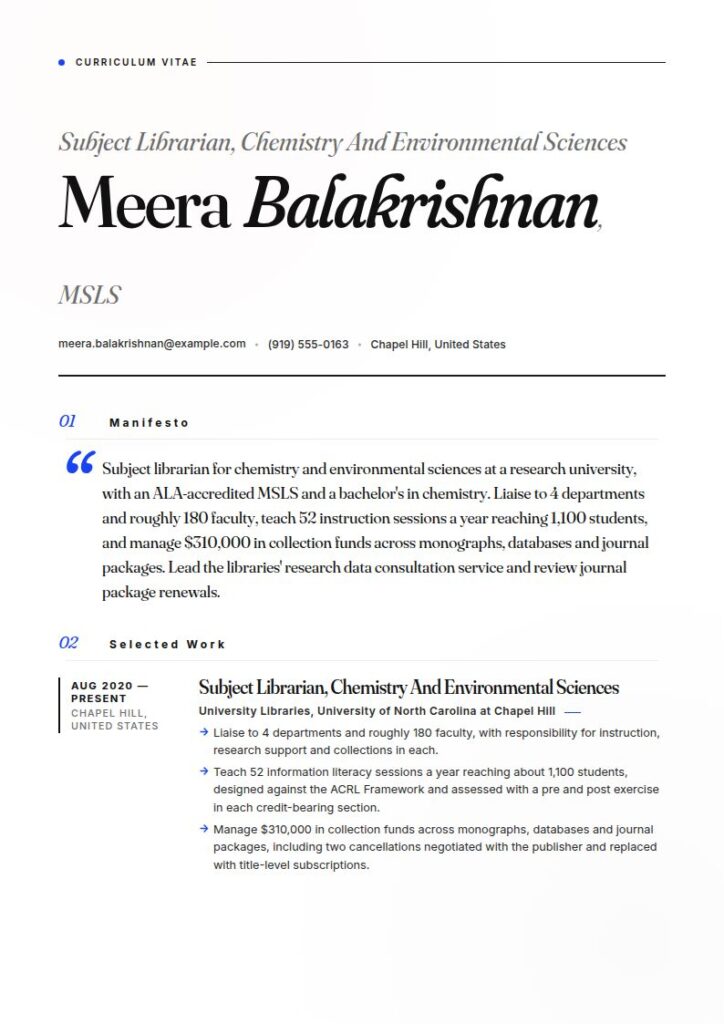
Subject librarian for chemistry and environmental sciences at a research university, with an ALA-accredited MSLS and a bachelor's in chemistry. Liaise to 4 departments and roughly 180 faculty, teach 52 instruction sessions a year reaching 1,100 students, and manage $310,000 in collection funds across monographs, databases and journal packages. Lead the libraries' research data consultation service and review journal package renewals.
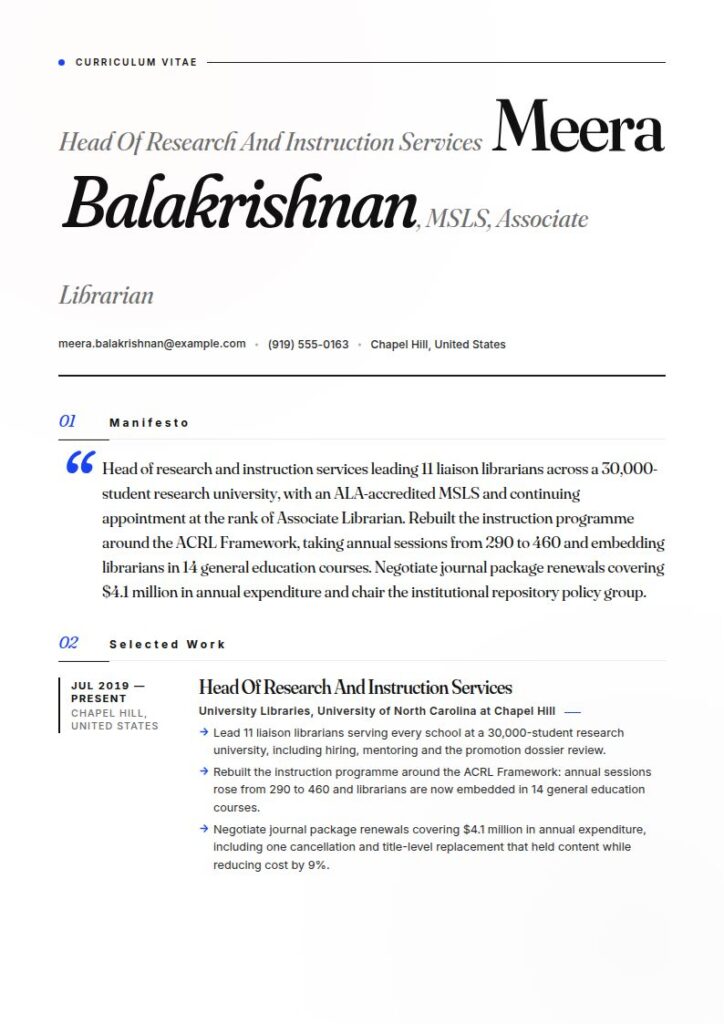
Head of research and instruction services leading 11 liaison librarians across a 30,000-student research university, with an ALA-accredited MSLS and continuing appointment at the rank of Associate Librarian. Rebuilt the instruction programme around the ACRL Framework, taking annual sessions from 290 to 460 and embedding librarians in 14 general education courses. Negotiate journal package renewals covering $4.1 million in annual expenditure and chair the institutional repository policy group.
Right vs wrong: the same academic librarian summary, twice
| ✅ Right | ❌ Wrong |
|---|---|
| Subject librarian for chemistry and environmental sciences, ALA-accredited MSLS with a bachelor's in chemistry. | Experienced librarian with a passion for research and student success. |
| Manage $310,000 in collection funds across monographs, databases and journal packages. | Assist with collection development. |
The right column tells a committee which vacancy you fill. The left column could be any of sixty other files.
Outline your professional experience
Institution, library, title, dates. Then bullets carrying a department, a number and a time frame. The unit of work here is a department served, a session taught or a fund managed.
| Instead of | Use |
|---|---|
| Taught library instruction sessions | Taught 52 sessions a year to roughly 1,100 students against the ACRL Framework, assessed with a pre and post exercise |
| Served on library committees | Chaired the journal package review committee, returning $190,000 to the monograph budget |
Subject Librarian, Chemistry and Environmental Sciences, University Libraries, University of North Carolina at Chapel Hill, Chapel Hill, NC, August 2020 to Present
Liaise to 4 departments and roughly 180 faculty, with responsibility for instruction, research support and collections in each.
Teach 52 information literacy sessions a year reaching about 1,100 students, designed against the ACRL Framework and assessed with a pre and post exercise in each credit-bearing section.
Manage $310,000 in collection funds across monographs, databases and journal packages, including two cancellations negotiated with the publisher and replaced with title-level subscriptions.
Hold 340 research consultations a year, 61% with graduate students and faculty, and deposit 1,240 articles and 86 datasets to the institutional repository under the federal public access workflow I wrote.
Name your liaison portfolio, your instruction load and the funds you manage
This is the block that decides the search, and most applicants leave it implied.
An academic library vacancy is almost never for a generic librarian. It is for the person who will serve the school of nursing, or the business school, or the sciences, and the committee is placing you against those departments.
| Element | What to write | Why it decides |
|---|---|---|
| Liaison portfolio | The departments by name, plus faculty and students served | The vacancy is a portfolio, and yours either transfers or does not |
| Instruction load | Sessions a year, students reached, course levels, framework | Instruction is the largest single demand on a liaison's time |
| Collection responsibility | Fund names, the dollar figure, the decisions you made | It is the part of the job carrying institutional money |
| Functional specialism | Scholarly communication, repository, data, assessment, licensing | Committees hire the specialism as often as the subject |
| Consultations | Number a year, and the graduate and faculty share | It separates a service desk from a research partnership |
Liaison portfolio: Chemistry, Environmental Sciences and Engineering, Marine Sciences, Geological Sciences. Roughly 180 faculty and 2,400 majors
Instruction: 52 sessions a year, about 1,100 students, built against the ACRL Framework for Information Literacy for Higher Education. Embedded in 3 courses across a full semester, including a graduate research methods seminar.
Collections: $310,000 across monograph, database and journal funds. Two package renegotiations and one cancellation with title-level replacement
Functional specialism: Scholarly communication and research data. Repository deposit, federal public access compliance workflow, data management plan consultations.
Consultations: 340 a year, 61% graduate students and faculty, including 22 systematic review searches
Two of those deserve extra attention, because they are where academic librarianship has moved.
The first is instruction against a named framework. The ACRL Framework for Information Literacy for Higher Education was filed by the ACRL Board in February 2015 and adopted in January 2016, replacing a standards model with six conceptual frames, among them Authority Is Constructed and Contextual and Scholarship as Conversation. Saying you teach against the Framework, and naming a frame you build a session around, distinguishes a librarian who designs instruction from one who demonstrates a database.
The second is scholarly communication. The August 2022 memorandum from the White House Office of Science and Technology Policy required federal agencies to make peer-reviewed publications from federally funded research publicly available without embargo, with agency policies effective by 31 December 2025. That pushed repository deposit, compliance workflows and data management support into the liaison's ordinary work. If you have built a compliance workflow, say so with the deposit count behind it.
Build a snapshot of your key skills
Twelve to sixteen entries in four groups: subject and research, instruction, collections and scholarly communication, systems.
Subject and research: Chemistry and environmental sciences literature, Systematic review searching, Research data management, Bibliometrics
Instruction: ACRL Framework session design, Embedded and credit-bearing instruction, Assessment of student learning, Graduate research methods
Collections and scholarly communication: Fund management, Journal package negotiation and cancellation analysis, Repository deposit, Federal public access compliance, Open educational resources
Systems: Alma and Primo, LibGuides, DSpace, Web of Science, SciFinder, Scopus, Python for collection analysis
List your education and professional credentials
The accredited master's first, with the accreditation named. Then the subject degree, which in a liaison post is a qualification rather than background.
Master of Science in Library Science, School of Information and Library Science, University of North Carolina at Chapel Hill, Chapel Hill, NC, 2019. ALA-accredited. Concentration in academic librarianship and research data management
Bachelor of Science, Chemistry, North Carolina State University, Raleigh, NC, 2016
Professional development: ACRL Immersion Program, Teacher Track (2023). Research Data Management Librarian Academy (2022). Licensing and negotiation workshop, NASIG (2024)
Service: Chair, Science and Technology Section programme committee, Association of College and Research Libraries (2025 to 2026).
Choose the right layout and design
Single column, plain type at 11 or 12 point, clear headings, no photograph. University applicant systems parse these into a structured record, and multi-column templates are where that breaks.
For a faculty-status post, switch documents rather than compressing. A CV has its own conventions: full publication and presentation lists in a citation style, grants with amounts, service by committee and term.
Write the accreditation next to the degree. Name your liaison departments with their faculty and student counts. Give instruction as sessions a year and students reached. State the framework you design against. Put a dollar figure on the funds you manage. Send a CV for a faculty post.
Do not write "provided reference services" when the consultation count is the evidence. Do not leave your subject degree buried if it qualifies you for the portfolio. Do not describe an identifiable patron or a reference question. Do not compress a faculty CV to two pages. Do not list every database you have used as a skill.
Academic librarian job market and outlook
A steady occupation in which the academic share is about one job in six, and college and university pay sits above the occupational median.
| Measure | Value |
|---|---|
| Librarian and library media specialist jobs, 2025 | 142,300 |
| Projected change, 2025-35 | 3% (about as fast as average) |
| Projected annual openings | ~12,600 |
| Typical entry-level education | Master's degree in library science |
| Median annual wage, May 2025 | $68,270 |
Source: U.S. Bureau of Labor Statistics, Occupational Outlook Handbook, 2025-35 projections and May 2025 wage data.
Where the jobs sit:
| Setting | Share of employment | Median annual wage (May 2025) |
|---|---|---|
| Local government, excluding education | 32% | $62,860 |
| Elementary and secondary schools | 31% | $74,710 |
| Colleges, universities and professional schools, state | 9% | $74,490 |
| Colleges, universities and professional schools, private | 8% | $73,700 |
| Information services | 5% | $60,360 |
Source: U.S. Bureau of Labor Statistics, Occupational Outlook Handbook, May 2025.
What an academic library actually spends its time and money on
In the ACRL 2024 annual survey, answered by 1,367 of the 3,457 United States institutions invited, total library expenditures averaged $2.1 million with a median of $487,000, and staff costs took 48.3% of the budget against 41.7% for materials and services (ACRL, State of U.S. Academic Libraries, 2024 survey).
The same survey found 79.6% of academic library collections now in digital or electronic format and subscription commitments alone consuming 33.1% of total expenditures. Libraries reported a mean of 198 group presentations a year reaching an average of 2,462 attendees, and a mean of 3,344 reference transactions and consultations.
Those proportions are the job description. A third of the budget is locked into subscriptions, which is why licensing and cancellation analysis is a hireable skill. Instruction and consultation are counted and reported, which is why those numbers belong on the page.
What salary you can expect as an academic librarian
The median annual wage for librarians and library media specialists was $68,270 as of May 2025. The lowest 10 percent earned less than $43,660 and the highest 10 percent more than $103,990 (BLS, May 2025).
Academic posts sit above that midpoint: a median of $74,490 in state colleges and universities and $73,700 in private institutions, against $62,860 in local government excluding education (BLS, May 2025).
Inside a university, pay is set by rank and appointment type more than by negotiation. A faculty-status library has librarian ranks with promotion steps decided on a dossier of instruction, scholarship and service; a staff-status library uses a professional band. Either way the documents decide, so a resume that records instruction counts, funds managed and packages negotiated in numbers is doing the work twice.
Key takeaways for an academic librarian resume
- Write "ALA-accredited" next to the master's degree; it is the screening criterion.
- Name your liaison departments, with faculty and student counts.
- Give instruction as sessions a year and students reached, against a named framework.
- Put a dollar figure on the funds you manage and the decisions you made.
- Name your functional specialism: scholarly communication, data, assessment, licensing.
- Count your consultations and give the graduate and faculty share.
- Send a CV, not a resume, when the post carries faculty status.
Build your academic librarian resume in 15 minutes.
Related education resume examples
- Librarian resume
- College professor resume
- Adjunct professor resume
- Research assistant resume
- Academic tutor resume
- Instructional designer resume
- Teacher resume
- High school teacher resume
- ESL teacher resume
- School counselor resume
- Substitute teacher resume
- Tutor resume
Pair it with a matching academic librarian cover letter.
Academic librarian resume questions, answered
Do I need an ALA-accredited degree to be an academic librarian?
For nearly every professional post, yes. The American Library Association accredits master's programmes in library and information studies through its Committee on Accreditation, and academic postings almost universally require a degree from an accredited programme. Because accredited degrees carry several titles, write the accreditation on the page rather than relying on the degree name.
Resume or CV for an academic library job?
Read the posting. A staff appointment wants a one to two page resume. A post with faculty status, a librarian rank, tenure or continuing appointment, or stated research and service expectations wants a full CV with publications, presentations, grants and committee service.
How do I move from a public or school library into academic work?
Translate your work into the academic units. Instruction becomes sessions taught and students reached against a framework. Collection work becomes funds managed and selection decisions. Reference becomes consultations, with the share that were extended research appointments. Then add what other sectors rarely develop: subject depth, a functional specialism, or scholarly communication experience.
Does a second master's in the subject matter?
It helps, and in some research library posts it is preferred or required, particularly in the sciences, area studies and music. If you have one, list it prominently. Otherwise a bachelor's in the subject plus a record of serving those departments is the next best evidence.
What do I write with no academic library experience yet?
Write the graduate work as work. A practicum with the institution, hours and duties. Graduate assistantships at a service point. Instruction you co-taught, with the session count. Any project with a named output: a LibGuide, a collection analysis, a repository deposit batch. Then name the departments your undergraduate subject qualifies you to serve.