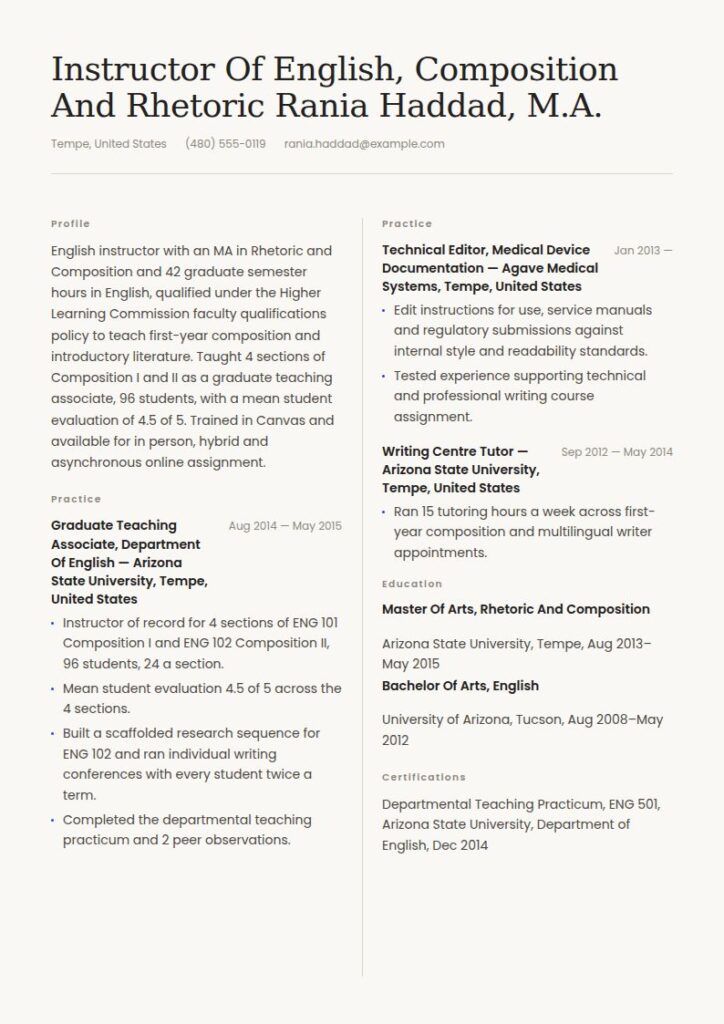
Instructor of English, Composition and Rhetoric Rania Haddad M.A.
Graduate Teaching Associate, Department of English
[email protected] | (480) 555-0119 | Tempe, United States
Profile
English instructor with an MA in Rhetoric and Composition and 42 graduate semester hours in English, qualified under the Higher Learning Commission faculty qualifications policy to teach first-year composition and introductory literature. Taught 4 sections of Composition I and II as a graduate teaching associate, 96 students, with a mean student evaluation of 4.5 of 5. Trained in Canvas and available for in person, hybrid and asynchronous online assignment.
Work Experience
08/2014 - 05/2015, Graduate Teaching Associate, Department of English, Arizona State University, Tempe, United States
- Instructor of record for 4 sections of ENG 101 Composition I and ENG 102 Composition II, 96 students, 24 a section.
- Mean student evaluation 4.5 of 5 across the 4 sections.
- Built a scaffolded research sequence for ENG 102 and ran individual writing conferences with every student twice a term.
- Completed the departmental teaching practicum and 2 peer observations.
01/2013 - Present, Technical Editor, Medical Device Documentation, Agave Medical Systems, Tempe, United States
- Edit instructions for use, service manuals and regulatory submissions against internal style and readability standards.
- Tested experience supporting technical and professional writing course assignment.
09/2012 - 05/2014, Writing Centre Tutor, Arizona State University, Tempe, United States
- Ran 15 tutoring hours a week across first-year composition and multilingual writer appointments.
Education
08/2013 - 05/2015, Master of Arts, Rhetoric and Composition, Arizona State University, Tempe, United States
42 graduate semester hours in English, meeting the Higher Learning Commission expectation of a master's degree in the discipline for general education instruction.
08/2008 - 05/2012, Bachelor of Arts, English, University of Arizona, Tucson, United States
Skills
First-year composition instruction, 75
Scaffolded research sequences, 70
Writing conferences, 80
Supporting multilingual writers, 75
Technical and professional writing, 85
Canvas and Turnitin, 80
Languages
English, native
Arabic, native
Spanish, intermediate
Certificates
12/2014, Departmental Teaching Practicum, ENG 501, Arizona State University, Department of English
Required for instructor of record status in first-year composition.
Summary
An adjunct professor resume is a two to three page teaching document that names the courses you can be assigned, the graduate hours that qualify you for each one, and what your student evaluations say. This guide gives you three adaptable versions, the qualification file deans are required to keep, and current Bureau of Labor Statistics pay and outlook.
Adjunct Professor resume examples by experience level
An adjunct professor resume is a two to three page teaching document that names the courses you can be assigned, the graduate credit hours that qualify you for each one, and what happened in the sections you have already taught.
It is not a research CV, and that distinction is the whole page. A tenure-track search reads a CV for a scholarly trajectory and takes nine months. An adjunct appointment is a per-course contract, often decided three weeks before term by a chair with an unstaffed section and a compliance file to satisfy. Sending the first document to the second reader is the most common mistake in contingent hiring.
Resume guide for an adjunct professor resume
This guide and the corresponding adjunct professor resume example will cover:
- How to write an adjunct professor resume, section by section
- Why it is a teaching document and not a research CV
- Three adaptable summaries: new, multi-institution and course lead
- The qualification file a dean is required to keep, and how to hand it to them
- What the market looks like and what per-course work actually pays
How to write an adjunct professor resume
Six sections: contact header, teaching profile, courses taught, teaching appointments, qualifications and graduate hours, and service or professional practice. Two pages is normal, three once the course inventory is long. The ordering is inverted from an academic CV, deliberately.
| Section | What it is answering | Where it goes |
|---|---|---|
| Courses taught | Which unstaffed section can I hand this person? | Page one, above appointments |
| Graduate hours by discipline | Can I document that they are qualified to teach it? | Immediately after, as a number |
| Teaching appointments | Have they done this at institutions like mine? | Reverse chronological, with terms and modalities |
| Evaluations | What do students and observers say? | Inside the appointments, with the scale |
| Research | Only if it supports the teaching | Last, short |
Put the course inventory on page one, above everything else
A chair filling a section is matching a course number to a person who can be put in front of it, under time pressure.
Give them a course inventory: the course number and title, the level, the modality, the enrolment and how many times you have taught it. "ENG 101 Composition I, 18 sections, in person and asynchronous online, 22 to 26 students" is a decision the reader can make in four seconds.
A publication list on page one asks them to translate your scholarship into a course assignment. Most will not, and a research-shaped file also raises the fear that you will leave the moment a full-time post appears.
Run the finished file through the free Rezoom ATS resume checker before you apply. Community college and university district systems parse applications into a structured record before a human opens them.
Choosing the best resume format for an adjunct professor resume
Reverse chronological with a course inventory block on page one. Two pages, three once your inventory justifies it.
Do not use a functional format; overlapping appointments at three institutions look unusual enough without hiding the timeline. Do not use a CV format either, unless the posting asks for one. Keep a CV for the occasional full-time search and this version for the per-course applications that make up most of the market.
Include your contact information
| ✅ Right | ❌ Wrong |
|---|---|
| Rania Haddad, M.A. | Rania Haddad |
| Adjunct Instructor of English, Composition and Rhetoric | Educator and lifelong learner |
| 42 graduate semester hours in English; MA, Rhetoric and Composition | Master's degree holder |
| (480) 555-0119, [email protected], Tempe, AZ | (480) 555-0119, [email protected] |
Put the graduate hours in the header. It is the first thing a chair has to verify and the last thing most applicants mention.
Make use of a summary
Four lines: discipline, the courses you can be assigned, the scale of your teaching, and one number on outcomes or evaluations.
English instructor with an MA in Rhetoric and Composition and 42 graduate semester hours in English, qualified under the Higher Learning Commission faculty qualifications policy to teach first-year composition and introductory literature. Taught 4 sections of Composition I and II as a graduate teaching associate, 96 students, with a mean student evaluation of 4.5 of 5. Trained in Canvas and available for in person, hybrid and asynchronous online assignment.
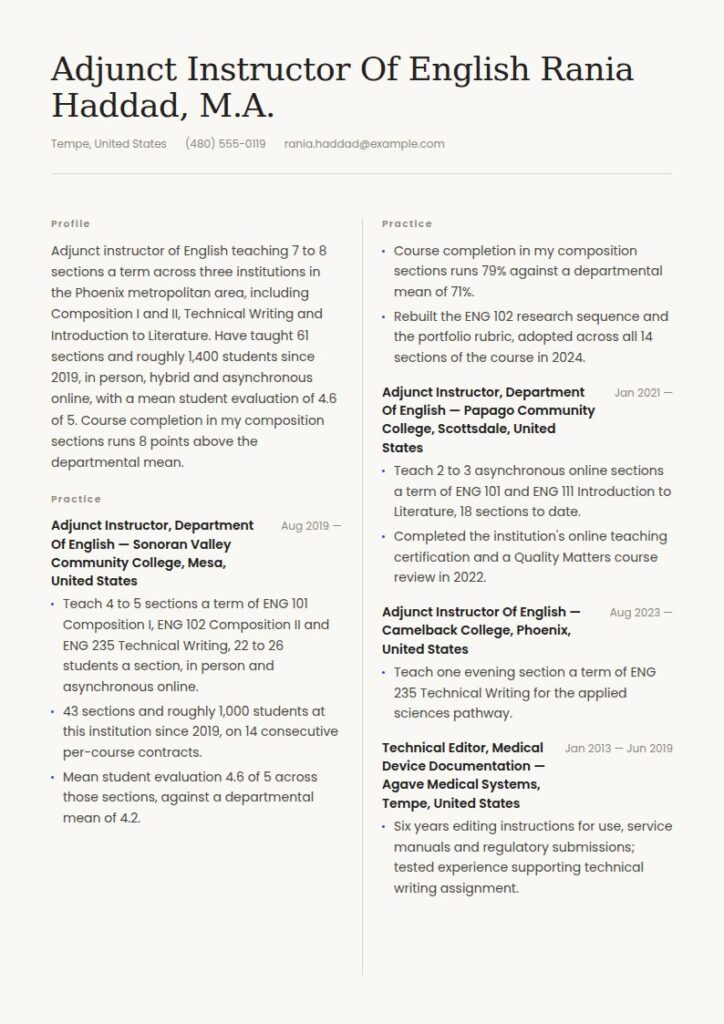
Adjunct instructor of English teaching 7 to 8 sections a term across three institutions in the Phoenix metropolitan area, including Composition I and II, Technical Writing and Introduction to Literature. Have taught 61 sections and roughly 1,400 students since 2019, in person, hybrid and asynchronous online, with a mean student evaluation of 4.6 of 5. Course completion in my composition sections runs 8 points above the departmental mean.
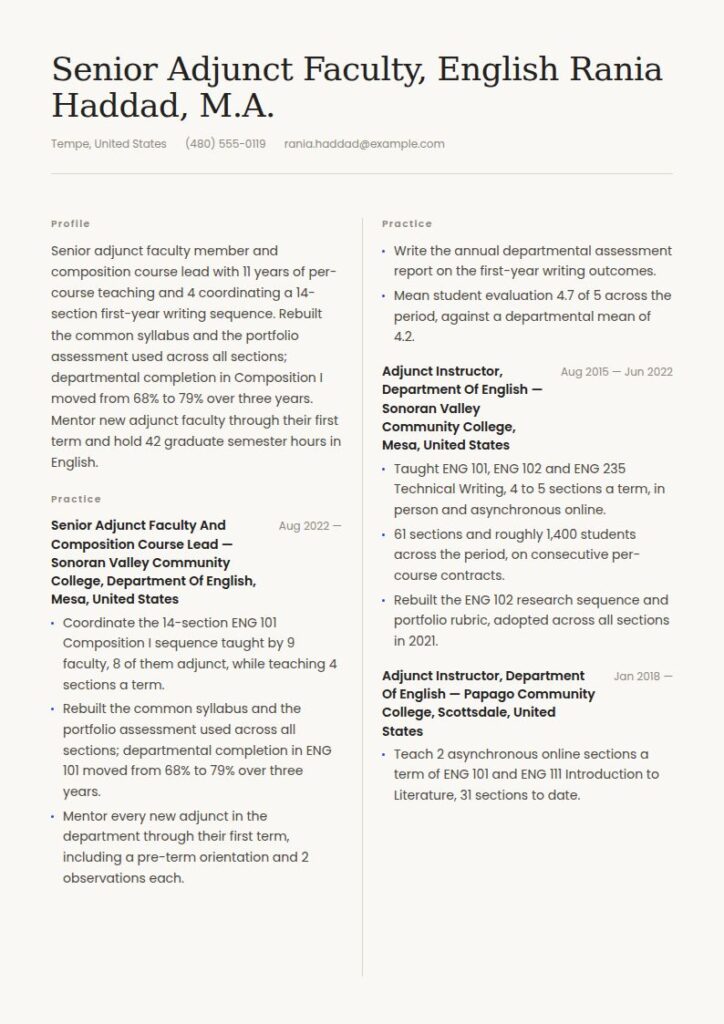
Senior adjunct faculty member and composition course lead with 11 years of per-course teaching and 4 coordinating a 14-section first-year writing sequence. Rebuilt the common syllabus and the portfolio assessment used across all sections; departmental completion in Composition I moved from 68% to 79% over three years. Mentor new adjunct faculty through their first term and hold 42 graduate semester hours in English.
Right vs wrong: the same adjunct professor summary, twice
| ✅ Right | ❌ Wrong |
|---|---|
| Adjunct instructor of English teaching 7 to 8 sections a term across three institutions. | Experienced higher education professional with a passion for teaching. |
| 61 sections and roughly 1,400 students since 2019, in person, hybrid and asynchronous online. | Taught a range of undergraduate courses in a variety of formats. |
| Course completion in my composition sections runs 8 points above the departmental mean. | Committed to student success and academic excellence. |
The left column can be scheduled and documented. The right column asks a reader to take a stranger's word for it three weeks before term.
Outline your teaching experience across institutions
List each institution as its own appointment with the department, the dates, then the courses, modalities, section counts and evaluation figures. Overlapping dates are normal here; do not hide them.
| Instead of | Use |
|---|---|
| Taught undergraduate English courses | Taught ENG 101 and ENG 102, 18 sections, 22 to 26 students each, in person and asynchronous online |
| Received positive student feedback | Mean student evaluation 4.6 of 5 across 24 sections, departmental mean 4.2 |
| Developed course materials | Rebuilt the ENG 102 research sequence and the portfolio rubric now used across 14 sections |
| Taught online classes | Designed and taught 9 asynchronous online sections in Canvas, including the Quality Matters review |
Adjunct Instructor, Department of English, Sonoran Valley Community College, Mesa, AZ, August 2019 to Present
Teach 4 to 5 sections a term of ENG 101 Composition I, ENG 102 Composition II and ENG 235 Technical Writing, 22 to 26 students a section, in person and asynchronous online.
Taught 43 sections and roughly 1,000 students at this institution since 2019, on 14 consecutive per-course contracts.
Mean student evaluation 4.6 of 5 across those sections, against a departmental mean of 4.2.
Course completion in my composition sections runs 79% against a departmental mean of 71%.
Rebuilt the ENG 102 research sequence and the portfolio rubric, adopted across all 14 sections of the course in 2024.
Adjunct Instructor, Department of English, Papago Community College, Scottsdale, AZ, January 2021 to Present
Teach 2 to 3 asynchronous online sections a term of ENG 101 and ENG 111 Introduction to Literature, 18 sections to date.
Completed the institution's online teaching certification and a Quality Matters course review in 2022.
Build the qualification file your dean has to keep on record
This section exists only on a contingent faculty resume, and writing it is the highest-value thing you can do.
When a chair assigns you a course they are also creating a compliance record an accreditor can ask to see. Under the Higher Learning Commission faculty qualifications policy adopted on 2 November 2023, faculty teaching general education courses hold a master's degree or higher in the discipline, and a faculty member whose degree is in another discipline should have completed a minimum of 18 graduate credit hours in the discipline or subfield in which they teach. The policy also allows institutions to qualify faculty through equivalent tested experience, or a combination of the two.
Every regional accreditor has a version of this rule, which means your resume is read as evidence for a file. Most applicants leave the reader to assemble that evidence from a transcript nobody has requested yet. Do it for them.
State your graduate hours as a number, by discipline. Not "MA in English", but "MA, Rhetoric and Composition, 42 graduate semester hours in English". If you have hours in a second field, list those separately, because they may qualify you for a second course and a second contract.
Map hours to courses. A short table beats a paragraph.
MA, Rhetoric and Composition, Arizona State University, 2015. 42 graduate semester hours in English.
Qualified to teach and have taught: ENG 101 Composition I, ENG 102 Composition II, ENG 111 Introduction to Literature, ENG 235 Technical Writing
Qualified to teach, not yet assigned: ENG 213 Advanced Composition, ENG 218 Introduction to Rhetoric, developmental writing
Additional qualification: Graduate Certificate in Teaching English as a Second Language, 18 graduate hours, Arizona State University, 2018, supporting ESL composition sections
Tested experience: 6 years as a technical editor in medical device documentation, supporting technical and professional writing assignment
Name the tested experience. If part of your qualification comes from professional practice rather than credit hours, say what it is and how long it ran. Accreditor policy allows it, and a chair who wants to hire you still has to write it down.
Most of the profession is contingent
About 68 percent of faculty members in US colleges and universities held contingent appointments in fall 2023, against about 47 percent in fall 1987, and roughly 49 percent of all faculty appointments were part-time (AAUP, Data Snapshot: Tenure and Contingency in US Higher Education, spring 2025). The trend is structural: between fall 2002 and fall 2023, full-time contingent appointments grew by about 65 percent while tenured appointments grew by about 6 percent.
That is good news and bad news in one figure. The good half is that most postings you will answer are teaching appointments, read by people who need a section covered well, and a document written for that reader is uncommon enough to stand out.
Build a snapshot of your key skills
Ten to fourteen entries in groups, weighted towards teaching delivery and the systems the institution runs.
Teaching: First-year composition, Technical and professional writing, Portfolio assessment, Writing conferences, Supporting multilingual writers
Modalities and design: Asynchronous online course design, Hybrid delivery, Quality Matters course review, Accessibility and captioning compliance
Systems: Canvas, Blackboard, Turnitin, Starfish early alert, Zoom
Service: Common syllabus and rubric development, New adjunct mentoring, Departmental assessment reporting
List your education and credentials
Degrees with graduate hours attached, then teaching credentials, then anything that widens the range of courses you can be assigned.
Master of Arts, Rhetoric and Composition, Arizona State University, Tempe, AZ, 2015. 42 graduate semester hours in English.
Graduate Certificate, Teaching English as a Second Language, Arizona State University, Tempe, AZ, 2018. 18 graduate semester hours.
Bachelor of Arts, English, University of Arizona, Tucson, AZ, 2012
Credentials: Quality Matters Peer Reviewer (2023). Online Teaching Certification, Sonoran Valley Community College (2020). Accessible Course Design, 2024.
Choose the right layout and design
Single column, plain type at 11 or 12 point, clear headings, page numbers, no photograph. District portals parse applications before a human sees them, and columns, text boxes and graphics break that.
Put the course inventory on page one with course numbers, section counts and modalities. State graduate hours as a number and name the discipline. Give evaluation figures with the scale and the departmental comparison. Keep every institution as its own appointment. Name the courses you are qualified for but have not been assigned, and the modalities you can teach.
Do not send a research CV to a per-course posting. Do not lead with publications unless the posting asks for a research record. Do not hide overlapping appointments; they are the normal shape of the work. Do not write "various undergraduate courses" when the course numbers are the point. Do not omit the graduate hours line.
Adjunct professor job market and outlook
Postsecondary teaching is growing faster than the average occupation, and a large share of that work is part-time and per-course.
| Measure | Value |
|---|---|
| Postsecondary teaching jobs, 2025 | 1,378,200 |
| Projected change, 2025-35 | +7% (much faster than average), +98,200 |
| Projected annual openings | ~103,300 |
| Typical entry-level education | A doctorate at four-year institutions; a master's is often enough at community colleges |
| Median annual wage, May 2025 | $85,330 |
Source: U.S. Bureau of Labor Statistics, Occupational Outlook Handbook, 2025-35 projections and May 2025 wage data.
The Handbook notes that most postsecondary teachers work full time although part-time work is common, and that part-time professors, generally known as adjunct professors, usually spend most of their time teaching rather than on research (BLS Occupational Outlook Handbook, 2026).
Where the work sits:
| Setting | Share of employment | Median annual wage (May 2025) |
|---|---|---|
| Colleges, universities and professional schools, state | 41% | $96,120 |
| Colleges, universities and professional schools, private | 39% | $89,660 |
| Junior colleges, local | 10% | $81,640 |
| Junior colleges, state | 6% | $68,160 |
Source: U.S. Bureau of Labor Statistics, Occupational Outlook Handbook, May 2025.
What salary you can expect as an adjunct professor
Read the occupational median carefully. The $85,330 figure covers all postsecondary teachers, most of whom are salaried and full-time. Per-course work is paid on a different basis entirely.
Per-course pay, and what comes with it
Among 555 institutions reporting part-time faculty data to the AAUP, the median starting pay was $3,121 per course section in 2024 to 2025, nearly 87 percent of participating institutions hired part-time faculty on a per-course-section basis, and nearly 70 percent reported providing those faculty neither retirement nor medical benefits (AAUP, preliminary 2025-26 Faculty Compensation Survey results).
That figure is the reason the course inventory matters more than anything else on your resume. Your annual income is a multiplication: sections per term, terms per year, institutions willing to give you a contract. Everything on the page that makes it easier to assign you another section has a direct cash value.
Two levers move an adjunct income beyond section count. The first is range: every additional course you are documented to teach is another section you can be offered when the first one does not run. The second is modality, because an asynchronous online section can sit alongside an in person timetable at a second institution without a travel conflict.
Key takeaways for an adjunct professor resume
- Write a teaching document, not a research CV; the reader is filling a section, not evaluating a scholar.
- Put the course inventory on page one, with course numbers, section counts and modalities.
- State graduate hours as a number and name the discipline, because that is the compliance bar.
- Map hours to courses, including courses you are qualified for but have not yet taught.
- Give evaluation figures with the scale and the departmental comparison.
- List every institution as its own appointment, overlaps included.
- Name the modalities you can teach, since online sections stack without travel conflicts.
- Keep a separate CV for the occasional full-time search, and do not send it here.
Build your adjunct professor resume in 15 minutes.
Related education resume examples
- College professor resume
- Academic resume
- Academic tutor resume
- Academic librarian resume
- Research assistant resume
- Instructional designer resume
- ESL teacher resume
- Tutor resume
- Teacher resume
- High school teacher resume
- Math teacher resume
- Student teacher resume
Pair it with a matching adjunct professor cover letter.
Adjunct professor resume questions, answered
Should an adjunct professor send a resume or a CV?
A resume, unless the posting asks for a CV. Per-course appointments are teaching appointments, decided quickly by a chair covering a section, and a two-page teaching document written for that decision reads better than a fifteen-page research record. Keep the CV updated for full-time and tenure-track searches, and keep the two files separate.
How many graduate hours do I need to teach a college course?
Most regional accreditors expect a master's degree or higher in the discipline for general education courses, and a minimum of 18 graduate credit hours in the discipline or subfield where the degree is in another field (Higher Learning Commission faculty qualifications policy, adopted 2 November 2023). Institutions may also qualify faculty through equivalent tested experience. Count your hours, state the number, and keep an unofficial transcript ready.
How do I show teaching quality without tenure-track observations?
Use what your institutions already collect: student evaluation means with the scale and the departmental comparison, completion and pass rates against the departmental mean, peer or chair observation notes, and repeat rehiring. Fourteen consecutive per-course contracts at one institution is an evaluation, and worth stating as one.
Is it a problem that I teach at three institutions at once?
No, it is the normal shape of the work, and hiding it looks worse than showing it. About 49 percent of faculty appointments were part-time in fall 2023 (AAUP, spring 2025), and chairs know what that means in practice. List each appointment separately with its own dates and be straightforward about your availability by day and modality.
When should I apply for adjunct positions?
Earlier than feels sensible, then again later than feels sensible. Departments build schedules months ahead but fill the gaps left by enrolment changes and departures in the final weeks before term. Send your file to the chair and to the adjunct pool posting, then follow up two to three weeks before classes start, when the unstaffed sections become visible.