Education Researcher Ingrid Solberg-Ade
Graduate Research Assistant, Longitudinal Literacy Study
[email protected] | (734) 555-0115 | Ann Arbor, United States
Profile
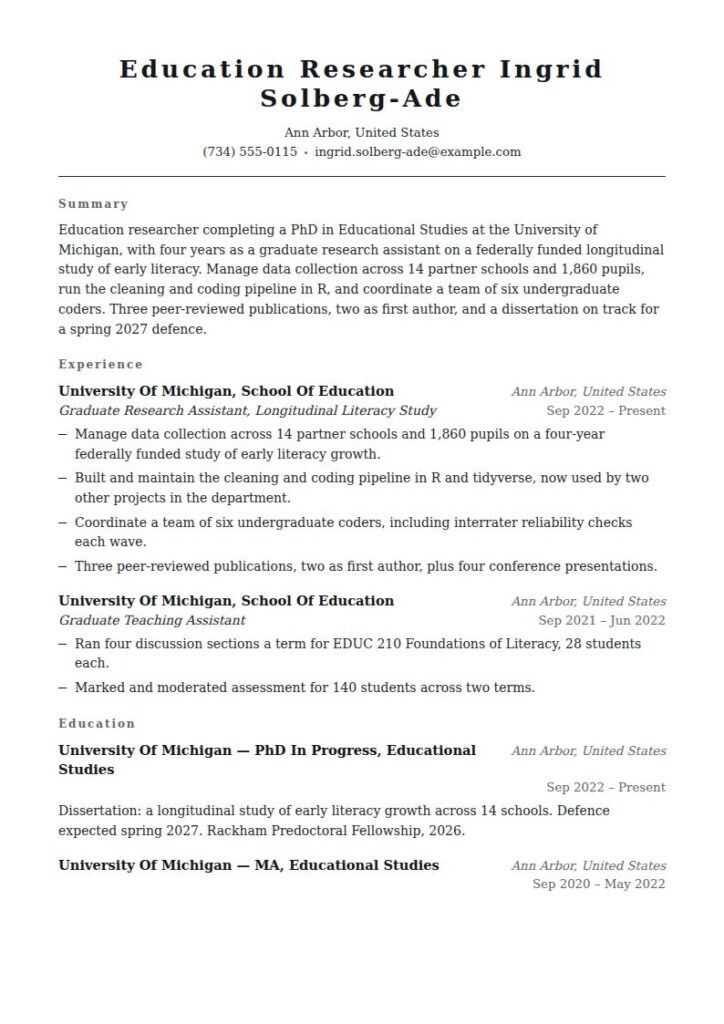
Education researcher completing a PhD in Educational Studies at the University of Michigan, with four years as a graduate research assistant on a federally funded longitudinal study of early literacy. Manage data collection across 14 partner schools and 1,860 pupils, run the cleaning and coding pipeline in R, and coordinate a team of six undergraduate coders. Three peer-reviewed publications, two as first author, and a dissertation on track for a spring 2027 defence.
Work Experience
09/2022 - Present, Graduate Research Assistant, Longitudinal Literacy Study, University of Michigan, School of Education, Ann Arbor, United States
- Manage data collection across 14 partner schools and 1,860 pupils on a four-year federally funded study of early literacy growth.
- Built and maintain the cleaning and coding pipeline in R and tidyverse, now used by two other projects in the department.
- Coordinate a team of six undergraduate coders, including interrater reliability checks each wave.
- Three peer-reviewed publications, two as first author, plus four conference presentations.
09/2021 - 06/2022, Graduate Teaching Assistant, University of Michigan, School of Education, Ann Arbor, United States
- Ran four discussion sections a term for EDUC 210 Foundations of Literacy, 28 students each.
- Marked and moderated assessment for 140 students across two terms.
Education
09/2022 - Present, PhD in progress, Educational Studies, University of Michigan, Ann Arbor, United States
Dissertation: a longitudinal study of early literacy growth across 14 schools. Defence expected spring 2027. Rackham Predoctoral Fellowship, 2026.
09/2020 - 05/2022, MA, Educational Studies, University of Michigan, Ann Arbor, United States
Skills
Longitudinal study design, 75
R and tidyverse, 90
Qualitative coding and interrater reliability, 80
Survey instrument design, 70
Research ethics and IRB protocols, 80
Supervision of research assistants, 70
Languages
English, native
Norwegian, native
Summary
An academic resume is a one to two page document for the parts of higher education that hire like any other employer, and for the work you apply for outside it. This guide gives you three adaptable versions, the rule for choosing between a resume and a CV, and current Bureau of Labor Statistics pay for the main academic occupations.
Academic resume examples by experience level
An academic resume is a one to two page document used for the parts of higher education that hire like any other employer: professional staff posts, research positions off the tenure track, programme and centre administration, and every job you apply for when you leave the academy.
It is not a curriculum vitae, and choosing the wrong document is the most common mistake people with graduate training make. A CV is cumulative and unbounded. It lists everything you have ever produced because a faculty search committee is assessing a record. A resume is selective and bounded. It argues that you can do one named job, and anything that does not serve that argument comes off the page.
Resume guide for an academic resume
This guide and the corresponding academic resume example will cover:
- When an academic resume is wanted and when a CV is wanted instead
- How to write each section, and what to cut from a CV to get there
- Three adaptable summaries: research assistant, faculty, and centre director
- How to weight teaching, research and service for the post in front of you
- How large the academic sector is and what its main occupations pay
How to write an academic resume
Six sections: contact header, summary, experience, research and teaching evidence, education and funding, and skills. One page if you are within a few years of the doctorate, two once you are running things.
The hard part is subtraction. A working CV runs to eight, fifteen, forty pages. The resume keeps what the posting asks about and drops the rest into a linked online profile.
| Section | What it is answering | Where it goes |
|---|---|---|
| Summary | What is this person, in one line, and can they do this job? | Top, four lines, no philosophy |
| Experience | What have they run, taught, funded or delivered? | Reverse chronological, with numbers |
| Selected research | Does the record support the claim, without listing all of it? | Three to five items, then a link |
| Education and funding | The degree, the field, the money you have won | Degree, institution, year, awards |
Convert your CV by asking what each line is evidence of
Take the posting and write down the four things it is actually assessing. A research programme manager post is usually assessing project delivery, budget handling, writing for non-specialists, and supervision. A faculty post is assessing publication, funding, teaching and fit.
Now go through the CV line by line and ask what each entry proves about those four things. A conference talk in your third year proves nothing about budget handling; a $412,000 grant you administered proves a great deal. Keep the second, cut the first.
What survives becomes the resume. What does not stays on your institutional page, your ORCID record or your personal site, linked once from the header so nobody thinks you are hiding it.
Run the finished file through the free Rezoom ATS resume checker before you submit. University human resources systems parse applications into structured records before a search chair opens them, and a two-column CV layout is where that parsing fails.
Choosing the best resume format for an academic resume
Reverse chronological. Graduate study, postdoctoral work and fixed-term appointments produce a timeline that looks broken to anyone outside the sector, and a functional format makes that worse by hiding the dates entirely.
Label the gaps rather than concealing them. A doctorate is a job, so write it as one: institution, dates, what you built, what it cost, what came out of it. A postdoc is a job. A teaching fellowship is a job. Written that way, a decade of training reads as ten years of employment, which is what it was.
Include your contact information
| ✅ Right | ❌ Wrong |
|---|---|
| Ingrid Solberg-Ade, PhD | Dr Ingrid Solberg-Ade |
| Education Researcher and Programme Evaluator | Passionate scholar and lifelong learner |
| (734) 555-0115, [email protected], Ann Arbor, MI | [email protected] |
| orcid.org/0000-0000-0000-0000 | Full mailing address, date of birth, marital status |
Use one email you will keep after the appointment ends. Institutional addresses are switched off when contracts finish, and a search that takes four months will outlive yours.
Put the ORCID or Google Scholar link in the header on a research resume and leave it off an administrative one, where it reads as a signal that you would rather be doing something else.
Make use of a summary
Four lines: what you are, the field, the scale of what you have handled, and one outcome with a number on it.
Education researcher completing a PhD in Educational Studies at the University of Michigan, with four years as a graduate research assistant on a federally funded longitudinal study of early literacy. Manage data collection across 14 partner schools and 1,860 pupils, run the cleaning and coding pipeline in R, and coordinate a team of six undergraduate coders. Three peer-reviewed publications, two as first author, and a dissertation on track for a spring 2027 defence.
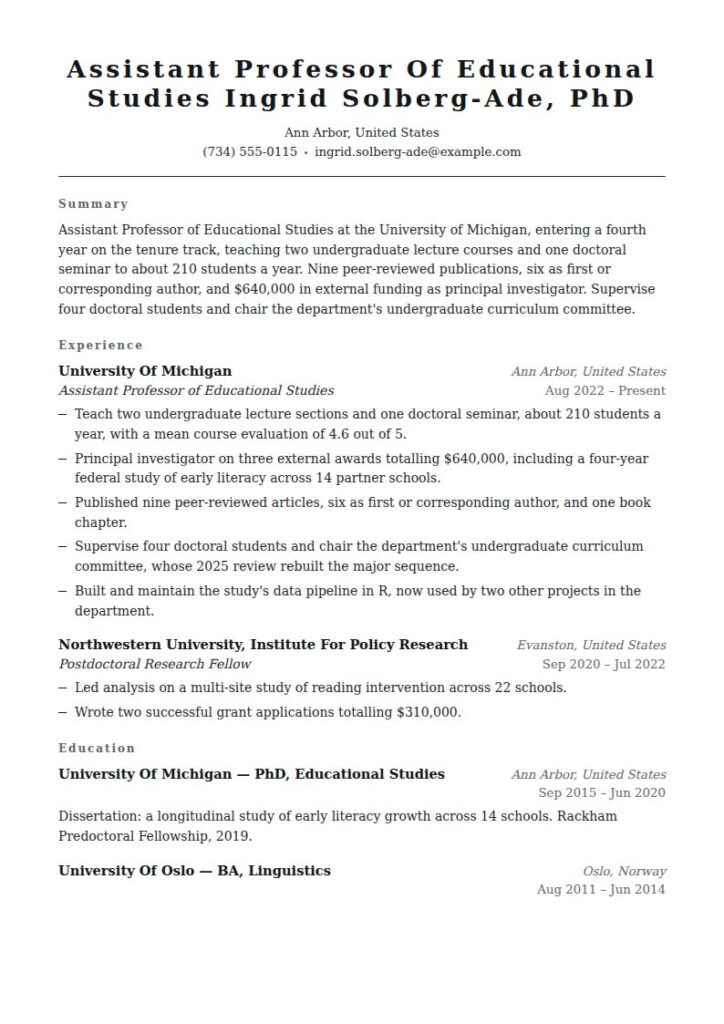
Assistant Professor of Educational Studies at the University of Michigan, entering a fourth year on the tenure track, teaching two undergraduate lecture courses and one doctoral seminar to about 210 students a year. Nine peer-reviewed publications, six as first or corresponding author, and $640,000 in external funding as principal investigator. Supervise four doctoral students and chair the department's undergraduate curriculum committee.
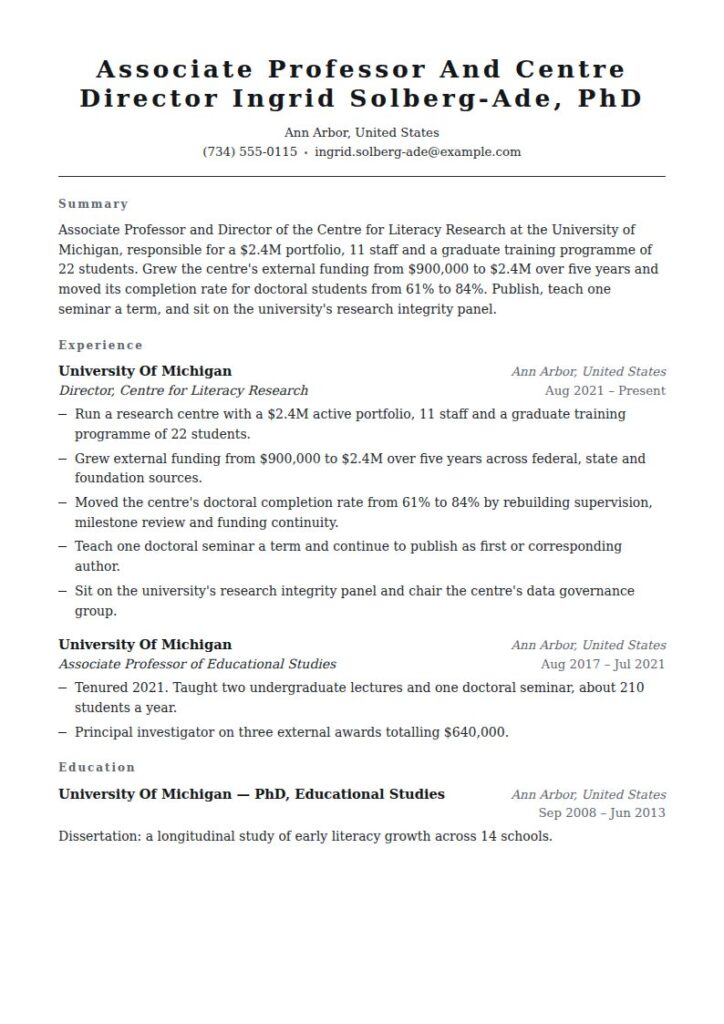
Associate Professor and Director of the Centre for Literacy Research at the University of Michigan, responsible for a $2.4M portfolio, 11 staff and a graduate training programme of 22 students. Grew the centre's external funding from $900,000 to $2.4M over five years and moved its completion rate for doctoral students from 61% to 84%. Publish, teach one seminar a term, and sit on the university's research integrity panel.
Right vs wrong: the same academic summary, twice
| ✅ Right | ❌ Wrong |
|---|---|
| Assistant Professor of Educational Studies, entering a fourth year on the tenure track. | Early career scholar with a passion for research and teaching. |
| Nine peer-reviewed publications, six as first or corresponding author. | Author of numerous publications in leading journals. |
| $640,000 in external funding as principal investigator. | Experienced in securing research funding. |
The right column can be checked in ten seconds. The left column is the same record written so that nobody has to take your word for anything.
Outline your experience
Title, institution, city, dates, and then three to five bullets. Each one carries a number: students taught, papers published, dollars administered, people supervised, or the change in something you were responsible for.
| Instead of | Use |
|---|---|
| Conducted research on early literacy | Ran data collection across 14 partner schools and 1,860 pupils over three waves |
| Taught undergraduate courses | Taught 2 lecture sections and 1 doctoral seminar, about 210 students a year, mean evaluation 4.6 of 5 |
| Secured external funding | Won $640,000 as principal investigator across three awards, including a four-year federal grant |
| Supervised students | Supervised 4 doctoral students and 6 undergraduate research assistants; 3 have defended |
| Served on committees | Chaired the undergraduate curriculum review that rebuilt the major sequence adopted in 2025 |
Assistant Professor of Educational Studies, University of Michigan, Ann Arbor, MI, August 2022 to Present
Teach two undergraduate lecture sections and one doctoral seminar, about 210 students a year, with a mean course evaluation of 4.6 out of 5.
Principal investigator on three external awards totalling $640,000, including a four-year federal study of early literacy across 14 partner schools.
Published nine peer-reviewed articles, six as first or corresponding author, and one book chapter.
Supervise four doctoral students and chair the department's undergraduate curriculum committee, whose 2025 review rebuilt the major sequence.
Built and maintain the study's data pipeline in R, now used by two other projects in the department.
Academic CV or resume: which document the application actually wants
This is the decision that determines whether your file is read, and the rule is simple enough to apply in ten seconds.
| The posting is for | Send | Why |
|---|---|---|
| A faculty post, postdoc, fellowship or grant | A full CV | The committee is assessing a complete record, including everything you did not get |
| University professional staff: admissions, advising, research administration, development | A resume, one to two pages | Hiring is run by human resources against a job description |
| A research post in industry, government or a non-profit | A resume, one page unless you are senior | The reader is not from your field and will not decode a CV |
| A teaching post at a community college | A resume, with a teaching-first ordering | Course coverage decides these, not publications |
| A job advertised on a university human resources portal with a two-page limit | A resume, obviously | The limit is the instruction |
Where the two documents overlap, the numbers must agree. Committees do compare, and a publication count that changes between files is worse than a low one.
Keep both, and keep both current. The CV is the master record you add to as things happen; the resume is generated from it for a specific posting and then thrown away.
The teaching, research and service split, and how to weight it
Every academic post divides into teaching, research and service, and every posting weights those three differently. Most applicants send the same ordering to all of them.
Read the advertisement for the weighting and reorder the page to match it.
- A research-intensive post wants publications, funding and method on page one. Teaching goes to a short block with courses, levels and enrolment.
- A teaching-focused or community college post wants courses taught, by name and level, with enrolment and outcomes. The publication list shrinks to a line saying how many and a link.
- A staff or administrative post wants neither in the old form. It wants budgets, headcount, delivery dates, committees chaired and things that changed because you ran them. Teaching becomes evidence of communication and service becomes evidence of governance.
Teaching: EDUC 210 Foundations of Literacy (lecture, 140 students, twice a year), EDUC 505 Research Design (doctoral seminar, 14 students), EDUC 390 Independent Research (6 students a year). Mean evaluation 4.6 of 5 across 11 sections.
Supervision: 4 doctoral students in progress, 3 defended; 6 undergraduate research assistants, 2 now in funded graduate programmes.
Service: Chair, undergraduate curriculum committee, 2024 to present. Member, research integrity panel. Reviewer for three journals in the field.
Build a snapshot of your key skills
Ten to fourteen entries in three groups: method, tools, and the things that read as employable outside the department.
Method: Longitudinal study design, Mixed methods, Multilevel modelling, Survey instrument design, Qualitative coding and interrater reliability, Research ethics and IRB protocols
Tools: R and tidyverse, Stata, Qualtrics, NVivo, Git, LaTeX
Delivery: Grant writing and post-award reporting, Budget management, Project scheduling, Supervision of research staff, Writing for non-specialist audiences, Conference and workshop organisation
The third group is the one that gets an academic hired outside the academy, and the one most people leave off because it feels like the part that is not real work.
List your education, funding and credentials
Degree, field, institution, year. Then the funding, because money won is the single most portable credential academic work produces.
PhD, Educational Studies, University of Michigan, Ann Arbor, MI, 2022. Dissertation: a longitudinal study of early literacy growth across 14 schools.
MA, Educational Studies, University of Michigan, 2018
BA, Linguistics, University of Oslo, Norway, 2015
Funding: Principal investigator on three external awards totalling $640,000, including a four-year federal study, 2023 to 2027. Rackham Predoctoral Fellowship, 2021.
Selected publications: 9 peer-reviewed articles, 6 as first or corresponding author. Full list at orcid.org.
Choose the right layout and design
Single column, plain type at 11 or 12 point, clear headings, no photograph and no personal details beyond city and contact. University portals parse the file before anyone reads it.
Decide between a resume and a CV before you write a word. Write the doctorate and every postdoc as a job, with dates, scale and output. Put money administered and people supervised on the page. Name courses with their level and enrolment. Link the full record once, from the header. Use an email address that outlives your contract.
Do not send a fifteen-page CV to a human resources portal with a two-page field. Do not open with a research philosophy or a statement of scholarly identity. Do not list every conference talk, poster and workshop on a resume. Do not leave the funding figures off because they feel like boasting. Do not describe yourself as an emerging or early career scholar in a summary; say the rank and the year.
The size and shape of the academic sector
Higher education is a large sector that is growing while individual searches feel impossible, and both of those things are true at once.
| Measure | Value |
|---|---|
| Postsecondary teaching jobs, 2025 | 1,378,200 |
| Projected change, 2025-35 | +7% (+98,200) |
| Projected annual openings, postsecondary teaching | ~103,300 |
| Postsecondary education administrator jobs, 2025 | 231,800 |
| Projected change, administrators, 2025-35 | +2% (+4,100) |
| Private educational services employment, 2025 | 4,048,800 |
| Projected change, private educational services, 2025-35 | +2.5% |
Sources: U.S. Bureau of Labor Statistics, Occupational Outlook Handbook, 2025-35 projections and May 2025 wage data; BLS Employment Projections, employment by major industry sector, 27 August 2026.
Two in three faculty appointments are not on the tenure track
About 68% of faculty members in United States colleges and universities held contingent appointments in fall 2023, with about 32% holding full-time tenured or tenure-track posts. In 1987 the split ran the other way, 47% contingent to 53% tenured or tenure-track (AAUP, Data Snapshot: Tenure and Contingency in US Higher Education, fall 2023).
Where that work sits also shapes the pay. Of postsecondary teaching employment, 41% is in state colleges, universities and professional schools at a median of $96,120, 39% in private institutions at $89,660, 10% in local junior colleges at $81,640 and 6% in state junior colleges at $68,160 (BLS Occupational Outlook Handbook, May 2025).
The planning consequence is to keep two orderings of the same record. Most of the posts you will answer are not tenure-track, and a non-tenure-track teaching post reads a long publication list as evidence that you will leave the moment something better appears.
What the main academic occupations pay
There is no single academic wage, because the sector is a stack of different occupations with different entry bars. These are the medians for the ones most graduate-trained people end up in.
| Occupation | Median annual wage, May 2025 | Typical entry education |
|---|---|---|
| Postsecondary education administrators | $104,590 | Master's degree |
| Postsecondary teachers | $85,330 | Varies by institution |
| Instructional coordinators | $77,440 | Master's degree |
| Librarians and library media specialists | $68,270 | Master's degree |
| School and career counselors and advisors | $64,330 | Master's degree |
| Social science research assistants | $61,990 | Bachelor's degree |
Source: U.S. Bureau of Labor Statistics, Occupational Outlook Handbook, May 2025 wage data.
The spread inside postsecondary teaching is the widest of any of them: the lowest 10 percent earned less than $49,540 and the highest 10 percent more than $203,580 as of May 2025, and by field the medians run from law teachers at $128,500 and economics at $123,920 down through the rest of the disciplines (BLS Occupational Outlook Handbook, May 2025). Discipline and institution type decide most of that, not negotiation.
Every higher education career on Rezoom
This page is the entry point for the higher education side of the education category. Each link goes to a full resume guide with three adaptable examples and current pay data.
Faculty and instruction
- College professor resume
- Adjunct professor resume
- Instructional designer resume
- Academic tutor resume
- Tutor resume
Research
Libraries and collections
Student services and administration
Qualifications and sector guides
Routes in from school teaching
- Teacher resume
- High school teacher resume
- Math teacher resume
- English teacher resume
- ESL teacher resume
- Special education teacher resume
- Art teacher resume
- Student teacher resume
- Substitute teacher resume
- Principal resume
- Assistant principal resume
Key takeaways for an academic resume
- Decide between a resume and a CV first; the posting tells you which.
- Write the doctorate, the postdoc and every fixed-term post as a job with dates and scale.
- Put money administered and people supervised on the page; both travel anywhere.
- Name courses with level and enrolment, not "undergraduate teaching".
- Reorder teaching, research and service to match the weighting in the advertisement.
- Link the full record once from the header and cut everything else.
- Use a personal email address that will still work in four months.
Build your academic resume in 15 minutes.
Related education resume examples
- College professor resume
- Adjunct professor resume
- Research assistant resume
- Academic librarian resume
- Academic tutor resume
- Instructional designer resume
- College admissions resume
- Resident assistant resume
- Librarian resume
- School counselor resume
- Master's degree resume
- Education sector resume
Pair it with a matching academic cover letter.
Academic resume questions, answered
What is the difference between an academic resume and an academic CV?
Length and purpose. A CV is a cumulative record with no page limit, used for faculty posts, postdocs, fellowships and grants, where a committee is assessing everything you have produced. A resume is one to two pages, selective, and written to argue that you can do one named job. Keep both, generate the resume from the CV each time, and make sure the numbers in them agree.
How long should an academic resume be?
One page within a few years of the doctorate, two once you are running a programme, a centre or a budget. The page limit is the whole point of the document. If you cannot get under two pages, you are still writing a CV.
Do I put publications on a resume?
Three to five selected items at most, chosen because they support the job you are applying for, followed by a count and a link to the full list. On an administrative or non-academic resume, a single line with the count and the link is usually enough.
Is a PhD a disadvantage outside the academy?
Only if you present it as time spent rather than work done. Written as a job with dates, scale, funding, supervision and output, a doctorate reads as several years of independent project delivery. About 68% of faculty appointments in fall 2023 were contingent rather than tenured or tenure-track (AAUP, fall 2023), so leaving is the normal path, not the failure case.
What if my academic career has gaps and fixed-term contracts?
Label them. Fixed-term appointments, fellowships, parental leave and visiting posts are ordinary in this sector and hiding them with a functional format is what looks suspicious. Give each appointment its dates and its scale, and let the reader see a continuous working life.
Which academic jobs pay best?
Postsecondary education administrators had a median of $104,590 and postsecondary teachers $85,330 as of May 2025, though the teaching figure hides the widest spread of any occupation in the sector, from under $49,540 at the tenth percentile to over $203,580 at the ninetieth (BLS Occupational Outlook Handbook, May 2025). Discipline and institution type decide most of it.