Ingrid Solberg-Ade Education Researcher, PhD Ann Arbor, 48104, United States [email protected] · (734) 555-0115
11 September 2026
Prof. Folake Adeyemi Reading Development Group Institute for Policy Research Evanston, United States
Application for Research Scientist, Reading Development Group
Dear Professor Adeyemi,
I am applying for the Research Scientist post with the Reading Development Group at the Institute for Policy Research. I hold a PhD in Educational Studies from Michigan and currently run the data pipeline and school partnerships for a four-year federal study of early literacy across 14 schools and 1,860 pupils.
The reason I am writing to this group rather than sending a general application is the measurement problem in your 2025 paper on intervention dosage. We ran into the same attrition pattern in wave three, and I rebuilt our coding protocol and interrater checks around it. The pipeline I built in R is now used by two other projects in our department, and I would bring that work with me. I have three peer-reviewed publications, two as first author, and I have written and managed the post-award reporting on a $640,000 portfolio.
What I would want from the post is the chance to move from running one study to designing across several. I supervise six undergraduate coders and have trained two who went on to funded graduate programmes, so the supervision side of a scientist role is work I already do and enjoy.
I can start from January and I am happy to share code, protocols or preprints. Thank you for your time.
Sincerely, Ingrid Solberg-Ade, PhD
Summary
An academic cover letter names the post, the department and the work you would do there, and it is a different document from the long letter of application a faculty search wants. This guide gives you a full adaptable letter, the rule for telling the two apart, and what changes between a faculty search, a research post and a professional role inside a university.
Academic cover letter examples by experience level
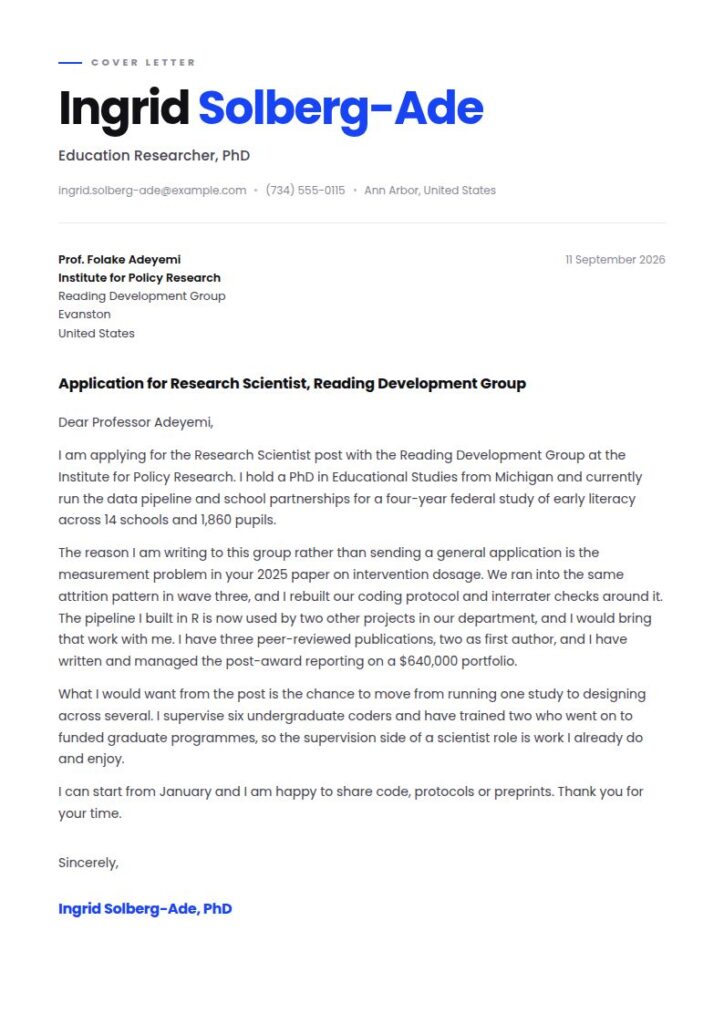
An academic cover letter is a one-page letter naming the post, the department, and the specific work you would do inside it.
It is also the place most applicants lose a job they were qualified for, because two different documents share the name. A research or professional post inside a university wants a one-page letter that reads like any other employer's. A tenure-track faculty search wants a letter of application that runs two to four pages and is structured as research, teaching, and fit. Sending the first to the second reads as an outsider; sending the second to the first reads as someone who did not read the posting.
Guide to an academic cover letter
This guide and the corresponding academic cover letter example will cover:
- How to tell which of the two documents an application actually wants
- How to structure the one-page academic cover letter, paragraph by paragraph
- What fit means to a search committee, and how to show it
- What changes between a faculty search, a research post and a professional role
- The habits carried over from graduate school that cost people interviews
Which document does this application want
| The posting says | What to send | Length |
|---|---|---|
| Cover letter, plus CV | A one-page letter | 1 page |
| Letter of application, or letter of interest, plus CV | The long academic letter | 2 to 4 pages |
| Cover letter, plus resume | A one-page letter, written like any employer's | 1 page |
| Research statement and teaching statement requested separately | A one-page letter; the substance goes in the statements | 1 page |
Read what the committee has to read
A faculty search committee is a group of academics reading applications on top of a full workload, often 150 or more for one post. They are not paid for it and they are reading in evenings.
That has two consequences. First, the opening paragraph has to name the post, the department and the thing about your work that fits it, because a letter that takes a page to arrive is a letter skimmed. Second, if the posting asks for separate research and teaching statements, the letter should not repeat them. Repetition is the single most common structural error in these applications.
For a research post or a professional role inside a university, the reader is usually a principal investigator or a hiring manager, and a one-page letter is what is wanted every time.
An academic cover letter example you can adapt
Dear Professor Adeyemi,
I am applying for the Research Scientist post with the Reading Development Group at the Institute for Policy Research. I hold a PhD in Educational Studies from Michigan and currently run the data pipeline and school partnerships for a four-year federal study of early literacy across 14 schools and 1,860 pupils.
The reason I am writing to this group rather than sending a general application is the measurement problem in your 2025 paper on intervention dosage. We ran into the same attrition pattern in wave three, and I rebuilt our coding protocol and interrater checks around it. The pipeline I built in R is now used by two other projects in our department, and I would bring that work with me. I have three peer-reviewed publications, two as first author, and I have written and managed the post-award reporting on a $640,000 portfolio.
What I would want from the post is the chance to move from running one study to designing across several. I supervise six undergraduate coders and have trained two who went on to funded graduate programmes, so the supervision side of a scientist role is work I already do and enjoy.
I can start from January and I am happy to share code, protocols or preprints. Thank you for your time.
Sincerely, Ingrid Solberg-Ade, PhD
Openings that work
| Instead of | Use |
|---|---|
| I am writing to express my strong interest in this position | I am applying for the Research Scientist post with the Reading Development Group |
| I am a passionate researcher with a lifelong love of learning | I hold a PhD in Educational Studies and run the data pipeline for a four-year federal study |
| I believe my background makes me an excellent fit | The reason I am writing to this group is the measurement problem in your 2025 paper |
| I have extensive research experience | 14 partner schools, 1,860 pupils, three publications, two as first author |
What fit actually means
Fit is not enthusiasm for the institution. It is a specific, checkable claim that the work you do belongs next to the work they do.
| Kind of fit | What it looks like in a sentence |
|---|---|
| Intellectual | We hit the same attrition pattern in wave three, and I rebuilt the coding protocol around it |
| Methodological | Your group runs multisite trials; I have managed data collection across 14 sites |
| Teaching | Your programme needs research design taught at doctoral level; I have taught it for three years |
| Infrastructure | I built the R pipeline two other projects now use, and would bring it |
| Funding | I have written and managed post-award reporting on a $640,000 portfolio |
| Service | I chaired a curriculum review that rebuilt the major sequence |
One paragraph of this is worth five of admiration. Read two or three recent papers from the group before you write, and say something only a reader of those papers could say.
Faculty search, research post, professional role
For a faculty search, follow the posting's structure exactly, usually research, then teaching, then fit and service, and address the institution type honestly: a teaching-intensive college wants the teaching paragraph first. For a research post, lead with methods, data and infrastructure, and name the group's own work. For a professional or administrative role inside a university, write a normal one-page business letter and translate academic work into scope: budgets, headcount, systems, stakeholders, outcomes. Name a start date in every version.
Do not repeat your research statement inside the letter when both are requested. Do not send a four-page letter to a job that asked for a cover letter. Do not list your publications in the letter; that is what the CV is for. Do not explain your dissertation in detail to a committee outside your subfield. Do not apologise for a non-linear path or a gap; describe what you did.
Habits from graduate school that cost people interviews
Hedging reads as uncertainty outside your field
Academic writing rewards qualification. Job letters do not. "This work may tentatively suggest that a relationship could exist" is careful prose in a journal and an evasion in an application.
Write the finding: "Dosage predicted growth in wave three but not in wave four, which changed how we sampled." Then, if it matters, one clause of limitation. A committee reads decisiveness as competence, and the people reading outside your subfield cannot supply the confidence you left out.
The other habit worth dropping is the passive voice around your own work. "Data were collected across 14 schools" hides the person who did it. You collected them.
Length, format and sending it
One page for everything except a faculty letter of application, which follows the posting. PDF, named for yourself and the post: ingrid-solberg-ade-research-scientist-cover-letter.pdf.
Address a named person wherever the posting or the department page gives one, and use the correct title. Pair it with a document that agrees: our academic resume example uses the same figures as this letter.
Key takeaways
- Work out first whether the application wants a one-page letter or a letter of application.
- Name the post, the department and the fit in the first three sentences.
- Make one specific, checkable claim about their work, not about your enthusiasm.
- Do not repeat a research or teaching statement the application already asks for.
- Translate scope into budgets, sites, headcount and outcomes for professional roles.
- Drop the hedging and the passive voice around your own work.
- Give a start date and offer code, protocols or preprints where relevant.
Write your academic cover letter in 10 minutes.
Academic cover letter questions, answered
How long should an academic cover letter be?
One page for a research post, a postdoctoral position or a professional role inside a university. Two to four pages when the posting asks for a letter of application, which is the convention in tenure-track faculty searches. The posting's own wording is the instruction; follow it literally.
Should the letter repeat my research statement?
No. When a search asks for separate research and teaching statements, the letter's job is to frame and connect them, not to summarise them. Committees read the repetition as padding, and it costs you the one page where you could have said something about their department.
How do I write to a department outside my exact subfield?
Assume an intelligent reader who does not know your literature. Name the question, the method and the finding in plain sentences, then the one implication that a neighbouring field would care about. If a colleague in a different subfield cannot follow your second paragraph, rewrite it.
What if I am applying from outside academia, or leaving it?
Say so in one clause and move on. For a professional role inside a university, translate everything into scope: how much money, how many people, which systems, what changed. A PhD is evidence of project management on a multi-year timeline with no supervision, and it is worth writing as that rather than as a credential.
Do I need a cover letter if I am sending a CV?
Almost always, yes, and the CV is the reason. A CV lists what you have done without saying why it belongs here. The letter is the only part of the application that argues, so a strong CV with no letter leaves the argument to a tired reader at the end of a long day.