Hannah Jonas
Student Teacher, Grades 2 and 4
[email protected] | (415) 612-0045 | San Mateo, United States
Profile
Recently credentialed elementary teacher with a California Multiple Subject Credential and 480 hours of supervised student teaching across Grades 2 and 4. Designed and delivered a six-week guided reading unit that moved 18 of 24 students up at least one Fountas & Pinnell level. Fluent in Google Classroom, Seesaw and standards-based grading, and trained in PBIS de-escalation.
Work Experience
08/2025 - 06/2026, Student Teacher, Grades 2 and 4, Lincoln Elementary School, Sacramento, United States
- Completed 480 supervised hours across a Grade 2 and a Grade 4 self-contained classroom.
- Designed and taught a six-week guided reading unit that moved 18 of 24 students up at least one Fountas & Pinnell level.
- Ran three daily small-group rotations for a class with a four-grade-level reading spread.
- Wrote weekly family updates in Seesaw and co-led two parent conference cycles.
09/2024 - 06/2025, Instructional Aide, Reading Intervention, San Mateo-Foster City School District, San Mateo, United States
- Delivered Tier 2 Heggerty phonemic awareness sessions to groups of four, four mornings a week.
- Recorded progress-monitoring data for 26 students and flagged five for MTSS review.
Education
09/2021 - 06/2025, Bachelor of Arts, English, University of California, Davis, Davis, United States
Teacher preparation programme completed concurrently. California Multiple Subject Teaching Credential issued June 2026, valid through 2031.
Skills
Guided reading, 75
Small-group differentiation, 75
Formative assessment design, 70
PBIS de-escalation, 70
Google Classroom, 85
Seesaw, 85
Languages
English, native
Spanish, conversational
Certificates
04/2026, CPI Nonviolent Crisis Intervention, Crisis Prevention Institute
De-escalation and behaviour support for classroom settings.
Summary
A teacher resume is a one-to-two page document that proves classroom impact with numbers rather than duties. This guide gives you a full teacher resume example, three adaptable summaries by career level, the exact skills O*NET lists as most valued for teachers, and current Bureau of Labor Statistics pay and outlook data for the 2024-34 decade.
Teacher resume examples by experience level
A teacher resume is a one-to-two page document that proves classroom impact with measurable student outcomes, not a list of subjects taught. That distinction matters more than it used to: the U.S. Bureau of Labor Statistics projects a 2% decline in kindergarten and elementary school teaching positions between 2024 and 2034, even while about 103,800 openings appear each year from retirements and career changes (BLS Occupational Outlook Handbook, 2024-34 projections). Fewer new posts and steady turnover means you are competing against experienced teachers for the same vacancy, and the resume that names a number wins.
This teacher resume example and guide covers every grade band, from preschool through high school, and every stage from student teaching to department head.
Resume guide for a teacher resume
This resume guide and the corresponding teacher resume example will cover the following:
- How to write a teacher resume that a hiring principal reads past the first section
- Choosing the right resume format for a teacher
- How to add your contact information, and what to leave off
- Using a teacher resume summary at entry, mid and senior level
- Adding your teaching experience with defensible metrics
- Listing education, licensure and endorsements
- Picking the right resume design and layout for school districts
- What the teacher job market looks like and what salary you can expect
How to write a teacher resume
A teacher resume needs six sections in this order: contact header, professional summary, teaching experience, education and licensure, skills, and certifications or professional development. Everything else is optional and most of it is padding.
The order is not arbitrary. District hiring is a two-stage filter. Stage one is software: a district applicant tracking system parses your file, indexes it against the posting, and ranks it. Stage two is a principal or an HR generalist scanning that ranked list for about six seconds per resume. Your file has to survive a parser that reads plain text and a human who reads only the top third of page one.
Write for both by putting the most district-specific evidence highest. If the posting says "Grade 4, self-contained, with a literacy intervention focus", the words Grade 4, self-contained and literacy intervention should all appear above the fold of page one, in your headline and summary, before a reader has to scroll.
Honing your teacher resume for the ATS
Applicant tracking systems are near-universal in large organizations. Jobscan's 2026 ATS Usage Report found that 97.4% of Fortune 500 companies (487 of 500) run a detectable applicant tracking system, and most public school districts of any size use one too, commonly Frontline, PowerSchool or Workday.
Parsers match literal strings, not meaning. Write "Individualized Education Program (IEP)" once in full with the acronym in parentheses so both forms index. Do the same for "English Language Learner (ELL)", "Multi-Tiered System of Supports (MTSS)" and "Positive Behavioral Interventions and Supports (PBIS)".
Then get specific with your evidence. Instead of "Taught reading", write "Implemented a structured literacy block and lifted the class DIBELS composite by 11 points across one school year."
Run the finished file through the free Rezoom ATS resume checker before you send it. It scores parseability, keyword coverage against a posting you paste in, and section structure.
Choosing the best resume format for a teacher
Use reverse-chronological format for a teacher resume. It is the only format district parsers index reliably and the only one principals expect.
Two exceptions are worth knowing:
- Career changers entering teaching can use a combination format that opens with a skills and classroom-readiness section, then lists prior work in reverse-chronological order underneath. The prior work still needs dates.
- Substitute teachers and long-term subs with many short placements should group assignments under a single district heading rather than listing each school as a separate job, which otherwise reads as instability to a scanner.
Never use a purely functional format that hides dates. School HR reads it as a gap you are concealing, and most parsers will fail to associate your accomplishments with any employer at all.
| Format | Best for | Risk |
|---|---|---|
| Reverse-chronological | Almost every teacher, at every grade level | None. This is the default |
| Combination | Career changers, alternative-certification candidates | Only works if prior roles still carry dates |
| Functional | Nobody applying to a school district | Parsers drop the employment link; HR assumes a gap |
Include your contact information
Your teacher resume header needs five things: full name, target job title, phone, professional email, and city and state. It does not need your street address, your date of birth, a photo, or your teaching philosophy.
The target title line does real work. It tells the parser what role to match you against and tells a principal in one glance which vacancy you are here for.
| ✅ Right | ❌ Wrong |
|---|---|
| Hannah Jonas, M.Ed. | Hannah Jonas |
| Elementary Teacher, Grades 3-5, Literacy Endorsed | Looking for a position in education |
| (415) 612-0045 | (415) 612-0045 |
| [email protected] | hjonas\[email protected] |
| San Mateo, CA. Credential #123456 | 914 24th Street, San Mateo, CA 94403 |
Two details in that right-hand column matter more than they look. Putting your credential number in the header answers the first compliance question a district HR office asks, which can move your file to the top of the pile. And using city and state without a street address keeps you eligible for postings across a metro area without volunteering a commute objection.
Make use of a teacher resume summary
A teacher resume summary is three to four lines that name your grade band, your subject or endorsement, your years of experience, and one measured outcome. Write it last, after the experience section, so you have real numbers to pull from.
The summary is the single highest-leverage block on the page, because it is the part a principal actually reads before deciding whether to read anything else.
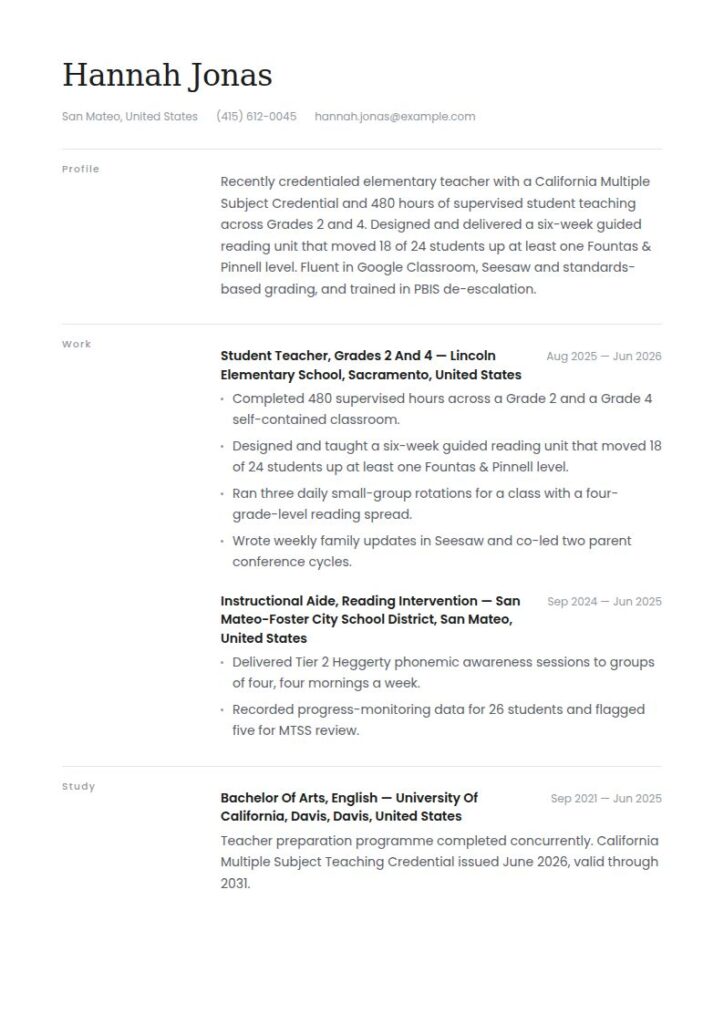
Recently credentialed elementary teacher with a California Multiple Subject Credential and 480 hours of supervised student teaching across Grades 2 and 4. Designed and delivered a six-week guided reading unit that moved 18 of 24 students up at least one Fountas & Pinnell level. Fluent in Google Classroom, Seesaw and standards-based grading, and trained in PBIS de-escalation.
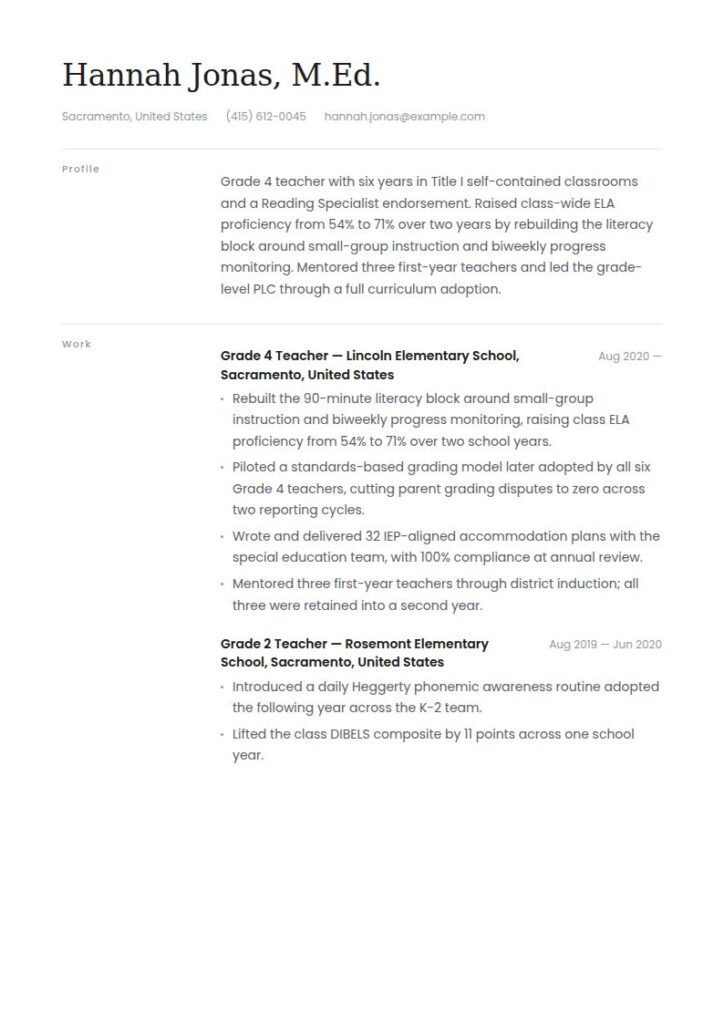
Grade 4 teacher with six years in Title I self-contained classrooms and a Reading Specialist endorsement. Raised class-wide ELA proficiency from 54% to 71% over two years by rebuilding the literacy block around small-group instruction and biweekly progress monitoring. Mentored three first-year teachers and led the grade-level PLC through a full curriculum adoption.
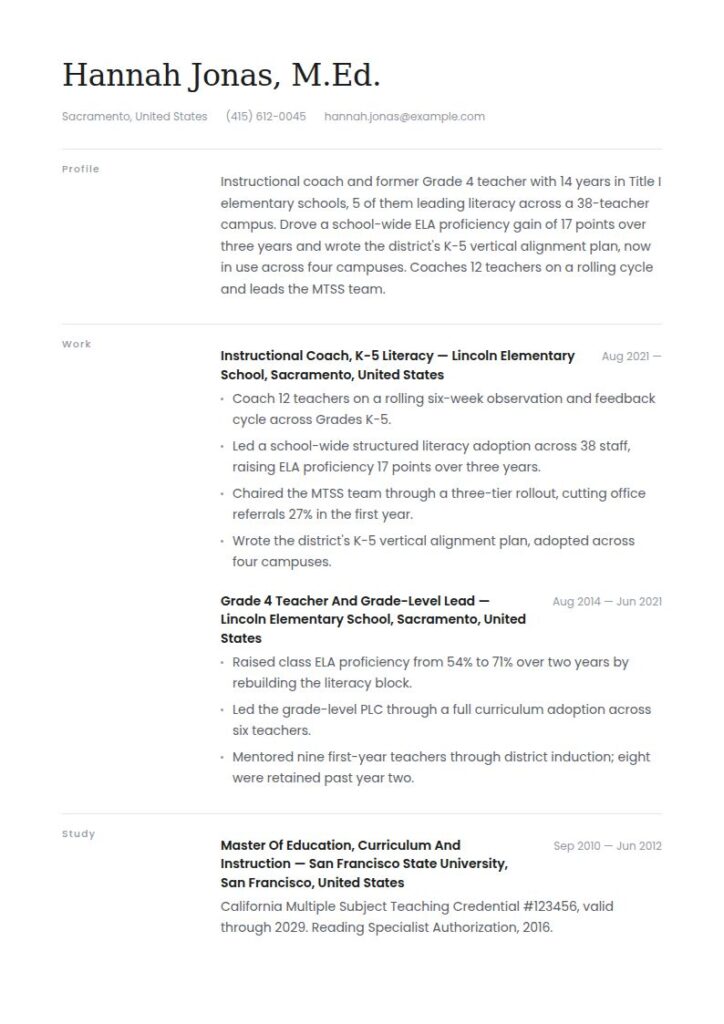
Veteran secondary educator and department chair with 14 years teaching AP English Language and 5 years leading a nine-teacher department. Grew AP exam participation by 62% and held the pass rate above 80% through the expansion. Wrote the district's vertical alignment plan for Grades 8-12 ELA, now in use across four campuses.
Notice what all three have in common: a credential, a grade band, a number, and a scope. Swap those four variables and the summary fits your history.
Right vs wrong: the same teacher summary, twice
The difference between a summary that works and one that does not is rarely vocabulary. It is whether a principal can picture your classroom after reading it.
| ✅ Right | ❌ Wrong |
|---|---|
| Grade 4 teacher with six years in Title I self-contained classrooms and a Reading Specialist endorsement. | Passionate and dedicated educator with a lifelong love of learning. |
| Raised class-wide ELA proficiency from 54% to 71% over two years by rebuilding the literacy block around small-group instruction. | Skilled at creating engaging lesson plans and building positive relationships with students and families. |
| Mentored three first-year teachers and led the grade-level PLC through a full curriculum adoption. | Seeking a position where I can make a difference in the lives of my students. |
Every line on the right names a grade, a number, a program or a scope. Every line on the left could have been written by any of the forty other applicants, which is exactly the problem.
Outline your teacher experience
List each teaching role with school name, city and state, grade level or subject, and dates. Under each, write three to five bullets, and make every bullet carry either a number or a named program.
The most common failure in teacher resumes is describing the job rather than the result. Every teacher plans lessons, differentiates instruction and communicates with families. None of that separates you from the other forty applicants. What separates you is what changed because you were the teacher in that room.
| Instead of | Use |
|---|---|
| Taught reading to a class of 24 students | Implemented the Mathology and Heggerty programs and drove an 11-point jump in class DIBELS composite scores across one year |
| Communicated regularly with parents | Built a weekly Seesaw family update that lifted conference attendance from 61% to 94% in two years |
| Differentiated instruction for diverse learners | Ran three daily guided-reading groups for a class with a 4-grade-level spread, moving 15 of 22 students to grade-level benchmark |
| Served on school committees | Chaired the MTSS team through a 3-tier rollout across 38 staff, cutting office referrals 27% in the first year |
Grade 4 Teacher, Lincoln Elementary School, Sacramento, CA, August 2020 to Present
Rebuilt the 90-minute literacy block around small-group instruction and biweekly progress monitoring, raising class ELA proficiency from 54% to 71% over two school years.
Piloted a standards-based grading model later adopted by all six Grade 4 teachers, cutting parent grading disputes to zero across two reporting cycles.
Wrote and delivered 32 IEP-aligned accommodation plans in collaboration with the special education team, with 100% compliance at annual review.
Mentored three first-year teachers through the district induction program; all three were retained into a second year.
If you are still student teaching, this section is where your placement goes, with the same rules. Name the district, the grade, the dates and the outcome. A student teaching placement with a number beats three years of unrelated work with none.
Build a snapshot of your key teacher skills
Your skills section should carry eight to twelve entries, split between instructional skills and named platforms. Write them as nouns a parser can match, not as sentences.
What employers of teachers actually value
ONET, the U.S. Department of Labor's occupational database, ranks the top skills for elementary school teachers in this order: Learning Strategies, Speaking, Active Listening, Critical Thinking, Monitoring, Reading Comprehension, Writing and Active Learning (ONET OnLine, 25-2021.00, 2025).
The technology O*NET flags as in demand for the same role is narrower than most teachers expect: Google Classroom, Google Docs, Microsoft Word, Microsoft Excel, Microsoft PowerPoint and Microsoft Outlook.
Instructional: Guided reading, Small-group differentiation, Standards-based grading, IEP and 504 implementation, MTSS and RTI, PBIS de-escalation, Formative assessment design, Vertical curriculum alignment
Platforms: Google Classroom, Seesaw, PowerSchool, Illuminate, Fountas & Pinnell benchmark assessment, DIBELS, Canvas
Name the platform your target district uses. If the posting mentions PowerSchool and your resume says "student information systems", a literal parser scores you as a non-match.
Name the exact curriculum, intervention and assessment you have used: Wit & Wisdom, Eureka Math, Heggerty, Fountas & Pinnell, DIBELS, i-Ready. Districts search for the programs they have already paid for, and a teacher who already knows the adopted curriculum saves them a summer of training. Include your grade band and your endorsement areas in the same block, because vacancies are posted by grade and subject, not by "teacher".
Do not list "classroom management", "differentiation" and "lesson planning" as skills with nothing behind them; those are the job description, not evidence, and every competing resume claims all three. Do not claim a curriculum you have only been trained on but never taught; principals ask about it in the interview. Do not list a certification that has lapsed, and do not describe a behavior intervention in terms that could identify the student it was written for.
List the education that elevates your candidacy
For a teacher, the education section is a compliance document as much as a credential list. Lead with your teaching license, including the issuing state, the license type and the expiration year, because that is the first thing district HR verifies.
Order it: teaching credential and endorsements, then degrees, then certifications and professional development.
Put the license number on the page
Districts screen for licensure before they screen for fit. A resume that says "California Multiple Subject Teaching Credential #123456, valid through 2029" clears a check that a resume saying "credentialed teacher" leaves open.
If you are mid-way through alternative certification, say so precisely: "Enrolled, Texas Alternative Certification Program, probationary certificate expected May 2027." Vagueness here reads as a problem you are hiding.
Master of Education, Curriculum & Instruction, San Francisco State University, San Francisco, CA, 2019
California Multiple Subject Teaching Credential #123456, valid through 2029. Reading Specialist Authorization, 2022
Bachelor of Arts, English, University of California, Davis, CA, 2016
Professional development: Orton-Gillingham Level 1 (2023), Google Certified Educator Level 2 (2022), CPI Nonviolent Crisis Intervention (2024)
Choose the right teacher resume layout and design
Keep a teacher resume to one page under five years of experience and two pages beyond it, in a single column, with a standard serif or sans-serif face at 10.5 to 12 point. Design creativity does not help you here and frequently hurts.
The reason is mechanical. Two-column layouts are read left-to-right across the full page width by many parsers, which interleaves your skills column into the middle of your experience bullets and produces unreadable indexed text. The resume looks fine to you and arrives as nonsense to the software.
Keep a single-column layout with standard section headings (Experience, Education, Skills) so a parser can find each block. Save and send as PDF unless the posting asks for .docx, and name the file yourself: hannah-jonas-grade-4-teacher-resume.pdf. Put your license number and grade band in the top third of page one where both the parser and the principal will see them.
Do not put your name, phone or email in the document header or footer; many parsers skip that region entirely and your file arrives with no contact details. Do not use tables, text boxes, icons or a photo. Do not name a student, a parent, or any detail from an IEP or a disciplinary record; FERPA applies to your resume, and a hiring principal who spots a student's initials next to a behavior outcome will read it as a judgment problem.
Ready to see how yours scores? Check your resume's ATS score for free. It takes under a minute and flags parsing failures before a district sees them.
Teacher job market and outlook
Teaching is a high-turnover, low-growth occupation, which produces a steady stream of openings without net job creation. Both major grade bands show the same pattern.
| Occupation | Jobs (2024) | Projected change, 2024-34 | Annual openings |
|---|---|---|---|
| Kindergarten and elementary school teachers | 1,539,800 | -2% (decline) | ~103,800 |
| High school teachers | 1,094,500 | -2% (decline) | ~66,200 |
Source: U.S. Bureau of Labor Statistics, Occupational Outlook Handbook, 2024-34 projections.
Roughly 170,000 teaching vacancies open every year across these two bands alone, and BLS attributes essentially all of them to replacement need rather than growth. Practically, that means two things for your resume. Retention is what districts are buying, so evidence that you stayed, grew and mentored is worth as much as evidence that you taught well. And because vacancies are replacement-driven, they cluster in hard-to-staff subjects and schools: special education, secondary math and science, bilingual education, and Title I campuses. An endorsement in any of those is the single highest-return line you can add to the page.
Non-obvious employers worth targeting: charter management organizations, which hire year-round rather than on the spring district cycle; international schools accredited to U.S. standards, which recruit from the same credential pool; and curriculum and edtech companies, which hire experienced classroom teachers into instructional design and teacher-success roles at a premium to district pay.
What salary you can expect as a teacher
The median annual wage was $62,310 for kindergarten and elementary school teachers and $64,580 for high school teachers as of May 2024 (BLS). Those medians hide a wide spread, because teacher pay in the United States is set by district salary schedules built on two axes: years of service and graduate credit hours.
| Role | Median annual wage (May 2024) | Typical entry education |
|---|---|---|
| Kindergarten and elementary school teachers | $62,310 | Bachelor's degree |
| High school teachers | $64,580 | Bachelor's degree |
Source: U.S. Bureau of Labor Statistics, May 2024 Occupational Employment and Wage Statistics.
Because the schedule is public and formulaic, your resume does not negotiate your base pay. What it does negotiate is your step placement: how many years of prior experience the district agrees to credit, and whether your graduate hours land you on a higher lane. Listing every year of contracted teaching, including long-term substitute assignments, with exact dates, and listing graduate credits earned beyond your degree, is worth real money at the offer stage.
Teacher Resume Examples & Templates
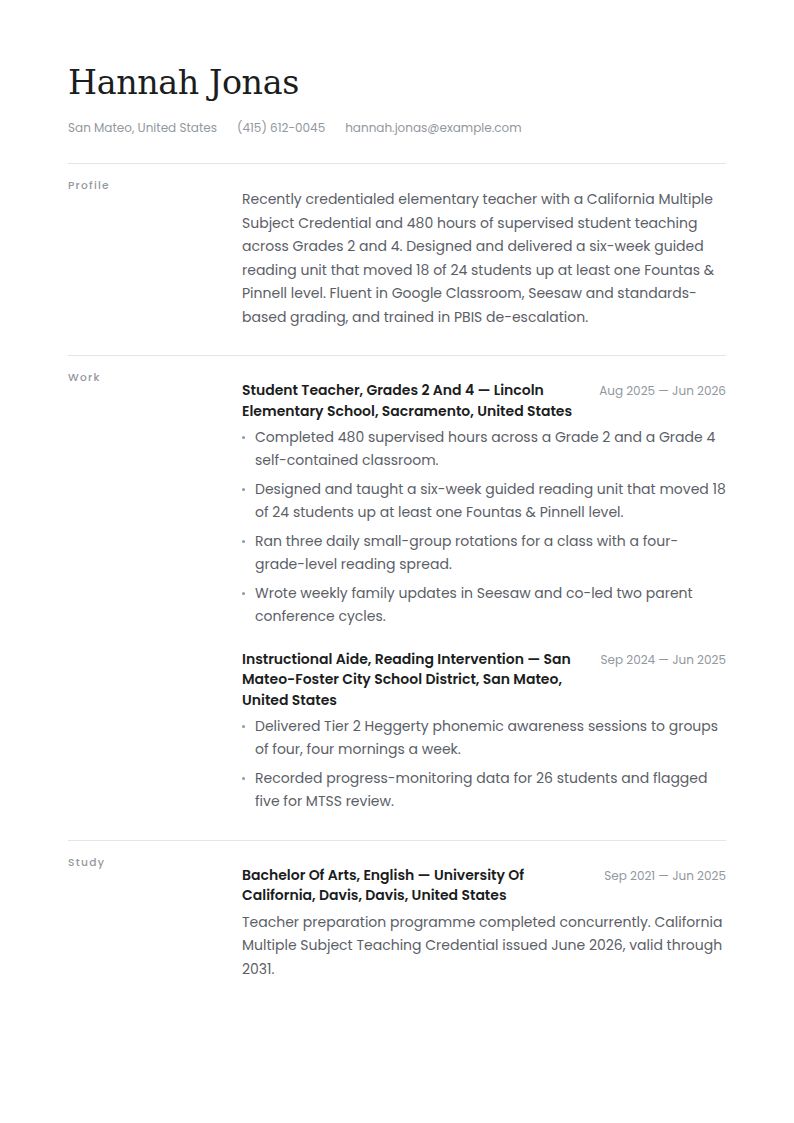
A teacher resume example built around measured student outcomes, with adaptable summaries for entry, mid and senior career levels.
Teacher Resume Examples & Templates
A teacher resume example built around measured student outcomes, with adaptable summaries for entry, mid and senior career levels.
Related teacher resume examples
Take a look at our other education resume examples:
- Elementary school teacher resume
- High school teacher resume
- Middle school teacher resume
- Kindergarten teacher resume
- Preschool teacher resume
- ESL teacher resume
- Special education teacher resume
- Substitute teacher resume
- Teacher assistant resume
- Math teacher resume
- Student teacher resume
- School counselor resume
Browse the full education resume examples category, or pair this resume with a matching teacher cover letter.
Key takeaways for building a teacher resume
- Put your grade band, subject and license number in the top third of page one, where both the parser and the principal will see them.
- Choose reverse-chronological format and a single column, because two-column layouts scramble when a district applicant tracking system parses them.
- Replace every duty statement with an outcome that carries a number, a named program, or both.
- Write three to four lines of summary last, after your experience section gives you real figures to quote.
- Spell out IEP, ELL, MTSS and PBIS once in full with the acronym in parentheses so both forms index against the posting.
- Name the exact platforms your target district uses (PowerSchool, Google Classroom, Seesaw) rather than generic categories.
- Never name a student or reference a specific IEP or disciplinary record; FERPA applies to your resume too.
Build your teacher resume in 15 minutes with a template that is already parseable, then check the score before you send it.
Teacher resume questions, answered
How long should a teacher resume be?
One page if you have fewer than five years of classroom experience, two pages beyond that. Department chairs, instructional coaches and administrators with a publication or presentation record can justify two pages earlier. Attention concentrates in the top third of page one either way, so length matters less than what you put in that block.
Should I include my teaching license number on my resume?
Yes. District human resources verifies licensure before anything else, and a resume that lists the state, license type, number and expiration year clears that check immediately. Put it in the contact header or at the top of the education section.
What skills should a teacher put on a resume?
O*NET ranks Learning Strategies, Speaking, Active Listening, Critical Thinking and Monitoring as the most valued skills for elementary teachers. Pair four or five of those with named platforms and frameworks (Google Classroom, PowerSchool, MTSS, guided reading, standards-based grading) and mirror the exact terms used in the job posting.
Can I put student test score data on my teacher resume?
Yes, in aggregate form. Class-level and cohort-level figures such as "raised class ELA proficiency from 54% to 71%" are appropriate and expected. Never include an individual student's name, initials, scores, IEP details or disciplinary history; that is a FERPA problem and a hiring principal will read it as poor judgment.
Do I need a different resume for every school district?
A different version, not a different resume. Fix the layout once, then change the title line, the summary, and three to five experience bullets to mirror the grade level, subject and programs named in each posting. That is usually fifteen minutes of work per application.
How do I write a teacher resume with no experience?
Treat your student teaching placement as a job. Name the district, the grade level, the supervising teacher's school, the exact dates and the hours completed, then write outcome bullets from that placement: a unit you designed, an assessment gain you produced, a family communication system you built. Add your credential status, your practicum hours and any tutoring, camp or coaching work that involved instruction and behavior management.